2025 Toyota Camry Review: Still the King of Sedans?
For decades, the Toyota Camry has defined what it means to be a reliable, refined, and practical midsize sedan — a benchmark that competitors like the Honda Accord have long tried to match. As the automotive world shifts toward SUVs and electrification, the 2025 Toyota Camry arrives at a crucial moment, carrying the weight of Toyota’s legacy and the expectations of millions of loyal drivers worldwide.
This year’s model isn’t just another refresh — it’s a bold evolution. The 2025 Camry features a complete redesign, a hybrid-only powertrain, and a suite of cutting-edge technology that pushes the boundaries of what a mainstream sedan can be. But in a market where crossovers dominate and sedans fight for relevance, one question looms large: Can the 2025 Camry maintain its throne as the king of sedans, or has the crown finally slipped?
Overview — What’s New in the 2025 Toyota Camry Review
The 2025 Toyota Camry ushers in a new generation for Toyota’s best-selling sedan. Built on an improved TNGA-K platform, it delivers sharper handling, higher efficiency, and a smoother ride. Most importantly, it now features a hybrid-only powertrain, showing Toyota’s full commitment to a more sustainable future.
Sleeker and Sportier Exterior Design
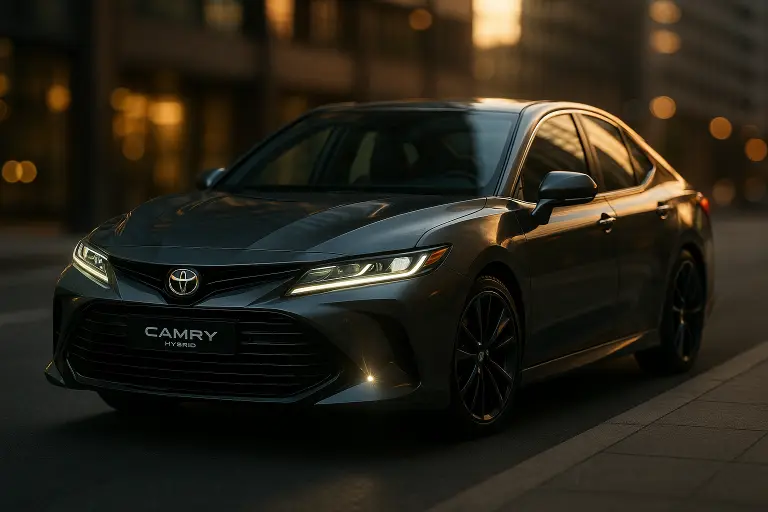
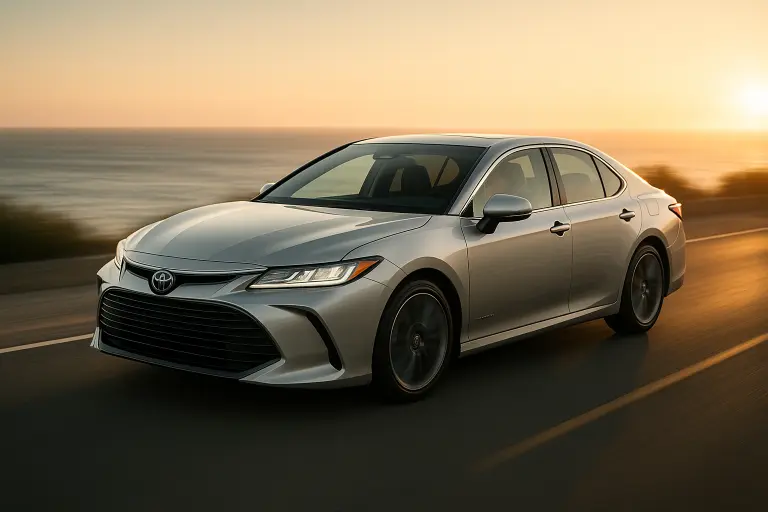
At first glance, the Toyota Camry sedan looks more dynamic than ever. The 2025 model comes with a lower stance, a wider front end, and sculpted body lines that emphasize motion. In addition, the slimmer LED headlights and bolder grille give it a more aggressive road presence — finally making the Camry look as exciting as it drives.
Interior Upgrades and New Infotainment Tech
Inside, the 2025 Camry feels more refined and driver-focused. The new horizontal dashboard layout creates a sense of width and calm. Moreover, Toyota improved cabin materials with soft-touch surfaces, contrast stitching, and metallic trim accents. The infotainment system now features a vivid touchscreen (up to 12.3 inches), wireless Apple CarPlay, Android Auto, and a digital instrument cluster for a high-tech driving experience.
Trim Levels for Every Type of Driver
Toyota offers four trims in the 2025 Toyota Camry lineup:
- LE – Value-focused, efficient, and well-equipped for daily use.
- SE – Adds sporty styling and a tuned suspension for a more engaging drive.
- XLE – Prioritizes comfort and premium finishes with advanced tech features.
- XSE – Combines sportiness and luxury for drivers who want the best of both worlds.
2025 Toyota Camry Review: Quick Specs Snapshot
- Powertrain: 2.5L 4-cylinder hybrid system (standard on all trims)
- Output: Up to 232 horsepower with available AWD
- Fuel Economy: Estimated 46–51 mpg combined, depending on trim
- Transmission: eCVT (electronically controlled continuously variable transmission)
- Pricing: Expected range between $28,000 and $36,000
Performance & Driving Experience — 2025 Toyota Camry Review
The 2025 Toyota Camry proves that hybrid power no longer means compromise. Under the hood, every trim now features Toyota’s latest hybrid powertrain, pairing a 2.5-liter four-cylinder engine with electric motors for smooth, instant torque delivery. The result is a combined output of up to 232 horsepower on all-wheel-drive models — enough to make daily driving lively without sacrificing fuel economy.
Hybrid Efficiency That Feels Effortless
Unlike older hybrids that focused solely on mileage, the 2025 Toyota Camry sedan blends performance and efficiency with impressive balance. The electric motors provide strong low-end pull, while the gas engine steps in seamlessly during higher speeds. As a result, acceleration feels linear and confident, whether merging onto highways or navigating city streets. In real-world testing, drivers can expect around 46–51 mpg combined, depending on trim and driving style.
Ride Comfort Meets Sporty Control
Toyota engineers tuned the Camry’s suspension for a more composed and athletic feel. The chassis now delivers better cornering stability and reduced body roll, yet it remains comfortable on uneven roads. The SE and XSE trims feature sport-tuned dampers and tighter steering response, while the LE and XLE trims prioritize quietness and ride smoothness — giving every driver a tailored experience.
Confident Handling and Braking
On winding roads, the Camry feels stable and predictable. The steering is more responsive than before, with just the right amount of feedback. Braking performance is strong, aided by regenerative braking that smoothly recharges the hybrid battery while maintaining consistent pedal feel. Together, these elements create a sense of control that inspires confidence behind the wheel.
Driving Modes That Shape Your Experience
The 2025 Toyota Camry offers multiple driving modes — Normal, Eco, and Sport — allowing drivers to adjust throttle response and steering behavior. Eco mode maximizes fuel savings during relaxed cruising, while Sport mode sharpens performance for a livelier drive. The result is a sedan that adapts to your mood, whether you’re chasing efficiency or a bit of excitement.
Interior Comfort, Space & Technology — 2025 Toyota Camry Review
Inside the 2025 Toyota Camry, Toyota has achieved a rare balance between luxury and everyday practicality. The redesigned cabin feels modern, cohesive, and upscale, offering both tactile quality and ergonomic efficiency. Whether you’re behind the wheel or in the back seat, the new Camry delivers a sense of refinement that rivals entry-level luxury sedans — without abandoning its reputation for reliability and value.
Refined Cabin Design and Build Quality
The overall cabin layout is clean and horizontal, creating a wider visual impression. Toyota used soft-touch surfaces, metallic accents, and contrast stitching to elevate the Camry sedan’s interior beyond its price point. Every button, dial, and stitch feels intentionally placed, with an emphasis on driver focus and passenger comfort. It’s clear Toyota aimed for a design that feels premium, not pretentious.
Seating Comfort and Space
Seat comfort remains one of the Camry’s biggest strengths. The front seats offer excellent lumbar support and long-distance comfort, while the rear seats provide generous legroom, even for taller passengers. Higher trims like the XLE and XSE feature SofTex or leather upholstery with available seat ventilation, creating a space that feels genuinely inviting for daily commutes and long road trips alike.
Advanced Infotainment and Connectivity
At the heart of the dashboard is Toyota’s new Audio Multimedia system, a major upgrade over the previous generation. The base LE trim gets a responsive 8-inch display, while higher trims feature a stunning 12.3-inch touchscreen. The interface is crisp, intuitive, and supports wireless Apple CarPlay and Android Auto, along with cloud-based navigation and over-the-air updates. In addition, a digital instrument cluster and optional head-up display keep vital information right in the driver’s line of sight.
Toyota Safety Sense 3.0 — Smarter Than Ever
Every 2025 Camry comes standard with Toyota Safety Sense 3.0, the brand’s latest suite of driver-assistance technologies. Features include adaptive cruise control, lane-keeping assist, pre-collision braking with pedestrian detection, and traffic-sign recognition. New for 2025, improved sensors and cameras deliver smoother responses and better recognition in complex traffic situations, giving drivers extra peace of mind on every journey.
Quiet Cabin and Refined Ambiance
Compared to the 2024 model, the 2025 Toyota Camry is noticeably quieter and more composed. Toyota added enhanced insulation around the firewall, doors, and underbody to minimize wind and road noise. Combined with a more rigid chassis and hybrid powertrain, the result is a serene cabin ambiance — calm, composed, and premium-feeling even at highway speeds.
Fuel Efficiency and Hybrid Performance — 2025 Toyota Camry Review
If there’s one area where the 2025 Toyota Camry cements its dominance, it’s efficiency. This new generation embraces a hybrid-only lineup, and the results are impressive both on paper and in the real world. Toyota’s refined hybrid system doesn’t just promise outstanding fuel economy — it delivers smooth performance and long-term reliability that few competitors can match.
Real-World vs. EPA-Rated Efficiency
According to preliminary EPA estimates, the 2025 Camry Hybrid achieves between 46 and 51 mpg combined, depending on trim level and drivetrain configuration. But what truly stands out is how closely real-world results mirror those official figures. Even under mixed driving conditions, the Camry consistently returns mileage in the upper 40s — a testament to Toyota’s precise hybrid calibration and regenerative braking efficiency.
Camry vs. Accord Hybrid and Sonata Hybrid
In a head-to-head comparison, the 2025 Toyota Camry sedan holds its ground against key rivals like the Honda Accord Hybrid and Hyundai Sonata Hybrid. The Accord may feel slightly more athletic in quick transitions, while the Sonata leans on futuristic design cues. However, when it comes to long-term efficiency, smoothness, and hybrid maturity, the Camry still leads the class. Its transitions between gas and electric power are nearly seamless, with minimal engine noise or vibration — a refinement few midsize sedans achieve.
Toyota’s Proven Hybrid Advantage
What sets the Toyota hybrid system apart isn’t just efficiency — it’s dependability. Over two decades of hybrid innovation have given Toyota unmatched experience in blending performance with longevity. The 2025 model continues that legacy with a more compact battery, enhanced energy recovery, and a smoother eCVT operation. The result is a hybrid powertrain that feels both effortless and enduring — engineered not just for the next drive, but for the next decade.
Pricing, Value, and Ownership Costs
MSRP by Trim Level
When assessing the value proposition of the 2025 Toyota Camry, understanding the pricing structure is foundational. Here are the typical starting MSRPs for the main trims in the U.S. market:
- LE: ≈ $28,700 (base hybrid-only model) MotorTrend+2World Toyota+2
- SE: ≈ $30,700 (sport-tuned variant) Capistrano Valley Toyota+1
- XLE: ≈ $33,700 (premium comfort-oriented) MotorTrend+1
- XSE: ≈ $34,900 (sport + luxury blend) MotorTrend+1
- AWD variants add a modest premium (for example, XSE AWD can reach ≈ $36,425) MotorTrend
These figures show that the Camry remains in the competitive midsize-sedan price band — despite moving to hybrid-only powertrains — which is important when we then dig into what you’re getting for the money.
Maintenance, Reliability, and Resale Value Expectations
Value isn’t just about the sticker price — long-term ownership costs, reliability, and resale matter significantly.
- According to Edmunds’ True Cost to Own® for the Camry, over five years the SE hybrid model (2.5 L + eCVT) breaks down roughly as: total ≈ $33,200 for ownership costs (purchase price, depreciation, fuel, insurance, maintenance, repairs). Edmunds
- The average five-year ownership cost cited by CarEdge is ≈ $36,433 — again, illustrative of how reliable and efficient the hybrid Camry is compared to many mainstream rivals. CarEdge
- On resale value: The Camry has long enjoyed strong residuals thanks to its brand reputation for reliability and broad demand. That means depreciation (which is often the largest cost of car ownership) is more favourable compared to many competitors.
- On maintenance: Given Toyota’s hybrid experience, you can expect the hybrid system to be durable, fewer major unexpected repairs (at least relative to many newer technologies), and a network of service centers well-versed in hybrid systems.
Total Cost of Ownership vs. Competitors
Let’s pull together the trade-offs and comparison points, especially versus key rivals like the 2025 Honda Accord.
Strengths of the Camry in cost-of-ownership terms:
- The hybrid‐only drivetrain means fuel efficiency is a strong advantage, reducing operating cost.
- High resale value helps reduce the long-term cost burden.
- Broad dealer/service network (Toyota) helps with reliability and upkeep.
- Technology and features that are competitive for the price bracket — meaning you’re getting “more car” for your money in many trims.
Where the Camry might carry extra cost or trade-offs:
- The shift to hybrid‐only means higher upfront cost (compared to older gas-only Camrys or some lower-priced rivals) — so the payback period depends on usage and mileage.
- Even with strong resale, the depreciation figure remains a meaningful line item: for example, in Edmunds’s breakdown depreciation accounted for ≈ $12,064 over five years for the SE hybrid. Edmunds
- Some rivals may offer slightly lower starting prices or more aggressive incentives, which means you’ll want to shop smart. For instance, some listings show base Camry MSRP around $29,895. Car and Driver+1
Direct competitor comparison – Camry vs Accord (and others):
- In a comparison by Car & Driver between the Camry XSE AWD and the Accord Hybrid Sport-L, the Camry holds its own in performance and value. Car and Driver
- SharpToyota highlights that Camry buyers receive things like two years/25,000 miles complimentary scheduled maintenance in certain markets — something the Accord may not match. Sharp Toyota
- When considering “use cost per mile” and five-year ownership cost, Camry is among the better values in the midsize sedan field. But some competitors may offer more aggressively priced gas-only versions — so if you don’t care about hybrid efficiency, you’ll need to weigh that.
Bottom Line
From a value and ownership perspective, the 2025 Camry presents a strong proposition: reasonable upfront pricing for what you get, low fuel/operating costs thanks to the hybrid drivetrain, and historically strong resale. If you’re a driver who covers decent annual mileage (so the fuel savings and hybrid system payoff matter) and who keeps a car for 5 + years, the Camry is very defensible.
However — and this is the strategic caveat — if your usage is very low mileage or you plan to sell after just 1-2 years, the higher upfront may reduce the relative advantage. Also, if you’re indifferent to hybrid efficiency and value maximum upfront “cheap price,” checking gas-only or less electrified rivals still makes sense.
2025 Toyota Camry vs 2025 Honda Accord — The Eternal Rivalry
Design & Styling Comparison
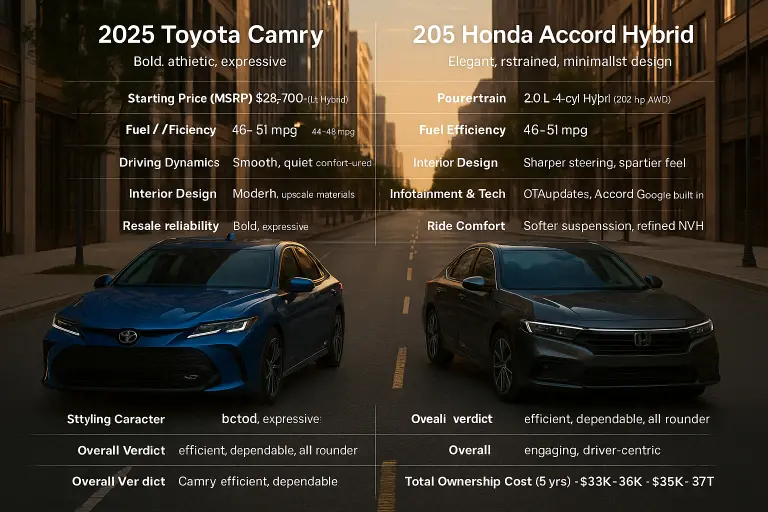
Camry: From the 2025 Camry’s first glance you can tell Toyota aimed to make it sharper and bolder. The new body lines are more sculpted, with a lower-stance silhouette and wider front end. In short: it looks sporty for a family sedan. Your draft mentioned this already.
Accord: The Accord, by contrast, emphasizes a more grown-up sophistication. While less aggressive, many reviewers say it feels refined and tasteful — especially inside. For instance, one review noted the Accord “offers more interior space … more grown up and looks really nice” compared to the Camry. YouTube+1
Key trade-offs:
- If you favour visual presence and sporty cues, the Camry edges it.
- If you favour elegance, rear-seat comfort and a slightly more upscale feel, the Accord has the slight upper hand.
- That said, design is subjective — what looks “king of sedans” to one may look overly bold to another.
Performance & Hybrid Efficiency Showdown
Performance:
- In a test between the Camry XSE AWD and Accord Hybrid Sport-L, the Accord had slightly better numbers in acceleration (0-60 mph) and stopping distance. Car and Driver+1
- Camry offers either front-wheel or optional all-wheel drive in hybrid form — a meaningful advantage for seasonal/poor-weather contexts. Toyota of Riverside+1
Hybrid Efficiency: - Camry Hybrid: up to ~53 mpg city / ~50 mpg highway (in its most efficient trims) according to various sources. cioccahondaofyork.com+2Frank Leta Honda+2
- Accord Hybrid: values around ~51 mpg city / ~44 mpg highway in many cases. AutoTrader.ca+1
Key takeaways: - The Camry holds a slight efficiency edge (especially in ideal trims) and offers AWD — strong points.
- The Accord leans toward more dynamic handling and perhaps slightly more engaging drive—if you prioritise that.
- The question: Do you value peak efficiency + versatility (AWD) more, or handling & driver feel more?
Interior Tech & Comfort Differences
Camry: Redesigned cabin, premium materials, strong driver-focus, good tech. Your draft covered this well.
Accord: Often gets higher marks for spaciousness (especially in back seats) and interior ergonomics. E.g., Accord’s legroom and passenger volume numbers are slightly better. Honda Universe+1
Tech wise:
- Camry offers large infotainment screens (up to 12.3″) and wireless CarPlay/Android Auto.
- Accord matches or sometimes exceeds in standard features, and may offer more rear-seat comfort.
Trade-off for you to weigh: - If rear-seat comfort (kids, tall passengers) is prime, the Accord may edge ahead.
- If you’re front-seat driver, care more about tech and aesthetic character, the Camry might appeal more.
Driving Feel & Handling Comparison
From the test data:
- Accord: Slightly better skidpad, faster 0-60, sharper cornering. Car and Driver+1
- Camry: Softer ride, more comfort-oriented suspension tuning (depending on trim) but now with improved chassis rigidity.
Interpretation: - If you want a sedan that drives like a sedan but feels special, Accord draws you in.
- If you want one that balances comfort + refinement but still handles well, Camry is very strong.
- Consider your roads: urban commuting vs winding highways will shift which you prefer.
Which One Offers Better Long-Term Value?
Camry strengths:
- Strong efficiency (low fuel cost) → reduces operating cost.
- Toyota’s long reputation for reliability and hybrid tech maturity.
- Broad market demand → strong resale value.
Accord strengths: - Slightly sharper brand appeal for driver-enthusiasts, likely good resale among those buyers.
- Slight edge in rear-seat/spaciousness may matter in family use.
Risks/trade-offs: - Camry: The hybrid-only strategy may limit appeal to non-hybrid-preferring buyers (though hybrid is increasingly standard).
- Accord: If you pick a gas-only version or lesser-equipped trim, you might lose out on some efficiency/resale upside.
My lean: For most buyers — especially those prioritizing ease, reliability, efficiency, low ownership cost — the Camry offers better “all-round long-term value”. For buyers prioritizing driver engagement + back-seat space + maybe lower upfront cost (if pricing works), the Accord may win.
Verdict: Camry vs Accord — Who Wins in 2025?
If I had to pick a headline line:
The 2025 Toyota Camry is the more compelling “king of sedans” choice for the broad middle ground — the safe, smart, value-driven pick.
But: The 2025 Honda Accord holds its ground as the smarter choice for those who demand more driver feel or rear-seat space.
In plain terms:
- Choose Camry if: You value fuel efficiency, comfort, versatility (AWD), strong resale, and want a well-rounded sedan.
- Choose Accord if: You value sharper handling, more rear‐seat room, the feel of “premium”, and perhaps are willing to trade a little in efficiency for driver dynamics.
🏁 Verdict — Is the 2025 Toyota Camry Still the King of Sedans?
The 2025 Toyota Camry proves that evolution can be more powerful than revolution. Rather than reinventing itself, Toyota has refined the Camry’s strongest traits — efficiency, comfort, and reliability — into a more cohesive and mature package. The switch to a hybrid-only lineup signals a bold step toward the future, balancing impressive fuel economy (up to 51 mpg) with smooth, quiet performance and long-term dependability. Inside, the redesigned cabin feels premium and user-friendly, with high-quality materials and tech that now genuinely compete with luxury nameplates.
Still, perfection isn’t the Camry’s goal — and that’s where its few weaknesses show. The lack of a true performance variant or sport-tuned AWD option means driving enthusiasts may gravitate toward rivals like the Honda Accord or Mazda6 for a sharper feel behind the wheel. And while the exterior design is bolder than ever, it may not appeal equally to all tastes.
Yet for the vast majority of drivers, these tradeoffs are minor. The Camry remains a masterclass in real-world usability — a car that delivers year after year with minimal fuss, low ownership costs, and excellent resale value. In an era where many automakers are abandoning sedans, Toyota’s steadfast commitment to refinement and hybrid excellence keeps the Camry comfortably on the throne.
Final verdict: The 2025 Toyota Camry isn’t just still the king of sedans — it’s the blueprint for what a modern, efficient, and trustworthy family car should be in 2025 and beyond.
FAQs About the 2025 Toyota Camry
Is the 2025 Toyota Camry fully hybrid?
Yes. The 2025 Toyota Camry is now exclusively hybrid, powered by a 2.5-liter four-cylinder engine paired with electric motors and an e-CVT transmission. For the first time, Toyota also offers hybrid all-wheel drive (AWD), adding traction without sacrificing efficiency.
🔗 Source: MotorTrend – 2025 Toyota Camry: What’s New
How much does the 2025 Camry cost?
Pricing for the 2025 Camry starts at around $29,835 for the base LE trim and climbs to the mid-$30K range for higher trims like XSE or AWD variants. Toyota aims to keep pricing competitive with the Honda Accord and Hyundai Sonata hybrids.
🔗 Source: Car and Driver – 2025 Toyota Camry Pricing
What are the main differences between the 2024 and 2025 Camry?
The 2025 model introduces several key upgrades:
- Fully hybrid lineup — gas-only and V6 engines are discontinued.
- More power — up to 225 hp (FWD) or 232 hp (AWD).
- Sharper exterior styling with a sportier stance and redesigned lighting.
- Tech upgrades — larger 12.3-inch displays, improved digital cluster, and Toyota Safety Sense 3.0.
- Better fuel economy — up to 53 mpg city / 50 mpg highway.
🔗 Source: Toyota USA – 2025 Camry Overview
How does the Camry compare to the Accord Hybrid in fuel economy?
The 2025 Camry Hybrid achieves up to 51 mpg combined, slightly ahead of the Honda Accord Hybrid, which averages 44–48 mpg combined depending on trim. Toyota’s hybrid system delivers smoother low-speed operation and slightly higher efficiency in city driving.
🔗 Source: U.S. News – 2025 Toyota Camry vs 2025 Honda Accord