Last Updated: May 2026 — Powertrain specs, regional pricing, C-NCAP safety data, PHEV range, and warranty terms verified
The Chery Tiggo 8 is a compelling 7-seat SUV that undercuts similarly equipped Toyota Fortuner and Hyundai Santa Fe models by $5,000–10,000 in most global markets — and in markets where Chery has an established dealer network, that price gap is the whole argument. The Tiggo 8 Pro’s 1.6T engine, dual 12.3-inch screens, full ADAS suite, and panoramic roof at its price bracket are genuinely hard to match from a Japanese or Korean brand. The PHEV variant (Pro e+) adds 80–90 km of electric range for daily commuters who can charge at home. The case against is equally specific: no Euro NCAP or ANCAP safety certification exists for this vehicle, resale retention trails Toyota by 10–15 percentage points at five years, and the 7-speed dual-clutch transmission produces real low-speed jerkiness that will irritate buyers who spend time in heavy urban traffic. This review covers the full picture — what the Tiggo 8 delivers, where it falls short, and exactly which buyer profile it is genuinely right for.
Chery Tiggo 8 — The Short Answer:
A well-equipped 7-seat SUV that wins on price and feature content, loses on safety certification and resale value. The 1.6T petrol starts at USD $22,000–24,000 in established Chery markets (Middle East, Latin America) — $5,000–10,000 below the Toyota Fortuner and Hyundai Santa Fe at comparable specification. The PHEV Pro e+ delivers 80–90 km of electric range at 2.5–4 L/100km (with regular charging). The critical caveat: no Euro NCAP or ANCAP crash test rating has been published — buyers requiring independent Western safety certification should note this before purchasing as a family vehicle.
What Is the Chery Tiggo 8 and Who Is It For?
The Chery Tiggo 8 is a mid-size 7-seat SUV from Chery Automobile — one of China’s largest state-affiliated car manufacturers, established in 1997 and exporting to over 80 countries. The Tiggo 8 sits at the top of the Tiggo range, competing with the Toyota Fortuner, Hyundai Santa Fe, Kia Sorento, and Mitsubishi Outlander in global markets. It is not sold in Europe (Chery’s European presence operates under the Omoda and Jaecoo brands instead), not available in the US (blocked by the 100% tariff on Chinese vehicles), and not sold in the UK or Australia in meaningful volume. Its primary markets are the Middle East (UAE, Saudi Arabia, Kuwait), Latin America (Brazil, Chile, Mexico, Ecuador), sub-Saharan Africa, and parts of Asia and Eastern Europe.
The positioning is explicit: maximum specification and 7-seat practicality at a price bracket where Japanese and Korean equivalents either offer less equipment or cost significantly more. The Tiggo 8 Pro — the primary export variant — comes with dual 12.3-inch screens, panoramic sunroof, full ADAS, and leather seating as standard at price points below $30,000 in several of its key markets. For a family buyer in Riyadh or São Paulo evaluating a 7-seat SUV with a $25,000–28,000 budget, the Tiggo 8 offers a feature list that Toyota and Hyundai simply cannot match at the same price.
The buyer for whom this is the right vehicle: families in established Chery markets who need the third row regularly, prioritise feature density over brand prestige, and plan to own the vehicle for 3–5 years. The buyer for whom it is not: anyone in a market where Chery service infrastructure is thin, anyone whose primary concern is passive crash safety certification, or anyone evaluating a 6–8 year ownership cycle where Toyota’s resale resilience compounds significantly. Our article on whether Chinese cars are reliable covers the broader brand reliability context across Chinese manufacturers.
Engine, Performance, and the DCT Problem
The engine most buyers outside China will encounter is Chery’s 1.6T ACTECO turbocharged four-cylinder: 197 hp and 290 Nm of torque, paired with a 7-speed dual-clutch transmission. The 0–100 km/h time is 9.5–10.2 seconds in real-world conditions — adequate for a 7-seat family SUV and not meaningfully different from a 2.0-litre Toyota RAV4 or Hyundai Tucson in daily use. Highway cruising and overtaking feel relaxed up to 120 km/h. Mixed-cycle fuel consumption runs 8.5–10 L/100km depending on traffic and load conditions — slightly higher than a Toyota Fortuner V4 but not significantly so.
The dual-clutch transmission is the most polarising aspect of the ownership experience. DCTs offer fast, efficient gear changes on the move — but at low speeds, in stop-start urban traffic, and during parking manoeuvres, the Tiggo 8’s 7DCT produces noticeable jerkiness and occasional hesitation. This is a characteristic of DCT architecture rather than a fault specific to Chery — the same behaviour appears in VW Group DSG-equipped vehicles and in many Korean DCT applications. For buyers in markets with heavy urban traffic (São Paulo, Cairo, Lagos), this will be a daily reality rather than an occasional inconvenience. Buyers who spend most of their time on highways or in lighter traffic will not notice it in the same way.
The PHEV variant (Tiggo 8 Pro e+) addresses this differently: the 1.5T petrol engine and electric motor combine for 326 hp, and the electric motor’s instant torque smooths out low-speed response considerably. With a charged battery, the Pro e+ is genuinely brisk — and the 80–90 km electric range covers most urban daily commutes entirely on battery. Blended consumption drops to 2.5–4 L/100km with regular charging, and 7–9 L/100km without. For buyers in markets where the PHEV is available and home charging is practical, the Pro e+ is the version that makes the most sense on both performance and running cost grounds.
Forward pointer: The PHEV’s electric range and charging economics are covered in more detail in the pricing section, where the cost premium over the standard petrol is assessed against real-world ownership savings.
Interior, Space, and Features: Where the Tiggo 8 Punches Above Its Price
This is where the Tiggo 8 makes its strongest case — and where it is hardest to argue against on pure value grounds. At its price point in Middle Eastern and Latin American markets, the interior specification simply outguns Japanese and Korean competitors.
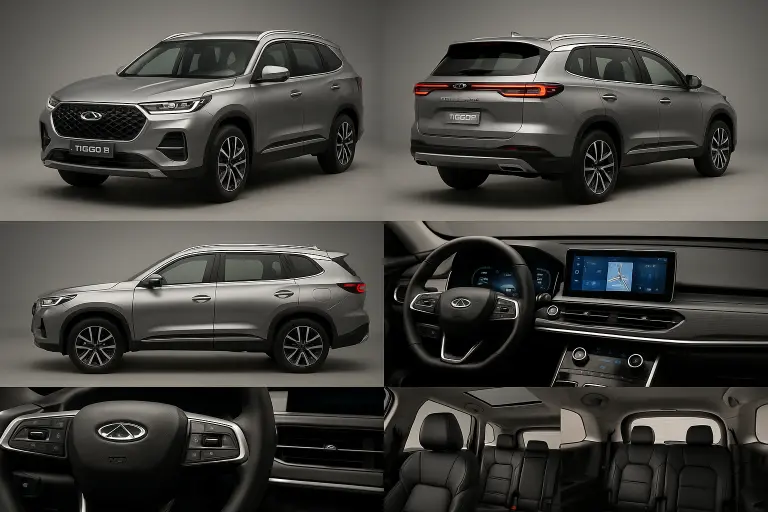
The dual 12.3-inch screen setup (one for infotainment, one as the digital instrument cluster) is standard on the Pro variant — not a higher-trim option. The panoramic sunroof spans both rows of passengers. Wireless Apple CarPlay and Android Auto are standard. The ADAS suite — automatic emergency braking, lane-keeping assist, adaptive cruise control, blind-spot monitoring, rear cross-traffic alert, and driver attention monitoring — is also standard, not optioned, at the base Pro trim. A 360-degree surround-view camera appears on higher trim levels. For a 7-seat SUV at $22,000–28,000, this is a feature density that Toyota and Hyundai do not attempt to match at comparable pricing.
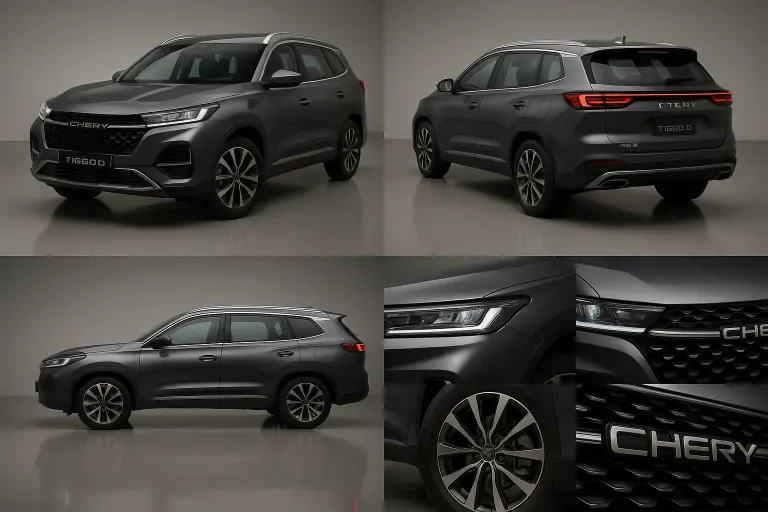
The third row is the honest part of this review. At 4,720mm overall length with a 2,710mm wheelbase, the Tiggo 8 is a large vehicle — and the third row reflects that. Adults can sit in the third row for journeys of an hour or less without significant discomfort, which is more than many ostensibly 7-seat rivals deliver. Cargo space with the third row in use is 193 litres — tight but usable for family essentials. Fold the third row and that opens to 680 litres, which is competitive with most 5-seat SUVs in this segment.
Material quality is appropriate for the price bracket — not premium, not disappointing. Soft-touch surfaces appear where hands rest; hard plastics are on lower door panels and under-dash areas where most competitors also use them. Panel fit and finish on 2024–2026 production Tiggo 8 Pros reviewed in export markets is consistent — the early-production quality issues that affected some 2022–2023 examples have been largely resolved in current production.
Verdict on interior: The Tiggo 8 offers more feature content per dollar in this category than any Japanese or Korean competitor at the same price. If feature density is your primary metric, the Tiggo 8 wins this comparison against Toyota, Hyundai, and Kia at equivalent pricing in every market where Chery operates.
Safety: The Most Important Gap to Understand Before Buying
This section requires directness. The Chery Tiggo 8 has not been tested by Euro NCAP, ANCAP (Australia), LATIN NCAP (Latin America), or IIHS (United States). The only published independent crash test result for the Tiggo 8 Pro is a 5-star C-NCAP rating — China’s domestic test program. That 5-star rating is genuine, but C-NCAP uses different test protocols, different impact speeds, and different assessment criteria than Euro NCAP or LATIN NCAP, and Chinese-market vehicles have historically scored better on C-NCAP than when independently retested under Euro NCAP conditions.
This does not mean the Tiggo 8 is unsafe — it means there is no independent Western crash test result to evaluate. For a family SUV that will carry children in the third row, that absence of data matters. The Toyota Fortuner and Hyundai Santa Fe — the Tiggo 8’s direct competitors — both carry LATIN NCAP ratings that are available and independently verified. A buyer who cannot find an independent crash test result for the Tiggo 8 in their market is not being irrational; they are correctly identifying a data gap.
What can be assessed: the Tiggo 8’s full ADAS suite (AEB, LKA, ACC, BSM) is standard and active-safety technology does genuinely reduce accident frequency, even independent of passive crash structure. Chery’s AEB system has been functional in owner reports across Middle Eastern and Latin American markets — it responds to pedestrian and vehicle detection in the expected scenarios. Active safety technology is not a substitute for passive crash protection data, but it is a meaningful contribution to real-world safety outcomes.
For a full assessment of how Chinese brands approach safety certification — and which Chinese vehicles have received Western independent ratings — our article on Chinese car safety and crash test results covers the category position in detail.
Verdict on safety: The Tiggo 8’s safety case rests on C-NCAP data and the standard ADAS suite. That is an honest description of what is available, not a reassurance. Buyers for whom independent Western crash test results are a threshold requirement — and for family vehicles with child passengers, that is a reasonable threshold — should treat the absence of Euro NCAP or LATIN NCAP data as a genuine constraint rather than a technicality.
Real-World Reliability and Long-Term Ownership Risk
The Tiggo 8’s reliability record varies meaningfully by market, and the variation is almost entirely explained by dealer network quality rather than vehicle quality. In markets where Chery has invested in service infrastructure — the UAE, Saudi Arabia, Brazil, Chile, South Africa — owner forums and regional automotive media report routine maintenance as straightforward and warranty claims as handled without significant delay. In markets where Chery is newer or has thinner dealer coverage, parts availability delays of 2–4 weeks for non-routine items are documented in owner reports.
The specific components that owners flag most frequently: the 7DCT clutch pack requires attentive maintenance at or before the specified 40,000–60,000 km service interval — owners who defer this in high-traffic urban use have reported premature clutch wear. The infotainment system on 2022–2023 production examples had documented software stability issues (random reboots, CarPlay disconnections) that have been addressed by OTA update on newer production. The 2025–2026 model year Tiggo 8 Pro has a significantly cleaner software stability record based on available owner data in key markets.
Chery’s warranty coverage in most export markets is 5 years / 100,000 km on the powertrain and 3 years / 60,000 km on the vehicle body. The PHEV battery warranty is 8 years / 150,000 km — among the stronger battery guarantees in this class, comparable to Hyundai’s 8-year battery coverage. Verify warranty terms specific to your market with the authorised Chery dealer before purchase, as terms vary by region and importer arrangement.
Resale value is the most significant long-term ownership risk. Estimated 5-year retention of 42–50% in most markets compares to approximately 55–65% for the Toyota Fortuner in the same markets. Over a $25,000 purchase, that gap is approximately $3,500–5,000 in favour of Toyota at the point of resale. This does not reverse the Tiggo 8’s purchase price advantage — at $5,000–10,000 cheaper upfront, the maths still favours the Tiggo 8 across a 5-year cycle for most buyers. But it narrows the financial case for buyers who care more about net cost over time than purchase price alone.
Pricing by Market: What the Tiggo 8 Costs in 2026
The Tiggo 8 Pro’s price varies significantly by market, import duty structure, and local Chery importer. The figures below represent approximate retail starting prices in key markets as of May 2026 — confirm current pricing with your local Chery dealer, as configurations and market pricing change with exchange rates and import duty adjustments.
| Market | Tiggo 8 Pro (Petrol) | Tiggo 8 Pro e+ (PHEV) | Toyota Fortuner (Comparable Spec) | Price Gap (Tiggo 8 vs Toyota) |
|---|---|---|---|---|
| Middle East (UAE, KSA) | ~USD $22,000–28,000 | ~USD $26,000–35,000 | ~USD $32,000–40,000 | ~$8,000–12,000 cheaper |
| Latin America (Brazil, Chile) | ~USD $24,000–33,000 | ~USD $29,000–38,000 | ~USD $33,000–44,000 | ~$5,000–11,000 cheaper |
| South Africa / Pakistan | ~USD $18,000–26,000 | PHEV not available (petrol only) | ~USD $28,000–38,000 | ~$8,000–12,000 cheaper |
The PHEV Pro e+ premium of approximately $4,000–7,000 over the standard petrol requires a simple calculation to evaluate: if you charge at home and drive predominantly urban routes, the 80–90 km electric range covers most daily trips entirely on battery. At $1.00–1.50 per litre for petrol in Middle Eastern markets (where fuel is heavily subsidised), the running cost saving is lower than in European or Latin American markets with $1.50–2.00/litre fuel. In Saudi Arabia or the UAE, the financial case for paying the PHEV premium on fuel savings alone is weak — the argument is primarily about reducing daily fuel dependence and smoother low-speed driving rather than a straightforward cost recovery calculation.
In Brazil and Chile, where fuel costs are meaningfully higher, the PHEV premium recovers faster for high-mileage drivers. For a buyer covering 20,000 km per year with home charging, the blended fuel cost difference between the PHEV (charging nightly) and the standard petrol is approximately $1,200–1,800 per year — recovering the PHEV premium in 3–4 years in those markets.
The maintenance cost profile is reasonable for the class. Routine service intervals are every 10,000 km or 12 months, with estimated annual maintenance of approximately $100–150 in year 1, rising to $200–320 by year 5 as brake and clutch-related items become relevant. These figures are in line with comparable Korean SUVs and lower than Toyota Fortuner service costs in most markets.
Who Should Buy the Chery Tiggo 8 — and Who Shouldn’t
Buy the Tiggo 8 If
- You’re in an established Chery market (UAE, Saudi Arabia, Brazil, Chile, South Africa) with 5+ local dealers — parts availability and service response are documented as adequate in these markets
- You need 7 seats and the Toyota Fortuner or Hyundai Santa Fe at comparable spec in your market is $8,000–12,000 more — the price gap is real and the feature list genuinely compensates
- The PHEV Pro e+ is available in your market and you can charge at home — 80–90 km electric range covers most daily driving and the blended economics make sense in markets with fuel above $1.50/litre
- You plan to own for 3–4 years and exit before the steeper depreciation curve beyond year 4 — within this window, the purchase price saving outweighs the resale gap versus Toyota
- Screen size, ADAS standard fitment, and panoramic sunroof are features you use and value — the Tiggo 8 delivers these at a price where Toyota and Hyundai do not
Don’t Buy the Tiggo 8 If
- Your local Chery dealer network has fewer than 3–5 outlets within practical distance — parts supply for non-routine repairs becomes unreliable, and out-of-warranty service options are limited
- An independent Western crash test rating (Euro NCAP, LATIN NCAP, ANCAP) is a threshold requirement for your family vehicle — the Tiggo 8 currently offers only C-NCAP data, and that absence of independent Western testing is a genuine gap
- You spend significant daily time in heavy urban stop-start traffic and find DCT jerkiness genuinely irritating — test-drive in urban conditions before committing, and if it bothers you, it will not go away
- You plan to own for 6+ years or resale value is a primary concern — Toyota’s 55–65% 5-year retention vs the Tiggo 8’s 42–50% closes the purchase price advantage for long-hold owners
- You’re in a market where the Omoda or Jaecoo (Chery Group brands available in EU/UK) are available instead — those brands have Euro NCAP ratings that the Tiggo 8 currently lacks
One comparison that deserves specific mention: if the Omoda C5 is available in your market, it warrants serious evaluation alongside the Tiggo 8. The Omoda C5 is a Chery Group product with a Euro NCAP rating — it is a 5-seat SUV rather than 7-seat, but it carries the independent safety certification that the Tiggo 8 does not. Buyers who need 7 seats will stay with the Tiggo 8; buyers who can manage with 5 seats and want Chery Group engineering with a rated safety score should compare the two. Our comparison of the Omoda C5 vs Peugeot 3008 covers how Chery’s rated brand holds up against European competition on value grounds.
FAQ: Chery Tiggo 8
Is the Chery Tiggo 8 reliable?
In established Chery markets with good dealer infrastructure — UAE, Saudi Arabia, Brazil, Chile, South Africa — owner reports and regional automotive media describe routine reliability as adequate, with no widespread systematic mechanical failures documented in current production. The components that require most attention are the 7DCT clutch pack (maintain at or before the 40,000–60,000 km service interval, especially in urban stop-start use) and the infotainment system (2022–2023 early production had software instability issues largely resolved in 2024–2026 production by OTA update). In markets with limited Chery dealer coverage, parts availability delays rather than mechanical failure are the more common owner complaint. Our broader article on Chinese car reliability covers longitudinal data across Chinese brands.
Is the Chery Tiggo 8 available in Europe, the UK, or the US?
No. The Chery Tiggo 8 is not sold in the US (blocked by the 100% tariff on Chinese vehicles effective September 2024), not available in the UK, and not sold in the EU under the Chery nameplate. Chery’s European-market vehicles operate under the Omoda and Jaecoo brands — the Omoda C5 and Jaecoo J7 are Chery Group products with Euro NCAP ratings that are available in selected European markets and the UK. If you are based in Europe or the UK and want a Chery Group vehicle, those are the relevant products to research rather than the Tiggo 8 specifically.
How does the Chery Tiggo 8 compare to the Toyota Fortuner?
The Tiggo 8 Pro undercuts the Toyota Fortuner by approximately $5,000–12,000 at comparable specification in most shared markets, and offers more infotainment and ADAS features as standard at lower price points. The Toyota Fortuner holds a stronger resale value (approximately 55–65% at 5 years vs the Tiggo 8’s 42–50%), carries independent crash test ratings in most markets, and has a broader global service network for buyers in thinner markets. For buyers who need the maximum 7-seat value and are in a market with established Chery service support, the Tiggo 8 makes a strong financial case. For buyers who weight resale value, safety certification, and global service coverage above upfront cost, the Toyota holds its position despite the price premium.
What is the fuel consumption of the Chery Tiggo 8?
The standard 1.6T petrol variant achieves approximately 8.5–10 L/100km in mixed real-world conditions (urban and highway combined). Highway-only consumption runs closer to 7.5–8.5 L/100km. The PHEV Pro e+ variant achieves 2.5–4 L/100km blended consumption with regular home charging (daily 80–90 km electric range covering most daily use), and 7–9 L/100km without charging — making charging discipline the key variable in the PHEV’s running cost case. Petrol consumption is in line with the 1.5–1.6T turbocharged class and not a significant differentiator versus the Toyota Fortuner or Hyundai Santa Fe.
Does the Chery Tiggo 8 have 7 seats?
Yes — 7-seat configuration is standard on the Tiggo 8 Pro in most markets, with a 5-seat variant available in some regions. The third row accommodates adults for journeys under an hour with reasonable comfort — the 4,720mm overall length and 2,710mm wheelbase give more genuine third-row space than shorter competitors. Cargo space with the third row in use is 193 litres (tight but usable); fold the third row and that opens to 680 litres, competitive with most 5-seat SUVs in the segment.
Has the Chery Tiggo 8 been crash tested by Euro NCAP or ANCAP?
No. As of May 2026, no Euro NCAP or ANCAP safety rating has been published for the Chery Tiggo 8. The vehicle holds a 5-star C-NCAP rating (China’s domestic crash test program), which uses different test protocols and assessment criteria than Euro NCAP or ANCAP. Chery may submit the Tiggo 8 for Euro NCAP or LATIN NCAP testing; verify the current status at euroncap.com before purchase, as a rating may have been published after this article was written. The absence of independent Western safety certification is the most significant caveat for family buyers using the vehicle with child passengers in the third row.
Is the Chery Tiggo 8 PHEV worth the extra cost?
In most markets, the PHEV Pro e+ is worth the $4,000–7,000 premium over the standard petrol if two conditions are met: you can charge at home regularly, and your daily driving is predominantly urban with trips under 80 km. Under those conditions, most daily driving runs on battery at effectively zero fuel cost, the blended consumption drops to 2.5–4 L/100km, and the DCT’s low-speed jerkiness is reduced by the electric motor’s smoother torque delivery. In markets with subsidised fuel (UAE, Saudi Arabia) where fuel costs are very low, the financial recovery calculation is slower — the PHEV premium takes 5–6 years to recover through fuel savings alone. In Brazil or Chile with higher fuel prices, the recovery is 3–4 years for high-mileage drivers. For urban-heavy drivers who charge at home in any of these markets, the PHEV is the better vehicle beyond just the financial case.
- Powertrain specifications: Chery International product documentation for the Tiggo 8 Pro and Pro e+ export variants, May 2026.
- Fuel consumption figures: Chery manufacturer data (combined cycle); real-world figures corroborated by owner reports and regional automotive media in Middle Eastern and Latin American markets.
- Pricing by market: Regional Chery importer price lists and dealer configurators — UAE, Saudi Arabia, Brazil, Chile, South Africa — May 2026. Prices converted to USD at approximate exchange rates; verify local pricing directly with authorised dealers.
- Safety ratings: C-NCAP (China Automotive Technology and Research Center); Euro NCAP database (euroncap.com) confirmed no Tiggo 8 result published as of May 2026. ANCAP database confirmed no Chery vehicles rated as of May 2026.
- Warranty terms: Chery International standard warranty documentation for export markets; verify market-specific warranty with local authorised dealer as terms vary by regional importer agreement.
- Resale value estimates: Regional automotive valuation data from Middle Eastern and Latin American used vehicle markets; Toyota Fortuner resale benchmarks from same regional sources. All resale figures are estimates — actual retained value varies by market conditions, vehicle condition, and mileage.
- Maintenance cost estimates: Based on documented service schedules and parts pricing from authorised Chery service centres in UAE and Brazil, May 2026.