EV Charging in Canada 2026: Every Network Ranked by Coverage, Speed, and Reliability

Last Verified: March 2026 — Data sourced from Paren Q4 2025, RIDEZ, NRCan, BC Hydro, and CBC Marketplace
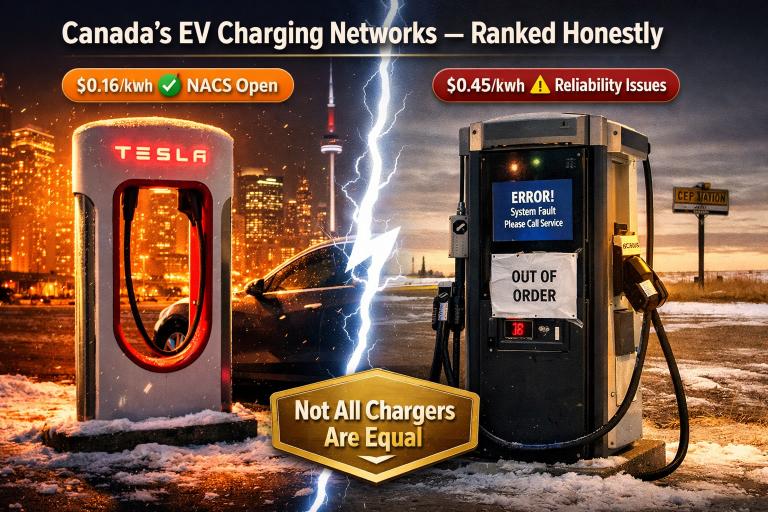
EV charging in Canada grew 28% in 2025, reaching 8,804 public DC fast charge ports nationally — but the pricing at those ports ranges from $0.16/kWh to over $0.45/kWh depending on which network you plug into, and session reliability varies just as dramatically. The national average hit $0.42/kWh in Q4 2025 (Paren), however that average conceals a split network landscape where Ontario and BC face capacity pressure while Saskatchewan averages just 1.1 sessions per port per day. This guide ranks every major EV charging network in Canada across the four criteria that matter: coverage along Canadian corridors, DC fast charge speed, cost per kWh with and without membership, and independently sourced reliability data. No U.S. network averages. No recycled figures.
Why Most EV Charging Guides Fail Canadian Drivers
I get this complaint at least twice a week: “I read a charging network comparison and it was basically a U.S. article with Canadian prices pasted in.” My answer is always the same — because that’s exactly what most of them are. Specifically, they cite ICCT uptime data measured in California, present national averages without provincial context, and ignore the sessions-per-port data that tells you whether a network is actually serving real drivers or just padding its port count. As a result, this article uses only Canadian-sourced data throughout, with explicit source dates so you know what’s fresh and what may have already changed.
EV Charging in Canada 2026 — The Quick Verdict:
Tesla Supercharger is Canada’s strongest road-trip network — ~230 stations, $0.16–$0.33/kWh, and 95%+ now open to non-Tesla EVs via NACS. Electrify Canada is the best highway supplement for non-Tesla vehicles. BC Hydro leads as a provincial utility network. ChargePoint has the most total ports but pricing variance makes it unreliable for cost-conscious DC fast charging. Petro-Canada and IVY have documented reliability issues. Saskatchewan, Manitoba, and Atlantic Canada buyers must plan home charging as primary — public DCFC cannot be relied upon as backup on most secondary routes in these regions.
The State of EV Charging in Canada in 2026: What the Data Actually Shows
Canada’s charging network is growing faster than almost any other infrastructure category in the country. That’s the honest positive. The honest negative is that growth is heavily concentrated, pricing is wildly inconsistent, and the gap between a great charging experience in Ontario and an unreliable one in rural Atlantic Canada is wider than most national headlines acknowledge.
How the Network Grew in 2025 and Where It Stands Now
According to Paren’s Q4 2025 Canadian DCFC report — the most comprehensive independent tracking dataset for Canada — the national network reached 8,804 DC fast charge ports, up 28% year-over-year. The top five operators accounted for 76% of all new 2025 port additions, meaning the network is concentrated rather than fragmented. However, that concentration creates both winners and losers: Ontario leads utilization at 6.1 sessions per port per day, BC follows at 6.0, and Quebec sits at 4.5. By contrast, Alberta registers 2.7 sessions per port per day and Saskatchewan just 1.1 — reflecting coverage-first expansion into lower-demand geographies rather than network saturation.
The Honest Gap That Persists in 2026
A federal infrastructure audit cited by Natural Resources Canada confirmed that rural, remote, and Indigenous communities still lack reliable public fast-charging access — and the data bears this out in the session figures. Beyond urban-rural gaps, CBC Marketplace’s January 2024 investigation documented 2x price variation for identical charge volumes depending solely on which network a driver used. As a result, the strategic question for Canadian EV owners is not just “is there a charger” but “is it reliable, is it priced fairly, and does my vehicle connect to it natively.” The network has improved — but unevenly.
Every Major EV Charging Network in Canada Ranked
Eight networks. Four criteria. One honest ranking. Here’s specifically what separates the networks Canadian EV drivers actually rely on from the ones that look good on a map but underdeliver at the plug.
Tier 1: National Road-Trip Networks
Tesla Supercharger — Canada’s Strongest Road-Trip Backbone
Tesla holds approximately 33.4% of cumulative Canadian DCFC port share and operates roughly 230 stations along Canada’s major corridors as of Q4 2025 (Paren). Speed at V3 and V4 stations peaks at 250 kW — real-world sessions typically deliver 150–250 kW depending on vehicle capability and station load. Pricing runs $0.16–$0.33/kWh, which is the lowest national average among major networks. Over 95% of Canadian Supercharger stations now accept non-Tesla vehicles via Magic Dock adapters or native NACS ports (RIDEZ, early 2026). That combination of pricing, reliability, and open access makes Supercharger the clearest network recommendation for interprovincial road-trip planning in 2026. The honest limitation: station spacing in northern and Atlantic routes requires more deliberate trip planning for drivers outside major corridors.
Electrify Canada — Best Highway Supplement for Non-Tesla Vehicles
Electrify Canada operates on a highway corridor focus with 350 kW peak capacity — however real-world sessions typically deliver 150–250 kW depending on vehicle accept rate and station load. Pricing runs $0.27–$0.40/kWh pay-as-you-go; the Pass+ membership at $4/month reduces effective per-session costs by approximately 25% (RIDEZ). As a result, Electrify Canada is the most strategically important non-Tesla highway charging option for Canadian road-trip drivers. The catch: its footprint remains smaller than Supercharger’s — making it a corridor supplement rather than a standalone network for national travel.
Tier 2: Urban and Provincial Networks
ChargePoint — Largest by Unit Count, Widest Pricing Variance
ChargePoint operates 7,000+ total charging points across Canada — the largest unit count of any operator. However, the majority are Level 2 installations in urban workplaces and destinations, not DC fast chargers for highway use. DCFC speed varies significantly by location. Pricing ranges from $0.25 to over $0.45/kWh because of ChargePoint’s site-host model — individual location operators set rates, creating the widest cost variance in the Canadian market. Specifically, this means two ChargePoint stations one hour apart on the same highway can charge materially different rates with no indication before you plug in. That unpredictability is ChargePoint’s primary weakness for cost-conscious drivers who plan routes carefully.
BC Hydro EV — Best Provincial Utility Network in Canada
BC Hydro operates 700+ ports across British Columbia, with 100 kW+ capability at more than 20 northern locations (BC Hydro, March 2026). Time-of-day pricing offers a 5¢/kWh overnight saving — the best off-peak value proposition in the BC market. NACS is supported at newer BC Hydro locations, with full transition ongoing through 2026. By contrast, older CCS-only sites remain in operation and require an adapter for NACS-native vehicles. For BC buyers specifically, BC Hydro’s provincial coverage density and overnight rate make it a strong primary public network alongside home charging.
Circuit Électrique — Quebec’s Dominant Operator
Circuit Électrique, operated by Hydro-Québec, accounted for 45% of Quebec’s new 2025 port additions (Paren Q4 2025) — making it the province’s dominant operator by a substantial margin. Its mix of Level 2 and DCFC installations covers both urban destination charging and highway corridors within Quebec. Province-wide coverage is the strongest of any utility-backed regional network in Canada. That said, Circuit Électrique’s strength is specifically provincial — it does not provide national road-trip coverage beyond Quebec’s borders.
Tier 3: Secondary Networks to Know
FLO delivers solid Level 2 urban coverage with DCFC options; no significant reliability issues were flagged in CBC Marketplace testing (January 2024, note: 2026 status may vary). Petro-Canada’s highway gas station integration provides geographic convenience, however CBC Marketplace documented charging failures at select locations — reliability concerns warrant verification before relying on Petro-Canada for critical charging stops. IVY (Ontario) shows mixed reliability in owner reports and is expanding through 2025–2026, therefore its network maturity should improve but remains inconsistent. Sun Country Highway has not added new stations in 2024–25, and the network is stagnating according to NRCan station data — not a reliable planning option for new routes.
← Scroll to see full table on mobile
| Network | DCFC Ports (CA) | Peak Speed | Price Range/kWh | NACS Access | Best Use Case | Reliability |
|---|---|---|---|---|---|---|
| Tesla Supercharger | ~2,940+ 33.4% share | Up to 250 kW | $0.16–$0.33 LOWEST | ✅ 95%+ open | National road trips | ⭐⭐⭐⭐⭐ Best |
| Electrify Canada | Corridor focus | Up to 350 kW | $0.27–$0.40 | ⚠️ CCS primary; NACS expanding | Highway supplement | ⭐⭐⭐⭐ Good |
| BC Hydro EV | 700+ (BC only) | Up to 350 kW select | ToD pricing; 5¢ overnight saving | ✅ Newer sites NACS | BC provincial primary | ⭐⭐⭐⭐ Good |
| Circuit Électrique | 45% of QC new ports | DCFC + L2 mix | Hydro-Québec rates | ⚠️ Adapter | Quebec provincial | ⭐⭐⭐⭐ Good |
| ChargePoint | 7,000+ (mostly L2) | Varies by site | $0.25–$0.45+ WIDEST VARIANCE | ⚠️ Site dependent | Urban destination L2 | ⭐⭐⭐ Variable |
| FLO | L2 + some DCFC | Varies | Variable | ⚠️ Adapter | Urban L2 backup | ⭐⭐⭐ Adequate |
| Petro-Canada | Highway stations | Up to 50 kW | Moderate | ⚠️ CCS | Highway stops | ⭐⭐ Reliability concerns |
| IVY (ON) | Ontario focus | Up to 150 kW | Moderate | ⚠️ CCS | Ontario urban supplement | ⭐⭐ Mixed reports |
Data: Paren Q4 2025, RIDEZ February 2026, BC Hydro March 2026, CBC Marketplace January 2024 (reliability notes updated where 2026 data available). Session reliability ratings are relative assessments based on independent testing data — not operator self-reported figures.
Pricing: Why You Could Pay Twice as Much for the Same Charge
This is the number that shocked me when I first compiled it: CBC Marketplace documented that the same charge volume at different networks could cost 2x as much depending purely on where you plugged in — not how fast you charged, not what time of day, just which network’s cable you grabbed. That’s not a fringe case. It’s a structural feature of Canada’s fragmented pricing landscape in 2026.
What You Actually Pay Per Network in 2026
Tesla Supercharger pricing runs $0.16–$0.33/kWh — the lowest national average among major operators, and the figure that most starkly illustrates how much premium non-Tesla networks charge. Electrify Canada runs $0.27–$0.40/kWh pay-as-you-go; the Pass+ membership at $4/month brings the effective rate down approximately 25% per session (RIDEZ). ChargePoint’s site-host model creates the widest variance: $0.25–$0.45+/kWh with no membership discount available to standardize costs. BC Hydro EV offers a 5¢/kWh overnight time-of-day saving — the best off-peak value in the BC market. The national Q4 2025 average of $0.42/kWh (Paren) sits materially above Tesla’s maximum rate, which is why Supercharger access has become a meaningful purchase consideration for buyers who charge publicly more than twice per month.
Membership Plans: Which Networks Reward Regular Users
Electrify Canada’s Pass+ at $4/month is the strongest membership ROI for highway corridor users. Break-even occurs at approximately 2–3 sessions per month — a threshold most road-trip-oriented drivers exceed in summer driving season. Tesla’s non-owner pricing differs from owner pricing, with the gap most relevant for non-Tesla NACS vehicle owners who may not have purchased the vehicle from Tesla directly — verify the current Canadian rate card at Tesla.com. ChargePoint has no meaningful membership discount due to its site-host model, which means frequent users get no cost benefit from loyalty. BC Hydro EV requires an account for time-of-day pricing opt-in — a one-time setup step with ongoing overnight rate savings. The practical recommendation for most Canadian EV drivers: a two-network strategy combining Supercharger access as primary with one regional utility or Electrify Canada Pass+ as backup outperforms any single-network approach on both cost and reliability.
← Scroll to see full table on mobile
| Network | Pay-As-You-Go Rate | Membership Fee | Member Rate | Break-Even Sessions/Mo |
|---|---|---|---|---|
| Tesla Supercharger CHEAPEST | $0.16–$0.33/kWh | None (owner pricing varies) | Same rate structure | N/A |
| Electrify Canada | $0.27–$0.40/kWh | $4/month (Pass+) | ~25% less per session | ~2–3 sessions BEST ROI |
| BC Hydro EV | Standard ToD rates | Free account | Overnight −5¢/kWh | First session (overnight) BC BEST |
| ChargePoint | $0.25–$0.45+/kWh | No meaningful plan | No discount available | N/A NO SAVINGS |
| Petro-Canada | Moderate per session | None | No plan | N/A |
NACS in Canada: What the Connector Shift Means for Every EV Owner in 2026
NACS adoption in Canada moved faster than almost anyone predicted — and it changes the network value calculation for buyers considering non-Tesla EVs more materially than any other single 2025 development. Here’s what it means for you specifically.
Open Supercharger Access: What It Means in Practice
Over 95% of Canadian Tesla Supercharger stations now accept non-Tesla EVs via Magic Dock adapters or native NACS ports as of early 2026 (RIDEZ). Most new non-Tesla EVs shipping in 2026 — GM vehicles including the Equinox EV and Bolt, Ford, Toyota bZ, and others — come with NACS ports or confirmed adapters. As a result, the adapter friction that was a real barrier in 2023–2024 is largely resolved for new vehicle buyers. What that means for the purchase decision: Hyundai, Kia, GM, Ford, and Toyota owners now have access to Supercharger pricing, reliability, and coverage that was previously exclusive to Tesla buyers. Specifically, a non-Tesla EV owner with NACS access in 2026 has materially better road-trip confidence than the same owner in 2024 without it.
Which Canadian Networks Are Transitioning to NACS
BC Hydro supports NACS at newer installations with full transition ongoing through 2026. Toronto Parking Authority (Green P) has converted approximately 65% of its DC fast chargers to NACS, with more planned for 2026 (Electric Autonomy, March 2025). Electrify Canada runs CCS as its primary connector but has confirmed NACS expansion for 2026. However, several networks remain CCS-only as of March 2026 — a relevant flag for legacy Nissan Leaf owners who depend on CHAdeMO, because that adapter dependency is not being resolved by any major Canadian network operator in the current expansion cycle. If you own a CHAdeMO-only vehicle, your public fast-charging options are narrowing rather than expanding.
Charging by Province: Where the Network Is Ready and Where It Isn’t
Honestly, the provincial charging gap in Canada is the single most consequential piece of information I can give a prospective buyer — and it’s the data point most national charging articles deliberately obscure with network-level averages. Your province changes your charging reality more than your vehicle choice does.
Where the Network Is Strongest in 2026
Ontario leads nationally at 6.1 sessions per port per day — the highest utilization rate in Canada and a sign that demand is approaching capacity pressure on popular corridors. Ontario hosts dense IVY, ChargePoint, Petro-Canada, and Green P coverage in major cities, supplemented by Supercharger stations on provincial highways. British Columbia follows at 6.0 sessions per port per day; BC Hydro’s 700+ ports with 100 kW+ capability at 20+ northern locations make it the strongest utility-backed provincial network in Canada. Quebec’s Circuit Électrique, having captured 45% of provincial new 2025 ports, delivers province-wide urban and highway coverage second only to Ontario and BC in completeness.
Where Gaps Are Real and Affect Ownership Decisions
Saskatchewan registers 1.1 sessions per port per day — not because there’s no demand, but because coverage-first expansion has prioritized placing stations over filling usage gaps. Secondary routes between major Saskatchewan cities are not reliably served for unplanned charging stops. Manitoba and Atlantic Canada show similar patterns: low session density, rural and secondary route gaps confirmed in the federal NRCan audit, and a dependency on home charging that is not optional but structural. Northern Canada — Yukon (0.6 sessions/port/day), Northwest Territories, and Nunavut — faces both extreme cold and absent Supercharger coverage. Buyers in these regions specifically need home Level 2 as primary infrastructure, with public DCFC treated as a bonus when available rather than a planning assumption.
← Scroll to see full table on mobile
| Province / Territory | Sessions/Port/Day | Network Maturity | Gap Severity | Recommended Strategy |
|---|---|---|---|---|
| Ontario | 6.1 HIGHEST | High — multiple networks | Low on major corridors | Supercharger + IVY/ChargePoint |
| British Columbia | 6.0 | High — BC Hydro dominant | Low urban; moderate rural north | BC Hydro + Supercharger highway |
| Quebec | 4.5 | High — Circuit Électrique | Low provincial; gaps beyond QC | Circuit Électrique + Supercharger |
| Alberta | 2.7 | Moderate and growing | Moderate — rural gaps exist | Supercharger + Electrify Canada |
| Manitoba | Low | Early-stage | High — secondary routes | Home L2 primary; DCFC backup only |
| Saskatchewan | 1.1 LOWEST PROV. | Coverage-first build-out | High — unplanned stops risky | Home L2 primary; plan carefully |
| Atlantic Canada | Low | Early and fragmented | High — rural sparsity | Home L2 primary; Supercharger in cities |
| Yukon / Territories | 0.6 Yukon | Minimal | Very high — extreme cold + gaps | Home L2 essential; no highway DCFC reliance |
Sessions/port/day: Paren Q4 2025. Gap severity is a qualitative assessment based on session data, NRCan federal audit findings, and secondary route DCFC coverage mapping.
How to Build Your Personal Charging Strategy in Canada for 2026
Every Canadian EV owner needs a charging strategy — not a network map. Here’s how to build yours based on your actual driving pattern rather than on which network has the most impressive logo.
Daily Drivers and Urban Commuters
Home Level 2 charging is your primary energy source — not optional, not a nice-to-have. For Canadian winters specifically, overnight home charging lets you precondition while plugged in, which is the single most effective cold-weather EV habit for maintaining daily usable range (CAA cold-weather testing data). Specifically, home charging eliminates 90% of your public DCFC reliance for daily use. As a result, the network membership question for daily drivers is simpler: BC Hydro EV time-of-day plan for BC buyers, ChargePoint for destination Level 2 access in major cities, and Supercharger as highway backup only. Green P (Toronto), Circuit Électrique (Montreal), and ChargePoint provide the best urban Level 2 coverage in Canada’s major metropolitan areas.
Highway and Road-Trip Drivers
Supercharger access is the non-negotiable backbone for cross-province EV travel in Canada in 2026. No other network matches the combination of pricing, reliability, and corridor coverage for national road trips. The recommended two-network stack for highway drivers: Tesla Supercharger as primary, with Electrify Canada Pass+ at $4/month as the highway supplement for routes where Supercharger spacing requires a backup stop. Before any long-distance departure, check PlugShare 3-month check-in data for every planned charging stop — not just the station map count. Prairie and Atlantic route planning requires 30% more buffer stops than southern Ontario or BC corridor planning. Confirm operating status of key stations 48 hours before departure.
Buyers Choosing Between EV Models: How Network Access Should Factor In
NACS-native vehicles — GM (Bolt, Equinox EV), Ford, Toyota bZ — have full Supercharger access in 2026 with no adapter dependency. That meaningfully expands their road-trip network to the strongest option in Canada at the lowest charging price. CCS vehicles with confirmed NACS adapters have equivalent access with minor friction. CCS-only vehicles without NACS adapter availability are limited to Electrify Canada, ChargePoint DCFC, and utility networks for highway charging — adequate for urban use, but requiring more deliberate planning on cross-provincial routes. Therefore, confirm the NACS status of your target model before signing — the answer changes your total charging cost and road-trip convenience materially.
🏙️ Daily Urban Driver
- Primary: Home Level 2 (essential)
- Urban backup: ChargePoint or Green P
- Quebec: Circuit Électrique
- BC: BC Hydro EV (overnight ToD)
- Membership: BC Hydro or ChargePoint
🛣️ Highway Road-Trip Driver
- Primary: Tesla Supercharger
- Backup: Electrify Canada Pass+
- PlugShare 3-month check-in audit pre-trip
- Prairies: add 30% more buffer stops
- Membership: Electrify Canada Pass+ ($4/mo)
🛒 Pre-Purchase Buyer
- Confirm NACS status of target model
- NACS-native = full Supercharger access
- CCS-only = limited to non-Tesla networks
- Audit home charging installation feasibility
- Check provincial rebate for home EVSE
FAQ: EV Charging in Canada 2026
What is the best EV charging network in Canada in 2026?
Tesla Supercharger is the strongest road-trip network in Canada — approximately 33.4% of national DCFC port share (Paren Q4 2025), pricing of $0.16–$0.33/kWh, and over 95% of stations now open to non-Tesla EVs via NACS. Electrify Canada is the best highway supplement for non-Tesla vehicles, specifically on corridors with Supercharger gaps. BC Hydro EV leads as a provincial utility network in BC, with time-of-day pricing offering the best overnight rate value in the province. For urban Level 2, ChargePoint has the widest footprint however with the most inconsistent pricing.
How much does it cost to charge an EV publicly in Canada?
The national Q4 2025 average for DC fast charging is $0.42/kWh (Paren), however the actual range is $0.16–$0.45+ depending on which network you use. Tesla Supercharger is the cheapest at $0.16–$0.33/kWh. Electrify Canada runs $0.27–$0.40/kWh pay-as-you-go, reduced approximately 25% with its $4/month Pass+ membership. ChargePoint shows the widest variance at $0.25–$0.45+ due to its site-host pricing model. CBC Marketplace documented 2x price variation for identical charge volumes between networks in January 2024 — a gap that persists into 2026.
Can non-Tesla EVs use Superchargers in Canada in 2026?
Yes — over 95% of Canadian Tesla Supercharger stations are open to non-Tesla EVs via Magic Dock adapters or native NACS ports as of early 2026 (RIDEZ). Most new non-Tesla EVs sold in 2026 — including GM models (Bolt, Equinox EV), Ford, and Toyota bZ — ship with NACS ports or confirmed adapters. As a result, the adapter barrier that complicated non-Tesla Supercharger access in 2023–2024 is largely resolved for buyers of new 2026-model-year vehicles. However, confirm your specific vehicle’s NACS status before treating Supercharger access as guaranteed.
Is EV charging reliable enough in Canada for long road trips in 2026?
On major corridors in Ontario, BC, and Quebec — yes, specifically with Supercharger access. Cross-Canada travel is feasible but requires deliberate planning at the corridor level rather than relying on map pin counts. Prairie routes (Saskatchewan, Manitoba), secondary Atlantic routes, and northern Canada present genuine reliability gaps confirmed by NRCan federal audit data — these regions require planned buffer stops and, for northern routes specifically, acceptance that Supercharger coverage does not extend to territories. The honest answer: national road trips are viable in 2026 for Supercharger-capable vehicles; they require more preparation for non-Supercharger vehicles.
The Bottom Line on EV Charging in Canada in 2026
EV charging in Canada in 2026 is simultaneously better than the media narrative suggests and not yet as seamless as government targets require — and which reality you experience depends almost entirely on which province you live in and which network you rely on. The practical conclusion is clear: Tesla Supercharger is the primary backbone for cross-provincial travel, supplemented by BC Hydro EV or Circuit Électrique provincially and Electrify Canada Pass+ for corridor gaps. Saskatchewan, Manitoba, and Atlantic Canada buyers face a materially different charging reality than Ontario or BC drivers — and must treat home Level 2 as infrastructure, not convenience. Before purchasing your next EV, take three specific actions: confirm your target model’s NACS status; check PlugShare 3-month check-in data for your most-used corridor; and audit home charging installation feasibility before treating public DCFC as a daily energy strategy. Understanding how to maximize your EV battery life through smart charging habits will also compound your savings across every network you use.