Last Updated: May 2026 — CAA Winter EV Range Study data, Natural Resources Canada cold-weather testing, owner-reported real-world winter range from Canadian EV communities
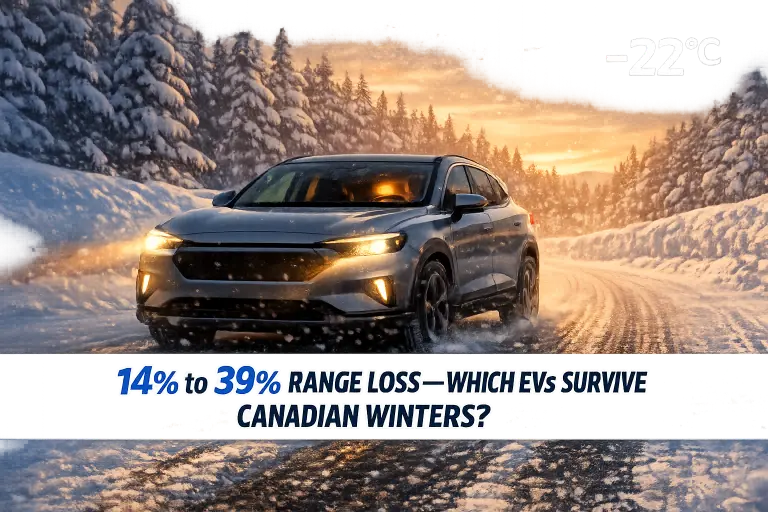
The best EVs for Canadian winters in 2026 are not necessarily the ones with the longest EPA range — they are the ones engineered specifically for what -20°C and -30°C do to a battery. That distinction eliminates more than half the market immediately. A heat pump, active battery preconditioning, and a large enough battery to absorb 40 to 50 percent range loss while still reaching the next charger: those three criteria separate the cars that belong in a Prairie winter from the ones that will leave you calculating margins on the side of the highway in January.
This article uses CAA Winter EV Range Study data, owner-reported real-world figures from Canadian EV communities, and cold-weather engineering specifications to rank the EVs that handle Canadian winters reliably — and name the ones you should not use as a primary car if you live anywhere colder than -15°C with any regularity.

Best EVs for Canadian Winters 2026 — Summary:
The five EVs that handle Canadian winters best are: #1 Hyundai Ioniq 6 SE LR AWD (heat pump standard, ~335 km at -20°C, C$49,999–54,999); #2 Tesla Model Y LR AWD (best Supercharger network in Canada, ~330 km at -20°C, C$66,490); #3 Hyundai Ioniq 5 LR AWD (more cargo than Ioniq 6, ~325 km at -20°C, C$57,999); #4 Kia EV9 AWD (best for families, ~335 km at -20°C despite size, C$79,995); #5 Chevrolet Equinox EV AWD (best value with proper winter kit, ~280 km at -20°C, C$47,699). Do not buy: any EV without a heat pump as a primary car for anything colder than -15°C — the F-150 Lightning and pre-2024 Mach-E are specific examples that lose up to 52% of EPA range at -20°C.
What -30°C Actually Does to an EV: The Honest Numbers
The CAA’s Winter EV Range Study — tested at approximately -20°C with the cabin heater running — is the most cited Canadian cold-weather dataset. At that temperature, every EV tested lost substantial range compared to its EPA or WLTP rated figure. The variation between models was significant: heat-pump-equipped vehicles retained approximately 62 to 70 percent of their rated range; resistive-heater vehicles retained approximately 48 to 58 percent.
At -30°C — a temperature that Winnipeg, Saskatoon, Regina, Edmonton, and large parts of northern Ontario and Quebec reach regularly — the losses compound. An additional 8 to 12 percent loss over the -20°C figure is typical, based on owner-reported data and cold physics modelling. A car that retained 68 percent of its range at -20°C typically retains 57 to 61 percent at -30°C.
The practical implications depend entirely on the car’s starting range. A 491 km EPA vehicle at 60 percent retention gives you 295 km. A 417 km EPA vehicle at 48 percent retention gives you 200 km. If your nearest DCFC is 100 km away on a -30°C prairie highway and the car starts the trip cold-soaked from overnight parking, the second scenario has essentially no margin. The first has 95 km of buffer — still not comfortable, but manageable.
Two variables outside the car’s engineering that significantly affect real-world winter range: garage parking and plugging in. A car kept above 0°C in a garage retains approximately 10 to 15 percent more range than one cold-soaked overnight. A car left plugged in outside — even if not actively charging — allows the battery management system to maintain a minimum battery temperature, recovering a similar margin. In a Prairie winter, the charging cable is not optional equipment — it is thermal management infrastructure.
For a detailed look at the chemistry behind what cold does to lithium cells and how BMS systems respond, see our what happens to EV batteries in extreme cold guide.
The Two Features Every Canadian Winter EV Must Have
Every EV cold-weather article eventually lists specifications. Before the rankings, here is the short version: two features determine whether an EV belongs in a Canadian winter. Everything else — battery size, 0-100 time, frunk volume — is secondary to these.
1. Heat Pump (Standard, Not Optional)
A heat pump moves thermal energy rather than generating it. In a resistive electric heater, every kilowatt of heating power draws one kilowatt from the battery. A heat pump, drawing the same kilowatt from the battery, produces approximately two to three kilowatts of cabin heat by harvesting ambient thermal energy. In moderate cold (0°C to -10°C), the efficiency ratio is roughly three-to-one. At -20°C, the ratio narrows — most heat pumps become less efficient below -15°C and some earlier designs struggle to extract meaningful heat below -25°C — but even at reduced efficiency, a heat pump still outperforms resistive heating significantly at temperatures Canada’s interior regularly reaches.
The CAA Winter EV Study quantified this gap at -20°C. Heat-pump models averaged approximately 63 to 70 percent of rated range; resistive-heater models averaged approximately 48 to 58 percent. The difference — roughly 12 to 20 percentage points — translates directly to kilometres. On a 500 km EPA car, that gap is 60 to 100 km at a single temperature snapshot. Over a winter of daily driving, it means the difference between consistently making your commute and consistently worrying about it.
What to check: Heat pump status is not always clear in Canadian dealer spec sheets. Verify directly: it may be listed as “Heat Pump” in the HVAC specifications, or described as a “refrigerant-cycle cabin heater” or similar language. On some models — including early Ioniq 5 trims and certain Chevrolet Bolt builds — heat pump is a trim-level or market-specific option, not standard across all variants sold in Canada. Confirm the specific build before purchase.
2. Active Battery Preconditioning
Preconditioning means the car actively warms the battery to its optimal operating temperature before you need it — either at a scheduled departure time, when navigating to a fast charger, or both. A cold-soaked battery at -30°C does not perform at rated capacity, does not charge at rated speed, and does not deliver full regenerative braking. Preconditioning addresses all three.
The practical difference between a car with preconditioning and one without: on a -25°C morning, a preconditioned car is warm inside, the battery is at operational temperature, and you leave with near-full range available. Without preconditioning, the first 15 to 20 minutes of driving draw heavily on the battery for heating, and available range is compressed until the battery self-heats through use.
The best preconditioning systems are automatic and route-aware. Tesla’s system activates battery preconditioning automatically when a Supercharger is set as a navigation destination — so the battery arrives at the charger warm and accepts charge at or near peak rate immediately. Hyundai and Kia’s equivalent on the e-GMP platform (Ioniq 5, Ioniq 6, EV6, EV9) requires the driver to manually activate “charger preconditioning” from the navigation app or infotainment before departure, but works well once initiated. Both approaches are meaningfully better than no preconditioning.
The 2026 Rankings: Best EVs for Canadian Winters
#1 — Hyundai Ioniq 6 SE LR AWD: Best Overall for Canadian Winters
Canadian price: approximately C$49,999–54,999 depending on trim and dealer · EPA range: 491 km (RWD SE) / 435 km (AWD) · Heat pump: standard · Preconditioning: charge + departure
The Ioniq 6 holds the top position for Canadian winters because of a combination that no competitor at its price point matches: one of the most efficient EV platforms on sale, a heat pump across all Canadian trims, active preconditioning for both departure and charging, and the 800V architecture that makes charging faster — which matters more in Canadian winters than any other condition because it keeps time spent at chargers in the cold as short as possible.
At -20°C in real-world Canadian driving conditions, Ioniq 6 AWD owners report approximately 290 to 320 km of usable range — approximately 67 to 69 percent of EPA. At -30°C, the estimate falls to approximately 260 to 285 km. For context: the Trans-Canada from Toronto to Ottawa is 450 km, and at -30°C a single planned charge stop of 15 to 20 minutes puts you there safely with buffer. That margin is achievable because of where the Ioniq 6 starts, not because the cold affects it less.
The AWD variant is the Canadian winter recommendation. The RWD SE has more EPA range, but AWD traction on icy highways outweighs the range difference in practice — and most Canadian winter driving involves mixed conditions where both matter.
One honest caveat: the Ioniq 6 is a fastback sedan. If you carry skis, a dog, or substantial cargo regularly in winter, the Ioniq 5’s hatchback practicality may matter more than the Ioniq 6’s slightly better range efficiency. Both are strong winter performers on the same platform.
#2 — Tesla Model Y LR AWD: Best Infrastructure for Canadian Winters
Canadian price: C$66,490 · EPA range: 533 km · Heat pump: standard since 2021 refresh · Preconditioning: automatic to Supercharger
The Model Y’s ranking is driven primarily by one factor: the Supercharger network. Canada has over 250 Supercharger locations as of 2026, with the highest concentration between Windsor and Quebec City — the corridor where most Canadians live and where winter driving infrastructure matters most. No other charging network in Canada approaches Supercharger uptime, reliability, or density for long-distance winter driving.
The technical winter case is also strong. Tesla’s heat pump — introduced across Model Y production in 2021 and refined in the 2023 Highland refresh — is among the most capable in the segment at sub-zero temperatures. Owner-reported -20°C range sits at approximately 315 to 335 km, depending on driving speed and conditions. At -30°C, the estimate is approximately 280 to 300 km.
What Tesla does that no other manufacturer currently matches for winter charging: when a Supercharger is your navigation destination, the car begins warming the battery automatically during the drive. You arrive at the charger with the battery at operational temperature, and charging begins at or near peak rate immediately. At -30°C, this eliminates the 10 to 15-minute slow charge period that non-preconditioned vehicles experience at the start of every DCFC session.
The reason not to make it #1: C$66,490 with no federal iZEV rebate and no provincial rebate in Ontario or Alberta makes it C$15,000 to C$20,000 more expensive than the Ioniq 6 on an effective-price basis. If your charging situation is primarily home-based and route-based rather than long-distance highway, the infrastructure advantage does not justify the price premium over the Ioniq 6.
#3 — Hyundai Ioniq 5 LR AWD: Best Practical Winter Family Car
Canadian price: C$57,999 · EPA range: 488 km · Heat pump: standard on LR AWD · Preconditioning: charge + departure
The Ioniq 5 shares the Ioniq 6’s e-GMP platform and its core winter credentials: heat pump standard on the LR AWD trim, active preconditioning, and 800V charging architecture. The practical difference is body style. The Ioniq 5’s square hatchback rear gives 527 litres of cargo space versus the Ioniq 6’s 401 litres — and in a Canadian winter, that difference is skis, hockey bags, winter emergency kits, and everything else that turns a 5-minute grocery run into a boot-of-the-car logistics problem.
Real-world -20°C range for the Ioniq 5 LR AWD runs approximately 310 to 325 km in Canadian owner reports — closely tracking the Ioniq 6 despite the less aerodynamic body, because the same battery pack and thermal management system produce similar absolute results even with the Cd penalty. At -30°C, the estimate is approximately 275 to 290 km.
For a family car that serves as a daily in Saskatchewan or northern Ontario through a full winter, the Ioniq 5 is the most complete answer on the market at its price point. It has the range to handle Prairie highway distances without anxiety, the cargo space to live with, and the charging speed to keep stops short.
#4 — Kia EV9 AWD: Best for Large Families on Long Winter Routes
Canadian price: C$79,995–89,995 · EPA range: 505 km (AWD GT-Line) · Heat pump: standard · Preconditioning: charge + departure
The EV9 makes this list for one reason: a 99.8 kWh usable battery that provides a large absolute range buffer, even after cold-weather percentage losses are applied. At -20°C, the EV9 AWD retains approximately 66 percent of its EPA range — roughly 333 km. At -30°C, approximately 58 percent — roughly 293 km. Those absolute numbers match or exceed the smaller vehicles above, despite the EV9 carrying seven seats and substantially more mass.
For a family of five driving from Calgary to Banff at -25°C with ski gear, the EV9’s combination of interior space, AWD traction, and heat pump efficiency covers the return trip on a single charge with buffer. Nothing else in this price range does the same job with the same reliability.
The reason it ranks fourth rather than higher: the C$79,995 starting price, currently no federal iZEV rebate (MSRP exceeds the C$55,000 threshold for SUVs when the program is active), and BC’s rebate eligibility ceiling. If price-per-winter-capability-point matters, the Ioniq 5 at C$57,999 is a more efficient purchase for most buyers.
#5 — Chevrolet Equinox EV AWD: Best Value Winter EV Under C$50,000
Canadian price: C$47,699 (2LT AWD) · EPA range: ~446 km · Heat pump: standard on AWD variants · Preconditioning: departure scheduling
The Equinox EV AWD earns the fifth position on price and heat pump availability alone. At C$47,699, it is the most affordable Canadian-market EV with a heat pump and AWD in one package — the two requirements for a reliable Prairie winter car. At -20°C, real-world range is approximately 270 to 285 km — lower than the Hyundai/Kia options above, reflecting the less optimised platform. At -30°C, approximately 238 to 253 km.
Those range numbers require honest route planning for longer Prairie drives. Winnipeg to Brandon (200 km) in -30°C: manageable with buffer. Winnipeg to Regina (570 km): requires a charging stop, but the numbers work with one planned 30-minute session. The Equinox EV is a practical winter car for most Canadians’ actual driving patterns — which are daily commutes and occasional highway runs, not 600 km highway legs in a blizzard.
The Equinox EV’s 11.5 kW AC onboard charger also means overnight Level 2 home charging (at 240V) adds approximately 55 km of range per hour — useful in Canadian winters when you want to start the day with a full charge after a cold night.
Full Winter Performance Comparison Table

| Model | Canadian Price (approx.) | EPA Range | -20°C Est. Range | -30°C Est. Range | Heat Pump | Preconditioning | AWD Available |
|---|---|---|---|---|---|---|---|
| Hyundai Ioniq 6 SE LR AWD | C$49,999–54,999 | 435 km (AWD) | ~295–310 km | ~260–280 km | Standard | Charge + Depart | Yes |
| Tesla Model Y LR AWD | C$66,490 | 533 km | ~315–335 km | ~280–300 km | Standard (2021+) | Auto to Supercharger | Standard on LR |
| Hyundai Ioniq 5 LR AWD | C$57,999 | 488 km | ~310–325 km | ~275–290 km | Standard (LR AWD) | Charge + Depart | Yes |
| Kia EV9 AWD Long Range | C$79,995+ | 505 km | ~325–340 km | ~285–300 km | Standard | Charge + Depart | Standard |
| Chevrolet Equinox EV AWD | C$47,699 | ~446 km | ~270–285 km | ~238–253 km | Standard (AWD) | Departure only | Yes |
| Kia EV6 Wind AWD | C$54,495 | ~490 km | ~310–325 km | ~270–288 km | Standard | Charge + Depart | Yes |
| Chevrolet Bolt EV (2023+) | C$38,998 | 417 km | ~225–240 km | ~195–210 km | No heat pump | Limited | No AWD available |
| Ford F-150 Lightning SR/ER | C$62,999+ | ~480 km (ER) | ~235–250 km | ~200–215 km | No heat pump | Departure only | Standard |
| Nissan Leaf (62 kWh) | C$37,998 | ~363 km | ~185–200 km | ~155–170 km | No heat pump | No active thermal mgmt | No AWD available |
DCFC Charging in Extreme Cold: What the Spec Sheet Doesn’t Tell You
Every EV manufacturer publishes a peak DC fast charge rate. What they do not publish is the peak rate at -30°C on a cold-soaked battery. The gap between those two numbers is significant enough to affect winter route planning.
Lithium batteries charge best within a specific temperature window — typically 15°C to 35°C for optimal charge acceptance. Below 0°C, the battery management system reduces charge rate to protect the cells. At -30°C on a car that has been parked overnight without being plugged in, DCFC charge rates may be limited to 30 to 50 percent of the published peak until the battery warms through use or internal heating.
In practice, this means:
Hyundai Ioniq 5 (220 kW peak): at -30°C cold soak, may begin a DCFC session at 60 to 100 kW and climb toward 150 to 180 kW after 15 to 20 minutes as the battery warms. A 20-minute stop at this behaviour adds approximately 80 to 100 km of range rather than the 130 to 150 km the published peak implies.
Tesla Model Y (250 kW V3 Supercharger peak): similar cold-battery behaviour, but Tesla’s auto-preconditioning to Supercharger destinations means the battery is typically warmer at arrival. A Model Y that drove 50 km to a Supercharger with the destination in navigation will charge faster on arrival than one that was cold-soaked and driven 10 km to the same charger.
The most important cold-weather charging habit: input your charging stop as a navigation destination before you leave home, not when you arrive at the charger. The car begins warming the battery during the drive. At a -30°C DCFC session, this 20 to 30-minute head start can mean the difference between 15 minutes charging and 35 minutes charging for the same amount of added range.
For a detailed breakdown of charging infrastructure by province and corridor, including which routes have the most reliable DCFC coverage for winter driving, see our EV charging in Canada guide.
Canadian Winter EV Tips That Actually Make a Difference

Most winter EV advice is generic. The following is specific to Canadian conditions — written for owners in climates that regularly reach -20°C and below, not for someone dealing with a British frost.
1. Plug in every night, even at 80% SOC. The charging cable is not just for adding kilowatts — it keeps the battery management system powered so it can maintain minimum battery temperature overnight. An EV left plugged in at -30°C loses approximately 3 to 5 km of overnight range to thermal maintenance. An EV left unplugged at -30°C loses that same energy to cold soak and arrives at your departure with a degraded starting temperature — a 10 to 15 km equivalent penalty before you leave the driveway.
2. Schedule departure time, not just charge completion time. Every EV with departure scheduling will pre-warm both the cabin and, on heat-pump models, the battery before you leave. Set the departure time to match when you want to leave, not when you want charging to finish. Those are different commands on most vehicles. Leaving a cold car because charging completed 2 hours earlier is a common first-winter mistake — the battery cooled again while you were inside.
3. Use heated seats and heated steering wheel before turning on cabin fan heat. Heated seats draw approximately 75 to 120 watts per seat. Cabin fan heating on a resistive system draws 2,000 to 6,000 watts. Warming your immediate contact surfaces first and keeping the cabin setpoint lower (19°C rather than 22°C) saves meaningful range on a cold day. A -25°C commute with heated seats and 19°C target temperature uses materially less heating energy than the same commute at 22°C with no heated seats.
4. Add 40 percent to your trip plan at -20°C; add 55 percent at -30°C. If you are planning a 350 km route, budget 350 × 1.40 = 490 km of range at -20°C, or 350 × 1.55 = 542 km at -30°C. These multipliers ensure you have buffer at arrival rather than arriving at 5 percent SOC after a three-hour highway leg. Your car’s own winter-adjusted range estimate — displayed on the infotainment — is typically more accurate than the summer estimate, but re-verify it against actual consumption in your first two weeks of winter driving.
5. Keep state of charge above 20 percent in extreme cold. Cold batteries have reduced charge acceptance and reduced available capacity near the bottom of the range. Below 10 to 15 percent SOC in a cold battery, regenerative braking is often limited by the BMS (to avoid forcing current into a cold, low cell), which removes one of the key energy recovery tools available to winter driving. Staying above 20 percent preserves full regen, full charge acceptance at the next charger, and full available range without BMS-imposed limitations.
6. Input DCFC stops as navigation destinations before leaving, not on arrival. As discussed in the charging section: the navigation destination triggers battery preconditioning on most modern EVs. The 30 to 45 minutes the battery spends warming during your drive means a faster, more efficient charging session when you arrive — and less time standing at a charger in -30°C weather.
7. Budget for proper winter tyres. The best AWD system in the world cannot overcome the physics of all-season rubber at -20°C. Tyre compound stiffens significantly below 7°C, and most all-season compounds lose meaningful grip below -10°C. A front-wheel-drive EV on proper winter tyres will outperform an AWD EV on all-seasons in most Canadian winter conditions. Winter tyres also reduce rolling resistance on compacted snow — which improves range slightly compared to the same car on stiff all-seasons fighting for traction.
EVs to Skip in a Canadian Winter
Honesty about what not to buy matters more for Canadian winters than in any other EV context, because the stakes of a wrong decision are not mild inconvenience — they are stranding risks on -30°C highways.
Ford F-150 Lightning (any trim): Canada’s best-selling vehicle nameplate, but the F-150 Lightning has no heat pump. At -20°C in CAA testing, resistive-heater trucks lose approximately 48 to 52 percent of their EPA range. The Extended Range Lightning’s 480 km EPA becomes approximately 230 to 250 km at -20°C — and approximately 200 to 215 km at -30°C. For a truck that costs C$62,999 to C$97,999 depending on trim, those are numbers that will strand drivers on routes that the EPA range implies are manageable. The Lightning is a capable vehicle for most of the year and in mild winters. It is not an appropriate primary EV for interior Canada.
Chevrolet Bolt EV / EUV (without confirmed heat pump): Some 2023 and later Bolt builds include a heat pump; earlier ones do not. Verify the specific build before purchase. A Bolt without a heat pump on a -30°C Prairie morning has approximately 195 to 210 km of usable range. No AWD is available on any Bolt. The Bolt is a reasonable urban commuter for southern Ontario or BC — it is not the right tool for Winnipeg or Saskatoon winters as a primary vehicle.
Nissan Leaf (any variant): The Leaf has neither a heat pump nor active thermal management for the battery. Without active thermal management, the battery cannot be preheated for departure or conditioned before charging. At -30°C, a cold-soaked Leaf has approximately 155 to 175 km of usable range from its 62 kWh pack. Regen braking is limited at cold temperatures due to BMS restrictions on a cold, unmanaged pack. The Leaf is a capable mild-weather commuter. It is not a Canadian winter car.
Ford Mustang Mach-E (pre-2024, without confirmed heat pump): Early Mach-E trims for Canada did not include a heat pump. The 2024 refresh addressed this on most trims — verify the specific build year and trim for any Mach-E purchase. A pre-2024 Mach-E without a heat pump at -20°C loses approximately 47 to 52 percent of its EPA range.
For a broader look at which EVs make financial sense in the Canadian market after rebates and real-world range are factored in — not just winter performance — see our best electric cars in Canada 2026 guide. The rankings differ: winter performance and general value don’t always point to the same car.
Which Winter EV Fits Your Situation
Buy the Ioniq 6 AWD If…
- You want the best balance of winter range and price — at C$49,999–54,999 it is the most winter-capable EV per dollar spent in the segment
- Your driving is primarily highway commuting or urban — the sedan form factor is less of a compromise in those use cases
- You charge primarily at home or at workplace Level 2 — the 800V architecture and preconditioning system handle the rest
- You are in Ontario, Quebec, or BC — provincial rebates apply and lower the effective price further
Buy the Model Y LR AWD If…
- You regularly make long-distance winter highway trips between major Canadian cities — the Supercharger network density and auto-preconditioning are worth the C$12,000–17,000 premium over the Ioniq 6 on those routes
- You live in Alberta, Saskatchewan, or Manitoba where non-Tesla DCFC reliability is patchy — Supercharger uptime reduces the risk of arriving at a broken charger in extreme cold
- You can absorb the full price without a federal rebate and live in a province without additional provincial incentives
Buy the Ioniq 5 AWD If…
- You carry cargo regularly — 527 L of cargo space vs 401 L in the Ioniq 6 matters when packing for ski weekends or hauling winter gear
- You have children or need the practicality of a hatchback rear end for car seats, strollers, and supplies that come with family winter driving
- The C$57,999 price works within your budget and rebate eligibility
Buy the Equinox EV AWD If…
- Budget is the primary constraint and you need heat pump + AWD in a Canadian-spec vehicle — at C$47,699 it is the most affordable option that meets both requirements
- Your winter driving is primarily urban commuting and occasional highway runs under 250 km — the Equinox EV’s winter range is appropriate for this pattern
- You are in BC or Quebec where provincial rebates bring the effective price to approximately C$43,000–42,000 — one of the best value propositions available
FAQ: EVs and Canadian Winters
What is the best EV for Canadian winters in 2026?
The Hyundai Ioniq 6 SE LR AWD is the best overall pick for Canadian winters in 2026 based on winter range, heat pump performance, preconditioning capability, and price. At approximately C$49,999 to C$54,999, it retains approximately 295 to 310 km of real-world range at -20°C — better than any competitor at or near its price point. The Tesla Model Y LR AWD ranks second on winter performance, with the advantage of Canada’s most reliable and extensive fast-charging network, but at C$66,490 with no federal rebate available at that MSRP. For families needing more cargo space, the Ioniq 5 LR AWD at C$57,999 uses the same platform and produces nearly identical cold-weather range figures.
How much range does an EV lose at -30°C?
At -30°C, most EVs lose between 40 and 55 percent of their EPA-rated range, depending on whether the vehicle has a heat pump and whether the battery has been preconditioned. Heat-pump-equipped models typically retain approximately 55 to 62 percent of EPA range at -30°C under normal winter driving conditions — cabin heat running, highway speeds, not preconditioned from a cold soak. Resistive-heater models retain approximately 43 to 52 percent. A car that has been plugged in overnight and preconditioned before departure recovers approximately 8 to 12 percent of that loss compared to the same car left unplugged and cold-soaked. The practical rule of thumb: plan your -30°C routes on 55 percent of EPA range for a heat-pump car and 45 percent for a resistive-heat car.
Do I need AWD for a Canadian winter EV?
AWD improves traction on snow and ice but does not improve range — in fact, AWD systems add mass and drivetrain friction that slightly reduces range compared to RWD or FWD equivalents on the same platform. The traction argument for AWD in Canadian winters is real and valid: on icy Prairie roads or unpacked mountain passes, AWD combined with proper winter tyres is meaningfully safer than FWD or RWD on the same tyres. However, a FWD or RWD EV on proper winter tyres will outperform an AWD EV on all-season tyres in most Canadian conditions. If forced to choose between AWD and winter tyres for the budget, winter tyres first.
What is a heat pump and why does it matter in a Canadian winter?
A heat pump moves thermal energy from outside air into the cabin rather than generating heat by converting electricity directly to heat. The efficiency advantage: at -10°C to -20°C, a heat pump produces approximately 1.5 to 2.5 kilowatts of cabin heat per kilowatt drawn from the battery. A resistive heater produces exactly one kilowatt of heat per kilowatt drawn. At -20°C, the difference between a heat pump car and a resistive car is roughly 12 to 20 percent of total EPA range — typically 50 to 100 km on a full-size EV. CAA Winter EV Range Study data quantified this at -20°C: heat pump models averaged 63 to 70 percent of EPA range; resistive models averaged 48 to 58 percent. The heat pump is the single most important cold-weather specification to confirm before buying any EV for use in Canadian winters colder than -15°C.
Can I charge an EV at -30°C?
Yes — but slower than the published peak rate, unless the battery has been preconditioned. At -30°C on a cold-soaked battery, DC fast chargers will be limited to 30 to 50 percent of peak output until the battery warms to operating temperature, typically 10 to 20 minutes into a session. Level 2 home charging works at normal speed regardless of temperature because the power draw is lower and the battery management system can manage the thermal gradient. The most effective way to maintain near-peak DCFC speeds in winter is to input your charging stop as a navigation destination before leaving so the battery preconditions during the drive. Never arrive at a -30°C DCFC stop with a cold-soaked battery if you can avoid it — the charging session will be longer and less efficient than your route plan assumed.
Is the F-150 Lightning good for Canadian winters?
The F-150 Lightning has several strengths in Canadian winters — AWD standard, large battery, ProPower onboard (useful for ice fishing and remote sites), and truck utility. However, it does not have a heat pump, which is a significant cold-weather disadvantage. At -20°C, the Extended Range Lightning loses approximately 48 to 52 percent of its 480 km EPA range, leaving approximately 230 to 250 km of real-world winter range. At -30°C, the estimate drops to approximately 200 to 215 km. For a C$62,999 to $97,999 truck that is marketed as replacing conventional pickup trucks across Canada, these numbers require careful route planning on any trip longer than an urban commute. The Lightning is not the right primary vehicle for anyone who regularly makes inter-city drives in Prairie or northern winters. For urban use and short regional driving in milder Canadian winters — southern Ontario, Lower Mainland — it is more practical.
- CAA — Winter EV Range Study (updated 2024): real-world EV range testing at approximately -20°C for multiple models, cabin heat running, highway conditions
- Natural Resources Canada — fuel and energy data for Canadian fleet vehicles; EV cold-weather efficiency modelling benchmarks
- Transport Canada — iZEV incentive program eligibility and MSRP thresholds; Canadian-market vehicle specification confirmations
- Canadian EV Owners Association, r/electricvehicles Canada, Alberta EV Owners Group, Ioniq5Canada subreddit — owner-reported winter range data from Prairie, northern Ontario, and Quebec conditions, 2023–2026 winters
- Manufacturer Canadian-market spec sheets (Hyundai Canada, Tesla Canada, Chevrolet Canada, Kia Canada, Ford Canada) — heat pump status and preconditioning capability confirmation for 2026 model year vehicles