Last Updated: May 2026 — iZEV eligible vehicle list, MSRP caps, and provincial rebate amounts verified
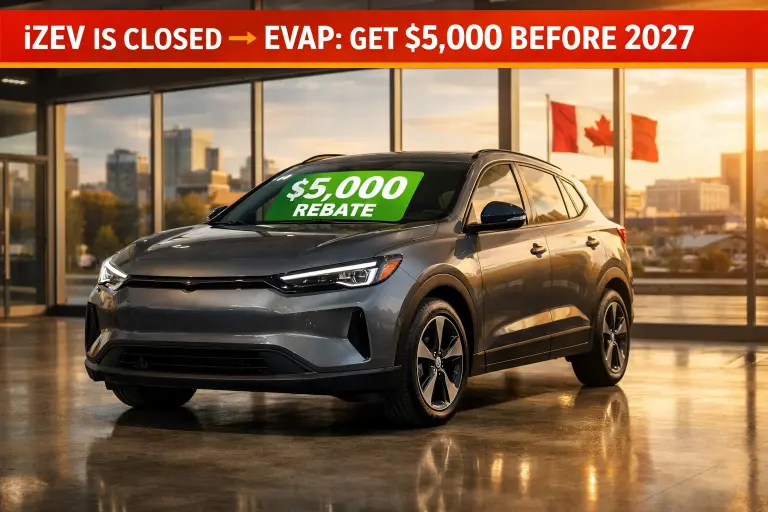
The iZEV rebate puts up to $5,000 on the hood of an eligible electric car in Canada — applied at the dealership, reducing your purchase price before you drive away. No forms to file, no tax return to wait for, no income cap. The most common reason buyers lose this money is not vehicle eligibility — it is the trim level. If the as-delivered price of your specific configuration exceeds $55,000 for a passenger car or $60,000 for an SUV or truck, the full rebate drops to zero. Not prorated — zero. One option package over the threshold and the entire $5,000 disappears from your deal.
Canada’s iZEV program (Incentives for Zero-Emission Vehicles) is administered federally by Transport Canada. Unlike the US federal EV tax credit — which requires filing a tax return, has household income limits, and imposes domestic manufacturing rules — the iZEV is a straightforward point-of-sale discount available to any Canadian resident purchasing or leasing a new eligible vehicle through a registered dealer. The eligible vehicle list is updated as manufacturers adjust pricing, and individual models cycle on and off as trims shift above the caps. This guide covers which EVs still qualify in 2026, where the MSRP trap catches buyers, and how provincial rebates stack on top for residents of Quebec, British Columbia, and PEI.

Canada iZEV Rebate 2026 — Quick Answer
The federal iZEV rebate is up to $5,000 CAD for eligible battery electric vehicles (BEVs) and fuel cell vehicles, and up to $2,500 CAD for eligible plug-in hybrids with 50+ km of electric range. It is applied automatically at the dealer — no forms, no income limit, no tax filing required. The critical rule: if your vehicle’s as-configured price exceeds $55,000 (passenger cars) or $60,000 (SUVs, trucks, minivans), you receive nothing. Higher trims of models with a qualifying base trim can go up to $65,000 or $70,000. Always verify your specific trim on the official Transport Canada iZEV eligible vehicle list before signing.
How Much Is the iZEV Rebate — and What Types of Vehicles Qualify
The rebate amount depends on which category your vehicle falls into. Transport Canada uses three tiers.
| Vehicle Type | Federal iZEV Rebate | Condition | Examples |
|---|---|---|---|
| Battery Electric Vehicle (BEV) | $5,000 CAD MAXIMUM | Vehicle must be on official eligible list · MSRP within cap | Hyundai Ioniq 6, Kia EV6, Chevrolet Equinox EV, Nissan Leaf |
| Hydrogen Fuel Cell (FCEV) | $5,000 CAD | Must be on eligible list · limited models available in Canada | Toyota Mirai (select markets) |
| PHEV — 50 km+ electric range | $2,500 CAD | Minimum 50 km EPA/NRCan electric range · MSRP within cap | Toyota RAV4 Prime, Hyundai Tucson PHEV, Ford Escape PHEV |
| PHEV — under 50 km electric range | $0 NOT ELIGIBLE | Does not meet minimum electric range threshold | Most standard non-plug-in hybrids, short-range PHEVs |
| Standard hybrid (non-plug-in) | $0 NOT ELIGIBLE | No plug-in capability — not a zero-emission vehicle under iZEV rules | Toyota Camry Hybrid, Honda Accord Hybrid, RAV4 Hybrid |
The rebate is not a tax credit. There is no interaction with your annual tax filing. The $5,000 or $2,500 reduces the purchase price at the dealer on the day you take delivery — the dealer is subsequently reimbursed directly by Transport Canada. Buyers who purchased before the eligible vehicle list was updated and whose vehicle was later removed have not had rebates clawed back; the rebate locks in at date of delivery. However, waiting for a vehicle that is about to fall off the eligibility list carries risk.
Which EVs Qualify for the iZEV Rebate in 2026
The following table covers the major models available in Canada and their current iZEV eligibility status. Note that eligibility is determined trim-by-trim, not model-by-model — a Hyundai Ioniq 5 Preferred at $54,999 qualifies; a Hyundai Ioniq 5 Ultimate at $64,999 depends on whether it falls within the higher-trim threshold for SUVs.
| Vehicle | Type | Starting MSRP (CAD, approx.) | Rebate | Notes |
|---|---|---|---|---|
| Nissan Leaf S | BEV | ~$37,498 | $5,000 ELIGIBLE | All trims well under cap — most affordable eligible BEV in Canada |
| Chevrolet Equinox EV 1LT | BEV | ~$44,998 | $5,000 ELIGIBLE | Entry trims well within cap · higher trims require checking vs $70,000 SUV threshold |
| Toyota Prius Prime | PHEV | ~$39,090 | $2,500 ELIGIBLE | 68 km electric range · all trims well within cap |
| Ford Escape PHEV | PHEV | ~$43,000 | $2,500 ELIGIBLE | ~61 km electric range · verify specific trim within SUV cap |
| Kia EV6 Standard Range RWD | BEV | ~$48,495 | $5,000 ELIGIBLE | Base trims well inside passenger car cap · higher AWD/GT trims need checking |
| Hyundai Tucson PHEV | PHEV | ~$44,949 | $2,500 ELIGIBLE | ~51 km electric range · SUV cap provides margin on most trims |
| Kia Sorento PHEV | PHEV | ~$48,485 | $2,500 ELIGIBLE | ~67 km electric range · verify higher trims vs SUV threshold |
| Volkswagen ID.4 Pro | BEV | ~$52,995 | $5,000 ELIGIBLE | Classified as SUV — $60,000 base cap provides meaningful headroom on most trims |
| Hyundai Ioniq 6 Standard Range | BEV | ~$52,999 | $5,000 ELIGIBLE | Passenger car — $55,000 cap is close; added options can breach eligibility |
| Toyota RAV4 Prime XSE | PHEV | ~$52,790 | $2,500 ELIGIBLE | ~68 km electric range · SUV cap; XSE Premium trim can approach threshold with packages — verify |
| Hyundai Ioniq 5 Preferred | BEV | ~$54,999 | $5,000 ELIGIBLE | SUV — $60,000 base cap · higher trims (Ultimate) eligible up to $70,000 threshold |
| Mitsubishi Outlander PHEV | PHEV | ~$48,498 | $2,500 ELIGIBLE | ~87 km electric range · among the longest PHEV range in Canada · SUV cap |
| Tesla Model 3 RWD | BEV | ~$52,990 | Verify | Tesla pricing changes frequently — confirm current model/trim on official iZEV list before purchase |
| BMW i4 eDrive35 | BEV | ~$70,000+ | $0 NOT ELIGIBLE | Exceeds passenger car MSRP caps — no trim qualifies |
| Tesla Model Y Long Range AWD | BEV | ~$67,990+ | $0 NOT ELIGIBLE | Exceeds $60,000 base cap and $70,000 higher-trim cap for SUVs — confirm current pricing |
| Porsche Taycan | BEV | ~$105,000+ | $0 NOT ELIGIBLE | Far exceeds cap — not designed for this program |
The MSRP Cap Trap: Why Your Trim Determines Whether You Get the Money
This is the section most buyers skip — and where $5,000 regularly disappears from deals that should have included it.
The iZEV program uses two different MSRP thresholds depending on the vehicle category:
Sedans, hatchbacks, coupes, station wagons
Base/standard trims: Must be at or below $55,000 MSRP.
Higher trims: Eligible up to $65,000 MSRP, but only if a lower trim of the same model is priced at or below $55,000.
Example: Hyundai Ioniq 6 Standard Range at ~$52,999 qualifies. Adding a $3,500 option package that pushes it to $56,499 removes the rebate entirely.
Sport utility vehicles, pickup trucks, passenger vans
Base/standard trims: Must be at or below $60,000 MSRP.
Higher trims: Eligible up to $70,000 MSRP, but only if a lower trim of the same model is priced at or below $60,000.
Example: Hyundai Ioniq 5 Preferred at ~$54,999 qualifies easily within the SUV cap. The Ioniq 5 Ultimate at ~$64,999 also qualifies as a higher trim under the $70,000 threshold.
The “higher trim” threshold only applies if the model has a qualifying base version. If every trim of a vehicle starts above $55,000 or $60,000, none are eligible — regardless of what the higher threshold says. This is why the BMW i4 and Tesla Model Y Long Range receive no rebate: even the entry variant of those models exceeds the relevant cap, eliminating the higher-trim pathway entirely.
The MSRP assessed is the final as-configured price of the specific vehicle being purchased — the base trim price plus any factory-installed options, packages, and accessories that affect MSRP. Dealer-installed accessories (floor mats, paint protection film) typically do not count toward the MSRP test. Factory options that appear on the Monroney label do. The practical implication: always calculate your configured price before assuming your chosen setup qualifies.

How to Claim the iZEV Rebate: Step by Step
The iZEV claim process is straightforward for the buyer precisely because the paperwork falls on the dealer, not you. Here is how the process works end to end.
Step 1: Confirm your vehicle and trim are on the current eligible list. Go to the official Transport Canada iZEV page (tc.canada.ca) and look up your specific vehicle and trim. Do not rely on what a dealer tells you verbally. Print or screenshot the eligible list entry before visiting the showroom. The list shows the eligible trims, the MSRP cap for each, and the rebate amount.
Step 2: Confirm the dealer is a participating iZEV retailer. Most franchised dealerships selling eligible vehicles are registered with the iZEV program. Independent dealers and some specialty importers may not be. The Transport Canada iZEV page includes a dealer locator. A non-registered dealer cannot apply the rebate regardless of what you were promised.
Step 3: Confirm your as-configured price before signing. Have the dealer produce a written quote showing the total MSRP of your specific configuration — base price plus all factory-ordered options. Verify this number falls within the relevant cap for your vehicle category. If it does not, either remove options or accept that the rebate is not available for this configuration.
Step 4: The rebate is applied at point of sale. When you sign the purchase agreement or lease contract, the iZEV rebate is listed as a line-item credit reducing the vehicle price. You pay (or finance, or lease) the post-rebate amount. For a purchase: the selling price is reduced by $5,000 or $2,500. For a lease: the rebate typically reduces either the capitalised cost or the first payment — confirm with the dealer how it is applied in the lease structure, as this affects your total monthly payment calculation.
Step 5: The dealer claims reimbursement from Transport Canada. After delivery, the dealer submits the VIN and delivery documentation to Transport Canada to receive reimbursement for the rebate amount they applied to your deal. This is invisible to the buyer — no action required on your end.
Provincial Rebates That Stack on Top of iZEV
The federal iZEV rebate is available nationally. On top of that, three provinces have their own programs that stack, potentially doubling or tripling the total incentive. The remaining provinces offer nothing additional — knowing which column you are in matters significantly for the total cost calculation.
| Province / Territory | Provincial Rebate | Combined with Federal (BEV) | Key Conditions |
|---|---|---|---|
| Quebec BEST | Up to $7,000 CAD Roulez Vert programme |
Up to $12,000 CAD | Income-tested: full $7,000 available to those earning under ~$100,000/yr · lower rebate above that threshold · also covers used EVs |
| British Columbia | Up to $4,000 CAD CleanBC Go Electric |
Up to $9,000 CAD | Income cap applies (under $80,000/yr individual income for full rebate) · also available for used EVs · MSRP cap aligns roughly with federal |
| Prince Edward Island | Up to $5,000 CAD | Up to $10,000 CAD | One of the most generous combined stacks in Canada · verify current program terms with PEI Energy Corporation |
| Nova Scotia | Up to $3,000 CAD | Up to $8,000 CAD | Efficiency Nova Scotia rebate program · verify current terms as program structure has changed over time |
| Ontario | $0 NO REBATE | $5,000 (federal only) | Provincial EV rebate was cancelled in 2018 and has not been reinstated — Ontario buyers receive federal iZEV only |
| Alberta | $0 NO REBATE | $5,000 (federal only) | No provincial EV incentive program |
| Saskatchewan | $0 NO REBATE | $5,000 (federal only) | No provincial EV incentive program |
| Manitoba | $0 | $5,000 (federal only) | No provincial-level passenger EV rebate as of May 2026 — verify with Manitoba Hydro for any current programs |
| New Brunswick, Newfoundland, other territories | Varies — check locally | $5,000+ (federal) | Some utility and provincial programs exist — verify with provincial government or local utility |
The provincial difference is large enough to influence vehicle purchase timing and even province of registration. A buyer in Quebec purchasing a Chevrolet Equinox EV at $44,998 receives $12,000 in combined rebates — reducing the effective price to approximately $32,998 before taxes. The same buyer in Ontario receives $5,000, producing an effective price of approximately $39,998. That $7,000 gap is structurally baked into Quebec’s aggressive EV adoption policy and has contributed to Quebec consistently leading Canada in EV market share.

Who Doesn’t Qualify — and Common Mistakes
The program excludes more scenarios than most buyers assume. These are the situations where the rebate is commonly expected but does not apply.
You Do Qualify If
- You are purchasing a new eligible BEV or PHEV through a registered Canadian dealer
- Your specific trim and configuration is at or below the applicable MSRP cap
- You are a Canadian resident (individual, business, organisation, or municipality)
- You are leasing a new eligible vehicle — the rebate applies to leases as well as purchases
- You are a business purchasing for company use — no income limit, no cap on number of vehicles
- You have claimed the rebate before — there is no lifetime limit per individual
You Do Not Qualify If
- You are buying a used EV — the standard iZEV covers new vehicles only (a separate used EV rebate program exists; check Transport Canada for current eligibility)
- Your vehicle’s configured price exceeds the MSRP cap — even by $1
- Your vehicle is a standard (non-plug-in) hybrid — no rebate regardless of how fuel-efficient it is
- You are buying from a non-registered dealer or private seller
- Your PHEV has under 50 km of electric range — it falls below the minimum threshold
- You are importing a vehicle from outside Canada — iZEV applies to sales by Canadian registered dealers only
The most expensive mistake is selecting a vehicle without checking the current eligible list. Several buyers have discovered at delivery that their model was removed from the iZEV list between their deposit and their delivery date — either because the manufacturer raised prices above the cap or because Transport Canada updated its criteria. The rebate does not lock in at order or deposit; it locks in at delivery date. If your vehicle is delivered when the model is no longer on the eligible list, the rebate does not apply. For vehicles with long order-to-delivery windows, monitor the eligible list periodically and be prepared to adjust your configuration downward if your model approaches the threshold.
Frequently Asked Questions
How do I claim the Canada iZEV rebate?
You do not file anything. The rebate is applied at the dealership at the time of purchase or lease signing. The dealer reduces the vehicle price by $5,000 or $2,500 and then submits paperwork to Transport Canada to receive reimbursement. Your only action is confirming before you sign that your vehicle and configured price appear on the current iZEV eligible vehicle list at tc.canada.ca. Bring documentation of that eligibility — a printout or screenshot — to the dealership.
Does the iZEV rebate apply to leased vehicles?
Yes. The iZEV rebate applies to both purchases and leases of eligible new vehicles. For a lease, the rebate is typically applied as a reduction to the capitalised cost, which lowers your monthly payment. However, the specific application varies by dealer and lease structure — some dealers apply it to reduce the first payment or down payment instead. Ask the dealer to show you in writing exactly how the $5,000 or $2,500 is applied in the lease structure before signing, since a rebate buried in a high capitalised cost may not produce the monthly savings you expect.
Is there an income limit for the iZEV rebate?
No. The federal iZEV program has no household income test. A Canadian individual earning $400,000 per year qualifies for the same $5,000 rebate as someone earning $45,000. This is one of the key structural differences from the US federal EV tax credit, which phases out above $150,000 individual income. Note that some provincial rebates — including Quebec’s Roulez Vert and BC’s CleanBC — do have income caps at the provincial level.
Can I claim the iZEV rebate more than once?
Yes. There is no lifetime limit on the number of iZEV rebates an individual or business can claim. Each qualifying purchase or lease on a new eligible vehicle receives the applicable rebate. A household purchasing two separate eligible EVs receives two separate rebates. A business purchasing a fleet of 10 eligible vehicles receives 10 rebates. Each vehicle must independently meet the eligibility criteria — trim, MSRP cap, and delivery date on the eligible list.
Is the Toyota RAV4 Prime eligible for the iZEV rebate?
Yes, most RAV4 Prime trims qualify for the $2,500 PHEV rebate. The RAV4 Prime has approximately 68 km of electric range, which exceeds the 50 km minimum for PHEV eligibility. As an SUV, it falls under the $60,000 base MSRP cap, which provides adequate margin for the XSE and most option packages. The XSE Premium with the Technology Package is the trim most likely to approach the cap — configured prices in the $57,000–$60,000 range require verification. Always confirm your specific trim and configuration on the current eligible list before purchase.
Does the iZEV rebate apply to used electric cars?
The standard iZEV program covers new vehicles only. Transport Canada has operated a separate used ZEV rebate initiative with different terms. As of May 2026, verify current used vehicle program availability and eligibility directly at tc.canada.ca — the used vehicle program has had intermittent funding and specific eligibility criteria that differ from the new vehicle program. Some provincial programs, including Quebec’s Roulez Vert, separately cover used EVs.
What happens if my vehicle’s price exceeds the MSRP cap by a small amount?
You receive no rebate — zero. The iZEV MSRP threshold is a hard cutoff, not a sliding scale. A vehicle configured at $55,001 for a passenger car receives $0, not a partial rebate. If you are close to the cap, the practical options are: remove factory options that push you over, downgrade to a trim that is comfortably under the cap, or accept that this configuration does not qualify and proceed without the rebate. There is no appeal mechanism or rounding tolerance.