Infiniti Cars Are Made in Which Country? Origin, Manufacturing Plants,and What It Means for Buyers

Last Verified: March 2026
Infiniti cars are made in which country? The short answer: primarily Japan, with specific models coming from the United States. Where Infiniti builds its vehicles matters more than most buyers realize — because country of assembly directly affects VIN structure, parts sourcing timelines, USMCA tariff compliance, and occasionally resale perception in the used market. Getting this wrong before you buy can mean surprises at the dealer that a five-minute VIN check would have prevented.
Why Country of Origin Matters for Infiniti Buyers in 2026
The question is more relevant in 2026 than it was even two years ago, specifically because of how U.S. import tariff policy has shifted. Vehicles assembled in Japan carry different tariff exposure than those assembled domestically — and that exposure can translate into dealer pricing adjustments or import cost changes that affect both new and used Infiniti buyers. This guide covers the complete manufacturing picture: which models come from which plants, how to verify your specific vehicle’s origin, and what the assembly location actually means for quality, warranty, and long-term ownership.
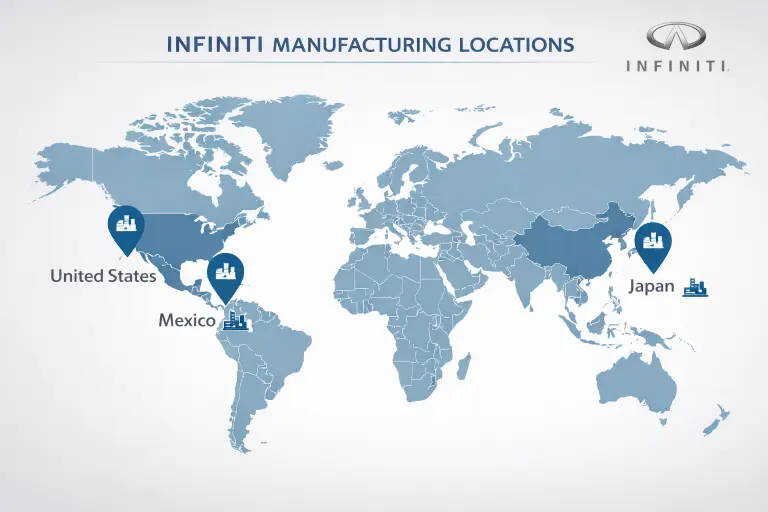
Infiniti Cars Are Made in Which Country? — Direct Answer:
Infiniti vehicles primarily come from Japan — specifically Nissan’s Tochigi and Oppama plants. Select models — historically including the QX60 and certain Q50 variants — also come from Smyrna, Tennessee. Dongfeng-Nissan builds China-market Infiniti models but doesn’t sell them in North America or Europe. Your specific vehicle’s assembly country is confirmed by the first character of its 17-digit VIN: “J” indicates Japan, “1” or “4” indicates the United States.
The Short Answer: Where Are Infiniti Cars Made?
Japan is the origin of most Infiniti vehicles sold globally — and has been since the brand launched in 1989. That foundation matters because it means Infiniti’s manufacturing quality standards, supplier relationships, and quality control processes trace directly to Nissan’s most experienced production facilities. However, the complete picture is more nuanced than a single-country answer, because U.S. production has played a meaningful role for specific models over the years.
Infiniti’s Relationship with Nissan and Japan
Infiniti is Nissan’s premium luxury division, founded in 1989 and headquartered in Yokohama, Japan. The brand was created specifically to compete with Lexus and Acura in the North American luxury market — and from its inception, most of its vehicles have been engineered and assembled in Japan. Nissan’s Tochigi plant in Tochigi Prefecture is the spiritual home of Infiniti production, specifically building the performance-oriented and higher-specification models. As a result, the Japanese manufacturing identity is central to the brand’s quality positioning — and to how dealers and consumers perceive the vehicles in the used market.
A Quick Model-by-Model Country-of-Origin Overview
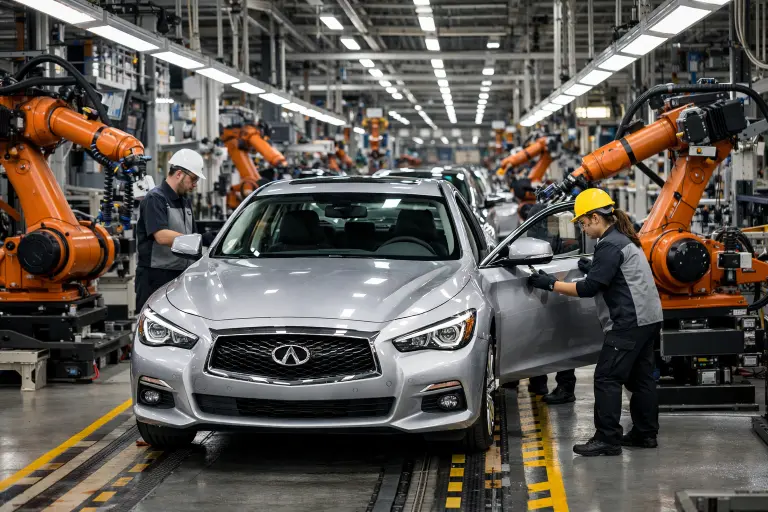
The current Infiniti lineup as of 2026 comes from three primary locations. Nissan builds the Q50 sedan and QX80 full-size SUV in Japan. The QX55 and QX60 crossovers have historically come from Smyrna, Tennessee — however assembly assignments shift with production updates and you should verify any specific vehicle by VIN. Nissan builds China-market models domestically in China and doesn’t export them to North America or Europe. The table below provides the reference-level overview; always verify your specific unit’s origin through the VIN.
← Scroll to see full table on mobile
| Infiniti Model | Primary Assembly Country | Plant / Location | Market |
|---|---|---|---|
| Q50 | Japan PRIMARY | Tochigi, Japan | Global |
| QX50 | United States | Smyrna, Tennessee | North America |
| QX55 | United States | Smyrna, Tennessee | North America |
| QX60 | United States | Smyrna, Tennessee | North America |
| QX80 | Japan | Oppama / Tochigi | Global |
| China-market models | China NOT EXPORTED | Dongfeng-Nissan | China only |
Infiniti’s Manufacturing Plants: Locations and What They Produce
Station count is a press release metric — and so is a country name without the plant-level detail behind it. Here’s the specific production geography that determines what you’re actually buying when you purchase an Infiniti.
Japan: The Home of Infiniti’s Core Production
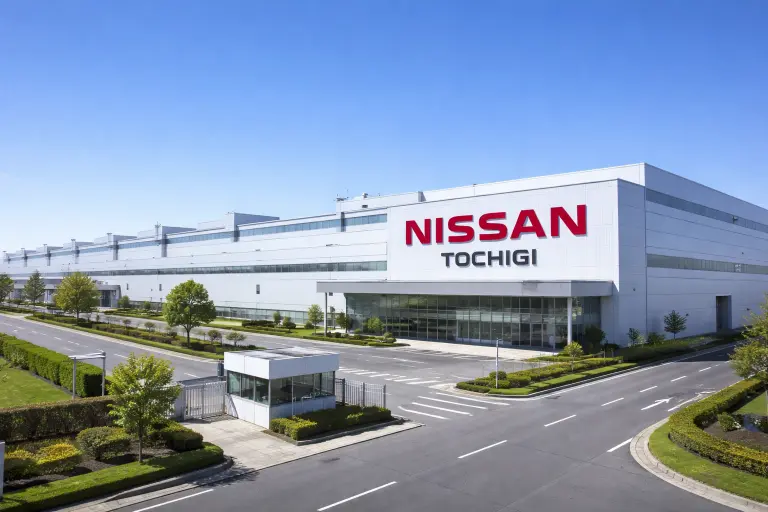
Nissan’s Tochigi plant in Tochigi Prefecture has been the dedicated home for Infiniti’s premium and performance models since the brand’s founding. Tochigi is Nissan’s high-specification facility — it also builds the GT-R and Nissan Z, which sets the quality and precision standard for the plant. Infiniti has produced the Q50 here throughout its full lifecycle. The QX80 full-size luxury SUV comes from related Nissan facilities in Japan, meeting the same quality control standards as Tochigi output. Japanese assembly gives Infiniti access to Nissan’s deepest supplier relationships and the longest institutional experience with Infiniti-specific build requirements.
United States: The Smyrna, Tennessee Connection
Nissan’s Smyrna, Tennessee plant is one of the most productive automotive assembly facilities in the United States. For Infiniti buyers, the relevant models built there include the QX50, QX55, and QX60 — all crossover SUVs specifically targeting the North American market. U.S. assembly carries USMCA compliance benefits, which means these vehicles meet North American content requirements for tariff treatment under current trade agreements. That matters in 2026 specifically because of ongoing trade policy uncertainty — a domestically assembled Infiniti carries lower tariff exposure risk than a Japan-imported equivalent. As a result, buyers concerned about potential pricing changes from import policy should note which model they’re purchasing.
China: Market-Specific Manufacturing
Dongfeng-Nissan assembles Infiniti models specifically for the Chinese domestic market. These vehicles follow local specifications and Nissan doesn’t export them to North America, Europe, or other global markets. Therefore, if you’re buying an Infiniti in the United States, Canada, or Europe, you won’t encounter a China-assembled Infiniti in a dealership. The China production line serves local demand without the import cost structure of Japanese-built vehicles — it’s market-specific and completely separate from the global lineup that most buyers interact with.
How to Check Your Specific Infiniti’s Country of Origin
I get this question at least twice a week: “How do I know where my specific Infiniti was actually built?” My answer is always the same — check the VIN. It takes 30 seconds and gives you a definitive answer that no dealership conversation can contradict.
Reading the VIN: What the First Character Tells You
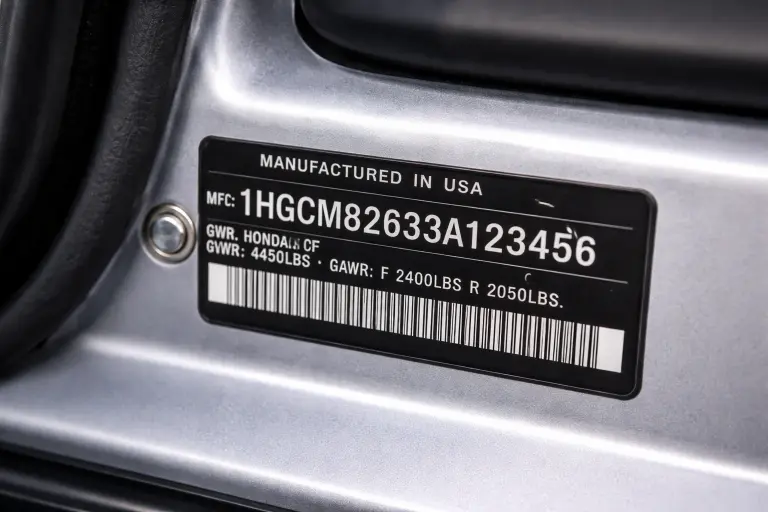
Every vehicle sold globally carries a 17-character Vehicle Identification Number. The first character is the World Manufacturer Identifier — it encodes the country of assembly. For Infiniti vehicles: a VIN beginning with “J” confirms Japanese manufacture. A VIN beginning with “1” or “4” confirms United States assembly — specifically Smyrna, Tennessee for the crossover models. Global standards define these codes, so they’re completely reliable. Find the VIN on the driver’s side dashboard (visible through the windshield from outside), on the driver’s door jamb sticker, and on the title and registration documents.
Using the NHTSA VIN Decoder for Instant Verification
The NHTSA VIN decoder at vpic.nhtsa.dot.gov is the most authoritative free tool for verifying any vehicle’s country of assembly, plant location, and manufacturing specifications. Enter the 17-digit VIN and the decoder returns the full manufacturing record — including plant country, plant city, and model year. Because this data comes directly from the federal vehicle database, it’s specifically more reliable than asking a dealer or searching a secondary source. For used Infiniti buyers in particular, running this check before purchase is a standard step that takes under a minute.
Does Country of Manufacture Affect Infiniti Quality?
Honestly, I was skeptical about this question when I first started fielding it regularly. Then I looked at the owner data — and the answer is more nuanced than either “no difference” or “Japanese is always better.”
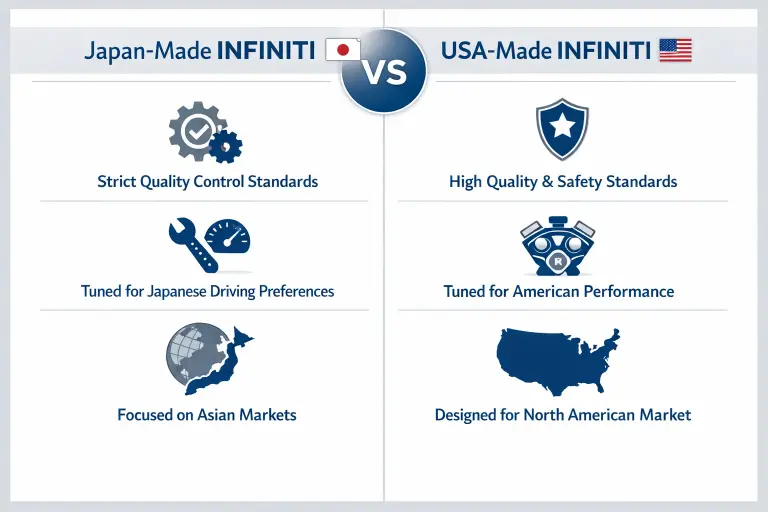
Japan-Built vs. US-Built Infiniti: Is There a Real Difference?
Nissan requires both Tochigi-built and Smyrna-built Infiniti vehicles to meet the same corporate quality standards — it applies consistent quality control protocols across all approved manufacturing facilities. The measurable gap between Japan-built and U.S.-built Infiniti models is small. In day-to-day ownership, it’s largely imperceptible. However, owner perception of Japanese assembly remains higher in some markets — specifically in used car valuations where “Japan-built” can carry a modest premium. That premium is more psychological than data-supported. It exists and affects resale pricing in certain segments, however. The real quality story for Infiniti, by contrast, is less about assembly country and more about the model generation and maintenance history of the specific vehicle.
What Industry Reliability Data Says in 2026
Infiniti as a brand sits in the middle tier of luxury brand reliability rankings in recent J.D. Power and Consumer Reports assessments — generally competitive with German luxury equivalents but typically behind Lexus in predicted reliability scores. Specifically, models sharing the most mechanical content with mainstream Nissan platforms (including the QX60 on the Nissan Pathfinder architecture) tend to benefit from more extensive real-world reliability data than models on unique Infiniti-specific platforms. As a result, when evaluating an Infiniti purchase, the powertrain generation and model-year reliability record is a more meaningful variable than whether the car came from Japan or Tennessee. Both plants produce vehicles to the same standard — the bigger differentiator is which model year you’re targeting.
Manufacturing Origin and Its Impact on Buyers: The Practical Implications
The country-of-origin question earns its place in any Infiniti buyer’s research because three practical purchase variables are directly tied to it: warranty coverage, parts sourcing, and resale positioning. Here’s what each one actually means for you.
Warranty Coverage: Does Assembly Location Change Anything?
No — Infiniti issues the warranty at brand level, not plant level. The standard Infiniti warranty in the U.S. covers 4 years / 60,000 miles bumper-to-bumper and 6 years / 70,000 miles powertrain, regardless of whether Smyrna or Tochigi built the vehicle. Because the brand — not the plant — issues the warranty, buyers of Japan-built and U.S.-built models receive identical coverage terms. That’s an important clarification, specifically because some buyers assume Japanese assembly carries different warranty terms — it does not. Assembly location should not factor into your warranty evaluation at all.
Parts Availability: Where the Practical Gap Lives
Parts availability is where assembly country has a small but real practical effect. Japan-built Infiniti models share parts with the broader Nissan global network — however, specific Japan-market components occasionally carry longer lead times for U.S. dealers because the import supply chain adds distance. U.S.-built models get faster parts access through the domestic Nissan/Infiniti dealer network. In practice, this rarely affects routine maintenance items. That said, older Japan-built Infinitis needing discontinued or low-volume parts can see noticeably extended lead times.
Resale Value: Does Japanese Assembly Earn a Premium?
Resale perception favors Japanese assembly in some buyer segments — specifically buyers who research VINs before purchase, which is increasingly common in the used luxury market. The premium is typically modest at 2–4% in comparable used listings. It exists and is worth noting if you buy with resale in mind. However, powertrain condition and service history move the resale needle far more than assembly country does.
Parts Availability, Resale Value, and Import Considerations
Infiniti’s Manufacturing Direction in 2026 and Beyond
The production geography question has a forward-looking dimension that matters for buyers who are evaluating Infiniti against competitors with clearer EV roadmaps. Here’s where the brand stands on manufacturing evolution in 2026.
Infiniti’s Electrification Plans and Production Realignment
Nissan has publicly committed to an EV-forward strategy through its Ambition 2030 plan, which includes electrified Infiniti models on next-generation platforms. However, as of March 2026, Nissan has not publicly confirmed specific production assignments for electric Infiniti models or their plant locations. Nissan previously identified its Tennessee facility as a candidate for EV-related production expansion, given its existing infrastructure and USMCA-compliant supply chain. Therefore, buyers planning around EV models should expect production geography to shift — likely toward increased North American assembly. No definitive plant assignments for future Infiniti EVs exist on record as of this writing.
FAQ: Where Are Infiniti Cars Made?
Infiniti cars are made in which country?
Infiniti primarily builds its vehicles in Japan, at Nissan’s Tochigi and Oppama plants. Select models sold in North America — including the QX50, QX55, and QX60 — come from the Smyrna, Tennessee facility. Dongfeng-Nissan builds China-market Infiniti models domestically, and those vehicles don’t reach North America or Europe. The VIN’s first character confirms the assembly country: “J” for Japan, “1” or “4” for the United States.
Are Infiniti cars made in the USA?
Yes — Nissan assembles specific Infiniti models in Smyrna, Tennessee. As of 2026, the QX50, QX55, and QX60 have U.S. assembly history at that plant. U.S.-built Infinitis carry USMCA compliance, which matters for buyers watching import tariff exposure. To confirm whether a specific vehicle came from the U.S., check the VIN — a first character of “1” or “4” confirms American assembly.
Is Infiniti a Japanese car brand?
Yes. Nissan created Infiniti as its premium luxury division in 1989, headquartering it in Yokohama, Japan. The brand launched specifically to compete in the North American luxury market against Lexus and Acura. However, its engineering, design, and primary manufacturing operations remain rooted in Japan. Because Infiniti shares platforms and technology directly with Nissan, it draws on Nissan’s Japanese engineering heritage and supplier relationships — particularly on models the Tochigi plant builds.
Does where an Infiniti is made affect its warranty or quality?
Warranty coverage is identical regardless of assembly location — Infiniti applies its standard U.S. warranty of 4 years / 60,000 miles bumper-to-bumper and 6 years / 70,000 miles powertrain uniformly across Japan-built and U.S.-built models. On quality, both Tochigi and Smyrna meet the same corporate standards — owner data shows minimal measurable difference between the two locations. As a result, assembly country shouldn’t significantly influence your buying decision. Model year, maintenance history, and powertrain generation matter far more for long-term quality.
The Bottom Line on Where Infiniti Cars Are Made
The country-of-origin question for Infiniti has a clear answer — Japan for most of the lineup, Tennessee for the U.S.-market crossovers — and a clear verification method through the VIN’s first character. What matters practically for buyers in 2026 is less about which plant built the car and more about three specific variables: USMCA compliance for tariff-conscious buyers, parts availability for high-mileage or older used models, and model-year reliability record for long-term ownership confidence. Check the VIN, verify the assembly country, and make your decision on the variables that actually affect your ownership experience.