Last Updated: May 2026 — UK and Australian owner forum data, MG Motor UK warranty terms, independent specialist repair cost ranges verified
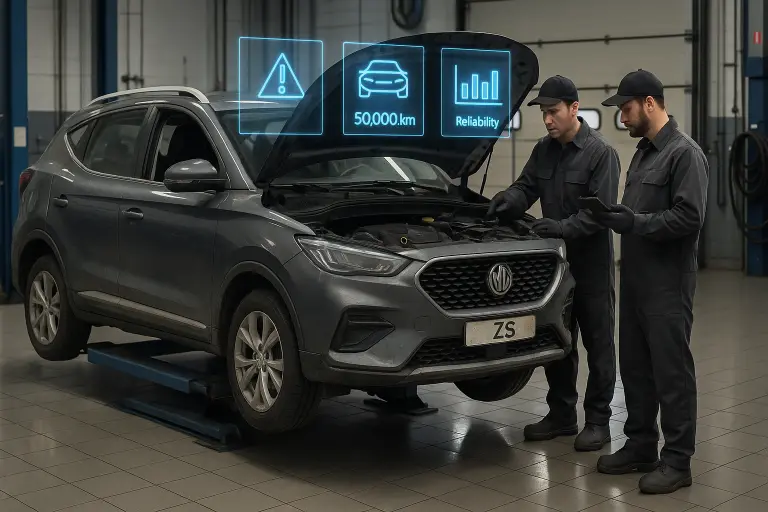
The MG ZS is mechanically reliable to 50,000 km — the engine, gearbox, and EV drivetrain rarely cause serious trouble at this mileage. What accumulates instead is a predictable set of quality-of-life problems: front suspension noise from strut top mount wear, road noise that worsens as door seals age, and infotainment instability that frustrates owners more than any mechanical issue. These MG ZS problems are not dangerous. They are irritants, and they are documented consistently enough across UK and Australian owner communities to constitute a pattern rather than isolated bad luck. This article names them, tells you when they typically appear, what they cost to fix, and whether any of them should change your buying decision.

MG ZS Problems After 50,000 km — Summary:
The most consistently reported MG ZS problems at high mileage are: (1) front strut top mount knock — a worn bearing causing a clunking sound over bumps, typically appearing between 50,000 and 80,000 km; (2) road and wind noise — present from new but worsens as door seals and bushings age; (3) infotainment instability — iSMART app disconnections, screen freezes, and navigation failures. None of these are drivetrain failures. The engine (petrol) and electric motor (EV variant) are not the weak points. What lets the MG ZS down at higher mileage is refinement, trim durability, and electronics — not the fundamentals.
The MG ZS at 50,000 km: The Honest Overview
This is the category most ownership articles get wrong — they either dismiss all problems as minor or catastrophise them into reasons not to buy. The honest position on the MG ZS at 50,000 km is this: the car’s core mechanicals are not the problem. The 1.5-litre naturally aspirated petrol engine is straightforward and durable when serviced correctly. The CVT transmission handles high mileage without drama if the fluid is changed at the right intervals. The ZS EV’s motor and battery pack are not sources of serious concern at 50,000–80,000 km for the vast majority of owners.
The problems that do appear at this mileage are in the comfort and electronics layer. MG built a competitive spec sheet — large touchscreen, decent safety kit, reasonable range — but paid less attention to NVH (noise, vibration, harshness) isolation and electronics polish than established European or Japanese brands. At 30,000 km, this is acceptable. By 50,000 km, as door seals compress, rubber bushings soften, and infotainment firmware accumulates issues, it becomes the defining characteristic of the ownership experience.
The five problems below are ranked by how consistently they appear across owner reports. All five have been documented in multiple UK and Australian owner communities between 2022 and 2026. None are unique to a single production batch.
Problem 1 — Front Suspension Knock (Strut Top Mounts)
This is the most significant mechanical problem the MG ZS develops at higher mileage — not because it is dangerous, but because it is consistent and owners are often surprised by it. The strut top mount is a bearing assembly that sits between the top of the front suspension strut and the car’s bodywork. It allows the strut to rotate when the steering turns. When the bearing wears, it produces a knocking or clunking noise over bumps and through slow-speed manoeuvres, particularly in cold weather when lubricants thicken.
On the MG ZS, this issue most commonly appears between 50,000 and 80,000 km. The rate of wear is accelerated by rough roads (a factor in UK urban driving and Australian country roads), and by the car’s weight — the ZS EV is heavier than the petrol variant, which puts more load through the front suspension components. The sound is typically a dull clunk from the front, noticeable on speed bumps, potholes, and uneven road surfaces. It is not a creak or squeak from bushings; it is a knock, and it is distinct once you know what to listen for.
Is it covered by warranty? No. Strut top mounts are classified as wear items in MG’s warranty terms — the same category as brake pads and tyres. Even within the 7-year warranty period, suspension wear items are excluded. This surprises some owners who assume a 7-year warranty covers everything.
What does it cost to fix? At an independent MG specialist, front strut top mount replacement typically runs £160–300 per axle in the UK (including parts and labour). At a main MG dealer, expect £250–400. The job requires removing the strut assembly, compressing the spring, and replacing the bearing — a straightforward job for a competent mechanic but not a novice DIY task without a spring compressor tool.
Verdict: Budget for this repair by 80,000 km if not before. It is not a reason to avoid the car, but it is a reason to factor maintenance costs into your ownership plan, and to check for the knock on any pre-purchase test drive by specifically seeking out rough road surfaces or speed bumps.

Problem 2 — Road Noise and Wind Noise
Road noise is the most consistent criticism across all MG ZS reviews — and unlike the strut top mount issue, it is not something that gets fixed. It is a fundamental characteristic of the car that worsens progressively as components age. At 50,000 km, most MG ZS owners report noticeably more tyre noise intrusion at motorway speeds than they experienced when the car was new, driven by three cumulative factors.
Tyre wear. The ZS’s factory tyres were not chosen for quietness; they were chosen for cost. As they wear past 50%, noise levels increase. Switching to a quieter tyre specification — Michelin CrossClimate 2 or Continental EcoContact are commonly cited upgrades in owner forums — improves the situation meaningfully. Some owners report a 20–30% reduction in perceived road noise from tyre choice alone. This is the single most cost-effective improvement available for ZS owners bothered by noise.
Door seal compression. The rubber door seals that keep wind noise out compress over time. At 50,000 km, the seals on many MG ZS examples have lost enough elasticity that wind noise at 70–80 mph is noticeably worse than when new. In the UK, this is most obvious on motorways in wet weather. Door seal replacement at a main dealer costs approximately £80–150 per door; some owners apply self-adhesive EPDM foam strip (£15–25 in total) to supplement the existing seals, which many report as effective for 12–18 months before needing replacement again.
Bushing wear. As the front and rear suspension bushings soften at higher mileage, road surface texture transmits more directly into the cabin. This is a harder and more expensive fix than tyres or seals — full bushing replacement at the front can cost £400–600 at an independent specialist for the full set. Most owners accept this as background noise rather than paying to fix it.
Verdict: Road noise on the MG ZS is the most common reason owners express regret about the purchase. It does not get better on its own. Budget for tyre replacement with a quieter specification at 50,000 km and inspect door seals. If you are sensitive to cabin noise on motorway journeys, test drive a high-mileage ZS on a motorway section before buying.
Problem 3 — Infotainment and iSMART Failures
MG’s iSMART connected services system is the third major complaint category at high mileage — and unlike the previous two, it can appear at any point in the car’s life rather than accumulating gradually with mileage. What makes it more common on high-mileage cars is that older firmware versions are more likely to have unresolved bugs, and OTA (over-the-air) update support for older ZS models is not guaranteed indefinitely.
The specific failures reported most consistently across UK and Australian owner communities are:
- iSMART app disconnection: The phone app loses connectivity with the car, requiring a manual reconnect via Bluetooth or a full system reboot. This affects remote pre-conditioning (useful for the EV variant in winter) and live vehicle data. The issue recurs rather than staying fixed.
- Screen freeze requiring reboot: The central touchscreen becomes unresponsive and requires a hard reboot (hold power button or disconnect battery). Typically takes 30–60 seconds to restart. Occurs more frequently in hot weather on some builds. Not dangerous — the climate control and radio may be affected but core driving functions are not.
- Navigation accuracy failures: The built-in navigation system produces routes or distance estimates that diverge from reality. Most UK owners use Apple CarPlay or Android Auto as a workaround, bypassing the native navigation entirely. This is an effective fix but not a solution — the native system should work.
- Voice command non-response: The voice assistant fails to process commands, particularly after a cold start or following a period of vehicle inactivity. More frustrating than consequential.
MG has issued OTA updates that address some of these issues on newer production. Older 2019–2021 ZS models received fewer updates and are more likely to carry unresolved firmware bugs. Whether MG continues to push OTA updates to early ZS models beyond 2026 is unknown — this is a genuine long-term risk for buyers of the oldest ZS EV examples.
Verdict: The infotainment issues are irritants, not dealbreakers. Most owners work around them with CarPlay/Android Auto. If you rely heavily on connected car features (remote pre-conditioning, live range data on the EV), verify that OTA updates are current before purchase and check that the iSMART app connects reliably during the test drive.
Problem 4 — Interior Trim Wear and Rattles
By 50,000 km, most MG ZS examples develop at least one persistent interior rattle. The specific locations that owners report most consistently are the dashboard lower edge (a vibration against the windscreen surround at idle and over rough roads), the B-pillar trim (particularly on the driver’s side), and on higher-mileage examples, the rear door trim panels. None of these indicate structural problems. They reflect the material quality choices MG made to hit its price point — and at the ZS’s price, the level of trim finishing is consistent with what you would find in similarly priced European alternatives.
The more notable interior wear item is the steering wheel leather on models with a leather-wrapped wheel. At 50,000 km the wheel edges — the 9 o’clock and 3 o’clock positions — show wear through the leather on examples that have been driven daily. This is cosmetically poor for a car that has been serviced and maintained properly. Replacement steering wheel covers (£20–40) address this, but it is a quality indicator worth noting on inspection.
Door card surfaces — particularly the lower sections of the front doors — show scuff marks and light scratching consistent with entry and exit wear. This is normal for any car at 50,000 km but is more visible on the MG ZS’s lighter interior colour options. Owners with dark interior trim report less visible wear at equivalent mileage.
Verdict: Interior rattle and trim wear is a cosmetic and comfort concern, not a mechanical one. Check for it on inspection — particularly the dashboard rattle over rough surfaces — but do not let it drive the purchase decision unless it is unusually severe. Persistent rattles can often be resolved cheaply with foam tape and clip replacements.
Problem 5 — EV-Specific Issues (MG ZS EV)
The MG ZS EV has its own fault pattern, distinct from the petrol variant, driven primarily by the additional complexity of its electric powertrain and its charging system.
Charging port mechanism. The charging port locking mechanism — which secures the cable during charging to prevent theft — occasionally fails to engage or disengage correctly. Owners report needing to manually operate the cable release or reboot the charging session. This is a quality control issue on the locking actuator, and it is more common on 2019–2021 MG ZS EV examples. Replacement of the locking mechanism at a dealer costs approximately £200–350 including labour. If buying a used ZS EV, specifically test the charging port operation by connecting and releasing a Type 2 cable during the test drive.
Heat pump absence on older models. The 2019 and 2020 MG ZS EV did not include a heat pump. Without one, the car heats the cabin using a resistive heating element — the same principle as a kettle. In winter, this draws between 3–5 kW from the battery continuously. On the smaller 44.5 kWh battery of the first-generation ZS EV, this reduces real-world range from approximately 180 km in summer to 120–140 km in cold UK conditions. This is not a fault — it is a specification limit. But buyers who do not know about it are caught out when their first cold winter significantly underperforms the advertised range. The 2021 and later ZS EV received a larger battery (51.1 kWh) and, on some trims, a heat pump. Check the specific trim and production date when buying.
12V auxiliary battery. All EVs — not just MG — rely on a separate 12V auxiliary battery to power the car’s electronics, lighting, and low-voltage systems. On the MG ZS EV, this 12V battery typically needs replacement around 4–6 years of ownership, which coincides with the 50,000–70,000 km mark for regularly driven examples. Symptoms are sluggish central locking, warning lights on startup, and failure to wake the car from a dormant state. Replacement costs £80–150 at an independent specialist. This is not an MG-specific problem, but it is one that catches EV owners by surprise because there is no equivalent in a petrol car — petrol cars use the starter battery, which most owners are aware of. For broader context on EV maintenance items that catch owners off guard, our article on how to maintain an EV covers all the non-obvious items.
Battery capacity retention. The MG ZS EV uses LFP (lithium iron phosphate) chemistry in its battery pack on most variants. LFP holds capacity well at high mileage. Owner-reported data from UK ZS EV communities suggests approximately 88–93% capacity retention at 80,000 km under normal mixed charging conditions. This is better than NMC chemistry batteries in some comparable vehicles. Daily charging to 100% does not meaningfully degrade LFP — owners can charge to full every night without the degradation penalty that applies to NMC batteries. For context on EV battery replacement costs if degradation does eventually become an issue, see our article on EV battery replacement costs.
Verdict on EV variant: The ZS EV’s battery and motor are its strongest long-term points. The specific watch items are the charging port lock mechanism and the 12V auxiliary battery — both fixable items, neither catastrophic. For buyers considering the first-generation (2019–2020) variant, the heat pump absence is the most significant practical limitation and affects real-world winter range substantially.
What the MG ZS Gets Right at High Mileage
Fairness requires naming what does not go wrong. The MG ZS’s mechanical foundation holds up well past 50,000 km, and this is the most important thing for most buyers to understand about the car’s long-term proposition.
Petrol engine. The 1.5-litre naturally aspirated engine in the petrol ZS is a conservative design by modern standards — no turbocharger, no direct injection, no variable valve timing complexity on earlier versions. These are normally features buyers want, but they also mean fewer failure modes. Owners with regular oil changes at 10,000–12,000 km intervals and coolant changes at the manufacturer’s schedule report no serious engine issues well past 100,000 km. The engine is not exciting, but it is durable.
CVT transmission. The continuously variable transmission is often a concern for high-mileage buyers, but the ZS’s CVT has a solid track record when the fluid is changed at the recommended service interval (typically 40,000–60,000 km or every 4 years, whichever comes first). Owners who skip transmission fluid changes report hunting behaviour and slip. Owners who maintain the service schedule report no issues. Check service history for transmission fluid change records.
Body structure and paintwork. No systematic corrosion issues have been documented on UK or Australian MG ZS examples at the 50,000–80,000 km mark, including on cars that have been through several UK winters. Panel fit and paint quality on 2021-onwards production is generally consistent. The earlier 2018–2020 models had isolated reports of paint adhesion issues at panel edges, but this was not widespread.
Brakes and ABS. Standard disc brakes all round, no documented systematic failure patterns at high mileage. Brake wear is reported as slightly faster than average — some owners replace pads at around 30,000–40,000 km rather than the 50,000–60,000 km some other brands achieve — but this is a normal consumable cost rather than a fault. Rotors are straightforward to source and replace.
Should You Buy a Used MG ZS With 50,000+ km?
Yes — with a specific set of conditions. The MG ZS at 50,000+ km is not a car you should avoid, but it is a car where the purchase price should reflect the known issues and where a pre-purchase inspection is worth the cost.
Buy It If
- The price reflects current market value for the mileage and condition — not 2022 inflated used prices
- A pre-purchase inspection confirms no active strut top knock and no charging port fault (EV)
- Service history shows oil changes at correct intervals (petrol) or transmission fluid change record (CVT)
- You are noise-tolerant or prepared to invest £200–400 in tyre upgrade and door seal work
- For EV variant: it is 2021 or later (larger battery, potential heat pump on higher trims) and iSMART firmware is current
- You want proven, affordable Chinese SUV ownership with genuine low running costs
Think Twice If
- The seller cannot provide a full service history — no way to verify oil change intervals or CVT fluid change
- The test drive reveals suspension knock and the seller has not disclosed it or is not willing to address it before sale
- You plan to use a 2019–2020 ZS EV as a primary vehicle through cold UK winters — the range limitation without a heat pump is a genuine constraint
- You need continuous reliable iSMART connectivity for daily use — verify app function during the test drive rather than trusting seller assurances
- Road noise sensitivity is high — test at motorway speed specifically before committing
For broader context on what Chinese EV ownership costs over time — including how MG compares to BYD and other brands at equivalent mileage — our article on Chinese EV quality and reliability covers the brand-level picture. For the full 5-year ownership cost picture including depreciation, see our hidden costs of Chinese EVs breakdown.
Pre-Purchase Inspection Checklist

These checks are specific to the MG ZS at 50,000+ km. Do not skip the physical inspection in favour of a low price or a seller’s verbal assurances. A professional pre-purchase inspection costs £80–150 at an independent specialist and is money well spent on any high-mileage vehicle.
| Check | What You’re Looking For | Red Flag | Priority |
|---|---|---|---|
| Test drive — rough road | Drive over speed bumps and rough surfaces at slow speed with windows down | Clunking or knocking from front suspension | Critical |
| Test drive — motorway speed | 15 minutes at 65–70 mph with radio off | Road or wind noise that is uncomfortable to you specifically | Important |
| Service history | Oil changes at 10,000–12,000 km intervals (petrol); CVT fluid change record | Gaps in service history or no record of CVT fluid change past 60,000 km | Critical |
| Infotainment — iSMART | Connect your phone via Bluetooth; test native navigation; try voice command | Screen freeze during test; app won’t connect after second attempt | Important |
| Door seals | Check all four door seals for compression and cracking. Open/close each door. | Visible cracking or hardening on main seal lip; gaps at corners | Important |
| EV: charging port lock (ZS EV only) | Insert and remove Type 2 cable 3 times. Confirm lock engages and releases cleanly. | Lock sticks; cable requires force to remove; error message on charge screen | Critical for EV |
| EV: battery health report (ZS EV only) | Request an MG diagnostic battery health printout showing State of Health % | SoH below 85% on a car under 100,000 km | Recommended |
| Interior rattle check | Drive at low speed on rough road with no audio; listen for dashboard/B-pillar rattles | Multiple simultaneous rattles from different locations | Minor |
| Undercarriage inspection | Lift the car and inspect front control arm bushings, anti-roll bar links, and strut tops | Visible cracking on rubber bushings; play in strut top bearing | Critical |
FAQ: MG ZS Problems After 50,000 km
What is the most common MG ZS problem after 50,000 km?
Front suspension noise from worn strut top mount bearings is the most consistently reported mechanical issue on the MG ZS after 50,000 km, appearing most frequently between 50,000 and 80,000 km across UK and Australian owner communities. The symptom is a knocking or clunking sound from the front suspension over bumps and through slow manoeuvres, particularly in cold weather. It is not dangerous, and it does not affect steering precision significantly until the wear becomes severe. Strut top mount replacement at an independent specialist costs approximately £160–300 per axle. Strut top mounts are a wear item excluded from MG’s 7-year warranty, even within the warranty period.
Is the MG ZS reliable at high mileage?
Yes — with specific caveats. The engine (petrol), CVT transmission, and EV drivetrain are not the sources of significant problems at 50,000–80,000 km for well-maintained examples. The MG ZS is mechanically conventional and the petrol engine in particular is straightforward and durable when serviced correctly. What deteriorates at higher mileage is the comfort and electronics layer: NVH isolation (road and wind noise), suspension wear items, and infotainment reliability. These reduce ownership satisfaction but do not constitute the kind of drivetrain failure that leaves you stranded. For a broader comparison of MG reliability against other Chinese EV brands, see our honest MG reliability review.
Does the MG ZS EV battery degrade quickly?
No — the MG ZS EV uses LFP (lithium iron phosphate) battery chemistry, which holds capacity well at high mileage. Owner-reported data from UK ZS EV communities indicates approximately 88–93% capacity retention at around 80,000 km under normal mixed charging conditions. LFP chemistry does not degrade meaningfully from daily charging to 100%, unlike NMC chemistry batteries. The battery is the strongest long-term component of the ZS EV. For context, the earliest UK MG ZS EV examples (2019) are now approaching 6–7 years old and the battery failure rate remains low. The main battery-related issue on older models is not degradation but the small pack size (44.5 kWh on 2019–2020 models), which limits winter range regardless of battery health.
How much does it cost to fix MG ZS suspension problems?
The most common suspension repair on the MG ZS — front strut top mount replacement — costs approximately £160–300 per axle at a UK independent MG specialist, including parts and labour. Main MG dealer rates are higher, typically £250–400 per axle. If both front strut tops need replacement simultaneously (common, as both sides wear at similar rates), budget £350–600 at an independent specialist. Anti-roll bar drop links — another common wear item by 70,000+ km — cost approximately £80–150 per axle. A full front suspension refresh on a high-mileage ZS, including strut tops, drop links, and front lower arm bushings, typically runs £700–1,100 at an independent specialist. This is the realistic maintenance budget for bringing a 70,000–80,000 km ZS back to a tight-feeling suspension.
Is the MG ZS infotainment system a major problem?
It is a significant source of owner frustration but not a major functional problem. The core driving experience — engine, gearbox, steering, brakes — is completely unaffected by iSMART connectivity issues. The practical impact falls on connected features: remote pre-conditioning (particularly relevant for the EV in winter), live vehicle data, and the native navigation system. Most UK owners work around infotainment limitations by using Apple CarPlay or Android Auto for navigation and avoiding the native MG system entirely. This is an effective workaround for most use cases. Where the infotainment issue becomes more significant is for EV owners who need reliable remote pre-conditioning during cold winters — this depends on iSMART connectivity that cannot always be guaranteed on older builds.
Should I buy a used MG ZS with 60,000 km?
Yes, if the price is right and the pre-purchase checks pass. A 60,000 km MG ZS is not a car in mechanical danger. The specific items to verify before purchase are: no active suspension knock (test drive on rough roads specifically), current iSMART firmware and working app connectivity, full service history with oil changes at correct intervals, and for the ZS EV, a battery health report showing SoH above 85%. At 60,000 km, budget for strut top mounts if they have not already been replaced (£350–600 for both fronts), tyre replacement with a quieter specification if the existing tyres are worn, and door seal inspection. Factor those costs into your offer price. A 60,000 km ZS that passes a pre-purchase inspection is a reasonable used buy at the right price point — see our MG ZS EV long-term review for the ownership picture beyond the mechanical checklist.
How does the MG ZS EV compare to newer alternatives at 50,000 km?
At 50,000 km, the MG ZS EV’s drivetrain — battery, motor, and power electronics — competes reasonably with any alternative from the same era. The battery chemistry (LFP) is arguably better suited to long-term capacity retention than the NMC packs in some contemporary rivals. What the ZS EV loses ground on, compared to alternatives like the BYD Atto 3 or MG4, is refinement: those later cars have better NVH isolation, more polished infotainment, and more current software. If buying new today, the MG4 is the more compelling product. If buying used at equivalent pricing, a well-maintained ZS EV at 50,000 km represents reasonable value — the fundamental drivetrain reliability holds up. For a direct comparison of where the MG4 improves on the ZS formula, our MG4 vs BYD Dolphin comparison covers that generation directly.
- Owner forum data: MG Owners Club UK forum (mg-cars.org.uk), MG ZS Owners Facebook groups (UK and Australia), Electric Vehicle forums (speakev.com) — problem pattern identification from threads with 20+ participant reports used as minimum threshold for inclusion in this analysis
- MG Motor UK warranty terms: 7-year/80,000-mile warranty documentation confirmed May 2026 — wear item exclusions including suspension components, tyres, brake pads, and battery degradation below 70% SoH
- Repair cost data: Survey of independent MG specialists in UK (South East, Midlands, North West) — quoted ranges for strut top replacement, door seal work, and charging port repair, May 2026
- Battery health data: UK ZS EV owner community self-reported SoH readings via MG diagnostic app and third-party OBD readers — sample from owners reporting at 70,000–90,000 km milestone posts
- What Car? Reliability Survey 2025 — MG brand classification and owner satisfaction data for the UK market