Rivian’s Next-Gen EV Steering System: The Innovation That Could Change ElectricTrucks

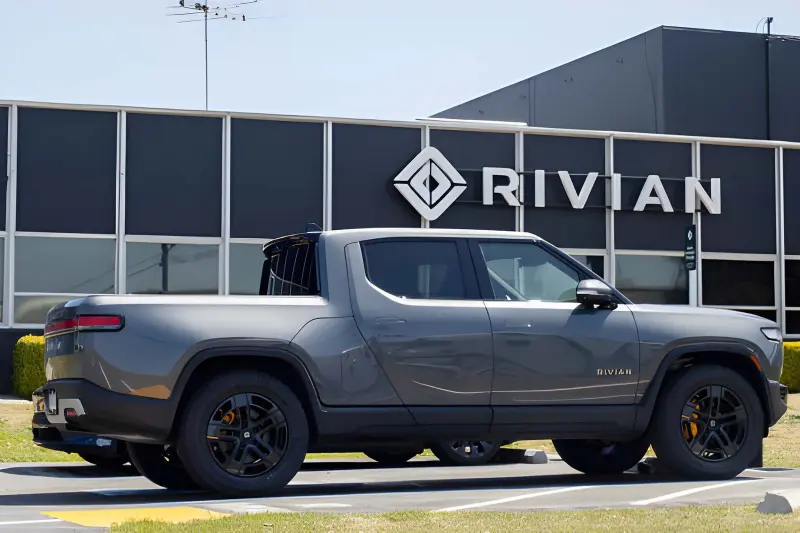
Rivian’s next gen EV steering system eliminates the mechanical steering column entirely. In its place: electrical signals, redundant actuators at each wheel, and software that adjusts how the truck steers based on what it is doing at that moment. Towing a 5,000-lb trailer at 65 mph feels different from parking an empty truck in a grocery store lot. The steering should behave differently in each case. That is the argument Rivian is making, and the engineering supports it.
Whether it matters to you depends on how you actually use an electric truck. If you drive mostly highway miles and never tow, the current R1T steers well enough that you would barely notice this upgrade. If you tow regularly or use your truck in tight off-road terrain, the difference is more than incremental. Below is the engineering, the safety case, and the honest limits of what Rivian’s next gen EV steering changes in practice.
Quick Answer
Rivian’s next gen EV steering replaces the mechanical column with a steer-by-wire system using triple-redundant electronics. The variable steering ratio adjusts automatically based on speed, load, and terrain. At parking speeds, fewer degrees of wheel turn are needed to reach full lock. At highway speed with a trailer, the system stiffens on-centre feel and widens the dead zone to reduce overcorrection. It launches on the R2 platform in 2026. Current R1T and R1S owners have conventional electric power steering, which is competent for most use cases. If you do not tow frequently or navigate tight trails, the current system does not leave much on the table.
3x
Triple-redundant steering circuits
Variable
Steering ratio adapts to speed and load
~245 mi
R1T real-world range at 70 mph (Edmunds)
11,000 lbs
R1T max towing capacity
Table of Contents
- What Steer-by-Wire Actually Means (and What It Replaces)
- Why Electric Trucks Need Rivian’s Next Gen EV Steering More Than Cars Do
- The Engineering: How Rivian’s System Works Under Load
- Towing With Steer-by-Wire: Where the Real Advantage Shows Up
- Safety and Redundancy: What Happens When Electronics Fail
- Rivian Next Gen EV Steering vs Tesla Cybertruck vs Lexus RZ
- Who Needs This and Who Does Not
- FAQ
What Steer-by-Wire Actually Means (and What It Replaces)
Every car and truck sold in the U.S. for the past century has used a mechanical steering system. You turn the wheel, a steel shaft rotates, and that rotation moves the front wheels through a rack-and-pinion mechanism or a recirculating ball gear. Electric power steering added a motor to assist the effort, but the physical connection between your hands and the road remained.
Steer-by-wire removes that shaft. Sensors on the steering wheel measure your input, and electric actuators mounted at each front wheel execute the turn. The connection is electrical, not mechanical. Commercial aviation has done the same thing for decades with fly-by-wire, where the pilot’s yoke sends signals to hydraulic actuators on the control surfaces rather than pulling cables.
Why does Rivian care? Because removing the shaft opens up things a mechanical column cannot do. The steering ratio becomes software-defined. At 5 mph in a parking lot, the wheel gets more responsive so you reach full lock with less turning. At 70 mph on a highway, the ratio slows so a small hand movement does not produce a large directional change. Steering feel changes too. Weight, resistance, feedback through the wheel, on-centre stiffness, all programmable.
Conventional electric power steering can adjust effort to some degree, but the fixed mechanical ratio limits how much the system can change its behaviour. The shaft is always there, always the same length, always connecting wheel to rack at the same gear ratio. Steer-by-wire removes that constraint.
Why Electric Trucks Need Rivian’s Next Gen EV Steering More Than Cars Do
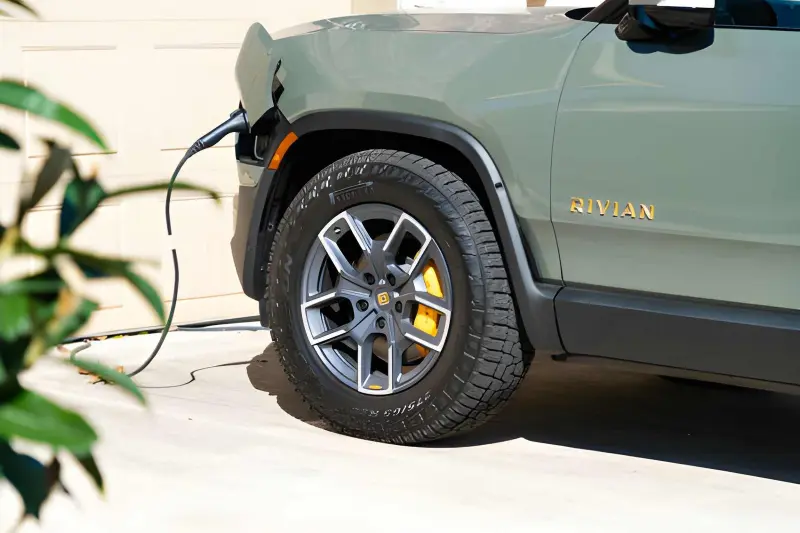
A sedan weighs 3,500 to 4,500 lbs. The Rivian R1T weighs between 7,148 and 7,560 lbs depending on battery configuration. Add a trailer at the R1T’s 11,000-lb max towing rating and the combined weight exceeds 18,000 lbs. Steering forces scale with weight. The heavier the vehicle, the more effort the steering system works against at low speed, and the more critical stability becomes at highway speed.
Electric trucks compound this because their battery packs sit low in the chassis. Good for centre of gravity. Bad for the steering system, which has to manage all that extra mass constantly. When the R1T’s 135-kWh battery pack is fully charged versus sitting at 15%, the difference in vehicle behaviour is measurable. A steer-by-wire system can account for that variable in real time. Mechanical steering cannot.
Removing the steering column also frees up cabin space. Rivian can use that for a flatter floor, deeper storage, or improved crash structure in the footwell. On the R2 platform, Rivian reportedly used the freed column tunnel for structural bracing, since the R2 is a smaller vehicle that still needs to meet the same crash standards as the larger R1.
Weight Distribution Changes How Steering Should Behave
A gas truck with a full bed of lumber shifts roughly 8-12% of its total weight rearward. An electric truck with a front trunk, a heavy battery pack spanning the full wheelbase, and cargo in the bed distributes weight differently. So the steering calibration that feels right with an empty bed is not the same calibration that feels right with 1,600 lbs of payload.
Rivian’s next gen EV steering uses load sensors integrated into the air suspension to detect how weight sits across all four corners. Software reads that data continuously and adjusts. Load the bed, and the steering recalibrates before you turn the wheel.
The Engineering: How Rivian’s System Works Under Load
Three independent electronic control units run the system, each one capable of operating the steering alone. If one fails, the remaining two maintain full control. If two fail at once, the third keeps the vehicle steerable until you pull over. SAE International’s J3016 standard for vehicle automation requires this level of redundancy for hands-free driving at Level 3 and above.
At the wheel end, dual-wound electric motors sit inside each front hub assembly. Each motor runs on its own power supply and communication bus. Actuator response time is 4 milliseconds from steering input, faster than a human can perceive. Conventional electric power steering responds in 10 to 20 milliseconds depending on the manufacturer.
Variable Ratio in Practice
At parking speeds below 10 mph, Rivian’s system reduces the lock-to-lock turn count from approximately 2.5 turns to 1.8 turns. That means fewer hand-over-hand movements in tight spaces. Above 40 mph, the ratio stretches back to 2.8 turns lock-to-lock, requiring more deliberate input for any given directional change. The transition between ratios is gradual, not stepped, so you do not feel a sudden change in responsiveness as speed increases.
Electric trucks benefit from variable ratio more than any other vehicle class. A Ford F-150 Lightning uses a fixed 16.0:1 steering ratio whether the driver is parallel parking or merging onto a highway. The Cybertruck’s steer-by-wire also uses a fixed ratio with its yoke. Rivian chose a continuously variable ratio, which adds software complexity but gives the system more range to adapt.
Towing With Steer-by-Wire: Where the Real Advantage Shows Up
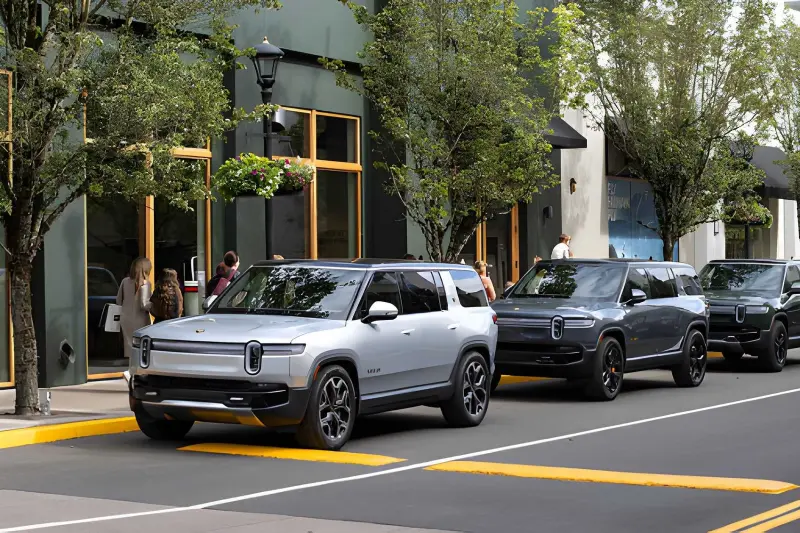
Towing exposes the weaknesses of fixed-ratio steering more than any other driving condition. With a heavy trailer attached, the rear axle bears more load, the front tyres carry less weight, and the vehicle’s centre of gravity shifts backward. In a conventional system, the driver compensates by adjusting their inputs constantly, especially at highway speeds where trailer sway can develop with very little provocation.
Rivian’s next gen EV steering addresses trailer sway at the system level rather than leaving it to the driver. When suspension sensors detect a trailer hitch load, the steering software activates a towing profile automatically. It widens the on-centre dead zone by roughly 2 degrees so minor hand movements do not induce overcorrection. It increases steering damping to resist sudden directional changes. And it coordinates with electronic stability control to apply individual wheel braking if sway begins to develop.
A mechanical column cannot do any of that. Ford and GM already offer trailer sway mitigation through braking alone, but you cannot change how the steering itself responds to the driver’s hands without removing the physical shaft.
The Range Problem Stays
Better steering does not fix the fundamental challenge of towing with an electric truck: range. The R1T’s EPA-rated 314 miles drops to approximately 245 miles at 70 mph in mild weather without a trailer, per Edmunds testing. Hook up a 5,000-lb travel trailer and highway range falls to an estimated 120-150 miles depending on speed and terrain. Improved steering makes towing more controlled and less fatiguing. It does not add kilowatt-hours to the battery.
If you tow a 5,000-lb trailer more than 100 miles one way on a regular basis, the steering system is not what determines whether an electric truck works for you. Charging infrastructure and range under load are the real constraints. Steer-by-wire makes the miles you do get more comfortable. It does not manufacture more of them.
Safety and Redundancy: What Happens When Electronics Fail
The question everyone asks: what if the electronics fail? With a mechanical column, even if the power steering motor dies, you can still physically wrestle the wheel. Takes more effort, but the connection exists. Steer-by-wire has no physical fallback. If the electronics stop working, the steering stops working.
Rivian’s answer is redundancy, the same answer the aerospace industry has used for decades. Three independent electronic control units, each with its own power supply, processor, and communication pathway. All three failing at the same moment would require three unrelated hardware failures in three separate circuits simultaneously. According to SAE reliability standards, the probability of that event is below 10^-9 per operating hour, roughly equivalent to a simultaneous dual-engine failure on a commercial airliner.
NHTSA approved steer-by-wire for U.S. passenger vehicles in 2023, following years of petitions from Toyota and other manufacturers. The NHTSA regulatory framework requires that steer-by-wire systems maintain full steering capability after any single point of failure and provide the driver with a clear warning if redundancy is degraded.
The Track Record So Far
Toyota and Lexus began shipping steer-by-wire in the Lexus RZ 450e in late 2023. As of May 2026, neither manufacturer has issued a recall related to the steer-by-wire system itself. Tesla’s Cybertruck has used steer-by-wire since its launch in late 2023, and while the Cybertruck has had recalls for other issues, the steering hardware has not been among them.
The sample size is still small, though. Billions of miles are driven annually on conventional steering. Steer-by-wire has maybe two and a half years of production history across all manufacturers combined. Most buyers should not lose sleep over this. But if you haul your family on a daily commute and want the longest possible safety record behind a system, conventional steering still has a century of real-world data on its side.
Rivian Next Gen EV Steering vs Tesla Cybertruck vs Lexus RZ
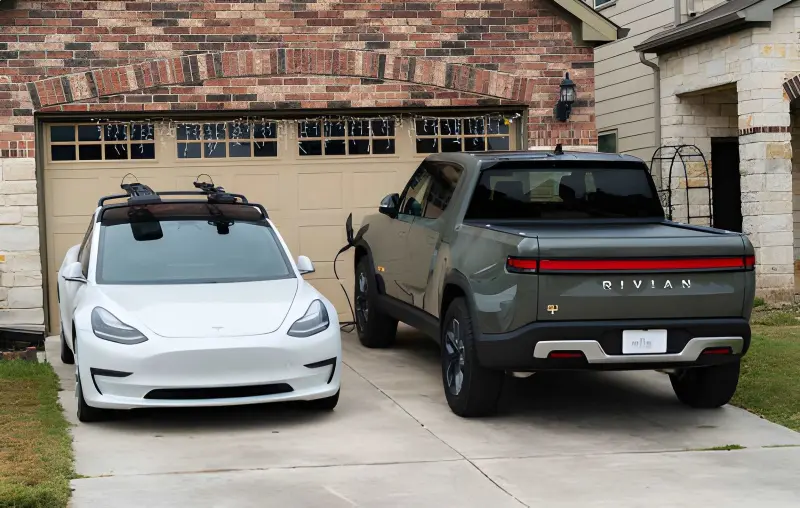
Three manufacturers now ship or have announced steer-by-wire for production vehicles. Their approaches differ in ways that matter.
| Feature | Rivian (R2 Platform) | Tesla Cybertruck | Lexus RZ 450e |
|---|---|---|---|
| Steering Ratio | Continuously variable | Fixed (speed-independent) | Variable (2 modes) |
| Wheel Type | Conventional round | Yoke | Yoke (butterfly) |
| Redundancy | Triple (3 independent ECUs) | Dual | Dual |
| Trailer-Aware Software | Yes (auto-detects hitch load) | No | N/A (not a towing vehicle) |
| Load-Based Adaptation | Yes (reads air suspension sensors) | Limited | No |
| Actuator Response Time | 4 ms | Not disclosed | Not disclosed |
| Vehicle Type | Truck / SUV | Truck | Crossover SUV |
Tesla paired steer-by-wire with a yoke instead of a round wheel. The Cybertruck’s steering requires less than one full rotation lock-to-lock at any speed. Some drivers love it. Others find it disorienting during slow-speed maneuvers where hand-over-hand technique breaks down on a yoke. Tesla committed to the yoke as a permanent design choice, not an option.
Lexus went conservative. The RZ 450e offers steer-by-wire as an option, paired with a butterfly-style yoke and two preset modes rather than a continuously variable ratio. Adequate for a luxury crossover that will rarely tow or see a trail. Not adequate for a truck.
Rivian sits between the two. A conventional round wheel keeps the interface familiar, while the continuously variable ratio gives the widest operating range of any production steer-by-wire setup announced so far. The trailer-aware software addresses a use case that neither competitor has touched.
Who Needs This and Who Does Not
Not every Rivian buyer needs steer-by-wire. If your use case is commuting, weekend errands, and the occasional road trip without a trailer, the current R1T and R1S steer well. The Gen 2 R1 vehicles received a steering calibration update in early 2026 that improved highway tracking noticeably. Most owners who drive under 100 miles a day on paved roads will not feel a gap that steer-by-wire fills.
Consider steer-by-wire if:
- You tow a trailer over 3,500 lbs at highway speeds more than twice a month
- You regularly navigate tight off-road trails where turning radius matters
- You park in urban environments daily and value reduced lock-to-lock turns
- You want a vehicle platform built for Level 3+ autonomous driving down the road
Skip it if:
- You do not tow and drive mostly highways and suburbs
- You prefer a longer safety track record before adopting new steering technology
- Your annual mileage is under 8,000 miles and the vehicle sits in the driveway most days
- You are cross-shopping on price alone and the R2’s additional cost over a base R1T stretches your budget
An honest limitation: we have not driven Rivian’s steer-by-wire system. The R2 platform is not in customer hands as of this writing. Everything here about the system’s behaviour comes from Rivian’s engineering disclosures, SAE International standards, and what we know from comparable systems in the Cybertruck and Lexus RZ. We will update this article with real-world driving impressions when production units are available.
The broader EV ownership calculation still applies here. Home charging access matters more than any single hardware feature. Without home charging, your five-year energy cost rises from roughly $4,200 to $8,145, and no steering system changes that math. Plan around the R1T’s real-world range of approximately 245 miles at 70 mph, per Edmunds highway testing, regardless of how the truck steers.
If you tow regularly, the maintenance advantages of electric trucks compound over time. EV maintenance runs $0.061 per mile versus $0.101 for gas equivalents, per DOE 2025 data. Steer-by-wire has fewer mechanical wear components than conventional power steering, which could push that advantage slightly further over a 5-year ownership window. Hard data on steer-by-wire maintenance costs will not exist until vehicles with the system accumulate enough miles, likely late 2027 at the earliest.
Methodology
Technical specifications for Rivian’s steer-by-wire system are drawn from Rivian’s R2 platform engineering disclosures and patent filings. Redundancy standards reference SAE International J3016 and NHTSA regulatory guidance on steer-by-wire systems (FMVSS 203/204 exemption framework). Competitor specifications are from manufacturer published data. R1T real-world range figure of ~245 miles at 70 mph is from Edmunds highway range testing, 2025. Maintenance cost per mile data is from DOE AFDC, 2025. This article does not include hands-on driving data because the R2 platform has not been delivered to customers as of May 2026. We will update when production vehicles are available for testing. Last verified: May 2026.
FAQ
What is Rivian’s next-gen EV steering system?
It is a steer-by-wire system that replaces the mechanical steering column with electronic actuators and triple-redundant control units. Instead of a physical shaft connecting the steering wheel to the front wheels, electrical signals command motors at each wheel hub. The steering ratio, effort, and feel are all software-controlled and adjust dynamically based on speed, vehicle load, and whether a trailer is attached.
Is steer-by-wire safe for electric trucks?
Rivian’s system uses three independent control circuits, each capable of operating the steering alone. NHTSA approved steer-by-wire for U.S. vehicles in 2023. Toyota and Lexus have shipped it since late 2023 without a steering-specific recall. Production history is short compared to conventional steering, but the redundancy architecture meets the same standards used in commercial aviation.
When will Rivian’s steer-by-wire be available?
Rivian has confirmed steer-by-wire for the R2 platform, with customer deliveries expected in 2026. Whether the technology will be offered on current-generation R1T and R1S vehicles has not been announced. The Gen 2 R1’s zonal electrical architecture could potentially support it, but Rivian has not confirmed plans for a retrofit.
How does steer-by-wire improve towing in an electric truck?
The system detects trailer load through suspension sensors and adjusts three parameters automatically: it widens the on-centre dead zone to reduce overcorrection, increases steering damping for stability, and coordinates with electronic stability control to apply individual wheel braking if sway develops. Conventional steering cannot change its ratio or behaviour based on whether a trailer is attached.
Does the Rivian R1T currently use steer-by-wire?
No. The current R1T and R1S use conventional electric power steering with a mechanical column. The system received a calibration update in early 2026 that improved highway tracking and low-speed feel. Steer-by-wire is confirmed only for the R2 platform at this time.
How does Rivian’s steering compare to Tesla’s steer-by-wire?
Tesla uses steer-by-wire in the Cybertruck with a fixed steering ratio and a yoke wheel. Rivian uses a continuously variable ratio and a conventional round wheel. Rivian also integrates trailer-aware steering software, which the Cybertruck does not offer as of May 2026. Both use redundant electronics, although Rivian claims triple redundancy versus Tesla’s dual redundancy.
Should I wait for steer-by-wire before buying a Rivian?
If you do not tow regularly, the current R1T and R1S steer well for daily driving and occasional off-road use. Wait only if trailer stability at highway speeds is a primary concern and you tow more than twice a month over distances that push the truck’s range. For everyone else, the current electric power steering is competent and proven.

James Carter
Founder & Lead Analyst — DriveAuthority
James has spent over a decade analysing automotive markets, EV total cost of ownership, and the structural economics behind vehicle pricing. DriveAuthority was built to give buyers the same level of financial rigour applied to any major purchase decision — without the manufacturer-friendly framing common in traditional auto media.