Chinese EVs are genuinely good if you prioritize technology over brand heritage—but only if you can navigate limited service networks and accept uncertain resale values. Models from BYD, NIO, and XPeng now match Western EVs in build quality and exceed them in battery innovation and software, though long-term reliability data outside China remains thin and ownership friction varies dramatically by region.
Fast Decision: Initial Suitability Filter
This framework identifies whether Chinese EVs merit further consideration for your ownership profile—not whether you should purchase immediately. Even well-matched buyers should conduct regional service verification and real-world testing before committing.
Chinese EVs merit serious consideration if:
- You have home charging and live within 50 miles of authorized service
- You want cutting-edge battery tech (BYD Blade, CATL Qilin) at 20-30% lower cost
- Advanced driver assistance and OTA updates matter more than brand prestige
- You’re comfortable being an early adopter with 3-5 year ownership plans
Delay evaluation until:
- Your market has fewer than 3 certified service centers for the brand
- You need proven 8+ year reliability data before committing
- Resale value is critical to your buying equation
- You regularly drive in extreme cold without guaranteed charging access
Disqualified if:
- The nearest service center exceeds 75 miles from your location
- You cannot charge at home at least 5 nights per week
- Import tariffs or geopolitical factors create parts supply uncertainty
- You need maximum resale value within 4 years
Who This Guide Is For (And Who Should Skip It)
This article serves tech-forward early adopters with home charging who value specifications over brand legacy and can absorb moderate ownership risk.
Understanding your psychological position matters: if brand heritage provides meaningful reassurance beyond rational analysis, or if purchase regret would stem from owning an “unproven” marque regardless of actual performance, Chinese EVs introduce unnecessary emotional friction.
Skip this if you:
- Require 10-year ownership track records
- Live where service infrastructure is sparse
- Prioritize brand heritage over technology
- Need guaranteed strong resale values
Are Chinese EVs Reliable? What the Data Actually Shows
The short answer: initial quality is competitive; long-term durability remains uncertain.
Euro NCAP safety testing awards 5-star ratings to BYD Seal, NIO ET7, and MG4 models—matching Mercedes EQE and BMW iX scores. JD Power’s 2024 China Initial Quality Study shows premium Chinese EV makers like NIO averaging 92 problems per 100 vehicles, identical to BMW’s score.
Critical context: These quality assessments reflect China’s domestic market conditions—predominantly urban use patterns, moderate climates, and different maintenance behaviors than Western markets. While manufacturing processes and component quality transfer globally, real-world durability confirmation requires Western-market data that’s still accumulating.
What this means in practice: The “are Chinese electric cars reliable?” debate conflates two separate issues—manufacturing quality (now proven competitive in controlled testing) versus long-term durability data (still developing outside China’s market).
BYD has delivered over 6 million EVs since 2021, creating substantial real-world data in China. But most Chinese brands entered European and North American markets only after 2022, meaning we lack meaningful 100,000+ mile ownership reports from varied climates and driving patterns.
When Chinese EV Quality Concerns Are Legitimate
Early market entry models (2020-2022) from brands like Aiways and Byton showed genuine quality issues—inconsistent panel gaps, software bugs, and supply chain problems. These failures damaged Chinese EV reputation broadly.
The critical distinction: Tier-one manufacturers (BYD, NIO, XPeng, Geely) invest billions in R&D and operate at Tesla’s production sophistication. Tier-two startups often don’t. Brand selection matters enormously.
Research the specific model’s production timeline. Vehicles manufactured after mid-2023 typically reflect mature manufacturing processes with significantly fewer defects.
How Good Are Chinese EV Batteries and Range?
This is where Chinese EVs often outperform Western competitors.
Battery Technology Leadership

BYD’s lithium-iron-phosphate (LFP) Blade battery architecture significantly reduces thermal runaway risks through structural design—no Chinese EV using this technology has experienced a catastrophic battery fire to date, though absolute risk elimination is impossible in any lithium-ion chemistry. The chemistry maintains 80% capacity after 3,000+ charge cycles, roughly double early Tesla NMC battery longevity.
According to U.S. Department of Energy research, LFP batteries also cost 20-30% less per kWh than NMC alternatives while using no cobalt—eliminating supply chain ethics concerns.
The cold-weather tradeoff nobody mentions: LFP chemistry loses 30-40% range below 20°F (-6°C), compared to 20-25% for NMC batteries in Western EVs. If you live in Minnesota or Alberta without daily charging access, this matters significantly.
CATL’s Qilin battery (used in some NIO and XPeng models) solves this with hybrid chemistry, but at higher cost. Check your specific model’s battery type before purchase.
Real-World Range: Are Chinese EVs Any Good in Practice?
Chinese manufacturers typically use the more lenient CLTC testing standard (China Light-Duty Vehicle Test Cycle) rather than EPA or WLTP ratings.
Translation: Advertised range often exceeds real-world performance by 25-30%, versus 15-20% for EPA-rated vehicles. A BYD Seal advertised at 520km CLTC delivers approximately 360-380km in mixed real-world driving—plan accordingly.
Independent testing from What Car? UK confirms Chinese EVs hit 70-75% of advertised range in standardized tests, similar to most non-Tesla Western EVs.
Chinese EV Price and Value: The Real Cost Equation
Here’s where Chinese electric vehicles genuinely excel: technology per dollar spent.
A BYD Seal delivers equivalent battery capacity, performance, and features to a Tesla Model 3 at $8,000-$12,000 less (before regional incentives). NIO’s battery-swap technology—800km range restored in 5 minutes—has no Western equivalent at any price point.
Hidden Ownership Costs That Offset Savings
Lower purchase prices don’t automatically equal lower total cost of ownership:
- Insurance: Expect 15-25% higher premiums due to limited repair shop certification and parts availability
- Depreciation: Budget for 40-50% residual value after 3 years versus 65-70% for established EV brands
- Service: Longer wait times and potential mobile service fees if you’re distant from authorized centers
Calculate your true 5-year cost including these factors. The initial savings often shrink to $3,000-$5,000 in real terms.
Service Networks and Parts: The Biggest Real Risk
Manufacturing quality is competitive. The genuine risk is service accessibility.
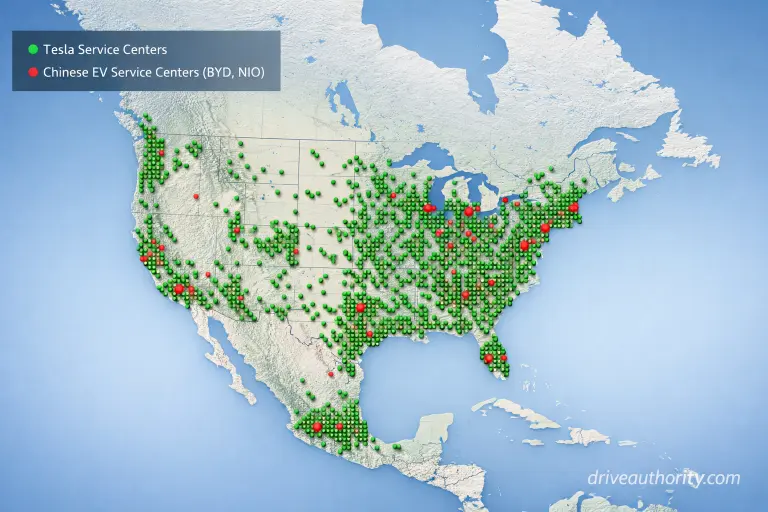
Unlike Tesla’s 600+ global service centers and extensive mobile fleet, most Chinese brands operate minimal Western infrastructure. BYD targets only 100 U.S. dealers by 2026. NIO operates 12 European service points as of January 2025.
Real-world scenario: A customer in rural Colorado with a BYD Seal experienced a minor battery management system fault requiring diagnostic tools unavailable at local shops. The vehicle required flatbed transport 180 miles to Denver, a 12-day parts wait from China, and total downtime exceeding three weeks for a repair that would take 48 hours at an established-brand dealer.
This isn’t hypothetical service risk—it’s current ownership reality in low-density service regions.
Use this Chinese EV service locator tool to calculate your exact distance to certified service. If it exceeds 50 miles, factor significantly higher ownership friction into your decision.
When Service Risk Becomes a Deal-Breaker
You should avoid Chinese EVs entirely if:
- No authorized service exists within 75 miles
- You regularly drive 200+ miles from home (breakdown risk)
- You cannot accommodate 1-2 week service appointments
- Your region lacks mobile service coverage
Which Chinese EV Brands Are Actually Good?
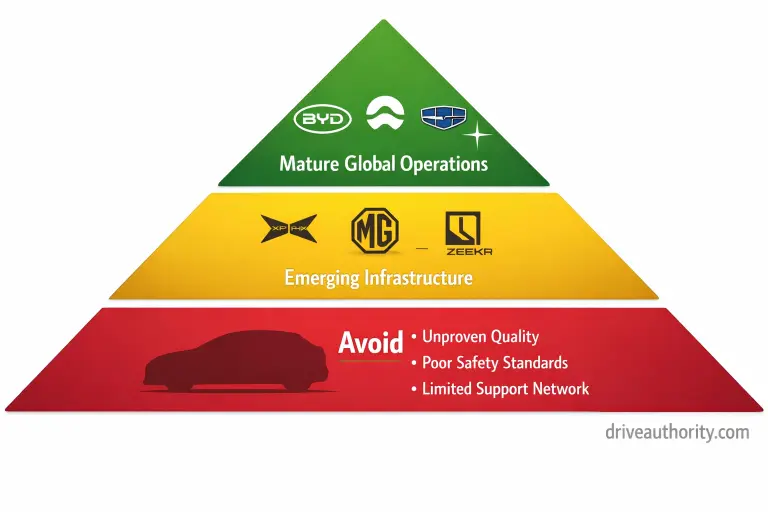
Brand tiering below reflects service maturity, global operational scale, and parts infrastructure—not purely engineering competence. Several tier-2 manufacturers produce excellent vehicles but lack the distribution networks to support Western ownership reliably.
Tier 1 (Mature Global Operations):
- BYD: 6M+ EVs sold, vertically integrated (makes own batteries and chips), strong European presence
- NIO: Premium positioning, battery-swap infrastructure, excellent software
- Geely/Volvo/Polestar: Established global operations, Western safety standards
Tier 2 (Emerging Infrastructure):
- XPeng: Strong technology but limited service network
- MG (SAIC): Value leader but basic feature sets
- Zeekr: New premium entry, unproven in Western markets
Avoid:
- Brands with no local service infrastructure
- Startups with <50,000 total production volume
- Any manufacturer without clear battery warranty terms
Are Chinese EVs Good Enough to Replace Western Brands?
The honest answer: it depends entirely on your ownership profile.
Chinese EVs now match Western competitors in the metrics that matter most—safety, initial quality, battery technology, and features. Euro NCAP and JD Power data confirm this definitively within their testing parameters.
But they can’t yet match the ownership experience infrastructure: service accessibility, proven long-term reliability data, strong resale markets, and parts availability.
The buying rule: Purchase a Chinese EV if you can absorb two specific risks—uncertain 8+ year durability data and potentially limited service access. These vehicles reward tech-savvy buyers who value innovation over established track records.
Your next step: Test drive your shortlisted model in conditions matching your daily reality. Join owner forums to verify real-world winter range and service wait times in your specific region. Calculate exact distance to certified service centers and whether that matches your risk tolerance.
The Real Question Isn’t “Are Chinese EVs Good?”
The engineering answer is settled: yes, modern Chinese EVs from established manufacturers deliver competitive quality and often superior technology.
The actual question is whether your ownership infrastructure, risk tolerance, and behavioral preferences align with early-stage market realities. The limiting factor isn’t Chinese EV capability—it’s whether you can navigate immature service networks, accept uncertain resale markets, and maintain home charging access consistently.
If those conditions don’t exist in your situation, no amount of superior battery technology or lower purchase price makes Chinese EVs the rational choice. If they do exist, dismissing Chinese EVs based on outdated quality assumptions means overpaying for equivalent capability.
The decision is yours—but it requires intellectual honesty about what you’re actually optimizing for.