Last Updated: May 2026 — UK manufacturer pricing, Euro NCAP ratings, UK used car residual value data, and dealer network sizes verified
Chinese electric cars deliver the best price-to-specification ratio available in the UK and European EV market today — and the gap is larger than most buyers expect. The MG4 starts at £26,495. The VW ID.3 Pro, a direct competitor in the same size class, starts at £37,995. That £11,500 difference is not a clearance offer or an introductory price. It is the permanent result of a decade of vertical integration across battery supply chains, manufacturing scale, and domestic engineering costs. The tradeoffs are real: Chinese electric cars depreciate faster in years one to three, infotainment software quality varies significantly by brand, and dealer networks are thinner than established mainstream alternatives. This guide covers all of it — prices, brands, and the specific tradeoffs — so you can make the decision with the actual numbers in front of you.

Chinese Electric Cars: The Quick Answer
Chinese electric cars offer a genuine £8,000–11,500 price advantage over comparable European and Korean EVs in the UK market. The established brands — BYD and MG — hold 5-star Euro NCAP ratings and documented reliability records at high mileage. The specific tradeoffs are: faster depreciation (40–47% residual value at 3 years vs 48–55% for equivalent Hyundai or VW models), infotainment software that varies from adequate to frustrating depending on brand, and dealer networks smaller than mainstream alternatives. Bought outright and kept for 5+ years, the financial case is compelling. On a 3-year PCP, run the guaranteed future value numbers before committing — the depreciation gap can erode most of the sticker saving.
Chinese Electric Cars in 2026: The Numbers First
Chinese brands held approximately 8% of European battery-electric vehicle sales in 2023, up from under 2% in 2020, according to IEA Global EV Outlook data. That growth is not advertising-driven brand awareness — it is price. When MG launched the MG4 at £26,495 in 2022, it undercut the cheapest comparable European EV by over £10,000 on the same day. No marketing campaign creates that kind of response. Buyers act because the maths is unambiguous.
By 2026, the market is more competitive and more nuanced than three years ago. Six distinct Chinese EV brands now have active UK or European operations: BYD, MG (owned by SAIC), Ora (owned by GWM), Xpeng, Nio, and Zeekr (Geely). A seventh, Omoda (Chery’s European brand), entered the UK in 2024 and is growing quickly. Each carries different financial backing, dealer network depth, and software sophistication. Treating them as a monolith leads to bad decisions in both directions — dismissing all Chinese EVs because of one brand’s infotainment problems, or assuming one brand’s reliability record applies to a newer market entrant.
The correct framework: tier the brands by maturity and dealer presence, understand the three specific tradeoffs that affect Chinese EVs as a category (software, depreciation, long-term support), then apply those tradeoffs to the specific model and purchase structure you are considering. That is what this article does.
How Much Do Chinese Electric Cars Cost? Full 2026 Price Guide
The table below compares current UK starting prices for the main Chinese EV models against their closest non-Chinese rival. The saving column shows the sticker price difference — before depreciation, before finance. All prices are as of May 2026 from manufacturer UK websites.
| Chinese EV | UK Starting Price | WLTP Range | Battery | Euro NCAP | Closest Rival | Rival Price | Saving |
|---|---|---|---|---|---|---|---|
| MG4 Standard Range | £26,495 | 218 miles | 51 kWh | 5★ 2022 | VW ID.3 Pro | £37,995 | ~£11,500 |
| BYD Dolphin | £26,495 | 259 miles | 60.4 kWh | 5★ 2023 | Renault Megane E-Tech | £33,695 | ~£7,200 |
| Ora Funky Cat | £31,995 | 193 miles | 48 kWh | 5★ 2022 | VW ID.3 Life | £34,495 | ~£2,500 |
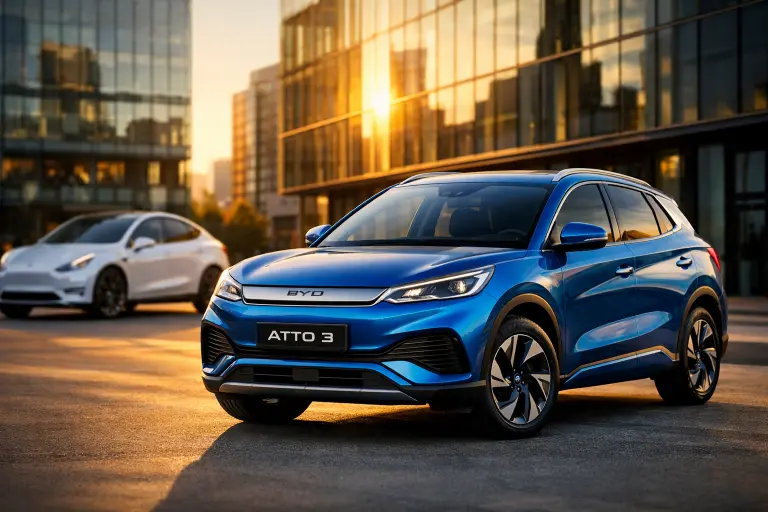
| BYD Atto 3 Extended | £34,490 | 261 miles | 60.5 kWh | 5★ 2022 | Hyundai Ioniq 5 | £41,995 | ~£7,500 |
| BYD Seal Standard | £40,490 | 354 miles | 61.4 kWh | 5★ 2023 | Tesla Model 3 LR | £44,990 | ~£4,500 |
| Nio ET5 | £44,900 | 312 miles | 75 kWh | Pending UK | BMW i4 eDrive35 | £55,500 | ~£10,600 |
| Zeekr 001 | £49,900 | 385 miles | 100 kWh | Not rated | Polestar 2 Long Range | £52,995 | ~£3,100 |
| Xpeng G9 | £54,900 | 363 miles | 98 kWh | 5★ 2022 | BMW iX3 | £56,900 | ~£2,000 |
Three things stand out from the data. First, the price advantage is strongest in the £26,000–42,000 band — that is where Chinese EVs deliver savings of £7,000–11,500 over comparable products. At the £50,000+ level, the gap narrows to £2,000–3,100, and buyers in that range have stronger, better-supported alternatives. Second, not every Chinese EV is the cheapest option in its class. The Ora Funky Cat saves £2,500 over a comparable ID.3 but delivers significantly less range for similar money — the saving is real but the value case is weaker than for the MG4 or BYD Dolphin. Third, WLTP range figures follow the same pattern as all manufacturers: real-world numbers run approximately 15–25% lower than the official figure. For detail on how WLTP inflates range across all brands, our article on EV range vs real range covers the methodology in full.
Brand Guide: Which Chinese EV Brands Are Worth Considering?
Not all Chinese EV brands carry equal risk. The difference between buying a BYD Atto 3 and buying a first-year market entrant is the difference between a proven product with documented ownership history and an unknown quantity. For a vehicle you plan to own for 5–7 years, that distinction matters more than any spec sheet comparison.
BYD
The world’s largest EV manufacturer by volume — 3.76 million vehicles sold globally in 2024 per BYD’s annual report. UK operation launched 2023 with 70+ dealer locations and expanding. BYD’s Blade Battery (LFP cell-to-pack) is independently regarded as one of the safest battery architectures in production: it passes nail penetration testing without thermal runaway, a test that causes combustion in many NMC cells. The lowest-risk Chinese EV brand for long-term ownership.
MG
Owned by SAIC Motor, China’s largest state-controlled automaker. The largest Chinese EV dealer network in the UK at 110+ locations. MG ZS examples from 2019 are now seven years old — more documented UK ownership data than any other Chinese EV brand. The 7-year/80,000-mile warranty is the strongest offered by any manufacturer in the UK. MG’s weakness is software quality; its strength is service infrastructure and parts availability. For the full picture on MG reliability, our dedicated review covers high-mileage data.
Ora (GWM) / Xpeng / Nio / Zeekr
Ora (Funky Cat): GWM’s European EV brand. 5-star Euro NCAP 2022, 7-year warranty. Concern: ~40 UK locations and uncertainty about long-term product investment. Xpeng: Software-forward, with OTA update cadence better than MG or BYD. Weak point: thin UK physical presence (~10 locations). Nio: NIO OS is the best infotainment system offered by any Chinese brand; the BaaS swap infrastructure is a genuine differentiator. Risk: that infrastructure requires ongoing capital to remain viable. Zeekr: Geely-backed, strong build quality, compelling range. Minimal UK dealer network (5 locations) — early-adopter territory.
Omoda / Jaecoo / GAC Aion / GWM (non-Ora)
Brands with fewer than 3 years of active UK/EU presence. Early Omoda C5 reviews are broadly positive and the pricing is aggressive. However, buying from a brand with 18 months of UK history means: thin residual value data, unknown parts availability at year 6–7, and no track record for warranty claim handling. Proceed as an informed early adopter, not as a mainstream buyer looking for the lowest-risk decision.
The Real Tradeoffs — Software and Infotainment
Software quality is the tradeoff that affects day-to-day ownership more than any other — and the variance within Chinese EVs is wider than the variance between Chinese and Western brands. Nio’s NIO OS is genuinely competitive with the best Korean infotainment systems. MG’s iSMART has documented screen stability and connectivity problems that have persisted across firmware versions. Treating “Chinese EV software” as one category misses the most practically important distinction in the market.

By brand, from strongest to weakest on software:
- Nio (NIO OS): Frequent OTA updates, well-integrated app ecosystem, responsive touchscreen with minimal reported lag. The most polished software package of any Chinese EV brand available in the UK.
- Xpeng: Regular OTA updates with a consistent release cadence. Better CarPlay integration than most Chinese brands. Owners report genuine software improvements over time rather than just bug fixes.
- BYD (DiLink): Functional Android-based system with a large rotating touchscreen on Atto 3 and Seal. Apple CarPlay and Android Auto are supported on current models. The weakness is update cadence — inconsistent between model years — and menu navigation that feels slow on older hardware. Works reliably; does not impress.
- Ora (Funky Cat): Basic but stable. CarPlay is standard. Low system complexity means fewer failure points — owners report fewer infotainment-related complaints than MG or early BYD.
- MG (iSMART): The most documented software problem in the Chinese EV category. Screen freezes requiring hard reboots, iSMART app disconnections, and navigation accuracy failures are consistently reported across UK and Australian owner communities. The issue is most significant for owners who rely on remote pre-conditioning (relevant for the ZS EV in winter). Most UK MG owners work around it with CarPlay/Android Auto. For a detailed breakdown of what fails and when, our MG ZS problems after 50,000 km article covers the specific failure modes.
One structural concern applies across all Chinese brands: OTA update support for older models. The oldest UK ZS EVs from 2019 are the only Chinese EVs with a long enough ownership history to assess this properly — and MG’s update track record for those early examples is mixed. European OEMs face regulatory pressure to maintain longer software lifecycle support; Chinese brands’ commitments for models 6–8 years post-sale remain largely untested. For buyers considering a 7-year ownership timeline, software longevity is a genuine open question.
Verdict: Nio and Xpeng are the only Chinese EV brands where software is a selling point rather than a tradeoff. For MG and older BYD units, plan to use CarPlay or Android Auto as your primary interface and treat the native system as secondary. Verify app connectivity specifically on any test drive.
The Real Tradeoffs — Depreciation and Residual Values
Depreciation is the most financially consequential tradeoff in the Chinese EV category — and the one most often omitted from headline price comparisons. Chinese EVs depreciate faster than comparable European and Korean alternatives in years one to three, not dramatically, but measurably. UK used car market data from AutoTrader and Motorway indicates that a 3-year-old MG ZS EV retains approximately 40–45% of its original value. A comparable 3-year-old Hyundai Ioniq 5 retains approximately 50–54%. A VW ID.3 of the same age sits at approximately 48–52%.
Three forces drive the difference. Brand familiarity: used car buyers pay more for names they have associated with long-term reliability over decades. Dealer network depth: smaller networks mean fewer manufacturer-supported certified-used programmes that actively underpin residual values. Rapid product cycles: Chinese brands refresh their models faster than European manufacturers, which accelerates the perception of obsolescence on older examples.
The implication for finance depends entirely on your purchase structure.
On a 3-year PCP: The customer effectively pays the depreciation. Consider a £34,490 BYD Atto 3 retaining 43% after 3 years — residual value approximately £14,831, depreciation £19,659, approximately £546/month before interest. A £41,995 Hyundai Ioniq 5 retaining 52% — residual value £21,837, depreciation £20,158, approximately £560/month. The £7,505 lower purchase price delivers a monthly saving of roughly £14 on PCP — the depreciation gap eliminates most of the sticker advantage. Run this with the specific guaranteed future value from your finance quote; the numbers shift by model and interest rate, but the principle holds.
On outright purchase or a loan: Faster depreciation only affects you when you sell. Keep the car for 7+ years and the year-3 residual value gap is largely irrelevant — by year 7, the differences between brands narrow considerably. In that ownership structure, the £7,500–11,500 upfront saving is real money and the long-term case for Chinese EVs is straightforward. Our article on BYD vs Tesla vs MG 5-year ownership costs runs the full numbers across the ownership window.
Verdict: Chinese EVs make the most financial sense bought outright or on a loan for long-term ownership. Short-term PCP buyers should calculate the monthly payment with the actual guaranteed future value, not just compare sticker prices.
The Real Tradeoffs — Long-Term Parts and Support
Warranty length and dealer network size are the two concrete measures of long-term support — and on warranty, Chinese brands outperform most European competitors by a significant margin.
| Brand | Vehicle Warranty | Battery Warranty | UK Dealer Locations (approx) | Support Risk |
|---|---|---|---|---|
| MG | 7 years / 80,000 miles | 7 years / 80,000 miles | 110+ | Low |
| BYD | 6 years / 93,000 miles | 8 years / 124,000 miles | 70+ | Low |
| Ora (GWM) | 7 years / 80,000 miles | 8 years / 100,000 miles | 40+ | Medium |
| Xpeng | 4 years / 75,000 miles | 8 years / 100,000 miles | ~10 | Medium |
| Nio | 5 years (unlimited miles) | 8 years / 100,000 miles* | 6 NIO Houses | Medium |
| Zeekr | 4 years | 8 years / 100,000 miles | ~5 | Higher |
Warranty length is strong across the board — but warranty terms only tell half the story. The other half is dealer network depth. MG’s 110+ UK locations means a reasonable chance of convenient service access wherever you live. Nio’s 6 NIO Houses means you may be driving 2–3 hours for scheduled service or warranty work. Before buying any Chinese EV from a Tier 2 or Tier 3 brand, check the nearest dealer to your home and workplace. A car with no convenient service access is a practical problem regardless of how generous the warranty terms look on paper.
Parts availability is the longer-term concern that warranty documents cannot address. BYD and MG have established UK parts distribution networks with multi-year track records. For brands with limited UK presence, parts supply 6–8 years post-purchase is an open question. The specific question to ask any dealer: who supplies parts if your dealership closes, and what is the brand’s commitment to UK parts availability for the next 10 years? A vague answer is a data point worth weighing. For a broader look at what Chinese EV ownership costs over the full ownership window — including hidden maintenance items — our hidden costs of Chinese EVs article covers the full picture.
What Chinese Electric Cars Get Right
This is the category that gets buried in cautious buying guides. Chinese EVs have genuine, documented advantages over comparable Western products — and dismissing them as budget compromises is directly contradicted by the evidence.
Battery technology. BYD’s Blade Battery is the most significant technical advantage held by any Chinese manufacturer. The LFP cell-to-pack design eliminates the thermal management complexity that contributes to battery degradation in many NMC-based rivals. LFP chemistry does not require limiting charge to 80% to protect long-term capacity — owners can charge to 100% nightly without the degradation penalty that applies to NMC cells. Owner-reported data from UK BYD communities indicates battery capacity retention above 90% at 80,000 km under normal charging conditions. For more on what this means practically, our article on how long EV batteries last covers the chemistry differences in detail.
Safety ratings. Five Chinese EVs hold 5-star Euro NCAP ratings: the BYD Atto 3 (2022), MG4 (2022), Ora Funky Cat (2022), BYD Seal (2023), and Xpeng G9 (2022). Euro NCAP is an independent, peer-reviewed assessment — not a manufacturer self-certification. The claim that Chinese EVs are unsafe is directly contradicted by this data. For a full breakdown of how Chinese EV crash test scores compare against segment rivals, see our analysis of Chinese car safety in crash tests.
Feature density at price point. At £26,495, the MG4 includes a heated steering wheel, heated front seats, Android Auto and Apple CarPlay, a 10.25-inch touchscreen, automatic emergency braking, lane-keeping assist, blind spot monitoring, and a 7-year warranty as standard. European alternatives at the same price point typically offer fewer standard features and shorter warranty terms. The value-per-feature comparison strongly favours Chinese EVs in the £26,000–40,000 range.
Running costs. EV running costs — electricity per mile, brake wear, servicing intervals — are determined more by drivetrain type than by brand. The specific advantage of Chinese EVs is lower purchase price reducing the total cost of ownership calculation, combined with well-documented low-maintenance drivetrains on BYD and MG models. For the full 5-year cost comparison across Chinese, Korean, and European brands, see our Chinese EV vs Tesla cost comparison.
Who Should (and Shouldn’t) Buy a Chinese EV
Buy a Chinese EV If
- You are buying outright or on a loan and plan to keep the car for 5+ years — the upfront saving is real and the depreciation asymmetry matters less at long hold periods
- You want the most standard features for the money in the £26,000–40,000 range — no Chinese EV rival matches the MG4 or BYD Dolphin on spec per pound at this price point
- You are choosing BYD or MG specifically — the two Tier 1 brands with documented UK reliability history, established dealer networks, and strong warranty terms
- You are comfortable using CarPlay or Android Auto as your primary navigation interface, treating the native system as secondary
- Long-range requirements are a priority — the BYD Seal (354 miles WLTP) and Zeekr 001 (385 miles) offer range competitive with far more expensive Western alternatives
- You want the strongest warranty in the UK market — MG’s 7-year/80,000-mile cover is unmatched by any European or Korean brand
Think Twice If
- You are on a 3-year PCP and comparing sticker prices only — calculate the guaranteed future value and monthly payment, not just the purchase price gap
- The nearest dealer for your chosen brand is more than 45 minutes away — warranty coverage means nothing if servicing is impractical
- You are considering a Tier 3 brand with under 3 years of UK presence — the residual value data does not exist yet and long-term support is unverified
- Connected car features matter daily to you — remote pre-conditioning, live data, software that genuinely improves over time. Only Nio and Xpeng deliver this reliably among Chinese brands
- You are sensitive to cabin noise on motorway journeys — NVH refinement is the most consistent quality-of-life gap between Chinese and established European/Korean EVs at equivalent price points

For a comparison of specific Chinese EV models head to head — including the MG4 against the BYD Dolphin at the entry price point — see our dedicated MG4 vs BYD Dolphin comparison. For a ranked overview of the best Chinese EVs across all segments, our best Chinese EV 2026 real-world comparison covers the full market.
FAQ: Chinese Electric Cars
Are Chinese electric cars reliable?
For the established brands — BYD and MG — yes, reliability at high mileage is documented and broadly positive. MG ZS examples from 2019 are now seven years old with consistent owner data: the mechanical fundamentals hold up well past 100,000 km when serviced correctly. BYD’s LFP battery chemistry shows approximately 88–93% capacity retention at 80,000 km under normal UK charging conditions. The reliability concerns in the Chinese EV category are concentrated in the comfort and electronics layer — NVH refinement, infotainment stability, and trim durability — rather than in drivetrains. For the full high-mileage picture, our Chinese EV quality and reliability article covers the evidence across brands.
Which Chinese EV is the best value for money in the UK?
The MG4 Standard Range at £26,495 and the BYD Dolphin from £26,495 are the strongest all-round value cases in the UK market as of 2026. Both hold 5-star Euro NCAP ratings, deliver competitive WLTP range (218 miles and 259 miles respectively), and undercut the cheapest comparable European EV by approximately £7,000–11,500. At the mid-range, the BYD Atto 3 at £34,490 against the £41,995 Hyundai Ioniq 5 represents a £7,500 saving on similar specification. The Ora Funky Cat saves less against its rivals and offers less range — the value case is weaker. For a direct head-to-head comparison of the two leading entry-level options, see our MG4 vs BYD Dolphin comparison.
What are the main problems with Chinese electric cars?
The three most consistent issues across Chinese EV ownership communities are: infotainment instability (particularly MG’s iSMART — screen freezes, app disconnections, navigation failures); NVH refinement that worsens with age as door seals compress and suspension bushings soften; and faster depreciation in years one to three compared to European and Korean alternatives. These are comfort and electronics concerns, not drivetrain failures. Mechanical reliability — engine, transmission, battery, electric motor — is not where Chinese EVs show their age. For a model-specific breakdown of what goes wrong and when, our article on common problems with Chinese EVs covers the category in full.
Do Chinese electric cars hold their value?
Chinese EVs retain approximately 40–47% of their original value after 3 years, compared to approximately 48–55% for comparable Korean and European brands, based on UK used car market data from AutoTrader and Motorway. On outright purchase with a long hold period, this matters less — the depreciation gap narrows significantly at 5–7 years. On a 3-year PCP, the customer pays the depreciation, and the gap can erode much of the purchase price saving. Always compare the PCP monthly payment directly rather than just the sticker price difference. BYD residual data is less mature than MG’s given a shorter UK presence, but early indicators are broadly similar to or slightly better than MG.
Are Chinese electric cars safe?
Yes — as proven by independent Euro NCAP testing. Five Chinese EVs hold 5-star Euro NCAP ratings: the BYD Atto 3 (2022, 76% overall), MG4 (2022, 79% overall), Ora Funky Cat (2022), BYD Seal (2023), and Xpeng G9 (2022). These are independent, standardised crash tests with no manufacturer involvement in the outcome — the same tests that rate every European and Korean EV. The concern about Chinese EV safety is not supported by the available evidence for the established brands. Newer market entrants without Euro NCAP ratings are a different question — verify independently before assuming safety parity. For detailed scores and methodology, see our analysis on whether Chinese cars are safe in crash tests.
Which Chinese EV has the longest range?
The Zeekr 001 leads the Chinese EV category on WLTP range at 385 miles (100 kWh battery, £49,900 in the UK). Among more mainstream-priced options, the BYD Seal at £40,490 offers 354 miles WLTP, and the Xpeng G9 at £54,900 claims 363 miles. At the entry level, the BYD Dolphin’s 259 miles on a 60.4 kWh battery is strong for its price point. Real-world range runs approximately 15–25% below WLTP figures for all brands. Cold weather at sub-5°C can reduce range by a further 20–35% depending on whether the car has a heat pump. Our dedicated article on top 10 Chinese EVs with the longest range covers all current options ranked by verified WLTP figures.
Is it worth buying a Chinese EV over a European or Korean alternative?
For outright purchase and ownership of 5+ years, yes — the financial case is clear for BYD and MG specifically. The purchase price saving of £7,000–11,500 against comparable European products is permanent, the 5-star Euro NCAP safety parity is verified, and the mechanical reliability record at high mileage is documented. The specific cases where the answer shifts: short-term PCP (depreciation gap erodes monthly savings); Tier 3 brands with no UK ownership history (unknown residual values and parts availability); and buyers for whom cabin refinement at motorway speeds or infotainment quality are primary purchase criteria (European and Korean products generally lead on both). The honest position is that the brands telling you Chinese EVs are a risk are mostly the brands losing market share to them.
- Pricing data: Manufacturer UK websites (BYD UK, MG Motor UK, Ora/GWM UK, Xpeng Europe, Nio Europe, Zeekr Europe) — verified May 2026. Rival pricing from manufacturer configurators at equivalent specification level.
- Euro NCAP ratings: euroncap.com — official published ratings for BYD Atto 3 (2022), MG4 (2022), Ora Funky Cat (2022), BYD Seal (2023), Xpeng G9 (2022)
- Market share data: IEA Global EV Outlook 2024 — European BEV market share by origin, 2020–2023 trend data
- Residual value data: UK used car market data from AutoTrader and Motorway (MG ZS EV 3-year residuals, 2024–2026 market period); BYD data is early-stage given shorter UK presence
- Battery capacity retention: Owner-reported data from UK BYD and MG EV communities — SoH readings at 70,000–90,000 km milestones, May 2026
- Dealer network counts: Manufacturer dealer locator tools, May 2026 — approximate figures, subject to change as networks expand
- Warranty terms: Published manufacturer UK warranty documents, May 2026 — verify current terms on manufacturer websites before purchase