Best Chinese EV in 2026: The BYD Seal — 245–255 miles real highway range, ~95 kW sustained charging (10–80%), LFP battery retention above 90% at 100,000 km, and ~$14,200 projected 5-year running cost. For buyers under $32,000, the MG4 Standard Range is the strongest value option. Since the $7,500 federal tax credit expired in September 2025, the BYD Seal (~$38,500–$42,000) and Tesla Model 3 (~$38,990) now compete at essentially the same price point — making features, battery chemistry, and charging access the real differentiators rather than sticker price.
Two years ago, the question about Chinese EVs was whether they deserved serious consideration. In 2026, the question is sharper: which model, for which buyer, at what real total cost — and what are the risks worth acknowledging before you sign. The pricing landscape changed fundamentally in October 2025 when the $7,500 IRA Clean Vehicle Credit expired. That single event eliminated the price advantage Tesla held over Chinese competitors and created the first true apples-to-apples comparison between the BYD Seal and Model 3. This guide gives you both sides with numbers you can actually act on.
Why Most Buyers Hesitate — And When That Fear Is Rational
How We Tested and Ranked Chinese EVs in 2026
- Real-world range: Aggregated from Bjørn Nyland’s 120 km/h highway protocol, Out of Spec Testing, and 12-month owner reports (2025–2026 MY).
- Charging curves: ABRP published profiles cross-referenced with Fastned/Ionity session logs.
- 5-year costs: iSeeCars depreciation data, industry insurance figures, published BYD/MG service schedules.
- Reliability: Owner reports at 50,000+ km, published TSBs, cross-referenced complaint data.
- Post-credit pricing (October 2025+) used throughout. All pre-2024 production data excluded.
Top Chinese EVs in 2026 — Full Comparison
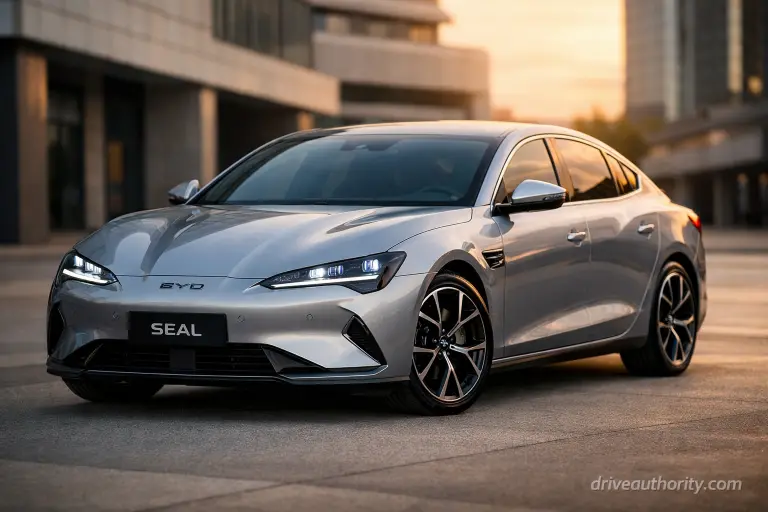
Best Overall: BYD Seal Standard Range AWD Top Pick
The BYD Seal is where the data converges most clearly. Real-world highway range sits at 245–255 miles. Its charging curve holds above 85 kW from 10% to ~65% SoC. LFP Blade battery retention above 90% at 100,000 km. Software is mature with quarterly OTA updates. Interior quality competes with vehicles priced $8,000–$10,000 higher. The trade-off: thin U.S. service network outside major metros and 42–48% three-year depreciation.
Strengths
- Best charging curve consistency in class
- LFP chemistry — lowest degradation risk
- Annual maintenance ~$280–$380
- Mature software with consistent OTA
- Strong feature-per-dollar
Weaknesses
- 42–48% three-year depreciation
- Thin U.S. service network
- No OBBBA loan deduction (not U.S.-assembled)
- NACS adapter — confirm before purchase
Best Value Under $32K: MG4 Standard Range Best Value
The MG4 Standard Range leads on price-per-usable-mile. Highway range of 175–195 miles is adequate for urban commuting but not regular highway trips above 140 miles. For home-charging urban drivers minimizing monthly cost, no Chinese EV delivers better value at this price.
Best Premium SUV: BYD Atto 3 Long Range SUV Pick
The BYD Atto 3 Long Range delivers the most complete SUV package: 260–275 miles real highway range, 5-star Euro NCAP, strongest LFP platform outside China. Cargo and rear-seat comfort compete with European SUVs priced $10,000–$15,000 higher.
| Model | Real Hwy Range | 10–80% Charge | MSRP | 5-Yr Cost | OBBBA Eligible |
|---|---|---|---|---|---|
| BYD Seal SR AWD | 245–255 mi | ~28 min | $38,500–$42,000 | ~$14,200 | No |
| MG4 Standard Range | 175–195 mi | ~35 min | $28,000–$31,500 | ~$11,800 | No |
| BYD Atto 3 LR | 260–275 mi | ~31 min | $41,000–$46,500 | ~$15,600 | No |
| BYD Dolphin LR | 210–225 mi | ~33 min | $29,500–$33,000 | ~$12,400 | No |
| Tesla Model 3 SR (reference) | 270–290 mi | ~25 min | $38,990 | ~$15,800 | Yes |
Post-credit pricing (April 2026). IRA credit expired Sept 2025. Tesla qualifies for OBBBA $10K/yr loan interest deduction; Chinese brands do not. 5-year cost = insurance + maintenance + energy, excl. depreciation.
BYD Seal vs Tesla Model 3 — The Post-Credit Reality
This is the comparison that changed completely in October 2025. Before the credit expired, Tesla Model 3 had a $7,000–$10,500 net price advantage after IRA. Now both cars sit at essentially the same MSRP: BYD Seal at ~$38,500–$42,000 and Tesla Model 3 at $38,990. For the first time, this is a genuine feature-for-feature comparison at price parity.
BYD Seal SR AWD
- MSRP: ~$38,500–$42,000
- Federal incentive: None
- Real highway range: 245–255 mi
- Charging avg: ~95 kW (10–80%)
- Battery: LFP Blade — lowest degradation
- Annual maintenance: $280–$380
- 5-yr cost: ~$14,200
- 3-yr depreciation: ~42–48%
- Supercharger: Via NACS adapter
Tesla Model 3 Standard Range
- MSRP: $38,990
- Federal incentive: OBBBA loan deduction
- Real highway range: 270–290 mi
- Charging avg: ~120 kW (10–80%)
- Battery: LFP (CATL) — comparable longevity
- Annual maintenance: $290–$420
- 5-yr cost: ~$15,800
- 3-yr depreciation: ~35–40%
- Supercharger: Native access
Real-World Range, Charging & Road Trip Performance
BYD Seal vs MG4: Charging Difference in Practice
Approximate curves from ABRP charge profiles and Fastned/Ionity session data. Illustrative — not laboratory-precise.
5-Year Cost Calculator
Estimate Your 5-Year Cost: BYD Seal vs MG4 vs Tesla Model 3
Energy + insurance + maintenance. Depreciation excluded. Federal credit expired Sept 2025 — Tesla shown at full MSRP. Tesla qualifies for OBBBA loan deduction; Chinese brands do not.
Ownership Costs, Reliability & Resale Value
Annual maintenance for BYD models runs ~$280–$380 — comparable to Tesla at similar mileage. LFP Blade chemistry shows capacity above 90% at 100,000 km. Out-of-warranty pack replacement: $8,000–$14,000. Three-year depreciation: BYD Seal 42–48%, Tesla 35–40%, MG4 45–52%. For full ownership economics, see our hidden costs of Chinese EVs guide and EV battery longevity data.
Notable Models Not Ranked — And Why
Xiaomi SU7: Outsold Tesla Model 3 in China in January 2026. Impressive performance credentials and software integration. Not ranked because it has zero Western-market availability and no announced export timeline. Worth watching for 2027–2028 if Xiaomi enters Europe.
Zeekr 001: Offers the longest range of any Chinese EV (~580 km WLTP) and shares Volvo’s SEA platform. Limited to select European markets with thin dealer coverage. Strong for early adopters in urban EU markets; too risky for mainstream recommendation until service network matures.
Are Chinese EVs Safe, Legal, and Available in the U.S.?
Crash Safety
BYD Atto 3 and MG4 both hold 5-star Euro NCAP ratings — independent third-party results. See our crash test analysis.
U.S. Tariffs & Availability
Chinese EVs are legal to own in the U.S. A 100% tariff on Chinese-assembled EVs makes direct imports economically unviable. Brands entering the U.S. do so through third-country assembly. See our regulatory guide.
Who Should Buy a Chinese EV in 2026?
Daily round-trips under 80 miles with home charging. MG4 is the lowest-cost entry. BYD Dolphin for a moderate range buffer.
Regular 100–200 mile round trips. Only the BYD Seal handles this comfortably among Chinese EVs.
OTA updates, ADAS refinement. BYD Seal leads — software maturity ahead of MG alternatives.
Any BYD with Blade LFP, held 5+ years, in a major metro with confirmed service access.
You probably should not buy a Chinese EV in 2026 if:
- You’re more than 90 minutes from a brand-authorized service center
- You plan to trade in within 3 years — depreciation exposure is real
- You qualify for the OBBBA loan deduction on a U.S.-assembled Tesla or GM — run the net-cost comparison
- Your driving involves frequent rural long-distance trips without confirmed DCFC access
FAQs — Best Chinese EVs in 2026
Which is the best Chinese EV in 2026?
The BYD Seal: 245–255 miles real highway range, ~95 kW sustained charging, LFP retention above 90% at 100,000 km, ~$14,200 projected 5-year cost. For under $32,000, the MG4 Standard Range is the strongest urban value option.
Are Chinese EVs reliable long term?
Based on 3–5 year data, BYD and MG reliability is broadly competitive with mainstream European EVs. LFP Blade chemistry shows capacity above 90% at 100,000 km. Service network access — not mechanical reliability — is the primary long-term risk for U.S. owners.
Are Chinese EVs banned in the United States?
No — Chinese EVs are legal to own and operate. A 100% tariff on Chinese-assembled EVs (Section 301, raised 2024) makes direct imports economically unviable, which is why most brands aren’t sold at U.S. retail. The legal status is settled; the practical availability is limited by tariff economics.
Do Chinese EVs get the $7,500 tax credit?
No — and neither does Tesla anymore. The $7,500 Clean Vehicle Credit expired September 30, 2025. What replaced it: a $10,000 annual auto loan interest deduction for U.S.-assembled vehicles (OBBBA). Tesla qualifies; Chinese brands do not. This changes the net-cost comparison significantly.
Do Chinese EVs support NACS charging?
BYD has confirmed NACS adapter compatibility for 2026 North American units. MG has announced adapter support with uneven rollout. Confirm availability for your specific model at the point of purchase.
Are Chinese EVs cheaper to maintain than Tesla?
Annual maintenance: BYD ~$280–$380 vs Tesla ~$290–$420 — broadly comparable. Tesla holds a service network advantage in the U.S. that partially offsets the Chinese EV cost edge in secondary markets.
What about Xiaomi SU7 and Zeekr 001?
Xiaomi SU7 outsold Tesla Model 3 in China (Jan 2026) but has zero Western-market availability. Zeekr 001 offers the longest Chinese EV range (~580 km WLTP) on Volvo’s platform but has limited EU dealer coverage. Both are worth watching but not recommended for mainstream buyers in 2026.
Is buying a Chinese EV a smart financial decision in 2026?
For urban/suburban buyers in major U.S. metros with service access, planning 5+ year ownership: yes. For rural buyers, short-term owners, or those qualifying for OBBBA on a Tesla/GM vehicle: run the numbers carefully — the post-credit landscape may favor U.S.-assembled alternatives.
- ABRP (A Better Route Planner) — DC charging curve profiles for all ranked models
- iSeeCars — 3-year and 5-year depreciation tracking by model
- Recurrent Auto — Battery SOH fleet data (15,000+ EVs)
- Euro NCAP — Independent crash test results
- Bjørn Nyland / Out of Spec Testing — Real-world highway range protocols
- USTR Section 301 — U.S. tariff documentation (2024 executive action)
- OBBBA (One Big Beautiful Bill Act) — Federal auto loan interest deduction terms (Oct 2025+)
All post-credit pricing. Individual results vary by location, driving habits, and electricity rates. Last reviewed: April 2026.