How long do EV batteries last? Most EV batteries last 8–15 years, or roughly 100,000–300,000 miles, depending on chemistry, climate, and charging habits. Real-world degradation averages 1.8–2.3% per year. All major manufacturers warranty batteries for at least 8 years or 100,000 miles with a 70% capacity retention guarantee.
How long do EV batteries last — and should this question change your buying decision? It’s the query every potential EV owner eventually types, and the answer matters more than the sticker price. A battery that degrades fast turns a smart financial decision into an expensive mistake. One that holds its capacity for a decade changes the ownership math entirely. This guide cuts through the marketing language and delivers real numbers: average lifespan, degradation rates by brand, warranty terms, replacement costs in 2026, and the habits that either protect or destroy your pack.
Average EV Battery Lifespan in Years and Miles
Typical Lifespan: 8–15 Years / 100,000–300,000 Miles
Based on aggregated fleet data, manufacturer disclosures, and third-party studies through 2025, most EV batteries realistically operate at acceptable capacity for 10–12 years under normal use. The range is wide because chemistry, climate, and charging patterns interact differently across ownership profiles.
High-mileage outliers — particularly Tesla Model S vehicles — have demonstrated capacity above 80% at 200,000+ miles. Fleet operators in temperature-controlled environments report similar durability. Conversely, EVs used heavily for DC fast charging in extreme climates show measurable degradation within 5–6 years. For a full comparison of how BYD batteries hold up after 5 years, see our dedicated analysis.
Real-World Degradation Rates
Industry data places average annual battery degradation between 1.8% and 2.3% per year. Geotab’s 2026 analysis of 22,700 EVs — the largest fleet-level degradation study available — confirmed an average rate of 2.3% per year, consistent with Recurrent Auto’s 15,000-vehicle dataset. Tesla’s published data suggests packs lose roughly 12% capacity over 200,000 miles — approximately 1.8–2% per year under typical usage.
| Vehicle | Est. Lifespan | Reported Mileage | Capacity Remaining |
|---|---|---|---|
| Tesla Model 3 (NMC) | 10–13 years | ~150,000 mi | ~88–90% |
| Tesla Model S (NMC) | 12–15 years | ~200,000+ mi | ~80–85% |
| Chevrolet Bolt EV | 9–12 years | ~120,000 mi | ~85–88% |
| Nissan Leaf (no TMS) | 7–10 years | ~80,000 mi | ~75–82% |
| BYD Seal / Dolphin (LFP) | 12–16 years | ~180,000 mi | ~89–93% |
| Hyundai Ioniq 6 (NMC) | 10–14 years | ~140,000 mi | ~87–91% |
| Ford Mustang Mach-E | 9–12 years | ~110,000 mi | ~84–88% |
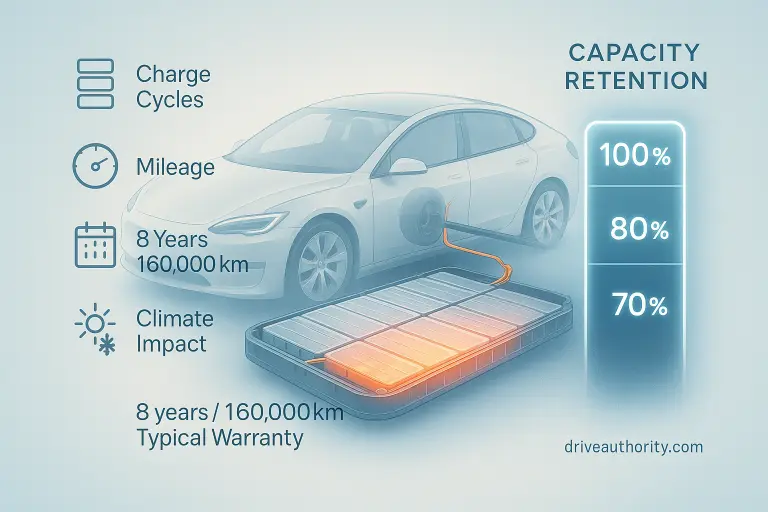
Battery lifespan isn’t about sudden failure — it’s a gradual capacity curve measured over years and miles.
What Affects EV Battery Longevity?
Charging Habits: DC Fast Charging vs. AC Charging
This is the single biggest controllable variable. DC fast charging generates significant heat. Used occasionally, the impact is negligible. Used daily, studies show it accelerates degradation by 10–15% over 5 years compared to Level 2 home charging. For a full breakdown of what public EV charging actually costs, see our network-by-network comparison.
LFP cells (standard in BYD and base Tesla Model 3/Y) tolerate DC fast charging significantly better than NMC packs. LFP can safely charge to 100% regularly. NMC packs benefit from the 20–80% rule. For everyday ownership: charge at home when possible, use fast charging for road trips.
Climate & Thermal Management Systems
Temperature is the second-largest factor. High ambient temperatures (above 95°F / 35°C) accelerate aging measurably. The Nissan Leaf’s historically faster degradation illustrates this: early Leafs used passive air cooling with no active TMS. Modern EVs use liquid thermal management that keeps cells within safe bands. Buyers in hot climates should specifically prioritize vehicles with active liquid cooling.
Battery Chemistry: LFP vs. NMC vs. Solid-State
LFP (Lithium Iron Phosphate): Lower energy density but exceptional cycle life (3,000–5,000+ cycles). BYD’s Blade Battery is the market leader. NMC (Nickel Manganese Cobalt): Higher density enabling longer range, but more sensitive to heat and overcharging. Solid-State (emerging): Toyota, Samsung SDI, and QuantumScape target 2027–2030 production — not a factor for 2026 buyers.
EV Battery Warranties Explained
Standard 8-Year / 100,000–150,000 Mile Coverage
Federal regulations require 8 years / 100,000 miles minimum. Several manufacturers exceed this: Hyundai/Kia offer 10-year / 100,000 miles; Rivian covers 8 years / 175,000 miles.
Capacity Retention Guarantees (70% Threshold)
If your battery drops below 70% of original capacity within warranty, the manufacturer must repair or replace it. OBD-II apps and Recurrent offer free battery health reports for used EV buyers.
| Brand | Duration | Mileage | Capacity Guarantee |
|---|---|---|---|
| Tesla (all) | 8 years | 100,000–150,000 mi | 70% |
| Hyundai Ioniq 5/6 | 10 years | 100,000 mi | 70% |
| Kia EV6/EV9 | 10 years | 100,000 mi | 70% |
| Ford Mach-E / Lightning | 8 years | 100,000 mi | 70% |
| Chevy Equinox/Blazer EV | 8 years | 100,000 mi | 70% |
| Rivian R1T/R1S | 8 years | 175,000 mi | 70% |
| BYD (non-US) | 8 years | ~150,000 mi | 70% |
| Nissan Ariya | 8 years | 100,000 mi | 75% |
Replacement Costs & Repair Options
Full Battery Pack Replacement Cost (2026)
Full replacement runs $8,000–$20,000 depending on vehicle size and brand. Compact EVs (40–60 kWh): $8,000–$12,000 installed. Midsize (75–100 kWh): $12,000–$17,000. Full-size/truck (130–200 kWh): $16,000–$22,000+. Most owners under normal use will never need full replacement within the warranty window. For a detailed breakdown, see our EV battery replacement cost guide by brand.
Module-Level Repairs vs. Full Replacement
The industry is shifting toward module-level servicing — swapping individual modules at 20–40% of full replacement cost. Third-party specialists now offer module rebuilds starting around $2,500–$5,000 for compact EVs with partial capacity loss. For complete ownership economics, see our monthly EV cost of ownership guide.
Do EV Batteries Last Longer Than Gas Engines?
Fewer Moving Parts & Lower Mechanical Wear
A gasoline engine contains ~2,000 moving parts. An EV drivetrain contains fewer than 20. No timing chain wear, no valve train stress, no catalytic converter depletion. The battery is the EV equivalent of the engine — the central high-cost component. A well-managed LFP pack can match or exceed the 200,000–300,000 mile window of a well-maintained engine.
Long-Term Maintenance Comparison
The U.S. Department of Energy estimates EV maintenance costs to be roughly 30–40% lower over 150,000 miles. See our electric car vs gas car total cost comparison for the full 10-year math.
| Category | EV (5 Yr) | Gas (5 Yr) | EV (10 Yr) | Gas (10 Yr) |
|---|---|---|---|---|
| Oil changes | $0 | $600–$900 | $0 | $1,200–$1,800 |
| Brake service | $100–$200 | $400–$800 | $200–$400 | $800–$1,600 |
| Drivetrain | Minimal | $300–$2,000 | Minimal | $600–$4,000+ |
| Fuel vs electricity | $3,500–$5,500 | $8,000–$14,000 | $7,000–$11,000 | $16,000–$28,000 |
| Battery / engine major | $0 (warranty) | $0–$3,000 | $0–$5,000 | $2,000–$8,000 |
Signs Your EV Battery Is Wearing Out
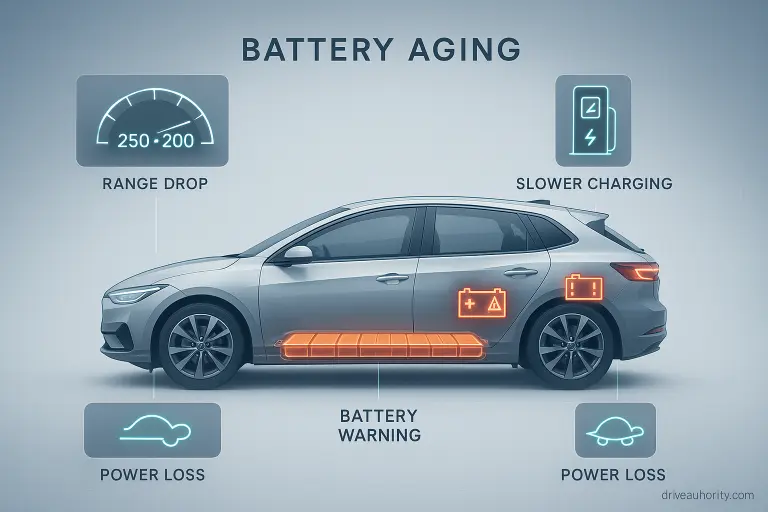
Three early warning signs: range loss, slower DC charging, and unusual SoH readings.
Battery degradation doesn’t happen overnight — it’s a gradual curve. But there are clear, measurable signals that indicate a pack is aging faster than expected.
Range Drops 15% or More Below Rated Estimate
Every EV has a rated range under standard conditions. If your real-world range consistently falls 15% or more below that figure — accounting for cold weather and highway speeds — the battery is likely below 85% state-of-health. A vehicle rated at 300 miles delivering a consistent 250 miles in moderate conditions is a clear signal. Compare your range against owner community data on Recurrent.
DC Fast Charging Slows Dramatically Before 80%
All EVs taper charging speed as they approach full capacity — this is normal. But if your vehicle’s DC fast charging slows dramatically before reaching 80%, or refuses high charge rates it previously handled, the BMS is throttling input to protect degraded cell groups. This is one of the most reliable early indicators of abnormal degradation.
State-of-Health Below 85% Before Year 5
Many modern EVs display SoH directly in the vehicle app or via OBD-II tools. An SoH reading below 85% before the 5-year mark suggests abnormal degradation — potentially qualifying for warranty replacement if you’re within the 8-year / 70% threshold. Document these readings with timestamps; they form the evidence base for any warranty claim.
How to Check Your EV Battery Health
You don’t need a dealership visit to get a reliable read on your battery’s condition. Three accessible methods give progressively more detail:
Method 1: Built-In Vehicle App (Fastest)
Most modern EVs display SoH in the manufacturer’s app. Tesla shows this under Battery in the app dashboard. Hyundai BlueLink and Kia Connect display similar data. Takes under 60 seconds.
Method 2: OBD-II Diagnostic App (Most Accessible)
A Bluetooth OBD-II adapter ($20–$50) paired with LeafSpy (Nissan), ScanMyTesla, or Car Scanner ELM OBD2 reads raw battery data including individual cell voltages and calculated SoH. Particularly useful for used EV buyers before committing.
Method 3: Third-Party Battery Health Report (Most Reliable)
Recurrent aggregates real-world data from thousands of identical vehicles — telling you not just your car’s SoH, but how it compares to other examples of the same model year. A Recurrent report ($0–$40) is one of the highest-ROI pre-purchase steps for used EV buyers.
For full guidance, see our EV range vs advertised range breakdown.
How to Extend EV Battery Life
The 20–80% Rule (NMC Only)
For NMC chemistry, keeping daily charge between 20% and 80% reduces cell stress. Set a charge limit via your app; override to 100% only before long trips. Exception: LFP batteries (base Tesla Model 3/Y, all BYD EVs) are engineered for regular 100% charging — it helps BMS recalibrate. The 80% rule is unnecessary and counterproductive for LFP.
Managing Heat & Cold
Park in shade during peak heat. In cold climates, use preconditioning before driving. Avoid leaving below 10% SoC for extended periods.
Software Updates
Modern EVs receive OTA updates that improve charge curve efficiency and thermal management. Keeping software current is active battery protection.
Solid-state batteries and second-life applications are reshaping long-term EV economics.
EV Battery Life Calculator
Use this calculator to estimate how much battery capacity — and real-world range — your EV will retain over time. The model uses a square-root degradation curve matching the pattern documented in Geotab’s 22,700-vehicle study: faster initial loss that slows over time, then gradually accelerates toward end of life.
Estimates based on Geotab (22,700 EVs) and Recurrent Auto (15,000 EVs) degradation curves. Uses √t calendar-aging model. Individual results vary. Not a guarantee.
FAQs — How Long Do EV Batteries Last?
How much does EV battery capacity drop per year?
Most modern EV batteries lose approximately 1.8–2.3% per year under normal use. At that rate, a battery retains around 80% capacity after a decade of typical ownership.
Can an EV battery last 15 years?
Yes — particularly with LFP chemistry and careful charging. High-mileage Tesla Model S units and BYD commercial fleet vehicles have demonstrated capacity above 80% at 12–14 years. Thermal management quality is the biggest determinant.
Is it worth replacing an EV battery?
For a vehicle worth $18,000–$25,000 with a $10,000–$14,000 replacement cost, the math often supports replacement — especially as module-level repairs bring costs down. For older, lower-value vehicles, the economics are less clear.
Do EV batteries degrade faster with fast charging?
Regular DC fast charging accelerates degradation by an estimated 10–15% over 5 years compared to Level 2 AC charging for NMC chemistry. LFP packs handle fast charging significantly better. Use fast charging for road trips, not daily routine.
What is the average EV battery replacement cost in 2026?
Full pack replacement runs $8,000–$20,000 depending on vehicle size. Compact EVs (40–60 kWh): $8,000–$12,000. Midsize (75–100 kWh): $12,000–$17,000. Module-level repairs start at $2,500–$5,000. Costs have dropped 40–50% since 2020.
How do I know if my EV battery needs replacing?
Three signals: range consistently 15%+ below rated estimate in moderate conditions, DC fast charging slowing dramatically before 80%, and State-of-Health readings below 85% before year 5. Use OBD-II apps or Recurrent for accurate readings.
Do EV batteries lose charge when parked?
Yes — all lithium-ion batteries self-discharge at approximately 1–2% per month when parked. In cold weather, the BMS may draw additional power for thermal management. Avoid leaving an EV below 10% SoC for extended storage periods.
Which EV has the longest-lasting battery?
BYD models with Blade Battery (LFP) show the best documented longevity — approximately 89–93% capacity remaining at 180,000 miles. Tesla Model S with large NMC packs and active thermal management also performs well, retaining 80–85% at 200,000+ miles.
- Recurrent Auto — Battery SOH tracking across 15,000+ EVs (2023–2025 cohorts)
- Geotab EV Battery Health Study 2026 — Fleet degradation analysis across 22,700 vehicles — largest dataset available
- U.S. Department of Energy (AFDC) — EV vs ICE maintenance cost data
- Tesla Impact Report 2024 — Published battery degradation data (200,000 mi fleet)
- Manufacturer warranty documentation — Tesla, Hyundai, Kia, Ford, GM, Rivian, BYD, Nissan
- Fleet operator reports — Rivian delivery fleet, BYD commercial bus fleet, municipal EV programs
All cost figures are range estimates based on industry averages. Individual results vary by model year, climate, charging habits, and mileage.