Summary: The cheapest electric car saves money only when charging access, climate, and driving patterns align. Otherwise, the lowest price often creates the highest friction.
Direct Answer
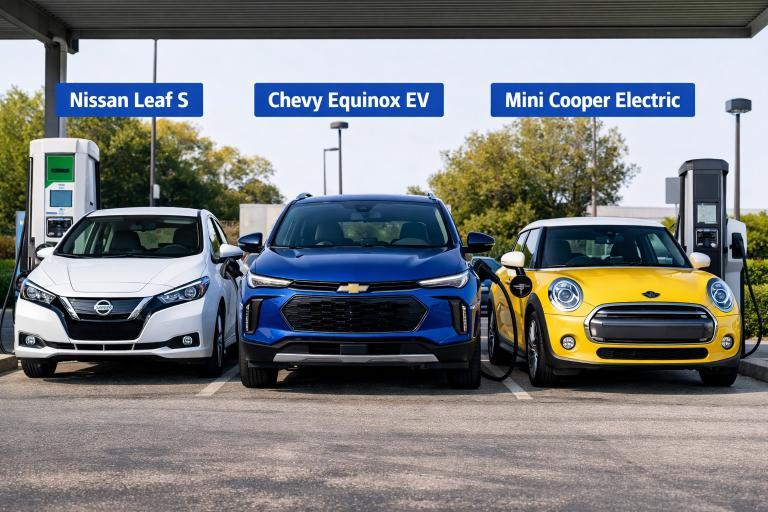
The cheapest new electric car options in the US and Canada typically include models like the Nissan Leaf S and, in some markets, the Chevrolet Equinox EV—depending on incentives, availability, and trim selection. Starting prices range from $28,000–$35,000 before federal and state credits. The real cost isn’t just the sticker price—it’s about understanding which features you’re sacrificing at the entry level and whether those trade-offs align with how you’ll actually use the vehicle. Most buyers discover that “cheapest” doesn’t mean “worst deal,” but it does mean being strategic about range, charging speed, and interior features.
Cheapest Electric Cars: Real-World Comparison (2026)
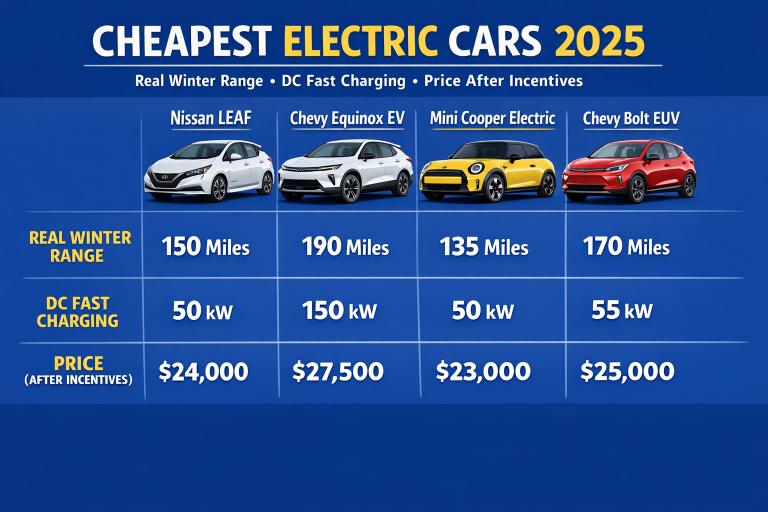
The table below compares the cheapest electric cars in 2025 based on real-world winter range, fast-charging capability, and post-incentive pricing.
| Model | Real Range (Winter) | DC Fast Charging Speed | Post-Incentive Price (US) | Best For | Not For |
|---|---|---|---|---|---|
| Nissan Leaf S | 140–160 miles | 50 kW (CHAdeMO) | $20,500–$23,000 | City commuters, home charging, mild climates | Road trips, cold climates, fast charging needs |
| Chevy Equinox EV 1LT | 240–270 miles | 150 kW | $27,500–$30,000 | Balanced daily use, occasional trips | Budget-only buyers, premium feature seekers |
| Mini Cooper Electric | 90–110 miles | 50 kW | $23,000–$26,000 | Urban-only drivers, second car | Primary vehicle, family use, highway driving |
| Chevy Bolt EUV | 180–200 miles | 55 kW | $20,000–$23,000 (discontinued, used market) | Value hunters, proven reliability | Latest tech, fast charging |
Notice that charging speed—not range—is often the limiting factor for budget EV usability.
What “Cheapest Electric Car” Really Means
The cheapest electric car isn’t defined by the lowest MSRP alone—it’s the intersection of upfront price, available tax credits, and whether the vehicle’s limitations fit your daily driving reality.
Entry-level EVs achieve lower prices by trimming range to 150–250 miles, using slower charging systems (often capping at 50–100 kW), and simplifying interior tech. In real ownership scenarios, most entry-level EV buyers discover these limitations are invisible when commuting 30 miles daily with home charging access. A family taking weekend road trips to visit relatives three hours away hits those boundaries immediately.
The cheapest option becomes expensive when it forces behavior changes you’re not willing to make—like always planning around charging stops or avoiding winter highway trips where range drops 20–30%. Owners of base-trim EVs often report that the monthly cost of ownership depends more on charging access than the purchase price itself.
Why Most People Misunderstand the “Cheapest” Label
Buyers often assume the cheapest electric car means the lowest total cost of ownership, but that’s only true under specific conditions.
The calculation breaks down when people forget to account for their charging situation. If you’re renting without home charging and relying on public fast chargers at $0.40–$0.60 per kWh, you’re spending nearly as much per mile as a fuel-efficient gas car—erasing the cost advantage. The cheapest EV is only cheap if you can charge at home for $0.10–$0.15 per kWh overnight.
Similarly, base models often lack cold-weather packages or heat pumps, which means winter range anxiety becomes more severe. In Canadian winters or northern US states, that 200-mile range becomes 140 miles in real conditions. The “cheapest” car demands more frequent charging, which adds time cost even if electricity stays affordable.
If you fall into the scenarios above, these electric cars offer better value for most buyers.
Cheapest EV: Quick Fit Test
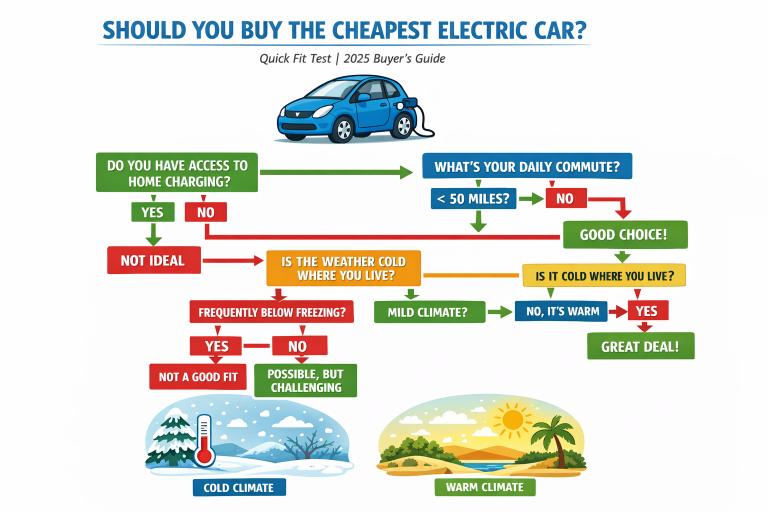
✅ Yes, if you have:
- Home charging access (garage, driveway, assigned parking with outlet)
- Daily driving under 50 miles round-trip
- Mild climate or tolerance for seasonal planning
- Simple feature needs (basic tech, heated seats optional)
❌ No, if you face:
- Public charging only (no home/workplace option)
- Frequent long trips (200+ miles) or winter highway driving
- Inconsistent driving patterns (some weeks 50 miles, others 300+)
- Need for fast turnaround charging (under 30 minutes)
If your situation matches the ❌ category, consider EVs under $40,000 with longer range or explore hybrid alternatives instead.
Secondary Factors (Not the Main Cause)
Depreciation patterns matter, but they’re unpredictable for budget EVs. Some entry-level models hold value poorly because newer versions offer better range at similar prices within two years. Others stabilize as used buyers prioritize affordability over cutting-edge specs. If you plan to keep the car 8–10 years, depreciation becomes irrelevant.
Insurance costs on entry-level EVs sometimes run higher than expected because replacement parts and battery repairs remain expensive, even on cheaper models. The difference isn’t dramatic—usually $200–$400 annually—but it’s worth confirming quotes before purchase, especially for new drivers.
Resale timing also plays a role. If you trade in after three years, the cheapest new EV might cost more in total than buying a slightly used mid-tier model with better range and features from the best EVs under $40,000 category.
How to Tell If the Cheapest Electric Car Fits Your Situation
This decision depends entirely on your driving patterns and charging access. You’re likely a good match if:
- Your daily commute is under 50 miles round-trip, and you rarely take road trips longer than 150 miles each way. The base range covers your routine without stress, and occasional long drives can be planned around charging stops.
- You have reliable home charging (garage outlet, driveway access, or assigned parking with electrical access). Paying $30–$50 monthly to charge at home versus $200+ relying on public chargers is where the savings actually happen. Learn more about setting up home EV charging.
- You live in a mild climate or accept seasonal planning. If winter temperatures rarely drop below 20°F, range loss is manageable. If you’re in Minnesota or Alberta, you’ll need to mentally budget for 25–35% range reduction from November through March.
- You value simplicity over features. Base trims often lack advanced driver-assist, premium audio, or heated seats. If you’re comfortable with a straightforward driving experience, the cheapest option delivers transportation without the extras.
You’re probably not a good fit if you frequently drive 200+ miles in a day, lack home charging, or need a vehicle that handles every possible scenario without advance planning. In those cases, consider the best electric cars for the money instead.
Practical, Safe Next Steps
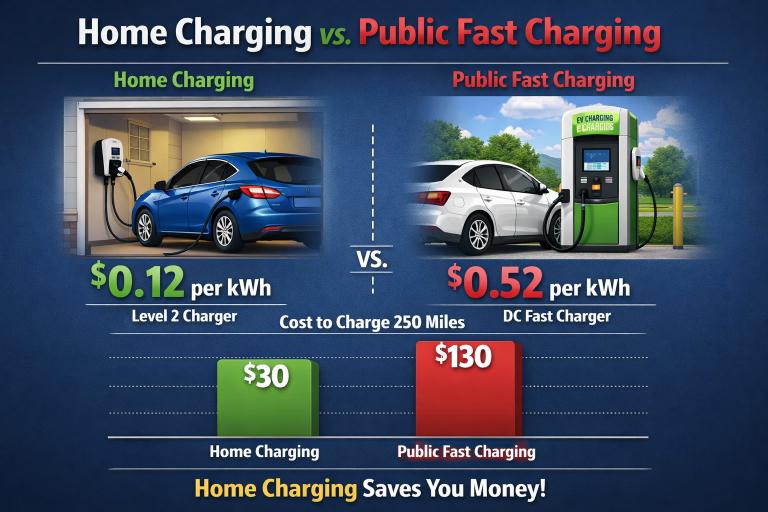
Charging Reality Check
Confirm your charging situation before even visiting a dealership. If you rent or live in a condo, contact your landlord or HOA about installing a Level 2 charger. Some utility companies offer rebates covering 50–75% of installation costs. Without home charging, the math on the cheapest electric car rarely works unless public charging is unusually affordable in your area.
Range Reality Check
Test the base range against your actual routes, not averages. Drive your typical weekly pattern—commute, errands, weekend activities—and map it honestly. If your real-world total is 120 miles per week, a 200-mile range car gives you buffer. If you’re regularly pushing 180 miles weekly, you’re charging every 3–4 days, which becomes friction over time.
Incentives Reality Check
Research federal and state incentives with your specific tax situation in mind. The federal tax credit (up to $7,500 in the US, varying provincial rebates in Canada) only helps if you owe enough taxes to claim it, or if the dealer offers point-of-sale application. Some states add $2,000–$4,000 in additional rebates. Run the numbers on post-incentive price, not MSRP—that’s your real cost.
Charging Speed Reality Check
Compare charging speed, not just range. A car with 180 miles of range that charges at 100 kW is often more practical than one with 220 miles charging at 50 kW. On road trips, the faster car recovers 80 miles in 20 minutes; the slower one takes 45 minutes. Understanding how long EV charging actually takes matters more than the initial range gap if you’ll ever fast-charge.
Ownership Reality Check
Evaluate based on five-year ownership, not just year one. Calculate estimated electricity costs, insurance, maintenance (usually $300–$500 annually for EVs), and likely depreciation. The cheapest purchase price sometimes loses to a $3,000-more-expensive model that holds value better and costs less to insure. Use online calculators, but verify insurance quotes yourself—they vary widely by region and credit profile.
Avoid common first-time EV mistakes that turn budget-friendly purchases into regrets. Many buyers underestimate their actual charging needs or overestimate their tolerance for planning. Check our guide on first-time EV buyer mistakes before committing.
When to Consider Expert Help
If you’re uncertain whether your electrical panel can support a Level 2 charger, or if installation quotes seem unusually high, consult a licensed electrician familiar with EV charging installations.
If your driving patterns are inconsistent—some weeks you drive 50 miles, others you drive 300—talk to a dealership EV specialist or current EV owners in your area. They can clarify whether real-world charging infrastructure along your routes makes the cheapest option viable or frustrating.
Cheapest Electric Car — Final Verdict
✅ Best if:
- You have home charging and predictable, short daily commutes
- Your budget is tight but you want to enter the EV market smartly
- You’re willing to plan around the vehicle’s range limitations
⚠️ Risky if:
- You rely on public charging as your primary option
- You need a do-everything vehicle with no compromises
- You live in extreme climates without tolerance for seasonal adjustments
🔄 Smart alternative:
- Consider a 2–3 year old mid-tier EV with better range/features at similar post-incentive prices
- Explore certified pre-owned options from the best electric cars 2025 list
- Compare against affordable hybrid alternatives if charging access is uncertain
Final Takeaway
This guide isn’t about pushing the lowest price—it’s about avoiding the wrong cheap decision.
The cheapest electric car is a smart financial decision when your driving habits, charging access, and climate align with its design compromises. It’s not about settling—it’s about recognizing that paying less upfront works brilliantly for the right use case and becomes expensive through inconvenience for the wrong one.
Focus on post-incentive price, confirm your charging situation first, and test the range against your reality, not the EPA estimate. When those factors line up, the cheapest option often delivers the best value per dollar spent. You’re not just saving money on the purchase—you’re buying confidence that the vehicle fits your life without forcing constant adjustments.
Cheapest Electric Car FAQs
Is the cheapest electric car worth it long-term?
Yes—if you have home charging and drive under 50 miles per day.
Typical long-term savings: $8,000–$12,000 over 8–10 years
The cheapest EVs cost $300–$500 annually for maintenance versus $1,200–$1,800 for gas cars. Over 8–10 years, you save significantly in fuel and service costs, even after accounting for battery degradation (typically 2–3% per year). The value proposition breaks down only if you rely heavily on expensive public charging.
What is the cheapest EV with fast charging?
The Chevrolet Equinox EV 1LT offers the best balance at around $27,500 post-incentive with 150 kW DC fast charging. It can add 70 miles in 10 minutes, making it practical for occasional road trips. The Nissan Leaf, while cheaper at $20,500, uses the outdated CHAdeMO standard at only 50 kW, limiting fast charging availability and speed significantly.
Is it cheaper to buy a used EV instead?
Often, yes. A 2–3 year old Chevy Bolt EUV or Hyundai Kona Electric costs $15,000–$20,000 with 85–90% battery health remaining. You lose the $7,500 federal tax credit, but the lower purchase price often compensates. Check battery warranty coverage (typically 8 years/100,000 miles) and verify charging port type before buying used.
How much does the cheapest EV really cost per month?
Expect $350–$500 monthly for a financed cheapest EV after incentives: $250–$350 for the car payment (60-month loan, 6–7% APR), $40–$60 for home charging (1,000 miles/month at $0.12/kWh), $50–$90 for insurance. This totals $4,200–$6,000 annually, about 30–40% less than an equivalent gas car when you factor in fuel and maintenance savings.
External Resources: