EV & Hybrid Zone

EV vs Hybrid vs Plug-in Hybrid: What’s the Difference?

📅 October 23, 2025 ⏱ 18 min read ✓ Verified Mar 2026
EV vs Hybrid vs Plug-in Hybrid: What’s the Difference?

Fact-checked by James Carter

Choosing between an EV, a hybrid, and a plug-in hybrid isn’t a question of which technology is better — it’s a question of which one fits how you actually drive. The wrong match costs you thousands over five years. The right one can eliminate most of your fuel bill entirely, or simply remove every friction point from your commute without changing a single habit. This guide breaks down exactly how each powertrain works, what it costs to own in 2026, and which buyer profile each one genuinely suits — with no agenda toward any particular technology.

Quick answer: An EV runs entirely on battery power and must be charged. A hybrid (HEV) is gas-primary with a self-charging assist battery — no plug needed. A plug-in hybrid (PHEV) combines both: 20–50 miles of electric-only range plus a full gas engine backup. EVs and PHEVs qualify for up to $7,500 federal tax credits; standard hybrids do not.

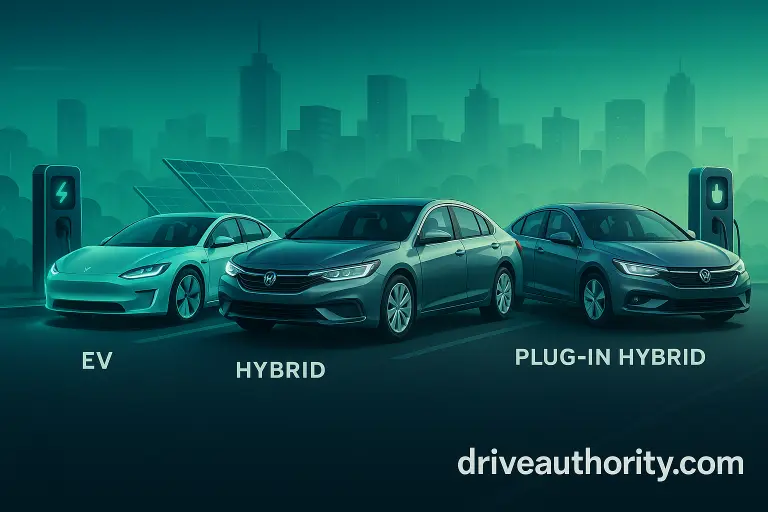
EV vs Hybrid vs Plug-in Hybrid — Quick Comparison Overview

How Each Powertrain Works

At the most fundamental level, the difference comes down to energy source and dependency on the grid. A battery electric vehicle (BEV) stores electricity in a large battery pack and converts it to motion through one or more electric motors — no combustion anywhere in the drivetrain. A conventional hybrid (HEV) is still primarily a gas car, but recovers energy through regenerative braking and engine load management to power a small electric motor at low speeds. A plug-in hybrid (PHEV) sits between the two: a larger battery charged from an external source enables 20–50 miles of electric-only driving, with a full gas engine available for longer trips.

Fuel Source & Charging Requirements

Only two of the three require a charging infrastructure decision: EVs and PHEVs. Standard hybrids never need plugging in — their batteries charge entirely from regenerative braking and the engine. This distinction matters significantly for buyers without home charging access, as it narrows the practical options to HEVs or PHEVs with opportunistic public charging.

At-a-Glance Comparison

Powertrain Comparison — 2026 Overview
Powertrain Fuel Source Battery Size Charging Needed Best For
EV (BEV) Electricity only 40–130 kWh Yes — daily or every 2–3 days Home charger access, short-to-medium daily drives
Hybrid (HEV) Gas + small electric assist 1–2 kWh No — self-charges while driving High-mileage drivers, no charging access, city stop-go
Plug-in Hybrid (PHEV) Electricity + gas backup 8–22 kWh Optional — benefit increases when charged regularly Mixed use: short daily EV trips + occasional long drives

How Electric Vehicles Work in 2026

Battery Packs, Inverters & Electric Motors

A modern EV drivetrain has three core components: a high-voltage battery pack (typically 400V or 800V architecture), a power inverter converting DC battery current to AC for the motor, and one or more permanent magnet electric motors driving the axles. The system operates with dramatically fewer moving parts than an internal combustion engine — no pistons, no crankshaft, no multi-speed transmission in most designs.

Battery chemistry in 2026 has bifurcated clearly. Entry-level EVs — including base Tesla Model 3/Y, most BYD models, and several GM platforms — use LFP (lithium iron phosphate) chemistry: exceptional cycle life (3,000–5,000+ full cycles) and better thermal stability at the cost of energy density. Premium range-focused models use NMC (nickel manganese cobalt) chemistry for higher energy density, enabling 300–400+ mile ranges but requiring more careful charging management to preserve longevity.

800V Architecture & DC Fast Charging

The shift to 800V electrical architecture — now standard on the Hyundai Ioniq 6, Kia EV6, Porsche Taycan, and GM Ultium-based vehicles — is the most consequential EV charging advance of this generation. Compared to legacy 400V systems, 800V platforms accept DC fast charging at up to 350 kW, enabling 10–80% in as little as 18 minutes on compatible hardware. For highway driving, this closes the practical refueling gap with gas vehicles for buyers near high-powered networks.

For real-world range data beyond EPA estimates, see our EV range vs. advertised range breakdown.

Key Advantages & Limitations

Advantages: Lowest per-mile energy cost (~$0.03–0.05/mile at average U.S. electricity rates vs. $0.09–0.14/mile for gasoline), minimal routine maintenance — no oil changes, significantly reduced brake wear via regenerative braking — and federal tax credits up to $7,500 for qualifying models under the Inflation Reduction Act.

Limitations: Higher upfront purchase price versus equivalent gas vehicles, dependency on reliable charging infrastructure, range degradation of 15–30% in extreme cold, and higher average insurance costs than non-electric equivalents.

How Hybrid Vehicles (HEVs) Work

The Self-Charging System Explained

A conventional hybrid never needs plugging in because it generates all its electrical energy internally from two sources: the gas engine (which drives a generator during certain operating modes) and regenerative braking (which recovers kinetic energy during deceleration). The battery pack is intentionally kept small — typically 1–2 kWh — and designed to cycle rapidly rather than store large amounts of energy. This is fundamentally different from the PHEV and EV battery philosophy, where stored capacity is the point.

Toyota’s Hybrid System (THS-II), which powers the RAV4 Hybrid, Camry Hybrid, and Corolla Hybrid, remains the most proven HEV platform globally. Its power-split device allows simultaneous engine and electric motor operation without a conventional transmission, enabling seamless transitions between electric-only at low speeds and combined power output at higher speeds.

Regenerative Braking & City Efficiency

Every time you lift off the throttle or apply the brakes in a hybrid, the electric motor reverses into generator mode, converting momentum into stored electricity. In city driving with frequent stops, this recovery is substantial — one reason hybrids deliver their greatest efficiency advantage over gas cars in urban cycles rather than on the highway, where fewer deceleration events occur.

Who HEVs Actually Suit

HEVs are the lowest-friction choice for buyers not ready to change any part of their fueling routine. Real-world fuel economy of 45–60 MPG in mixed driving is achievable with models like the Toyota Camry Hybrid and Honda Accord Hybrid, versus 28–35 MPG for their non-hybrid equivalents. The trade-off is clear: no federal tax credit, a purchase premium of $1,500–$4,000 over the base gas model, and no ability to eliminate fuel costs entirely. For high-mileage drivers who refuel away from home regularly, that trade-off is often worth it.

How Plug-in Hybrid Vehicles (PHEVs) Work

Dual-Mode Operation: EV Mode + HEV Mode

A PHEV operates in two distinct modes. With a charged battery, the vehicle runs in EV mode — the electric motor handles all propulsion and the gas engine stays off unless maximum acceleration is demanded or the battery depletes. Once the battery reaches its depletion threshold, the vehicle transitions seamlessly to HEV mode, operating identically to a standard hybrid for the remainder of the journey. This dual capability makes PHEVs uniquely versatile — and also more mechanically complex than either pure type.

Electric-Only Range: What the Numbers Mean in Practice

PHEV electric range in 2026 varies substantially by model: from 25 miles (Jeep Wrangler 4xe, Toyota RAV4 Prime) to 50+ miles (Volvo XC60 Recharge, BMW X5 xDrive50e, Ford Escape PHEV). The practical implication is significant. A buyer with a 28-mile daily commute who charges every night will run almost entirely on electricity and barely touch the gas engine. A buyer with a 70-mile commute will rely heavily on the gas engine daily. Your commute distance and charging habits determine whether your PHEV behaves more like an EV or a hybrid in practice.

When a PHEV Makes More Sense Than a Pure EV

PHEVs make the strongest case for buyers who take frequent long road trips beyond EV range practicality, live in apartments or situations without reliable home charging, or operate in markets where DC fast charging networks remain sparse. They also suit households with a second vehicle for long trips who want to electrify their primary short-trip commuter — the PHEV eliminates most daily fuel costs while removing range anxiety entirely for weekend drives.

PHEV Federal Tax Credit Eligibility in 2026 PHEVs with a battery capacity of 7 kWh or more qualify for the federal EV tax credit under the IRA — up to $7,500 for new vehicles or $4,000 for qualifying used vehicles, subject to MSRP caps and buyer income limits. Confirm current model eligibility via IRS Form 8936 or the fueleconomy.gov eligible vehicle list before purchasing, as battery sourcing compliance rules change quarterly.

Real-World Efficiency & Range Comparison

EV Range vs. EPA Estimates

EPA range ratings consistently overstate real-world performance by 10–20% under typical driving conditions. At highway speeds above 70 mph, temperatures below 40°F, or with aggressive climate control use, the gap widens further. A vehicle rated at 300 miles EPA should be planned around 240–260 miles on highway trips. Vehicles with 800V fast-charging capability partially offset this with shorter charging stops, but the range gap versus EPA persists across all architectures. For detailed model-specific real-world data, our real-world EV range analysis tracks over a dozen current models under standardized conditions.

Hybrid MPG vs. PHEV MPGe

Comparing efficiency across powertrains requires understanding two different metrics. Traditional MPG applies to HEVs just as it does to gas cars. PHEVs are rated in MPGe (miles per gallon equivalent) during electric operation — typically 70–120 MPGe — plus a conventional MPG figure for gas-only mode. A PHEV achieving 90 MPGe on electricity and 38 MPG on gas will perform very differently depending on charging frequency. Owners who charge daily on sub-35-mile commutes commonly see effective combined figures above 100 MPG equivalent. Owners who never plug in essentially drive a slightly heavier hybrid with no efficiency advantage.

Cold Weather Performance

Cold weather is the equalizer that marketing materials consistently underplay. At 20°F (-7°C), EV range drops 15–30% depending on battery thermal management quality. PHEVs lose electric range proportionally and fall back on the gas engine more heavily. HEVs are least affected — their small battery recovers quickly and the gas engine handles the primary load regardless. For buyers in cold climates across the Northeast, Upper Midwest, or Canada, apply a conservative 25% winter penalty to any published EV or PHEV electric range figure when evaluating real-world viability.

Real-World Efficiency — Typical 2026 Models, Mixed Driving Conditions
Powertrain Real-World Range Efficiency Metric Winter Impact
EV — Tesla Model 3 Long Range 260–300 miles ~3.5–4.2 mi/kWh −15 to −30% range
Hybrid — Toyota Camry Hybrid 600–700 miles per tank 44–51 MPG combined −5 to −10% MPG
PHEV — Toyota RAV4 Prime 25–42 mi EV + 580 mi gas 94 MPGe EV / 38 MPG gas −20 to −25% EV range

Charging, Refueling & Infrastructure

Home Charging vs. Public Networks

For EV and PHEV owners, home charging fundamentally changes both the cost equation and daily convenience. A Level 2 home charger (240V, ~7.2–11.5 kW) adds $500–$1,500 installed and delivers a full overnight charge for most EVs and a complete top-up for PHEVs. The per-mile electricity cost at home rates (~$0.13–0.16/kWh U.S. national average) runs 3–4× cheaper than gasoline per mile traveled. For apartment dwellers or those without dedicated parking, home charging isn’t an option — a reality that shifts the practical calculus significantly toward HEVs or PHEVs relying on public infrastructure for the electric portion.

For a complete breakdown of home charging setup costs, equipment options, and installation considerations, see our home EV charging setup guide.

Charging Time by Level

Charging Speed by Level — EV and PHEV Compared
Charging Level Power Output EV Full Charge Time PHEV Full Charge Time
Level 1 — 120V outlet ~1.2–1.4 kW 50–80 hours (impractical) 5–12 hours
Level 2 — 240V home/public 7–19.2 kW 6–12 hours 1.5–4 hours
DC Fast Charge — public only 50–350 kW 20–60 min (10–80%) Not supported on most PHEVs

Gas Refueling: The Convenience Baseline

For HEV drivers, refueling is identical to a gas car — 5 minutes at any station nationwide with no planning required. For PHEV drivers, the gas engine eliminates range anxiety entirely; when the battery depletes, the transition is seamless and requires no driver action. For EV drivers, the infrastructure picture in 2026 is meaningfully better than three years ago — Tesla’s Supercharger network now supports non-Tesla vehicles via NACS adapters, and the NACS connector is standard across most major automakers — but real gaps remain in rural corridors, apartment complexes, and parts of the interior U.S.

For current public charging costs by network, see our public EV charging cost breakdown.

Total Cost of Ownership Comparison

Purchase Price & 2026 Federal Incentives

Sticker price comparisons are misleading without factoring in incentives. The Inflation Reduction Act provides up to $7,500 for new qualifying EVs and PHEVs and up to $4,000 for qualifying used EVs under $25,000 MSRP (buyer income limits apply). Standard hybrids receive no federal incentive whatsoever — a gap that represents $5,000–$7,500 in effective purchase cost versus a comparable PHEV or EV after credits.

MSRP caps apply: $55,000 for passenger cars, $80,000 for trucks and SUVs. Income thresholds: $150,000 single / $300,000 joint for new vehicles; $75,000 single / $150,000 joint for used. Battery sourcing compliance rules change quarterly — verify current model eligibility at fueleconomy.gov or via IRS Form 8936 before committing to a purchase.

Maintenance & Repair Cost Differences

The maintenance hierarchy follows drivetrain complexity. EVs carry no oil changes, no spark plugs, no timing belt, no transmission service, and significantly reduced brake wear through regenerative braking. The U.S. Department of Energy estimates EV maintenance costs run 30–40% lower than comparable gas vehicles over 150,000 miles. HEVs require full gas engine maintenance — oil, filters, spark plugs — on top of hybrid-specific items (inverter coolant, 12V auxiliary battery, hybrid battery health checks), though brake service costs are lower than standard gas cars due to regenerative deceleration. PHEVs carry the highest theoretical complexity burden: dual drivetrain maintenance means two separate systems, though real-world data from major brands shows this risk is modest over 8–10 years of ownership.

5-Year Total Cost Estimate

5-Year Ownership Cost Estimate — Midsize Segment, U.S. Market, 15,000 miles/year
Cost Category EV Hybrid (HEV) Plug-in Hybrid (PHEV)
Purchase price (net of incentives) $32,000–$42,000 $30,000–$40,000 $33,000–$46,000
Fuel / electricity (5 years) $4,500–$7,000 $9,000–$13,000 $4,000–$8,000 *
Maintenance (5 years) $1,200–$2,500 $3,500–$6,000 $2,500–$5,000
Insurance (5 years) $8,500–$12,000 $7,000–$10,000 $7,500–$11,000
Estimated depreciation (5 yr) 45–55% 40–50% 42–52%

* PHEV fuel cost assumes regular home charging on daily commutes under 40 miles. Without regular charging, cost approaches HEV levels.

For a detailed breakdown of monthly running costs by powertrain, see our monthly EV cost of ownership analysis.

Environmental Impact & Emissions

Tailpipe Emissions

At the tailpipe, the ranking is straightforward: EVs produce zero direct emissions, PHEVs produce zero during EV mode and hybrid-equivalent emissions during gas mode, and HEVs produce 35–50% fewer tailpipe emissions than equivalent gas vehicles. In dense urban environments where stop-go traffic concentrates exhaust at street level, EVs offer the clearest air quality benefit regardless of grid source.

Lifecycle Carbon Footprint

Manufacturing an EV generates a meaningfully larger carbon footprint than producing a gas or hybrid vehicle, primarily due to battery production. Research from MIT and Transport & Environment places the carbon break-even point — where an EV’s lower operational emissions offset its higher manufacturing footprint — at 15,000–40,000 miles depending on the electricity grid’s carbon intensity. On the average U.S. grid in 2026, which continues its gradual decarbonization, EVs reach lifecycle parity with hybrids well within a typical 100,000-mile ownership period.

Grid Mix: The Variable That Changes Everything

An EV charged primarily on coal-heavy grids (portions of the Midwest) produces more lifecycle emissions than a Toyota Prius. The same EV charged on a renewable-heavy grid (California, Pacific Northwest, most of New England) carries a lifecycle footprint roughly 70–80% lower than a gas vehicle. PHEVs charged regularly are grid-dependent in the same way for their electric miles. For buyers in high-coal grid regions, a well-optimized HEV or PHEV may offer comparable lifecycle emissions to an EV at lower purchase complexity — a nuance that most EV-advocacy content sidesteps entirely.

Reliability & Long-Term Durability

Battery Longevity vs. Engine Wear

EV battery packs in 2026 degrade at an average of 1.8–2.3% per year under typical use, retaining approximately 80% capacity after a decade. All major manufacturers warrant packs for 8 years / 100,000 miles minimum at 70% capacity retention. For detailed degradation data by model, see our EV battery longevity guide. Conventional hybrid batteries present a different profile entirely — Toyota’s NiMH and lithium HEV packs have demonstrated exceptional longevity, with numerous documented cases exceeding 300,000 miles on original packs, largely because they operate within a narrow state-of-charge window and never fully charge or fully deplete.

PHEV Complexity Risks

PHEVs carry the highest theoretical complexity burden: two full powertrains, two separate cooling circuits, a more sophisticated battery management system, and higher-voltage electrical architecture alongside all conventional gas-engine mechanical components. In practice, established brands — Toyota, Ford, Hyundai/Kia — have demonstrated solid PHEV reliability over 8–10 year periods. The complexity risk is most relevant for lower-volume or less-proven PHEV models from manufacturers without a decade of hybrid drivetrain data behind them.

Warranty Coverage by Powertrain

All three powertrain types carry standard 3-year/36,000-mile bumper-to-bumper and 5-year/60,000-mile powertrain warranties in most U.S. configurations. EVs and PHEVs additionally carry the federally mandated 8-year/100,000-mile battery warranty at minimum 70% capacity retention. Hyundai, Kia, and Genesis extend this further with 10-year/100,000-mile powertrain coverage — a meaningful advantage for high-mileage buyers evaluating long-term ownership risk.

Pros & Cons by Powertrain

Electric Vehicle (EV)

✓ Pros
  • Lowest per-mile fuel cost (~$0.03–0.05/mile)
  • Minimal routine maintenance requirements
  • Up to $7,500 federal tax credit
  • Instant torque, smooth linear performance
  • Zero tailpipe emissions
  • Over-the-air software updates on major platforms
✗ Cons
  • Higher upfront purchase price
  • Requires reliable charging access
  • Range drops 15–30% in cold weather
  • Long-distance trips require charging planning
  • Higher insurance premiums than gas equivalents

Conventional Hybrid (HEV)

✓ Pros
  • No charging infrastructure required
  • Excellent real-world fuel economy (44–55 MPG)
  • Proven long-term reliability — especially Toyota
  • Refuel at any gas station in 5 minutes
  • Lower insurance costs than EVs
✗ Cons
  • No federal tax credit eligibility
  • Full gas engine maintenance still required
  • Cannot eliminate fuel costs entirely
  • Electric assist is modest — not a performance upgrade

Plug-in Hybrid (PHEV)

✓ Pros
  • Qualifies for up to $7,500 federal credit
  • 20–50 miles daily electric driving — fuel-free
  • No range anxiety — gas engine as full backup
  • Best flexibility for mixed-use drivers
  • Near-EV fuel costs when charged consistently
✗ Cons
  • Dual drivetrain adds mechanical complexity
  • Benefit disappears entirely if never charged
  • Heavier than pure EV or pure HEV equivalents
  • DC fast charging unavailable on most PHEVs
  • Higher insurance cost than conventional hybrids

Which Powertrain Is Right for You?

Short Daily Commutes Under 40 Miles

If your daily drive stays under 40 miles and you have access to home or workplace charging, an EV is the clear financial winner over five years. You may rarely need a public charger, fuel costs approach zero, and the federal credit substantially closes the upfront price gap. A PHEV is a strong second choice — you cover the commute electrically and use the gas engine only for exceptions. A standard hybrid makes sense here only if charging access is genuinely unavailable.

High-Mileage & Long-Distance Drivers

Drivers covering 300+ miles per week face a different calculus. An EV with 800V fast-charging capability — Ioniq 6, Kia EV6, newer Ultium-based GM vehicles — makes long highway trips workable with 18–25 minute charging stops at high-power networks. For buyers unwilling to plan around charging, a hybrid is the most frictionless option — maximum fuel efficiency, zero infrastructure dependency, minimum planning overhead. PHEVs offer limited advantage for sustained highway driving once the electric range depletes on the first leg.

Budget-Focused Buyers

After incentives, qualifying EVs and PHEVs can match or undercut HEV prices at the point of sale. But the correct metric is 5-year total cost — and EVs win decisively when home charging is available. Without home charging, a hybrid’s fuel efficiency and lower complexity often make it the more rational budget choice despite the absence of any incentive. For buyers under the income thresholds for used EV credits, a sub-$25,000 used EV now represents one of the most cost-efficient ownership propositions in the market.

Decision Checklist — Answer These 4 Questions Before You Buy
  • Daily mileage: Under 40 miles → EV or PHEV. Over 200 miles regularly → HEV or long-range EV with fast charging.
  • Charging access: Home charger available → EV is fully viable. No home charging → HEV or PHEV relying on public charging.
  • Climate: Cold winters below 20°F → apply a 25% range buffer to any EV or PHEV electric range estimate.
  • Incentive eligibility: Under income thresholds → prioritize EV or PHEV to capture the $7,500 credit. Over limits → HEV economics become more competitive on a net basis.

For first-time EV buyers, our first-time EV buyer mistakes guide covers the most common and costly pitfalls before you commit. If you’re evaluating specific budget-friendly options, our best EVs under $40,000 in 2026 ranks current models by total five-year ownership value.

Frequently Asked Questions

What is the main difference between an EV and a hybrid?

An EV runs entirely on battery power and requires charging from an external source. A hybrid runs primarily on gasoline with a small self-charging battery that assists the engine — no plugging in required. The hybrid can sustain electric-only operation only briefly at very low speeds; it is fundamentally a gas vehicle with an efficiency assist system.

Is a plug-in hybrid worth it in 2026?

Yes — if you charge it consistently. A PHEV charged nightly on a sub-40-mile daily commute runs predominantly on electricity and delivers the practical benefits of both powertrains. A PHEV that’s never plugged in is a heavier, more complex hybrid with no fuel-cost advantage. The value of a PHEV is directly proportional to how regularly it’s charged.

Which powertrain is cheapest to maintain long term?

EVs carry the lowest long-term maintenance costs — no oil changes, minimal brake service, fewer mechanical wear items overall. The U.S. Department of Energy estimates EV maintenance runs 30–40% lower than comparable gas vehicles over 150,000 miles. Hybrids require full engine maintenance but benefit from reduced brake wear. PHEVs fall between the two, with dual-drivetrain complexity adding some long-term uncertainty.

Do plug-in hybrids need to be charged every day?

No — PHEVs function perfectly without charging and simply operate as conventional hybrids. But the electric benefit and fuel savings only materialize when the battery is charged regularly. An uncharged PHEV offers no efficiency advantage over a standard hybrid while carrying more weight and complexity. Regular charging is what makes the PHEV purchase premium justifiable.

Which option qualifies for federal tax incentives in 2026?

EVs and PHEVs with a battery of 7 kWh or more qualify for up to $7,500 in federal tax credits under the Inflation Reduction Act. Standard hybrids do not qualify for any federal incentive. Income limits and vehicle MSRP caps apply — verify current eligibility for specific models at fueleconomy.gov before finalizing a purchase decision.

James Carter — DriveAuthority Founder and Lead Editor
James Carter Founder & Lead Automotive Editor — DriveAuthority

James has spent over a decade analyzing vehicle ownership costs across North American, Middle Eastern, and Asian markets, with a focus on EVs, Chinese car brands, and the real economics of buying decisions. Previously published in CarGuide Middle East and AutoSA.

Share Twitter Facebook Pinterest

[email protected]

Automotive journalist covering EVs, hybrids, and the future of driving.

Leave a Reply

Your email address will not be published. Required fields are marked *

Stay Ahead of the Curve

Weekly EV insights, honest reviews, and data you won't find elsewhere.

Join 10,000+ readers. No spam, ever.