Last Updated: May 2026 — EPA test methodology, AAA cold-weather study data, and 2026 model range figures verified
The EV range vs real range gap is typically 10–20% at steady highway speeds — and up to 40% in cold weather with the heater running. The number on the window sticker comes from a laboratory test conducted at 75°F with no wind, moderate speeds, and climate control off. Your commute is none of those things. Understanding why the gap exists — and how large it actually is for each variable — is the single most useful thing you can do before buying an electric car.
This article runs through the EPA test methodology, the real-world numbers from independent testing, the five factors that cut range most severely, and the WLTP vs EPA difference that catches UK and European buyers off guard. It also identifies which EVs on sale in 2026 have the smallest gap between their advertised and real-world figures.

EV Range vs Real Range — The Short Answer:
EPA range figures are 10–20% higher than what most drivers see in mixed real-world use. At 75 mph highway speeds, expect 15–18% below EPA. In cold weather at 20°F (–6.7°C) with cabin heat on, AAA testing found an average 41% range reduction. WLTP figures (UK, EU, Australia) run 20–30% above the EPA equivalent. The gap is not a defect — it is the predictable result of testing at conditions no real commute replicates. Plan your purchase around 80% of the EPA figure as your usable daily range.
How the EPA Tests EV Range — And Why It Produces High Numbers
The EPA does not test vehicles on public roads. Every range figure you see on a US window sticker comes from a dynamometer — a laboratory treadmill — under tightly controlled conditions. The test temperature is 75°F (24°C). Climate control is off. The driving cycles use a combination of urban stop-and-go (the UDDS cycle, averaging 19.6 mph) and a highway simulation (the HWFET cycle, topping out at 60 mph).
Those conditions are considerably easier than normal driving. Furthermore, the EPA applies a correction factor — multiplying raw test results by 0.7 — to bring figures closer to real-world expectations. However, even after that adjustment, the methodology still favours EVs in ways that matter.
Why the Test Cycle Gives EVs an Advantage
The UDDS cycle’s low average speed plays to EV strengths. Electric motors recover energy through regenerative braking in stop-and-go traffic — the more frequent the deceleration, the more charge returns to the battery. A real highway at 70–75 mph, by contrast, offers almost no regeneration opportunity and runs the motor continuously at higher output.
The 60 mph highway ceiling in the HWFET cycle is also below the national average highway speed. Most US highway drivers cruise at 70–75 mph. Aerodynamic drag increases with the square of speed — driving at 75 mph instead of 60 mph increases drag by approximately 56%. That directly reduces range, and the EPA test does not capture it.
The 30% Correction — What It Catches and What It Misses
The EPA’s 0.7 correction factor accounts for accessories use, higher speeds, and some temperature variation. It is better than the raw figures, which can run 25–30% above real-world results for some models. However, it does not fully account for cold-weather operation, consistent highway speeds above 65 mph, or aggressive driving style. Those factors compound in ways the test does not model.
The honest summary: the EPA figure is a standardised benchmark, useful for comparing models against each other. It is not a promise of what you will see on your commute. Relying on it without adjustment is one of the most common first-time EV buyer mistakes.
Real-World Range by Model: The Numbers Independent Testers Report
The table below uses steady-state highway testing data from independent sources — primarily Edmunds and owner aggregate data from ABRP (A Better Route Planner) — at approximately 70 mph in mild weather (55–70°F). These are not worst-case figures; they are typical figures under normal highway conditions.
| Vehicle (2025–2026) | EPA Range | Real-World ~70 mph | Gap | Notes |
|---|---|---|---|---|
| Hyundai Ioniq 6 SE RWD | 361 mi | ~300 mi SMALLEST GAP | –17% | Exceptional efficiency; best aerodynamic drag (Cd 0.21) |
| Tesla Model 3 LR RWD | 341 mi | ~285 mi | –16% | Consistent performer; Tesla’s energy display is accurate |
| Tesla Model Y LR AWD | 330 mi | ~275 mi | –17% | AWD slightly worse than RWD efficiency; still class-leading |
| Chevy Equinox EV LT | 319 mi | ~265 mi | –17% | Solid real-world figure for the price point |
| BMW iX xDrive50 | 324 mi | ~260 mi | –20% | AWD drag; larger frontal area than sedans |
| Ford Mustang Mach-E RWD | 311 mi | ~250 mi LARGER GAP | –20% | Mach-E historically underperforms EPA at highway speed |
| Rivian R1T Standard | 314 mi | ~245 mi LARGEST GAP | –22% | Truck aerodynamics and weight amplify the highway penalty |
Two patterns stand out. First, sedans and hatchbacks consistently outperform SUVs and trucks at highway speed — aerodynamics matter more than battery size for range efficiency. Second, the gap between EPA and real-world figures is remarkably consistent across manufacturers: roughly 15–20% at 70 mph in mild conditions. No major brand is significantly more honest or more misleading than any other — they all use the same EPA test.
The Five Factors That Cut Your Range Most
The EPA gap is not fixed. It expands or contracts depending on how and where you drive. These five variables account for the majority of range variation that owners experience.
1. Cold Weather — The Single Largest Variable
Low temperatures hurt EV range through two mechanisms. First, lithium-ion batteries lose electrochemical efficiency as temperature drops — the chemical reactions that release energy slow down, reducing usable capacity. Second, the cabin heater in an EV draws directly from the battery. Unlike a petrol car, which heats the cabin from waste engine heat at no fuel cost, an EV must generate heat electrically.

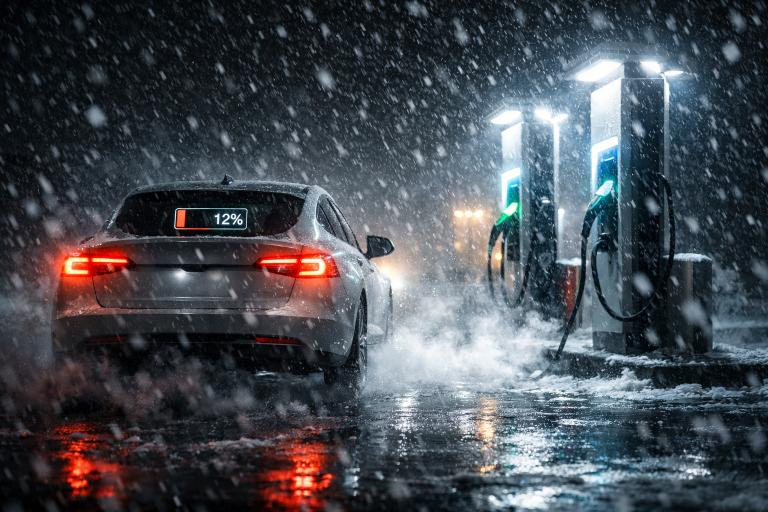
The AAA’s cold-weather EV range study found that at 20°F (–6.7°C) with cabin heat on, average range dropped 41% below EPA. At 32°F (0°C), the loss is more moderate — typically 15–25% depending on the model. EVs with heat pumps (standard on most 2024+ models) recover roughly 8–12 percentage points of that loss compared to resistive heating, which is why checking whether a specific model uses a heat pump is worthwhile if you live in a cold climate.
For a deeper look at the cold-weather specifics, see our guide on what happens to an EV battery in extreme cold.
2. Speed — The Most Controllable Variable
Aerodynamic drag increases with the square of speed. That is not a formula — it is a practical reality that compounds fast. Driving at 80 mph instead of 60 mph roughly doubles the aerodynamic load. In range terms: most EVs lose 20–25% of their highway range when driven at 80 mph compared to 65 mph.
The practical implication for road trips is significant. On a 300-mile trip at 65 mph, a vehicle with a 300-mile EPA rating might complete the journey with a stop for a brief top-up. At 80 mph, that same trip requires a longer or more frequent charge. Speed is also the variable most directly within the driver’s control — slowing down on the highway is the single most effective range-extension technique available.
3. Cabin Climate — Heating vs Cooling
Heating an EV cabin in winter draws 3–5 kW of power continuously — equivalent to running the motor at low effort just to keep the occupants warm. At typical EV efficiency figures, that translates to roughly 10–15 miles of range consumed per hour of heating, regardless of driving speed. Seat and steering wheel heaters draw far less power (0.1–0.5 kW each) and warm occupants more efficiently than heating the entire cabin — most EV owners learn to use them instead of the full HVAC in cold weather.
Air conditioning in summer has a smaller but still noticeable effect — typically 5–10% range reduction at peak heat. Modern EV heat pumps also assist with cooling efficiency on newer models, so the A/C penalty is lower than it was on 2020–2022 EVs.
4. Payload and Towing
A full car of passengers and luggage adds meaningful weight. For reference, the EPA range test is conducted with a single occupant and no cargo. Adding three adults and a loaded boot can reduce range by 5–10%. Towing is a more severe case — a 3,500 lb trailer behind a Tesla Model Y cuts real-world range to roughly 100–120 miles, not the 330 the window sticker implies. Range and towing are fundamentally incompatible in current-generation EVs.
5. Terrain and Elevation
Sustained uphill driving drains the battery at two to three times the flat-road rate. In hilly or mountainous terrain, range can drop 20–30% below flat-road estimates. However, terrain cuts both ways — the regenerative braking on long downhill sections can meaningfully recover charge. Drivers who navigate the same hilly route every day typically find the round-trip average stays close to flat-road estimates because the climb and descent largely cancel out.
WLTP vs EPA: Why UK and European Figures Look Higher
If you have researched EVs across international markets, you will have noticed that UK and European range figures are consistently higher than US figures for the same vehicle. A BYD Atto 3 with a UK WLTP figure of 260 miles has a US-equivalent range closer to 190–210 miles. This is not because the European version has a bigger battery — it is because the two test cycles measure different things.
WLTP (Worldwide Harmonised Light Vehicle Test Procedure) uses a broader speed range than the EPA cycle (up to 81 mph) but includes a heavier weighting toward urban and suburban driving, where EVs recover more energy through regeneration. The net effect is that WLTP figures typically run 20–30% above the EPA equivalent for the same vehicle.
A simple conversion rule: take any WLTP range figure and multiply by 0.75 to get a rough EPA-equivalent estimate. Multiply that by 0.82 again to get a realistic real-world highway range estimate. A vehicle with a 300-mile WLTP figure translates to roughly 225 miles EPA and approximately 185 miles of highway real-world range.
How to Estimate Your Actual Range Before Buying
Rather than relying on the EPA figure, run this four-step calculation using your specific driving conditions before committing to a model.
Step 1: Start with the EPA range figure from fueleconomy.gov — the most accurate source for US-market ratings.
Step 2: Apply the highway adjustment. If more than 50% of your driving is at 65–75 mph, multiply by 0.83. If mostly urban, multiply by 0.92. Mixed: multiply by 0.87.
Step 3: Apply a temperature adjustment for your coldest typical commute month. Above 50°F: no adjustment. 32–50°F: multiply by 0.88. Below 32°F: multiply by 0.72 (with heat pump) or 0.62 (without).
Step 4: The result is your realistic expected range. Compare that number — not the EPA figure — against your longest likely single-day drive. If it comfortably exceeds that, the range is sufficient. If it does not, look at models with larger batteries or prioritise home charging access so you start every day at full charge.
The range bars below show how each factor compounds a 300-mile EPA vehicle:
Based on a 300-mile EPA vehicle. Highway = 70 mph sustained. Cold adjustments reflect AAA and DOE temperature data. Individual model results vary.
Which 2026 EVs Have the Smallest EPA-to-Real-World Gap?
Not all EVs handle the gap equally. Aerodynamic efficiency and powertrain efficiency are the two biggest determinants of how close real-world range tracks the EPA figure at highway speed.

The Hyundai Ioniq 6 consistently produces the smallest gap among current models — its drag coefficient of 0.21 Cd is the lowest of any production EV. At 70 mph, it typically returns 300–310 miles against a 361-mile EPA rating, a gap of around 14–17%. The Tesla Model 3 Long Range performs similarly, partly because Tesla’s energy management software is mature and the vehicle’s displays accurately reflect real-time efficiency.
Trucks and large SUVs consistently show the largest gaps. The Rivian R1T, GMC Hummer EV, and Ford F-150 Lightning all lose 20–25% of EPA range at highway speeds. Their blunt aerodynamics — designed for utility, not air displacement — extract a disproportionate efficiency penalty at speed. If highway range matters, a sedan or aerodynamic hatchback will outperform an EV truck or large SUV at comparable battery sizes.
For a full ranked list of the longest-range models currently available, see our longest range electric cars guide.
Best for Minimal Range Gap
- Hyundai Ioniq 6 — best-in-class aerodynamics (Cd 0.21)
- Tesla Model 3 — proven efficiency, accurate energy display
- Tesla Model Y — consistent performer across climates
- Chevy Equinox EV — strong real-world figure for the price
Expect a Larger Gap With
- EV trucks (R1T, F-150 Lightning, Hummer EV) — blunt aerodynamics
- Large EV SUVs (GMC Hummer EV SUV, Kia EV9) at highway speed
- Any EV without a heat pump — larger cold-weather penalty
- Any model with dual motors if you regularly drive solo — AWD drag
Who Should Not Worry About the Range Gap
The range gap is a significant concern for some buyers and largely irrelevant for others. If your daily commute is under 50 miles and you charge at home overnight, the gap between EPA and real-world highway range almost never affects you. You will start every day at full charge and return home with plenty of battery remaining, regardless of whether the car delivers 85% or 95% of its EPA figure on any given day.
Similarly, if you live in a mild climate and drive primarily in urban and suburban conditions, your real-world range will often exceed the highway estimates above. Stop-and-go traffic with regenerative braking plays to EV strengths — some owners in temperate urban environments report real-world efficiency that approaches or occasionally exceeds their EPA figure on warm days.
The range gap matters most to buyers who regularly drive long distances on the highway, live in cold climates, lack reliable home charging, or plan to use an EV as their sole vehicle for road trips. For those use cases, planning around 75–80% of EPA as your usable range is the right starting assumption. For a practical look at how range affects long-distance travel, see our guide to the best EVs for road trips.
If range anxiety is a regular concern — separate from the gap issue — the underlying causes are worth examining. Our EV range anxiety guide covers the psychology and practical solutions in detail.
FAQ: EV Range vs Real Range
How much less range do EVs get in real life compared to the EPA figure?
At steady highway speeds around 70 mph in mild weather, expect 15–18% below the EPA figure. That means a 300-mile EPA vehicle delivers roughly 248–255 miles in typical highway use. In mixed city and highway driving, the gap narrows to 8–12% because regenerative braking recovers energy in urban traffic. Cold weather significantly worsens the gap — at 20°F (–6.7°C) with cabin heat on, AAA found an average 41% reduction from EPA. A 300-mile vehicle becomes a 177-mile vehicle in severe cold.
Why does cold weather reduce EV range so much?
Two separate mechanisms work simultaneously in cold weather. First, lithium-ion battery chemistry slows at low temperatures — cells lose 10–20% of their effective capacity below freezing even before any power is drawn for heating. Second, unlike petrol vehicles that heat the cabin from waste engine heat, EVs generate warmth electrically, drawing 3–5 kW directly from the drive battery. Together, these effects produce the 40%+ range reductions seen in cold-weather testing. EVs with heat pumps — standard on most 2024+ models — recover 8–12 percentage points of that loss by moving heat rather than generating it, but cannot fully compensate at very low temperatures.
What is the difference between EPA range and WLTP range?
EPA (US) and WLTP (UK, EU, Australia) use different test cycles. WLTP includes a heavier weighting toward urban driving — where EVs excel due to regenerative braking — and a different speed profile. The result is that WLTP figures typically run 20–30% higher than the EPA equivalent for the same vehicle. A car with a 300-mile WLTP rating has a rough EPA equivalent of around 225 miles. When comparing EVs across markets, always check which standard the figure uses before drawing conclusions.
Does driving faster reduce EV range significantly?
Yes — speed is one of the most impactful range variables. Aerodynamic drag increases with the square of speed, so driving at 80 mph instead of 65 mph roughly doubles the aerodynamic load on the vehicle. In practice, most EVs lose 20–25% of highway range when driven at 80 mph compared to 65 mph. A vehicle with an EPA figure of 300 miles typically delivers around 235 miles at 80 mph in mild conditions versus approximately 260 miles at 65 mph. Slowing down from 80 mph to 65 mph is the single most effective range-extension technique available to the driver.
Which EV has the closest real-world range to its EPA rating?
The Hyundai Ioniq 6 SE RWD consistently produces the smallest gap in independent highway testing — typically 14–17% below its 361-mile EPA figure at 70 mph, delivering around 300 miles. Its drag coefficient of 0.21 Cd is the lowest of any production EV, which directly reduces the speed-related efficiency penalty. Tesla Model 3 and Model Y also perform well relative to their EPA figures, partly due to Tesla’s mature energy management software. EV trucks and large SUVs show the largest gaps — typically 20–25% below EPA at highway speed.
What is the best rule of thumb for planning EV range?
Use 80% of the EPA figure as your realistic daily range estimate for mixed driving in mild conditions. For highway-heavy driving at 70+ mph, use 82–85% of EPA. For cold climates (regularly below 32°F), use 65–70% of EPA if the vehicle has a heat pump, or 55–65% if it uses resistive heating. Apply these figures to your longest likely single-day drive — if the adjusted figure comfortably covers it with margin to spare, the range is adequate. If it is borderline, prioritise home charging so you start each day at full battery rather than depending on public charging to bridge the gap.
- EPA fueleconomy.gov — official US fuel economy ratings and test methodology documentation
- AAA Automotive Research — cold-weather EV range study (2024): range reduction at 20°F with climate control on
- Edmunds — real-world EV range test data, standardised highway testing at 70 mph
- ABRP (A Better Route Planner) — owner-reported aggregate efficiency data by model and temperature
- WLTP conversion approximations based on manufacturer published figures across US and EU markets