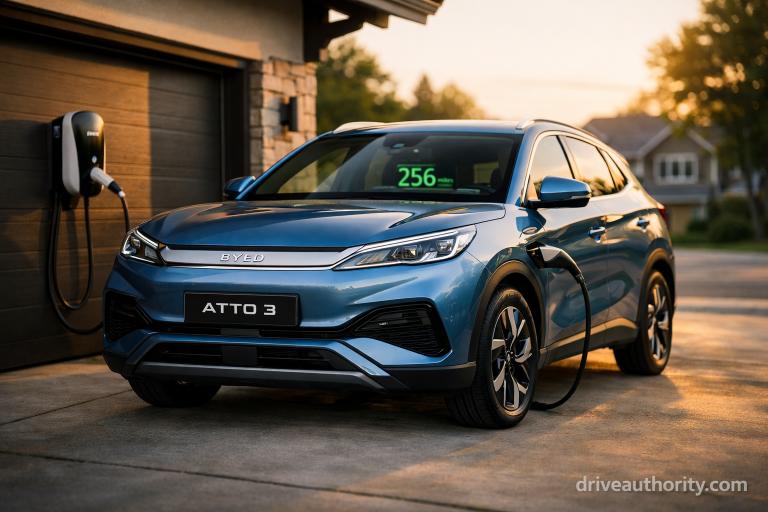
The BYD Atto 3 Extended Range is quoted at 260 miles WLTP. Most buyers discover the BYD Atto 3 range reality on their first motorway run: approximately 185–205 miles at 70mph. That 55–75 mile gap is not a BYD problem specifically — it is what WLTP always does when you compare a 46 km/h laboratory average speed against a 113 km/h motorway — but BYD dealers quote WLTP without routinely clarifying it, and most buyers do not calculate the difference until they are watching the range counter drop faster than expected. In winter below 5°C, that figure drops further to approximately 140–165 miles. These are the two numbers the window sticker does not show, and they are the ones that determine whether this car fits your life.
BYD Atto 3 Real Range — The Short Answer:
The Extended Range model (60.5 kWh, £35,490 base in the UK) delivers approximately 185–205 miles at a steady 70mph versus its 260-mile WLTP claim. In winter below 5°C, real-world range falls to approximately 140–165 miles. The DC fast charging ceiling of 80kW means a 10–80% stop takes around 38–45 minutes at a compatible charger — slower than most direct competitors at this price. The Atto 3 is a strong choice for buyers with home charging and daily mileage under 120 miles. It is not the right choice for regular long motorway journeys where charging stop frequency and speed matter.
Why the 260-Mile WLTP Figure Overstates Real-World Range
WLTP (Worldwide Harmonised Light Vehicle Test Procedure) replaced the older NEDC standard in 2018 and is more realistic — but it is still a laboratory test, not a driving test. The cycle runs at an average speed of 46.5 km/h (28.9 mph) across urban, suburban, and motorway-style phases, with a maximum speed of 131 km/h. The ambient temperature is 14°C. Climate control is operated at moderate settings. Regenerative braking is set to maximum recovery.
None of those conditions describe a UK motorway at 70mph in November. At that speed and temperature, three things change simultaneously: aerodynamic drag rises with the square of speed (roughly doubling energy consumption per mile versus the test average), the cabin heater draws continuously from the battery pack rather than periodically, and regenerative braking opportunities are limited to brief deceleration phases rather than frequent urban stop-start cycles.
The result for the Atto 3 Extended Range (60.5 kWh usable): at the WLTP average speed of 28.9mph, efficiency runs approximately 4.1–4.5 miles/kWh, producing the quoted 260-mile ceiling. At a genuine 70mph motorway cruise with the heater set to 21°C, efficiency drops to approximately 3.0–3.2 miles/kWh — delivering roughly 185–195 miles from a full charge. This 65–75 mile gap is not unique to BYD. It applies to every WLTP-rated EV. What is specific to the Atto 3 is that the gap between the headline figure and motorway reality is larger than buyers typically expect because the WLTP figure is particularly flattering relative to its weight class.
Real-World BYD Atto 3 Range at Motorway Speeds
Real-world range varies by driving style, speed, and passenger load. The figures below represent typical conditions for each scenario rather than best-case or worst-case outliers. A driver doing 40 miles of mixed urban and A-road driving daily will see efficiency well above the motorway numbers. A driver doing a sustained 80mph cruise on the motorway will see efficiency below them.
| Driving Profile | Typical Speed | Efficiency | Estimated Range | Versus WLTP |
|---|---|---|---|---|
| Urban / mixed A-road | 20–45 mph | 4.2–4.8 mi/kWh | 255–290 mi | MEETS OR EXCEEDS |
| Mixed commute (A-road + motorway) | 40–60 mph avg | 3.5–4.0 mi/kWh | 210–245 mi | ~5–20% below |
| Motorway cruise at 70mph | 68–72 mph | 3.0–3.2 mi/kWh | 185–195 mi | ~25% below |
| Motorway cruise at 80mph | 78–82 mph | 2.6–2.8 mi/kWh | 155–170 mi | ~35–40% below |
The key insight: for an owner doing a daily mix of town and A-road driving — the majority of UK commuters — the Atto 3 will often match or slightly exceed its WLTP figure. Regenerative braking in stop-start traffic recovers energy efficiently and the 60.5 kWh pack more than covers any practical daily commute. The issue arises specifically when the car is used for motorway journeys, which is exactly when buyers plan in advance and need the range figure to be accurate.
Winter Range: The Number That Changes the Purchase Decision
Winter range loss combines two effects: reduced battery chemistry performance at low temperatures (lithium cells lose capacity below 10°C and charge more slowly below 0°C) and continuous cabin heater draw. The Atto 3 uses a resistive electric heater rather than a heat pump. Resistive heating draws approximately 3–5 kW continuously in cold weather — a constant drain that compounds with the chemistry-related capacity reduction. Heat pump systems, by contrast, can deliver the same cabin warmth for 1.0–1.5 kW by moving heat rather than generating it.
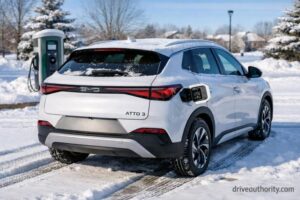
The absence of a heat pump on the Atto 3 is a notable omission at this price point. Both the MG4 EV Long Range and the Hyundai Kona Electric include heat pumps as standard on comparable trim levels — the Kona loses approximately 27% of range in winter versus the Atto 3’s 30–35%. On a 260-mile WLTP car, that difference translates to roughly 20–25 additional winter miles.
| Condition | Ambient Temp | Range Estimate | vs Mild Weather (14°C) | Planning Note |
|---|---|---|---|---|
| Mild — spring/autumn | 10–16°C | 185–205 mi | Baseline | Consistent with WLTP motorway phase |
| Cool — early winter | 3–9°C | 165–185 mi | ~10–15% less | Plan charging stops on 150+ mi trips |
| Cold — mid winter COMMON UK | 0–3°C | 145–165 mi | ~20–25% less | Maximum comfortable trip ~120 mi without charging |
| Freeze — deep winter | Below -3°C | 130–145 mi | ~30–35% less | Pre-condition while plugged in; plan every 100 mi |
The practical takeaway for UK buyers: the Atto 3 is adequate for a London-to-Birmingham motorway run (127 miles) in almost any winter condition with a full charge. London to Edinburgh (414 miles) requires two motorway charging stops regardless of season — and the speed of those stops depends on the 80kW charging ceiling covered in the next section. Pre-conditioning the battery and cabin while still plugged in at home — a feature BYD includes — recovers approximately 10–15 miles of winter range by warming the pack before departure.
The 80kW DC Charging Ceiling: What It Means on a Long Journey
The 80kW DC charging ceiling is the Atto 3’s most material limitation for road-trip use, and it is not something a software update will fix — it is a hardware decision embedded in the battery management system. At a 50kW public rapid charger (the most common standard on UK motorway services), the Atto 3 charges at 50kW — a 10–80% session takes approximately 50–55 minutes. At a 150kW+ rapid charger, it draws its maximum 80kW, bringing 10–80% down to approximately 38–42 minutes.
For comparison: the MG4 EV Long Range draws 150kW, completing 10–80% in approximately 38 minutes at a high-speed charger and providing 25–40% more range from the same stop time. The Ioniq 6 Standard Range draws up to 350kW, completing 10–80% in approximately 18 minutes. Neither of those competitors is significantly more expensive than the Atto 3 in UK trim-for-trim comparisons.
| Vehicle | UK Price (approx.) | WLTP Range | DC Peak (kW) | 10–80% Time | Miles Added / 30 min |
|---|---|---|---|---|---|
| BYD Atto 3 Extended | from £35,490 | 260 mi | 80 kW CEILING | ~38–42 min | ~90 mi |
| MG4 EV Long Range BETTER VALUE | from £30,495 | 323 mi | 150 kW | ~38 min | ~160 mi |
| Hyundai Kona Electric | from £34,995 | 261 mi | 100 kW | ~42 min | ~115 mi |
| VW ID.4 Pure+ | from £38,995 | 222 mi | 100 kW | ~38 min | ~100 mi |
| Hyundai Ioniq 6 SE SR | from £37,995 | 238 mi | 350 kW cap. | ~18 min | ~175 mi |
The MG4 EV Long Range charges at 150kW versus the Atto 3’s 80kW ceiling — and costs approximately £5,000 less at UK list price, with 63 additional WLTP miles. That combination makes it the stronger purchase for any buyer who plans to road-trip regularly. The Atto 3’s advantages over the MG4 are interior quality (a more premium, distinctive cabin), BYD’s longer warranty terms, and the Blade LFP battery chemistry which supports daily 100% charging without the long-term degradation concerns of NMC cells.
One important practical note: UK motorway services rapid chargers are predominantly 50kW or 150kW units. At a 50kW charger the Atto 3’s 80kW ceiling does not help — it charges at the station’s limit of 50kW, putting 10–80% at around 50–55 minutes. Buyers who regularly use motorway services should check that the specific stations on their regular routes have 80kW+ chargers before relying on sub-40-minute stops. A home 7.4kW wallbox changes the calculus entirely: overnight charging makes public DC speed largely irrelevant for typical daily use.
BYD Atto 3 vs Competitors: Range, Charging, and Price
The Atto 3 sits in a competitive segment. At £35,490 for the Extended Range, it competes directly with the Hyundai Kona Electric (virtually identical WLTP range and price, 100kW DC vs 80kW), the MG4 EV Long Range (cheaper, longer WLTP range, faster charging), and the VW ID.4 Pure+ (more expensive, more cargo, comparable charging). The right comparison depends on what you value most.
| Vehicle | UK Price | Battery | WLTP | Real-World 70mph | DC Max | Heat Pump | LFP Battery |
|---|---|---|---|---|---|---|---|
| BYD Atto 3 Extended | £35,490 | 60.5 kWh | 260 mi | ~190 mi | 80 kW | No | Yes |
| MG4 EV Long Range | £30,495 | 77 kWh | 323 mi | ~230 mi | 150 kW | Yes | No (NMC) |
| Hyundai Kona Electric | £34,995 | 64.8 kWh | 261 mi | ~200 mi | 100 kW | Yes | No (NMC) |
| VW ID.4 Pure+ | £38,995 | 52 kWh | 222 mi | ~180 mi | 100 kW | Yes | No (NMC) |
The Atto 3’s LFP (lithium iron phosphate) Blade battery is a genuine advantage for daily charging habits. Unlike the NMC chemistry used in the Kona, MG4, and ID.4, LFP cells do not degrade meaningfully from regular 100% charges. NMC owners are routinely advised to charge to 80% daily and only top to 100% before long trips. Atto 3 owners can charge to 100% every night without concern. Over a five-year ownership period, this translates to a meaningfully larger usable range window on most days. For a detailed breakdown of BYD’s Blade LFP battery advantages and limitations against NMC chemistry, see the BYD vs Tesla comparison.
Who the BYD Atto 3 Is Right For — and Who Should Look Elsewhere
The range and charging limitations described above matter differently depending on how you drive. A buyer doing 60 miles of mixed commuting daily with a home wallbox will never encounter the motorway range gap in normal use. A buyer doing weekly 200-mile motorway runs will encounter the 80kW charging ceiling on every trip. Getting this distinction right before purchase determines whether the Atto 3 feels like good value or a constant compromise.
Buy the BYD Atto 3 if…
- You have a home wallbox or reliable workplace charging
- Your daily mileage is under 120 miles on mixed routes
- You value daily 100% LFP charging without battery anxiety
- You want a distinctive, premium-feel interior at this price point
- You live in a mild climate or primarily drive in spring and summer
- Long-distance road trips are fewer than twice a month
Look elsewhere if…
- You regularly drive 150+ miles on motorways without home charging
- Your region regularly sees temperatures below 0°C and you need 160+ miles confidence
- You want the fastest possible DC charging stops (consider Ioniq 6)
- Budget is a priority — the MG4 EV Long Range is £5,000 cheaper with faster charging
- You need a heat pump for consistent winter efficiency
Frequently Asked Questions About BYD Atto 3 Range
What is the real-world range of the BYD Atto 3?
At a steady 70mph on UK motorways in mild conditions (around 14°C), the Atto 3 Extended Range (60.5 kWh) delivers approximately 185–205 miles — roughly 25% below its 260-mile WLTP figure. In urban and mixed A-road driving, real-world range typically meets or slightly exceeds the WLTP figure, as regenerative braking recovers energy efficiently at lower speeds. The 260-mile WLTP figure is achievable in practice only at average speeds well below motorway pace.
How much range does the BYD Atto 3 lose in winter?
At temperatures between 0°C and 3°C — typical for a UK January — real-world motorway range drops to approximately 145–165 miles, a reduction of around 20–25% compared with mild-weather motorway figures. Below -3°C, range can fall to 130–145 miles. The Atto 3 uses a resistive heater rather than a heat pump, which draws 3–5 kW continuously in cold weather. Pre-conditioning the battery and cabin while still plugged in at home recovers approximately 10–15 miles by starting with a warmer pack.
What is the BYD Atto 3 DC fast charging speed?
The Atto 3 Extended Range has a maximum DC charging rate of 80kW. At a compatible 80kW+ rapid charger, a 10–80% session takes approximately 38–42 minutes and adds roughly 90 miles of real-world motorway range. At a common 50kW motorway services charger, the car draws 50kW (the station’s limit), extending 10–80% to approximately 50–55 minutes. The 80kW ceiling is a hardware limitation — it applies regardless of the charger’s maximum output.
Is the BYD Atto 3 good for long motorway trips?
It is manageable but not the strongest choice in its class. On a London-to-Edinburgh journey (414 miles), an Atto 3 requires two charging stops in summer and potentially three in winter, with each stop lasting 38–55 minutes depending on the charger available. By comparison, the MG4 EV Long Range completes similar journeys with fewer stops and charges faster. If regular long motorway trips are part of your use case, the 80kW DC ceiling and winter range reduction are likely to cause friction. For occasional motorway use or primarily urban/suburban driving, the Atto 3 is a practical choice.
Does the BYD Atto 3 have a heat pump?
No. The Atto 3 uses a resistive electric heater for cabin warming, not a heat pump. This is a notable omission at this price point — the MG4 EV Long Range, Hyundai Kona Electric, and most other comparable EVs include heat pumps as standard on mid-range trims. A heat pump delivers the same cabin warmth for roughly 1.0–1.5 kW rather than 3–5 kW, preserving 10–15% more winter range. The BYD pre-conditioning feature partially compensates by warming the battery before departure, but it does not replicate the continuous efficiency advantage of a heat pump during the drive itself.
Can you charge the BYD Atto 3 to 100% every day?
Yes, and this is one of the Atto 3’s genuine advantages. Its Blade battery uses lithium iron phosphate (LFP) chemistry, which does not degrade meaningfully from regular 100% charging. NMC battery vehicles (Kona Electric, MG4, ID.4) are typically recommended to charge to 80% daily to preserve long-term battery health. Over a five-year ownership period, the LFP daily 100% charge habit means more usable range on every journey — effectively an invisible advantage that compounds over time. BYD warranties the battery to 70% capacity over 8 years as standard.
How does the BYD Atto 3 compare to the MG4 EV?
For most buyers who prioritise value and motorway capability, the MG4 EV Long Range is the stronger purchase. At approximately £30,495 it is around £5,000 cheaper than the Atto 3 Extended Range, has a longer WLTP range (323 miles vs 260), charges significantly faster (150kW vs 80kW), and includes a heat pump. The Atto 3’s advantages are its BYD Blade LFP battery (supports daily 100% charging without degradation), a more distinctive and premium-feeling interior, and marginally longer warranty terms. If interior quality and daily charging convenience matter more than motorway charging speed and price, the Atto 3 remains a considered choice.
Is the BYD Atto 3 available in the United States?
No. The BYD Atto 3 is not available in the United States. A 100% import tariff on Chinese-manufactured vehicles, applied from 2024, effectively blocks BYD from the US passenger car market at any competitive price point. The Atto 3 is sold in the UK, Australia, parts of Southeast Asia (Thailand, Singapore, Malaysia), the Middle East (UAE, Saudi Arabia), and select European markets. US buyers seeking a comparable vehicle should consider the Chevrolet Equinox EV or Hyundai Kona Electric.