The BYD vs Tesla comparison changed fundamentally in late 2025. The $7,500 federal EV tax credit expired September 30, 2025. Tesla discontinued Model S and Model X in Q1 2026. BYD’s Seal got a 2026 update with a bigger boot and new tech at unchanged pricing. For the first time, these two brands compete on pure product merit — no credit advantage, no legacy halo models. This guide compares them honestly across pricing, range, charging, technology, reliability, and 5-year ownership cost with April 2026 data.
BYD vs Tesla 2026 — Quick Verdict: In North America, Tesla wins on charging network (3,000+ Supercharger stations), software maturity, resale value, and OBBBA loan deduction eligibility. BYD wins on battery durability (Blade LFP), standard equipment depth, and upfront price in tariff-free markets (UK: BYD Seal £45,730 vs Tesla Model 3 ~£38,990). The 100% U.S. tariff makes BYD non-competitive in America. In the UK and EU, it’s a genuine head-to-head for the first time.
Pricing: The Post-Credit Reality
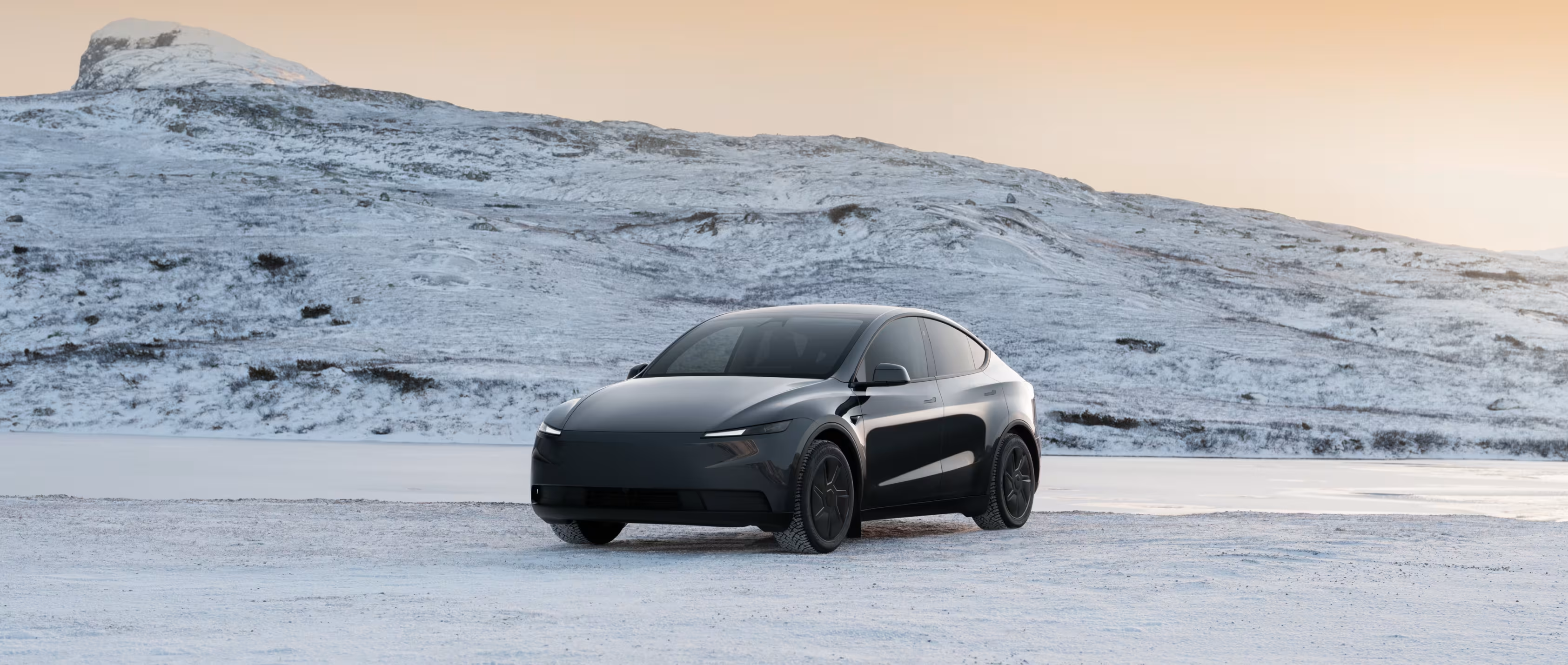
The expired IRA credit eliminates Tesla’s biggest North American price advantage. Tesla Model Y RWD is now $34,990 at full MSRP — no $7,500 discount. Tesla does qualify for the OBBBA auto loan interest deduction ($10K/yr, U.S.-assembled), saving ~$2,200/yr at the 22% tax bracket. BYD, assembled in China, qualifies for neither the old credit nor OBBBA. In the U.S., the 100% tariff doubles BYD’s effective price — making it commercially nonviable. In the UK, BYD Seal starts at £45,730 vs Tesla Model 3 at ~£38,990 — BYD is actually more expensive.
| Model | U.S. Price | UK Price | Federal Incentive | OBBBA Eligible? |
|---|---|---|---|---|
| Tesla Model Y RWD | $34,990 | ~£36,990 | None (expired) | Yes |
| Tesla Model Y LR AWD | $43,990 | ~£44,990 | None | Yes |
| Tesla Model 3 RWD | $38,990 | ~£38,990 | None | Yes |
| BYD Seal Design | ~$70,000+ (after tariff) | £45,730 | None | No |
| BYD Seal Excellence AWD | ~$97,000+ (after tariff) | £48,730 | None | No |
| BYD Dolphin Comfort | N/A (tariff) | £30,195 | None | No |
Sources: Tesla.com (April 2026), BYD UK (Feb 2026). IRA credit expired per OBBBA (July 4, 2025). U.S. tariff: 100% on Chinese-assembled EVs.
Range, Efficiency, and Charging
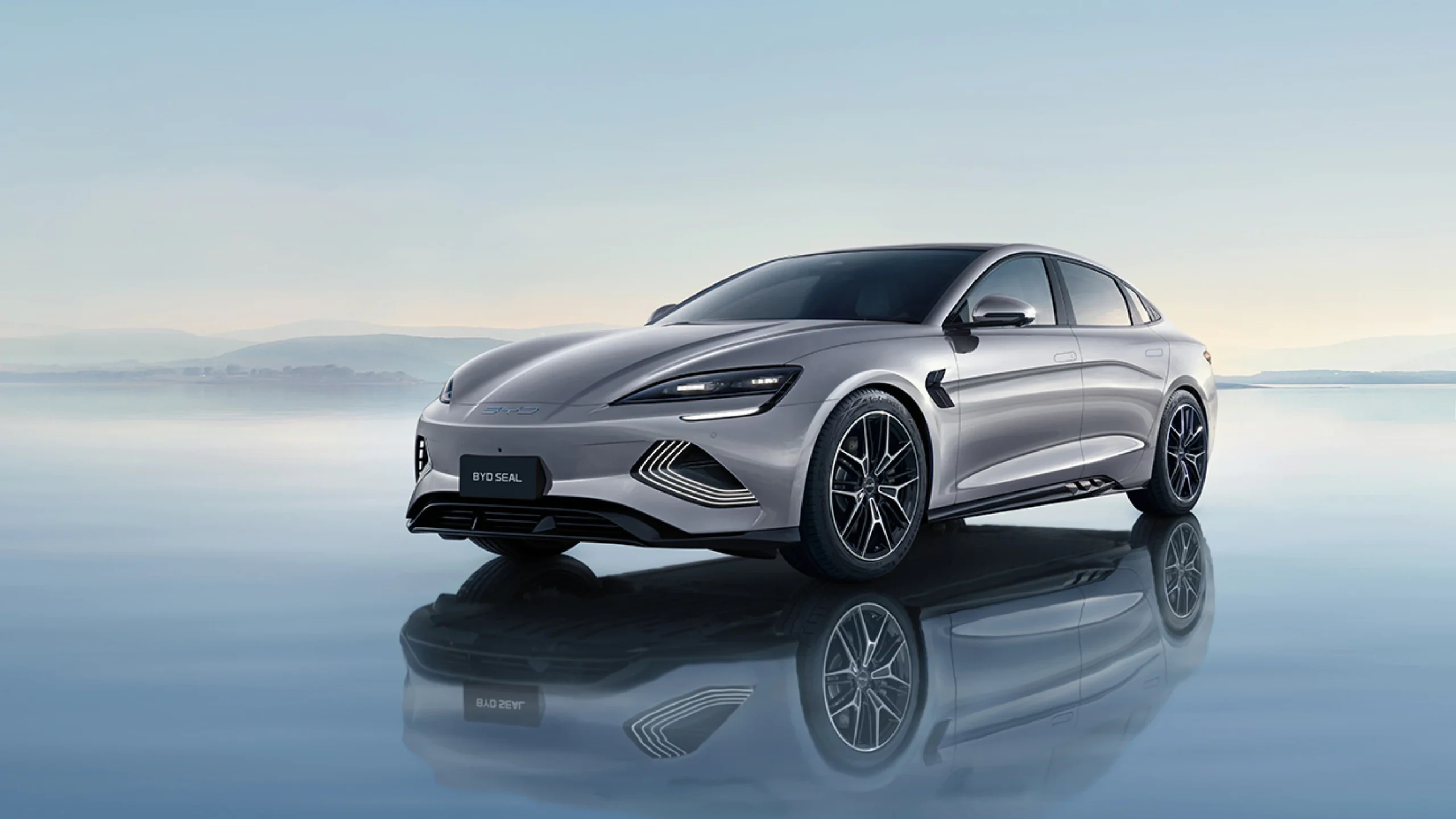
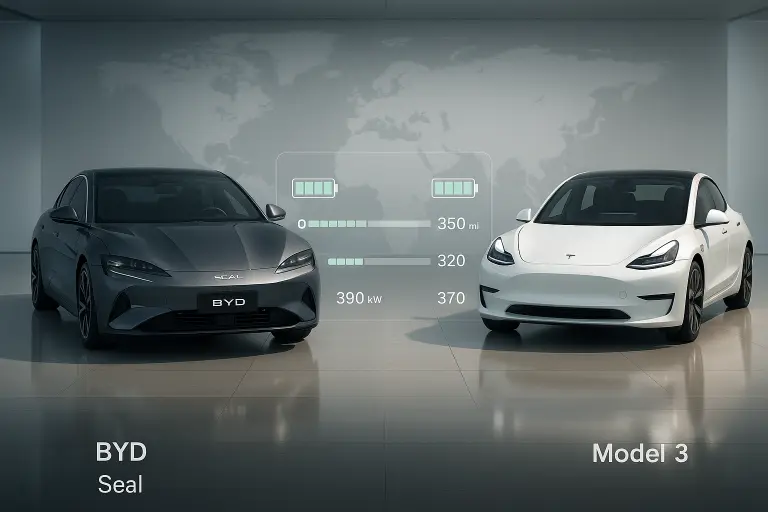
The BYD Seal Design delivers 354 miles WLTP (82.5 kWh Blade Battery) — heycar UK estimates ~300 miles real-world. Tesla Model 3 RWD: 272 miles EPA. Tesla Model Y LR: 326 miles EPA. In real-world mixed driving, Tesla achieves approximately 3.8–4.1 mi/kWh vs BYD’s 3.6–3.9 mi/kWh. Tesla’s advantage: smaller, lighter packs with higher energy density. BYD’s advantage: LFP chemistry handles daily 100% charging without accelerated degradation.
Charging is Tesla’s clearest structural advantage. Tesla Supercharger: 3,000+ stations, 250 kW V3, up to 500 kW V4, 10–80% in ~27 min. BYD Seal: 150 kW DC max, 10–80% in ~37 minutes. BYD uses CCS2 in UK/EU with access to Ionity/BP Pulse, but third-party network reliability still trails Supercharger. In the UK, this gap is narrower than in the U.S. For cold climates: Tesla’s NMC loses 15–25% range below freezing; BYD’s LFP loses 20–30% — a genuine disadvantage for Canadian and Northern European buyers.
Technology, Software, and ADAS
Tesla’s software ecosystem remains its most defensible advantage. OTA updates improve the car for years after purchase — range optimization, ADAS improvements, UI changes, all without a dealer visit. FSD Supervised ($99/mo subscription) handles highway and urban driving scenarios with the industry’s largest real-world training dataset. BYD’s DiLink infotainment is capable — the Seal’s 15.6-inch screen, Dynaudio audio, and Nappa leather are all standard. But OTA update frequency runs at roughly half Tesla’s cadence. BYD’s DiPilot ADAS is competent on highways but lacks FSD’s urban scenario coverage.
One area where BYD leads: standard equipment. The 2026 Seal includes panoramic roof, heated/ventilated front seats, wireless charging, 12-speaker audio, and Driver Monitoring System — all standard at £45,730. Tesla charges extra for several comparable features or bundles them into higher trims.
Reliability, Battery Life, and Ownership Costs
BYD’s Blade Battery carries an 8-year / 155,350-mile warranty — longer than Tesla’s 8-year / 100,000-mile (Model Y LR) or 120,000-mile (Performance) coverage. LFP chemistry is more cycle-stable: BYD owners can charge to 100% daily with less degradation risk. Tesla NMC packs show ~91–94% retention at 100,000 miles when charging to 80–90%. Both are strong — BYD’s chemistry advantage is real but the practical difference for most owners is marginal.
Tesla’s service network: 200+ U.S. centers + mobile service. BYD’s North American presence is minimal due to tariffs. In the UK: BYD has ~50 retail points; Tesla has ~30 service centers but stronger mobile service. Auto Express reports BYD Seal resale at 48% after 3 years — stronger than Tesla Model 3 (41–48%) and BMW i4 (37–40%) in the UK market. For our full ownership cost analysis, see BYD vs Tesla vs MG: 5-Year Cost.
BYD vs Tesla by Market — The Answer Changes
United States
Tesla wins decisively. 100% tariff makes BYD non-competitive. Tesla qualifies for OBBBA deduction. Supercharger network is unmatched. Service infrastructure is established. There is no realistic BYD vs Tesla comparison in the U.S. in 2026 — Tesla is the only viable option.
United Kingdom
Genuinely competitive. BYD Seal (£45,730) vs Tesla Model 3 (£38,990) — Tesla is cheaper. But the Seal includes more standard equipment and has stronger UK resale data. For buyers who value interior quality and battery longevity over price and charging speed, the Seal is compelling. For value buyers: the MG4 at £28,495 undercuts both. See our MG4 vs Dolphin comparison.
Australia and MENA
BYD’s strongest markets — no tariff barriers, growing dealer networks, and LFP’s heat tolerance is an advantage in hot climates. The Seal competes directly with Model 3 on price in Australia (~AU$50K vs ~AU$52K). BYD’s 6-year warranty and 8-year battery coverage provide ownership confidence. See our Chinese EVs vs Tesla comparison.
Who Should Buy Which?
Choose Tesla If…
- You’re in North America (BYD effectively unavailable)
- Supercharger network access is a priority
- Software updates and FSD matter long-term
- You want the OBBBA loan deduction (U.S. only)
- Cold climate — less range loss than BYD LFP
- Resale predictability matters (established data)
Choose BYD If…
- You’re in UK, EU, Australia, or MENA (no tariff)
- Battery longevity and 100% daily charging matter
- Standard equipment depth is a priority
- You plan to own 5+ years (longer battery warranty)
- Interior quality matters more than software
- Hot climate — LFP handles heat better than NMC
FAQ: BYD vs Tesla 2026
Does Tesla still get the $7,500 tax credit in 2026?
No. The $7,500 IRA Clean Vehicle Credit expired September 30, 2025. Neither Tesla nor BYD receives a federal purchase credit. Tesla qualifies for the OBBBA auto loan interest deduction ($10K/yr max, U.S.-assembled vehicles), which saves ~$2,200/yr at the 22% bracket. BYD does not qualify for OBBBA.
Is BYD available in the United States?
Effectively no. A 100% tariff on Chinese-assembled EVs doubles BYD’s price at the U.S. border, making every model commercially unviable. BYD challenged the tariff legally in early 2026 but it remains in effect. In the UK, EU, Australia, and MENA, BYD is widely available without tariff barriers.
Which has better battery technology — BYD or Tesla?
BYD’s Blade LFP leads on thermal safety, cycle durability, and warranty length (8yr/155K mi vs Tesla’s 8yr/100–120K mi). Tesla’s NMC/4680 cells lead on energy density — more range per kilogram. For long-term owners who charge to 100% daily, BYD’s LFP has a structural advantage. For maximum range per charge, Tesla wins.
Is the Tesla Model S still available?
No. Tesla discontinued Model S and Model X in Q1 2026. Custom orders are closed. Remaining inventory is priced at $111,380+. Tesla now sells Model 3, Model Y, and Cybertruck only. Used 2024–2025 Model S is available at $55,000–$75,000.
BYD Seal vs Tesla Model 3 in the UK — which is better?
Tesla Model 3 (£38,990) is ~£7,000 cheaper than BYD Seal (£45,730). Tesla charges faster (250 kW vs 150 kW) and has better software. BYD Seal has a premium interior (Nappa leather, Dynaudio standard), larger battery (82.5 kWh), more range (354 mi WLTP vs ~305 mi), and stronger UK resale (48% vs 41–48% at 3 years per Auto Express). If price and charging speed lead: Tesla. If interior, range, and resale lead: BYD.
Which brand holds value better?
In the UK: BYD Seal retains ~48% at 3 years — stronger than Tesla Model 3 (41–48%) per Auto Express. In the U.S.: Tesla has established residual data (55–65% at 3 years); BYD has none due to tariff-driven absence. In Australia: both are establishing data, with BYD showing competitive early signals.
- BYD UK Official — 2026 Seal pricing, specs, warranty
- Auto Express — BYD Seal review, resale data (48% at 3yr)
- electrive.com — Seal UK launch confirmation
- Tesla.com — Model 3/Y pricing (April 2026)
- IRS OBBBA Guidance — Loan deduction rules
- heycar UK — Real-world range (~300 mi mixed)