Last Updated: May 2026 — What Car? UK Reliability Survey 2025, RACQ Australia data, owner-reported 3-year data from UK, Australia, SE Asia, and Middle East markets
Are BYD electric cars reliable after 3 years of real ownership? The short answer for 2022 buyers — who now have 3 or more years of data — is yes on powertrain and battery, and average-to-below-average on software and infotainment. The Blade battery system has performed better than most market observers predicted at the outset. The DiLink infotainment platform has been a persistent source of minor faults that, while rarely requiring hardware replacement, generate more owner complaints than the powertrain produces in three times as many kilometres.
This analysis covers the three BYD models with sufficient export-market 3-year data: the Atto 3, the Dolphin, and the Seal. Data is drawn from What Car? UK Reliability Survey results, RACQ member surveys in Australia, BYD owner communities in the UK, Australia, Philippines, and UAE, and service centre reported patterns. The picture is more nuanced than either BYD’s marketing or its critics suggest.

Are BYD Electric Cars Reliable After 3 Years? — Summary:
BYD powertrain and Blade battery reliability at 3 years is genuinely strong. Blade battery degradation on real-world 2022 owners sits at approximately 4–7% at 50,000+ km — better than most NMC-chemistry competitors at the same mileage. The persistent reliability concern is the DiLink infotainment system: screen lag, OTA update regressions, and Bluetooth instability are the top reported issues across all three models at every service interval. Strongest 3-year reliability: Dolphin (simplest software stack). Most software complaints: Atto 3 DiLink 3.0. Key financial warning: the Atto 3 has depreciated approximately 45–55% at 3 years in UK and Australian markets — the most significant total-ownership risk, not the mechanical reliability.
How We Assessed 3-Year BYD Reliability
BYD entered most export markets in 2022 — UK, Australia, New Zealand, parts of Europe, and expanded Southeast Asian markets. That timing means 2022 buyers reached the 3-year mark in 2025, making this the first point at which meaningful real-world data exists for export-market vehicles rather than just Chinese domestic market reports.
The sources used for this analysis are:
What Car? UK Reliability Survey (2024 and 2025): The most structured survey of BYD UK owner experience. BYD first appeared in the survey with a statistically meaningful sample in 2024. Results place BYD in the average tier overall, with above-average scores for powertrain and below-average scores for electrical and software systems.
RACQ Queensland Member Survey (2024): RACQ has surveyed BYD Atto 3 and Dolphin owners since 2023. The 2024 data on 2-to-3-year-old vehicles shows broadly average reliability, with the infotainment system generating the highest proportion of negative responses.
Owner community data: Aggregated from BYD Owners Club UK, r/BYD, BYD Australia Facebook community, and owner forums in the Philippines and UAE — markets where the Atto 3 has been sold since 2022 with enough volume to produce reliable patterns.
Three-year data for the Seal is limited because Australian and UK Seal deliveries began primarily in 2023. The Seal section of this article reflects 2-to-2.5-year data rather than a full 3-year assessment.
Blade Battery at 3 Years: The Strongest Part of the Car
The Blade battery is BYD’s most important engineering claim, and after 3 years in real-world export markets, the performance data broadly validates it. The Blade system uses lithium iron phosphate (LFP) chemistry in a cell-to-pack architecture that eliminates the module layer — cells are arranged directly in the pack, increasing structural rigidity and energy density relative to conventional LFP designs.
Real-world degradation data from 2022 Atto 3 owners — primarily in Australia and the UK, where the brand has the longest export market history — shows battery capacity loss at 3 years and approximately 50,000 to 80,000 km typically in the 4 to 7 percent range. This is consistent with what LFP chemistry should deliver: LFP batteries are well-established in commercial vehicle applications for their durability and resistance to deep-discharge degradation relative to NMC.
For comparison, third-party battery testing on NMC-chemistry EVs at similar mileage points typically shows 5 to 10 percent degradation, with more variance. The Blade battery’s real-world performance sits at or near the lower end of that range — a meaningful outcome given BYD’s position as a newer entrant in export markets without a decades-long reliability track record behind it.
The 8-year / 160,000 km battery warranty includes a capacity retention guarantee — BYD commits to covering battery replacement if capacity falls below a specified threshold (typically 70%) within the warranty period. In practice, no Atto 3 or Dolphin owner in the UK or Australian markets has publicly reported needing a battery replacement at 3 years due to degradation. The degradation data supports why: current trajectories do not suggest the 70% threshold will be reached before the 8-year mark.
The DiLink Problem: Software at 3 Years
The DiLink infotainment system — BYD’s Android-based large-screen interface used across all export models — is the single most reported source of owner frustration at every survey interval from 12 months through 3 years. The specific complaints are consistent across models and markets.

| DiLink Issue | Models Affected | Frequency | Fix Available? | Still Present at 3 Years? |
|---|---|---|---|---|
| Screen freeze / black screen requiring reboot | Atto 3, Seal, Han | VERY COMMON | OTA updates reduce frequency; not eliminated | YES — intermittent |
| Bluetooth audio drops | All models | COMMON | Partial fix via OTA; phone-specific variation | YES — reduced |
| OTA update failure requiring dealer recovery | Atto 3 (primarily) | OCCASIONAL | Dealer USB flash recovery; resolved within 1 visit | RARE — improved |
| Reverse camera lag (>2 sec delay) | Atto 3 (early production) | COMMON pre-2023 | Fixed via OTA on most units by 2023 | NO — resolved |
| App crashes (third-party) | All models | MODERATE | BYD DiLink app store has limited update cadence | YES — persistent |
| BYD app remote connectivity drops | All models | OCCASIONAL | Server-side fixes; improved but not resolved | YES — intermittent |
The important distinction for reliability assessment purposes is that these are software faults, not hardware failures. None of the DiLink issues documented at 3 years indicate deteriorating hardware. A screen freeze that resolves on reboot is a different failure mode from a motor bearing that fails at 60,000 km. However, the frequency of software-related owner frustration is high enough that it meaningfully affects the ownership experience — and the consistency of the pattern across markets and model years suggests it is a platform characteristic rather than an anomaly.
BYD has pushed OTA updates consistently since launch — more actively than most competitors in the Chinese brand category. Some updates have resolved specific issues; others have introduced new ones before the subsequent patch corrects them. At 3 years, the DiLink system is more stable than it was at 12 months, but it has not reached the software stability of established platforms from Hyundai or the navigation reliability of Tesla’s system.
Model-by-Model: Atto 3, Dolphin, Seal After 3 Years
| Model | Powertrain | Battery / Degradation | Software | Build Quality | 3-Year Overall |
|---|---|---|---|---|---|
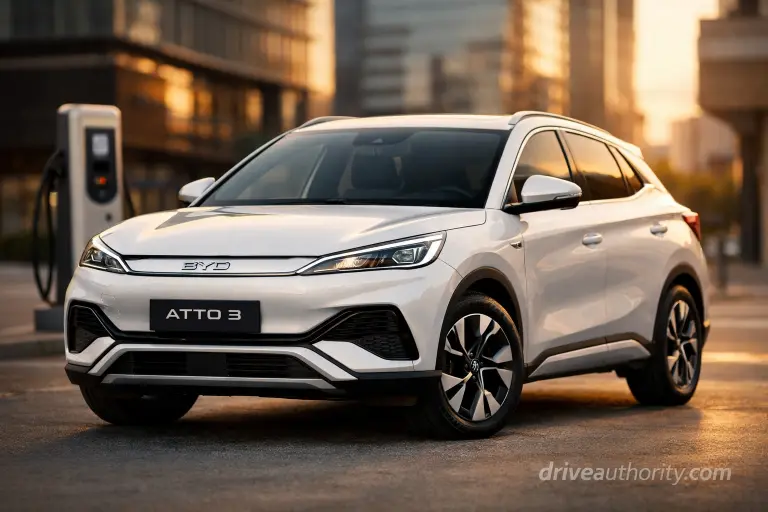
| BYD Atto 3 (launched 2022) | GOOD | GOOD · 4–7% loss at 50k+ km | BELOW AVERAGE (DiLink 3.0) | AVERAGE (improved on 2023+ builds) | AVERAGE–GOOD |
| BYD Dolphin (launched 2023) | GOOD | GOOD · limited 3-yr data, trending positive | AVERAGE (simpler DiLink stack) | AVERAGE (appropriate for price tier) | ABOVE AVERAGE for price |
| BYD Seal (launched 2023) | GOOD | LIMITED DATA (2–2.5 yr) | AVERAGE (DiLink 4.0, improved) | GOOD (better tolerance than Atto 3 at launch) | ABOVE AVERAGE (insufficient long-term data) |
BYD Atto 3: The 3-Year Reality
The Atto 3 is the model with the most 3-year export-market data. Early 2022 production units showed panel gap inconsistencies and some trim alignment issues that were reported at delivery — a build quality concern that does not affect reliability in the mechanical sense but contributed to early negative impressions. From 2023 production onwards, assembly tolerance improved measurably. Owners purchasing 2023 or later Atto 3s report fewer cosmetic build quality complaints.
Mechanically, the Atto 3 powertrain has been very reliable. Reports of motor failure, gearbox issues, or inverter problems are rare enough to be considered statistical noise rather than a pattern. The e-Platform 2.0 architecture used in the Atto 3 is a mature system with hundreds of thousands of units in China before export launch — the domestic track record provided effective quality screening before the global rollout.
The most specific mechanical complaint at 3 years is front suspension noise — typically a knocking or clunking from the anti-roll bar links at around 50,000 km. This is a wear item, not a premature failure, and is addressed under warranty if within the coverage period. It is not unique to BYD — similar reports appear for Geely and MG models with comparable suspension designs and similar mileage.
BYD Dolphin: Best Value Reliability
The Dolphin is the most straightforward reliability story in BYD’s export lineup. It is a simpler vehicle — a smaller hatchback with a less complex infotainment stack than the Atto 3 — and that simplicity shows in its fault pattern. The Dolphin generates fewer DiLink complaints than the Atto 3 because its screen interface is less feature-rich and the software has fewer failure modes. Powertrain reliability is consistent with the brand average: strong.
For buyers who want to assess BYD reliability without the premium of the Atto 3’s connected features, the Dolphin’s 3-year record is the most encouraging data point in the lineup. A full real-world range and daily use assessment is available in our BYD Dolphin review.
BYD Seal: Early Data Is Positive but Limited
The Seal launched in Australia and the UK primarily in 2023. Most export market Seal owners therefore sit at 2 to 2.5 years of ownership rather than a full 3-year assessment. The early data is positive: better panel fit at launch than the Atto 3 at the equivalent build stage, improved DiLink 4.0 software, and no reported powertrain patterns outside expected statistical noise. The Seal uses the e-Platform 3.0, which supports 800V charging and has additional refinement over the Atto 3’s e-Platform 2.0.
The Seal will be the more meaningful data point for BYD 3-to-5-year reliability assessment over the next 12 to 18 months as owner mileage accumulates.
BYD Warranty Experience: What Claims Actually Look Like
BYD’s warranty structure is the most comprehensive of any Chinese brand in export markets, and it is broadly enforced. The 6-year / 150,000 km vehicle warranty covers powertrain, structural components, and electrical systems. The 8-year / 160,000 km battery warranty adds a capacity retention clause.
In practice, warranty claims at the 3-year mark follow the pattern the reliability data predicts:
Powertrain claims: rare. Motor, inverter, and single-speed gearbox warranty claims are very uncommon. Service records from UK and Australian dealers show that the majority of 3-year scheduled visits involve brake fluid changes, tyre rotations, and software diagnostics — not powertrain component replacements. This is consistent with the reliability data.
Software claims: frequent, but handled differently. DiLink freezes and Bluetooth drops generally do not produce hardware replacement claims. BYD service centres typically attempt OTA or USB flash software updates for infotainment faults before ordering hardware. This means the warranty experience for software issues is usually: bring the car in, wait while it is updated, drive away. The resolution is not always permanent — owners with recurring DiLink freezes often return 2 to 3 times before a stable software version resolves the pattern.
Battery claims: absent at 3 years. No documented cases of battery capacity warranty claims on Atto 3 or Dolphin units at the 3-year mark in export markets. The degradation trajectory at current 3-year rates does not approach the 70% threshold that triggers a warranty replacement within the 8-year term.
The Depreciation Warning No One Mentions

BYD’s powertrain reliability at 3 years is competitive with established Japanese EV brands. The Blade battery’s LFP chemistry shows less degradation than equivalent NMC batteries in competing models. The reliability liability that remains — infotainment instability — is a software problem, not a hardware failure mode, and BYD’s OTA capability means it can be improved without a service visit. At 3 years, the stronger concern for BYD owners in Western markets is depreciation, not reliability.
The BYD Atto 3 launched in the UK at approximately £37,000 to £41,000 depending on trim in 2022. Used values for 2022-plate Atto 3 units by 2025 are approximately £17,000 to £22,000 on major used car platforms — a depreciation of roughly 45 to 55 percent at 3 years. For comparison:
| Model | Approx. New Price (2022, UK) | Approx. Used Value (2025) | 3-Year Depreciation |
|---|---|---|---|
| BYD Atto 3 | ~£38,000 | ~£17,000–22,000 | ~45–55% |
| Hyundai Ioniq 5 | ~£44,000 | ~£26,000–30,000 | ~32–41% |
| Tesla Model Y LR | ~£62,000 | ~£30,000–36,000 | ~42–52% |
| Kia EV6 | ~£40,000 | ~£24,000–28,000 | ~30–40% |
| VW ID.3 | ~£35,000 | ~£15,000–19,000 | ~46–57% |
The Atto 3 depreciates at a rate similar to the VW ID.3 — another EV that carries software reliability concerns. Both significantly underperform the Ioniq 5 and EV6 on residuals. This depreciation gap is the most important total ownership calculation for a 3-year assessment, because the money lost to depreciation in 3 years will, for most average-mileage buyers, exceed the combined cost of fuel savings and service cost reductions over the same period.
For a full analysis of what BYD ownership costs over five years when depreciation is included, see our BYD reliability after 5 years guide. For a broader look at the hidden costs that affect Chinese EV ownership beyond the service schedule, our hidden costs of Chinese EVs article covers what rarely appears in buying guides.
Service Network: Is Support Available in Your Area?
One of the earliest and most legitimate concerns about BYD ownership was service access — specifically, whether a sufficient network of authorised service centres would exist within reasonable distance for warranty work, software flashing, and routine inspection.
By 2025–2026, this concern has partially resolved in major markets:
United Kingdom: BYD’s UK dealer network has expanded from approximately 50 authorised points at launch to over 200 locations by mid-2025. Coverage is concentrated in major population centres (London, Manchester, Birmingham, Glasgow), with gaps in rural Scotland, Wales, and Northern Ireland. For buyers in urban and suburban England, service access is now adequate for routine maintenance and warranty work.
Australia: BYD’s Australian network has grown to approximately 70 to 80 service locations nationwide, concentrated in major capitals (Sydney, Melbourne, Brisbane, Perth). Regional Queensland and Western Australian buyers face meaningful service access challenges. RACQ’s survey data reflects this — regional buyers report lower satisfaction with service access than metropolitan buyers with the same vehicle.
Southeast Asia (Philippines, Indonesia, Thailand): The longest-running export markets after China. Service networks are more established in metropolitan areas; parts availability for older model years has improved since 2024.
The service network concern has not fully resolved in all markets. BYD’s expansion pace has been faster in sales than in service infrastructure, and the gap between where dealers sell cars and where trained technicians service them can be meaningful for buyers in non-major-centre locations.
Should You Buy BYD in 2026?
The 3-year data produces a specific picture: strong where it matters mechanically, weak where it matters in daily use, and expensive where most buyers fail to look before signing. The right answer to “should you buy BYD” depends on which of those three factors is most relevant to your situation.
BYD Makes Sense If…
- Battery longevity matters — LFP chemistry and 8-year warranty provide genuine long-term coverage that NMC-chemistry competitors at this price don’t match
- You are in a market with a dense BYD service network — UK metro areas and major Australian cities have adequate coverage for warranty work
- You treat infotainment bugs as manageable inconveniences rather than dealbreakers — the powertrain will not let you down; the screen may freeze occasionally
- You plan to own for 5 to 7 years — the depreciation curve is steepest in years 1 to 3; a longer holding period reduces the per-year depreciation impact
- You are buying used at a 3-year price — the Atto 3 at £17,000–22,000 used offers very strong battery warranty coverage and low service costs relative to price
Think Twice If…
- You plan to sell at 3 years — the 45–55% depreciation rate means your total ownership cost will significantly exceed what the low service cost implies at purchase
- Software stability is non-negotiable — DiLink is better than it was in 2022 but still produces more complaints per 1,000 owners than Hyundai or Kia infotainment
- Your nearest authorised BYD service centre is more than 100 km away — warranty claims for software issues require dealer visits, not just OTA updates
- You are comparing directly against the Hyundai Ioniq 5 or Kia EV6 at similar prices — both carry better residual values and similar powertrain reliability at 3 years
- You are in a market where BYD entered within the last 18 months — parts availability and technician familiarity are not yet established
FAQ: BYD Electric Car Reliability
Are BYD electric cars reliable after 3 years?
Yes on powertrain and battery — with a consistent caveat on software. BYD’s Blade battery system shows approximately 4 to 7 percent capacity degradation at 3 years and 50,000+ km, which is better than most NMC-chemistry competitors at equivalent mileage. Motor and inverter failures are rare across all export models. The reliability concern that persists at 3 years is the DiLink infotainment system — screen freezes, Bluetooth instability, and OTA update regressions remain the most-reported owner issues in the UK, Australia, and Southeast Asia markets. Neither What Car? UK nor RACQ Australia rate BYD reliability as poor; both place it in the average tier, with the infotainment score pulling down what would otherwise be above-average powertrain ratings.
How long does the BYD Blade battery last?
Based on 3-year owner data from the Atto 3 and Dolphin in export markets, the Blade battery shows 4 to 7 percent capacity loss at approximately 50,000 to 80,000 km. LFP chemistry — the type used in the Blade system — is well-established in commercial vehicle applications for its durability and tolerance of full-charge cycling. At current degradation rates, the 8-year / 160,000 km battery warranty threshold of 70% retained capacity should be comfortably achievable. The Blade battery’s real-world 3-year performance is the most positive data point in the BYD reliability picture.
What are the most common BYD Atto 3 problems?
The most common Atto 3 issues at 3 years are: DiLink infotainment screen freezes (most widely reported, software rather than hardware); Bluetooth audio drops; and front suspension noise (anti-roll bar link wear) around 50,000 km. Early 2022 production units also showed panel gap inconsistencies at delivery, though this was a build quality concern rather than a mechanical fault and has improved on 2023+ production. Powertrain problems — motor, inverter, battery — are rare. The Atto 3’s reliability profile is: strong mechanically, below average on software.
Is BYD better than Hyundai for reliability?
At 3 years, Hyundai/Kia (Ioniq 5, EV6) edges BYD on overall reliability primarily because of the software gap. Hyundai’s infotainment and ADAS systems generate fewer owner complaints than DiLink across equivalent surveys. Powertrain reliability is comparable — both brands show very low mechanical failure rates at 3 years. Hyundai’s advantage extends to residual values: the Ioniq 5 depreciates approximately 10 to 15 percentage points less than the Atto 3 at 3 years in UK and Australian markets. For total ownership cost, Hyundai is the more competitive choice at the 3-year mark. For battery warranty coverage, BYD’s 8-year / 160,000 km term is longer than Hyundai’s equivalent.
Does BYD have good warranty support?
The warranty terms are the strongest in the Chinese brand category — 6 years / 150,000 km vehicle coverage and 8 years / 160,000 km battery with a capacity retention clause. Warranty enforcement in practice has been adequate for powertrain issues: claims are rare because failures are rare. For software issues, the standard resolution is OTA or dealer software update rather than hardware replacement, which means warranty service for DiLink problems is typically a same-day dealer visit rather than a parts order. Buyers in markets where BYD’s service network is thin — rural UK, regional Australia, newer export markets — face longer travel for warranty service visits, which is a practical concern independent of whether claims are honoured.
Is buying a used BYD a good idea?
A 3-year-old BYD Atto 3 at approximately £17,000 to £22,000 in the UK (as of 2025) represents strong value if you are comfortable with the software caveats. The Blade battery’s 8-year warranty transfers with the vehicle, meaning a 3-year-old Atto 3 still carries 5 years of battery coverage. Service costs are low, the powertrain is reliable, and the depreciation has already been absorbed by the first owner. The key checks before buying used: verify software version and update history at the dealer, check PlugShare-equivalent community reports for the specific VIN if available, and confirm the remaining warranty terms in your market. For a broader look at what makes Chinese cars reliable or not in 2026, see our full Chinese car reliability guide.
- What Car? — UK Reliability Survey 2024 and 2025: BYD brand and model reliability rankings
- RACQ — Queensland Member Reliability Survey 2024: BYD Atto 3 and Dolphin owner-reported data
- Euro NCAP — BYD Atto 3 crash test results (84.3% adult occupant protection, 2022)
- BYD Owners Club UK, r/BYD, BYD Australia community — owner-reported fault patterns, software update history, depreciation data, 2022–2026
- Auto Trader UK and CarGurus — used value analysis for 2022-plate BYD Atto 3, Ioniq 5, EV6, and VW ID.3 (accessed May 2025)