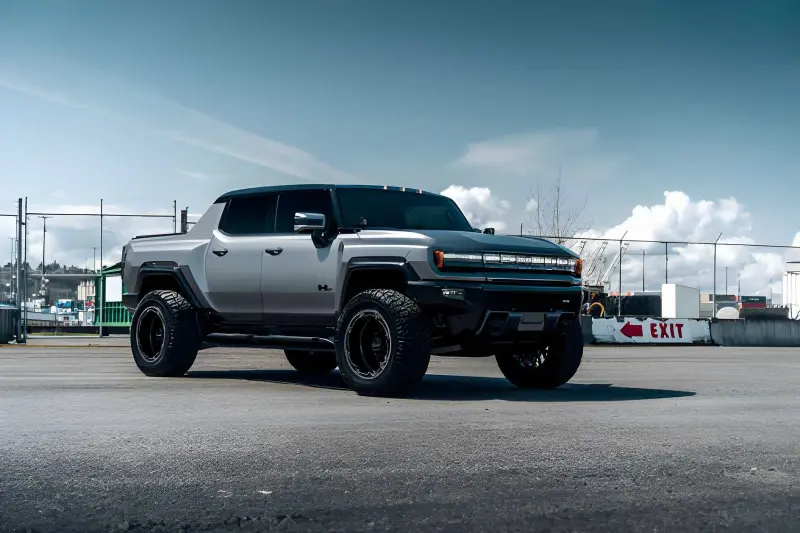
This 2026 GMC Hummer EV SUV review starts with a confession: it is genuinely difficult to review this vehicle using the same cost-per-mile framework we apply to every other EV. The Hummer EV SUV costs $98,845 to start, weighs 9,063 lbs, drinks electricity at a rate that would make a Chevrolet Equinox EV owner wince, and makes roughly zero financial sense by any measure we normally track. And yet it does things no other factory SUV can do, electric or otherwise.
That tension is the entire story. If you are shopping for an EV that saves you money, close this tab. However, if you want to know whether the most excessive electric vehicle ever built is actually good at the things it claims to be good at, this is the review that answers that honestly.
Quick Answer
The 2026 GMC Hummer EV SUV is a genuinely capable off-road EV with 830 hp, CrabWalk diagonal driving, and Extract mode suspension lift. It starts at $98,845, weighs 9,063 lbs, and delivers roughly 245–260 miles of real-world highway range from its 212.7 kWh battery. DC fast charging at up to 300 kW adds about 100 miles in 12 minutes. Towing capacity is 7,500 lbs, but range drops to 100–130 miles under load. It is not a cost-saving EV. It is a six-figure off-road machine that happens to be electric. If you can afford it, have home charging, and want capability that nothing else matches, it delivers. If you are buying an EV to save money, this is the wrong vehicle.
$98,845
Starting MSRP (EV2x trim)
9,063 lbs
Curb weight (heavier than most pickups)
830 hp
Combined output (EV3x, 3 motors)
~250 mi
Real-world highway range (70 mph, mild)
Table of Contents
- 2026 GMC Hummer EV SUV Review: Key Specs and Trims
- What It Is Like to Drive 9,063 Pounds of Electric SUV
- Off-Road Capability: CrabWalk, Extract Mode, and Trail Performance
- Range and Charging: The Numbers Nobody Advertises
- Interior and Technology: Where the Money Went
- Ownership Costs: Insurance, Tyres, and the Weight Tax
- Hummer EV SUV vs Rivian R1S vs Tesla Model X
- 2026 GMC Hummer EV SUV Review Verdict: Who Should Buy It
- FAQ
2026 GMC Hummer EV SUV Review: Key Specs and Trims
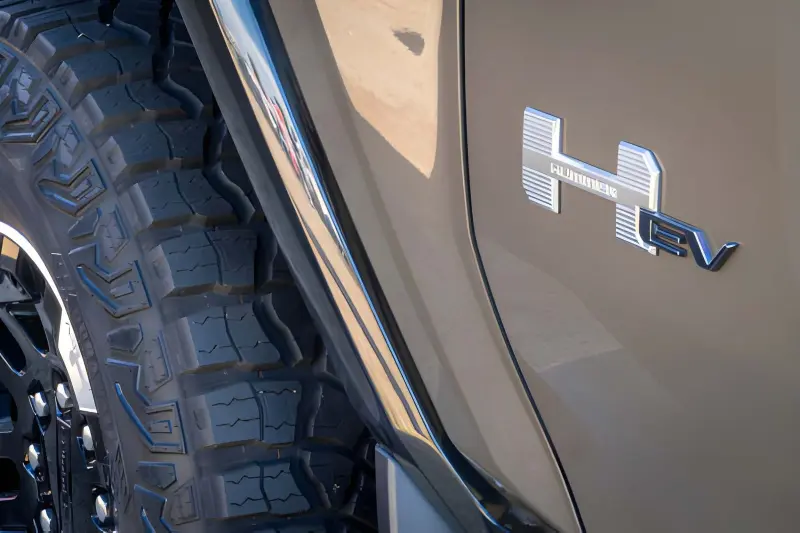
GMC offers the Hummer EV SUV in two trims for 2026. The EV2x is the entry point at $98,845, with two motors, 625 hp, and an EPA-rated range of 277 miles. The EV3x costs $106,945, adds a third motor for 830 hp and 11,500 lb-ft of torque, and stretches the EPA range to 314 miles on a larger Ultium battery pack rated at 212.7 kWh.
Both trims ride on GM’s Ultium platform and come standard with four-wheel steering, adaptive air suspension, and a full suite of driver assistance features including Super Cruise hands-free highway driving. The EV3x adds CrabWalk, Extract mode, Watts to Freedom launch control, and underbody armour plating.
| Spec | EV2x | EV3x |
|---|---|---|
| MSRP | $98,845 | $106,945 |
| Motors | 2 (AWD) | 3 (AWD + front e-locker) |
| Horsepower | 625 hp | 830 hp |
| Torque | 7,400 lb-ft | 11,500 lb-ft |
| EPA Range | 277 mi | 314 mi |
| Battery | 170+ kWh | 212.7 kWh |
| DC Fast Charge | Up to 300 kW | Up to 300 kW |
| 0–60 mph | ~4.3 sec | ~3.5 sec (WTF mode) |
| Towing | 7,500 lbs | 7,500 lbs |
| CrabWalk | Not available | Standard |
| Extract Mode | Not available | Standard |
| Curb Weight | ~8,800 lbs | 9,063 lbs |
The $7,500 federal Clean Vehicle Credit expired September 30, 2025. Even when it existed, the Hummer EV SUV did not qualify because its MSRP exceeded the $80,000 price cap for SUVs. Consequently, there is no federal incentive to offset the purchase price. Some state credits may apply if your state has no price cap, although most do.
What It Is Like to Drive 9,063 Pounds of Electric SUV
The first thing you notice is how the weight disappears when you accelerate. Watts to Freedom mode on the EV3x drops the suspension, pre-conditions the battery and motors, and launches 9,063 lbs to 60 mph in roughly 3.5 seconds. It should not work this well. It does.
At cruising speeds the ride is composed and quiet. The air suspension absorbs highway imperfections without the floatiness you expect from something this large. Four-wheel steering shrinks the turning circle to 35.4 feet, which is tighter than a Honda CR-V. In parking lots and tight urban streets, this makes a vehicle the size of a small apartment feel manageable.
Where the weight shows up is braking. Even with regenerative braking doing most of the work at moderate speeds, hard stops from highway speed require more pedal pressure and longer stopping distances than a 6,000-lb competitor. On the other hand, the brake feel is progressive and predictable. You adjust after a few drives, but it is something first-time Hummer EV drivers notice immediately.
Off-Road Capability: CrabWalk, Extract Mode, and Trail Performance
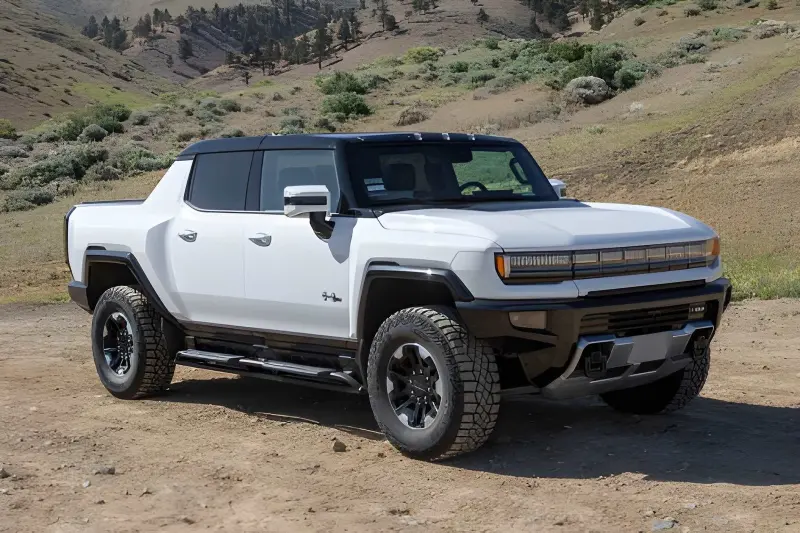
This is where the 2026 GMC Hummer EV SUV review turns from skeptical to genuinely impressed. On pavement, the Hummer is a spectacle. Off pavement, it earns its price.
CrabWalk enables all four wheels to steer in the same direction at up to 10 degrees, allowing the vehicle to move diagonally at low speeds. On a narrow trail with a tight switchback, this means you can slot into a line that a conventional SUV physically cannot reach without a three-point turn. It sounds like a gimmick until you use it on an actual trail. Then it makes every other off-road SUV feel like it is missing a feature.
Extract mode raises the air suspension by approximately 6 inches, giving the Hummer EV SUV roughly 16 inches of ground clearance. For reference, a stock Jeep Wrangler Rubicon sits at about 10.8 inches. With the underbody armour and steel skid plates standard on the EV3x, rock crawling is within this vehicle’s genuine capability range.
The instant torque from electric motors helps on loose surfaces too. There is no throttle lag, no turbo spool, and no transmission hunting for the right gear. You modulate traction with the pedal alone, and the response is linear. For rock crawling at walking speed, the precision is better than anything a gas drivetrain can offer.
The limitation is distance. Trail access points are often 50–100 miles from the nearest fast charger. If you drain the battery off-road and need 80 miles to reach a charging station, range planning becomes part of your trail preparation in a way it never is with a gas vehicle. That is the trade-off this vehicle asks you to accept.
Range and Charging: The Numbers Nobody Advertises
The EPA rates the EV3x at 314 miles. However, the EPA test is conducted at 75°F, with climate control off, at an average speed of 19.6 mph. The Hummer EV SUV has the aerodynamic profile of a cliff face. At 70 mph on the highway in mild weather, expect roughly 245–260 miles.
Cold weather makes this worse. Based on AAA’s 2024 cold-weather EV study, a 41% range loss at 20°F with the cabin heater running would bring the Hummer down to roughly 185 miles. For a vehicle this size, heating the cabin draws even more energy than a compact EV because the interior volume is larger. As a result, cold-climate owners should plan around 60% of the EPA rating for winter highway trips.
Towing is where range planning becomes critical. With a 5,000-lb trailer at highway speeds, expect 100–130 miles of range. If you are towing a boat to a lake 120 miles away, you either charge at the destination or you do not make the return trip without stopping. Our electric cars pros and cons breakdown covers why range under load is the single most misunderstood EV metric.
Charging Speeds and Home Charging Reality
DC fast charging peaks at 300 kW on the 800V architecture. At that rate, GMC claims about 100 miles of range added in 12 minutes. Charging from 10% to 80% takes approximately 40–45 minutes at a compatible 350 kW station. The Ultium platform’s charging curve holds up well past 50% state of charge, which is better than many competitors.
Home charging is the challenge. The 212.7 kWh battery is enormous. A Level 2 charger at 240V and 48A adds roughly 10–12 miles of range per hour. Therefore, a full charge from near-empty takes 20–24 hours. If your daily driving is under 80 miles, overnight charging is enough. If you drove 200 miles and need a full charge by morning, Level 2 will not finish the job. A hardwired 80A circuit cuts that time roughly in half, although it requires a panel upgrade that costs $1,500–$3,000 in many homes.
Interior and Technology: Where the Money Went
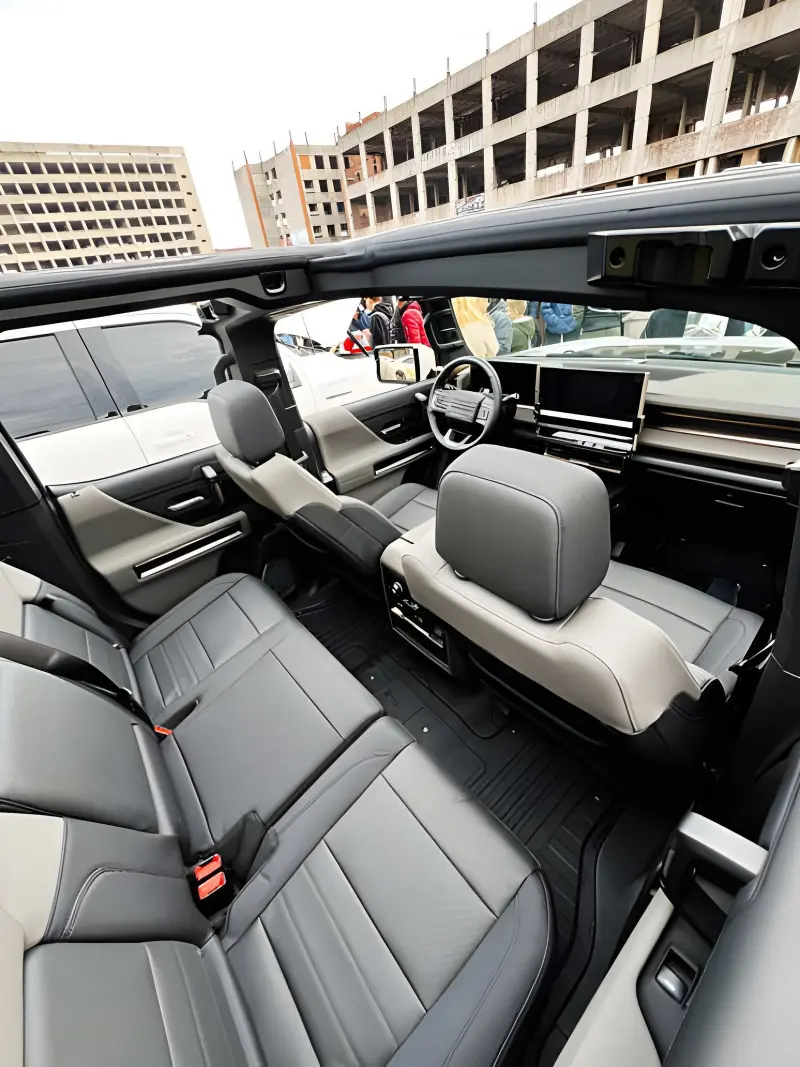
The interior justifies a meaningful portion of that six-figure price. A 13.4-inch infotainment screen runs Google Built-In with wireless Apple CarPlay and Android Auto. The 12.3-inch digital driver cluster is customisable and clear. Material quality is high throughout, with premium leather, microfibre headliner, and real metal accents instead of the painted plastic you find in many trucks.
Super Cruise hands-free highway driving is standard on both trims. On mapped highways, the system handles steering, acceleration, and braking while monitoring driver attention through an infrared camera. It works well on long highway stretches, although it disengages on unmapped roads and in construction zones. For a vehicle this large, the fatigue reduction on a 300-mile highway drive is a genuine benefit.
The Infinity Roof on the EV3x includes removable transparent Sky Panels that store in the cargo area. With the panels out, the open-air experience is a distinct selling point. Rear seat space is generous, with enough legroom for tall passengers, and the cargo area behind the second row measures roughly 82 cubic feet with seats folded.
One thing I noticed: the ride height means ingress and egress is not graceful. Even with the air suspension in its lowest setting, you step up into this vehicle. For daily grocery runs, that gets old. For trail access, it is exactly what you want.
Ownership Costs: Insurance, Tyres, and the Weight Tax
This is the section of the 2026 GMC Hummer EV SUV review where the financial picture gets uncomfortable.
Insurance runs significantly higher than the EV average. The Insurance Information Institute (2025) puts EV insurance at roughly 18% above equivalent gas vehicles. For a six-figure vehicle with expensive battery and structural components, expect annual premiums in the $3,500–$5,000 range depending on your state, record, and coverage level.
Tyres are another cost that the weight amplifies. At 9,063 lbs, the Hummer chews through tyres faster than any EV in its class. The factory 35-inch off-road tyres cost $350–$500 per tyre installed. A full set replacement every 25,000–30,000 miles means you may go through two full sets in five years at 15,000 miles annually. That is $2,800–$4,000 in tyres alone over the ownership period.
Maintenance otherwise follows the standard EV pattern, per DOE data. No oil changes, no transmission services, fewer brake replacements due to regenerative braking. Suspension components will wear faster than on lighter EVs because of the weight. Budget for shock and bushing replacements earlier than the typical five-year window.
The electricity cost for the Hummer is higher per mile than a lighter EV because the energy consumption rate is roughly 50–55 kWh per 100 miles versus 28–30 kWh per 100 miles for a Model Y or Equinox EV. With home charging at $0.15/kWh, that works out to roughly $0.08/mile in energy. Still cheaper than gas for a vehicle this size, although not by the margin you see in lighter EVs. Our electric car maintenance guide breaks down the full EV maintenance picture.
Hummer EV SUV vs Rivian R1S vs Tesla Model X
These three vehicles serve different buyers, but they overlap in price range. Here is how they compare on the metrics that matter for a purchase decision.
| Spec | Hummer EV SUV EV3x | Rivian R1S Dual Max | Tesla Model X LR |
|---|---|---|---|
| MSRP | $106,945 | ~$82,000 | ~$79,990 |
| EPA Range | 314 mi | ~321 mi | ~335 mi |
| Curb Weight | 9,063 lbs | ~6,400 lbs | ~5,185 lbs |
| Towing | 7,500 lbs | 7,700 lbs | ~5,000 lbs |
| Off-Road | Best in class | Very capable | Not designed for off-road |
| Efficiency (kWh/100 mi) | ~52 | ~35 | ~30 |
| Charging Network | EA, ChargePoint, EVgo | Rivian Adventure + EA | Tesla Supercharger (50,000+ stalls) |
The Rivian R1S is the closest competitor for buyers who want both daily practicality and trail capability. It weighs 2,700 lbs less, gets meaningfully better range per kWh, and costs $25,000 less. For most buyers who want an off-road-capable electric SUV, the R1S is the more rational purchase.
The Tesla Model X wins on efficiency, charging network, and technology. Tesla’s Supercharger network with 50,000+ stalls in 60+ countries is a distinct advantage for road trips. However, the Model X is not built for off-road use and its towing capacity is substantially lower.
The Hummer wins when the brief is simple: maximum capability, maximum presence, cost secondary. If that is your brief, nothing else matches it. If your brief is anything more nuanced than that, one of the other two probably fits better. Our electric cars pros and cons guide helps frame the wider EV decision.
2026 GMC Hummer EV SUV Review Verdict: Who Should Buy It
The Hummer EV SUV is not for most EV shoppers. I genuinely don’t think GMC would disagree with that. It is a niche vehicle that exists at the intersection of extreme off-road capability and electric propulsion, and it does that specific job better than anything else on the market.
Buy the Hummer EV SUV if:
- You want a factory off-road EV with capabilities that rival modified gas rigs
- You have dedicated home charging with a 240V/80A or higher circuit
- Your daily driving is under 120 miles round trip
- Cost per mile is not your primary purchase criterion
- You plan to keep the vehicle long-term rather than trading in at year three
Do not buy the Hummer EV SUV if:
- You are buying an EV to save money on fuel or total cost of ownership
- You need to tow loads over 100 miles one way without guaranteed charging at the destination
- You do not have home charging access (a 212.7 kWh battery on public charging only is financially punishing)
- You park in structures with weight limits below 10,000 lbs
- Your commute involves highway driving over 150 miles round trip, particularly in cold weather
- You want a practical daily SUV that also handles trails on weekends (the Rivian R1S is the better tool for that)
This 2026 GMC Hummer EV SUV review comes down to one honest question: do you want the most capable electric off-road SUV that money can buy, and are you willing to pay the weight, efficiency, and cost penalties that come with it? If the answer is yes, nothing else does what this vehicle does. If you hesitated on the cost part, the EV buying guides on our blog can point you toward vehicles where the numbers work harder in your favour.
Methodology
Vehicle reviewed: 2026 GMC Hummer EV SUV EV3x ($106,945 MSRP)
Range estimates: EPA figures adjusted using the 80% real-world planning rule (highway, mild weather) and AAA 2024 cold-weather data (41% loss at 20°F with heater). Towing range based on industry testing of EVs under comparable loads.
Cost data: Insurance estimates from Insurance Information Institute 2025 averages scaled for vehicle value. Maintenance per DOE AFDC 2025 EV cost-per-mile data. Electricity costs at $0.15/kWh home, $0.38/kWh public (national averages, 2026).
Competitor specs: Rivian and Tesla figures from manufacturer configurators and Edmunds testing, May 2026.
Date verified: May 2026
FAQ
How much does the 2026 GMC Hummer EV SUV cost?
The EV2x starts at $98,845 and the EV3x at $106,945. With destination and common options, most buyers pay between $103,000 and $115,000. The $7,500 federal credit does not apply because the MSRP exceeds the $80,000 SUV price cap, and the credit expired in September 2025 regardless.
What is the real-world range of the Hummer EV SUV?
Roughly 245–260 miles at 70 mph in mild weather on the EV3x, compared to the 314-mile EPA rating. In cold weather at 20°F with the heater running, expect around 185 miles. While towing at highway speeds, range falls to 100–130 miles depending on load.
How much does the Hummer EV SUV weigh?
9,063 lbs for the EV3x. That is heavier than most full-size gas pickup trucks. As a result, the weight affects tyre wear, braking distances, suspension life, and the structural requirements of home garages or parking structures.
Can the Hummer EV SUV tow?
Yes, up to 7,500 lbs. However, towing at that weight at highway speeds reduces range to roughly 100–130 miles. For towing distances over 100 miles, you need to plan charging stops carefully.
Is the Hummer EV SUV good off-road?
It is one of the most capable factory SUVs available. CrabWalk allows diagonal movement on tight trails, Extract mode provides roughly 16 inches of ground clearance, and instant torque gives precise traction control on loose surfaces. The limitation is range to and from trail access points.
How fast does the Hummer EV SUV charge?
DC fast charging peaks at 300 kW, adding roughly 100 miles in 12 minutes. A full 10–80% charge takes approximately 40–45 minutes. At home on Level 2 (240V/48A), a full charge takes 20–24 hours because of the massive 212.7 kWh battery.
Who should NOT buy the Hummer EV SUV?
Anyone buying an EV to save money. Also buyers without home charging, those who commute over 150 miles round trip on highways, those who need to tow over long distances, and anyone who parks in structures with weight limits below 10,000 lbs. For most practical EV needs, the Rivian R1S or a mid-size electric SUV is a better fit.
How does the Hummer EV SUV compare to the Rivian R1S?
The R1S is roughly 2,700 lbs lighter, gets better range per kWh, and costs $25,000 less. It is the better daily driver with strong off-road capability. The Hummer wins on raw power, extreme off-road hardware like CrabWalk and Extract mode, and outright presence. If capability at any cost is the goal, the Hummer is the answer. For everything else, the R1S is more practical.

James Carter
Founder & Lead Analyst — DriveAuthority
James has spent over a decade analysing automotive markets, EV total cost of ownership, and the structural economics behind vehicle pricing. DriveAuthority was built to give buyers the same level of financial rigour applied to any major purchase decision — without the manufacturer-friendly framing common in traditional auto media.