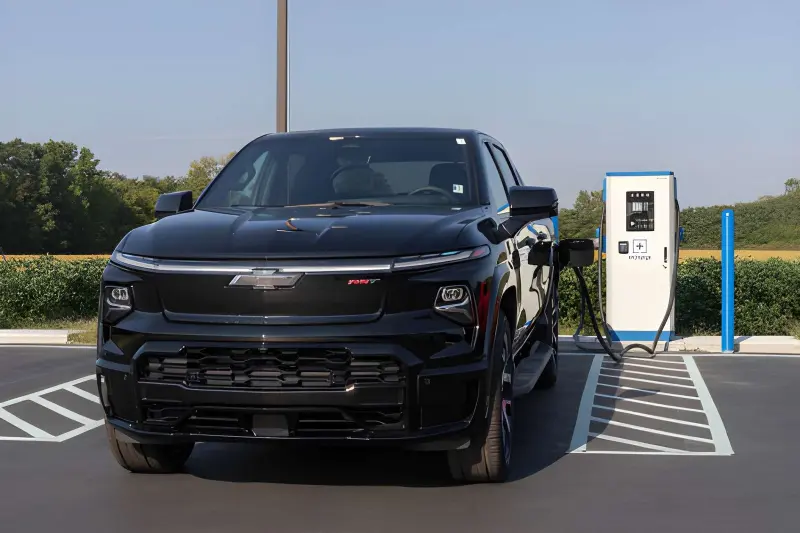
The 2024 Chevrolet Silverado EV is the most capable electric work truck on sale today. The RST does what most electric trucks promise but fail to deliver in practice: it tows 10,000 pounds, charges at 350kW — the fastest peak rate of any full-size electric pickup — and goes 440 miles on a full charge without a trailer attached. That combination did not exist in a single vehicle before this truck. The F-150 Lightning tows the same weight but charges at roughly half the speed. The Rivian R1T charges quickly but tows less and costs more. For a buyer whose work genuinely depends on towing range and charging speed, the 2024 Silverado EV is the most capable electric truck on the market. The honest caveat: the RST starts at $75,195, puts you well past the $49,995 Lightning Pro, and the range drops to roughly 200 miles when you are near maximum tow weight. That is still workable for most trade routes. Whether it is worth the premium over the Lightning is the question this review answers.
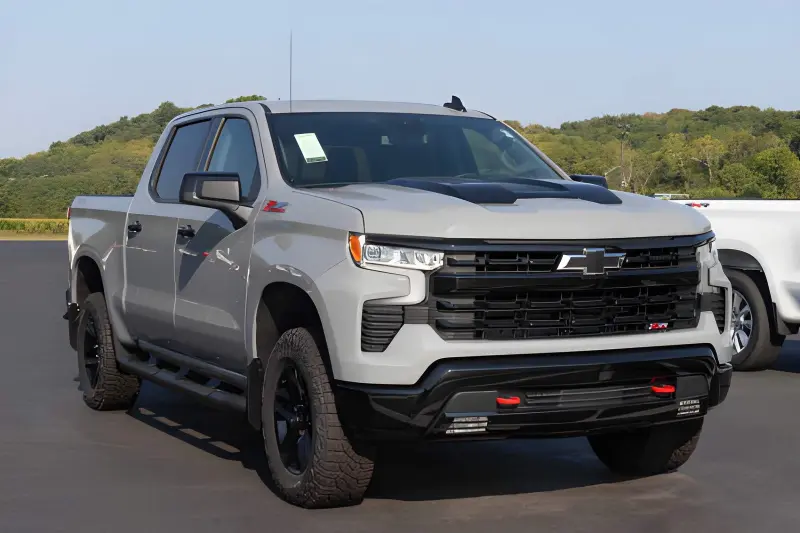
2024 Chevrolet Silverado EV Review — Quick Verdict
The Silverado EV RST is the most capable electric work truck available in 2024. 440 miles of EPA range, 10,000 lb tow rating, and 350kW peak charging are numbers no competitor matches simultaneously. Practical towing range drops to approximately 200 miles at maximum load — workable for trade routes but requiring planning. The RST at $75,195 is expensive against the F-150 Lightning Pro, but the charging speed advantage compounds on any day involving a charging stop. The Work Truck (WT) trim at $39,900 is fleet-only and not available at retail. For civilian buyers, budget $75,000 minimum. The $7,500 federal tax credit applied to qualifying purchases in 2024 but expired September 30, 2025.
2024 Chevrolet Silverado EV Specs, Trims, and Pricing at a Glance
The 2024 Silverado EV launched with four trim levels, though retail availability is concentrated in the RST and above. The Work Truck (WT) is sold exclusively to fleet buyers through GM Fleet channels — individual consumers cannot order it from a dealer. That matters for anyone drawn to the $39,900 number in headlines.
| Trim | MSRP (2024) | EPA Range | Horsepower | 0–60 mph | Tow Rating | Availability |
|---|---|---|---|---|---|---|
| Work Truck (WT) | $39,900 | 450 mi | 510 hp | 4.5 sec | 10,000 lb | FLEET ONLY |
| RST | $75,195 | 440 mi RETAIL | 510 hp | 4.5 sec | 10,000 lb | Retail |
| LTZ | ~$89,000 | 440 mi | 510 hp | 4.5 sec | 10,000 lb | Retail |
| Trail Boss | ~$80,000 | 400 mi | 510 hp | 4.5 sec | 8,000 lb | Retail |
| First Edition | $107,495 | 450 mi | 754 hp | 3.5 sec | 10,000 lb | Sold out |
All trims share the same Ultium battery platform and 350kW DC fast charging capability. The hardware is consistent across the lineup — what changes between RST, LTZ, and First Edition is content, comfort, and in the First Edition’s case, a dual-motor configuration that adds 244 horsepower. For buyers who need the truck to work rather than perform, the RST delivers everything the WT does at the same tow rating.
2024 Silverado EV Driving Impressions: How It Feels to Work This Truck
The 2024 Chevrolet Silverado EV drives more like a truck than most buyers expect from an electric vehicle. GM tuned the suspension for load-carrying rather than sporty handling — the ride is firm enough to feel planted without tow weight, and it settles properly when loaded. That matters for buyers who drive a truck for practical reasons and notice when something feels softened and car-like in the name of comfort.
The steering is accurate and weighted appropriately for a full-size pickup. It does not communicate road texture the way a sports car does, but it was not designed to. At highway speeds the Silverado EV is quiet — not EQS quiet, but genuinely better than the gas Silverado it shares a platform with. Road noise above 70 mph is the most noticeable source of cabin sound, with wind noise well controlled given the aerodynamic demands of a pickup body.
One-pedal driving works as expected in stop-and-go conditions. The regenerative braking captures energy on downhill grades noticeably better than a gas truck descending the same grade — a practical advantage for buyers who tow in mountainous terrain, where regen adds range back on the return leg. The transition from regen to friction braking is smooth and required no adaptation period during extended driving.
The RST’s 4.5-second 0–60 time is real but not the relevant metric for most buyers. The relevant metric is how confident it feels merging onto a highway at 65 mph with a trailer. The answer: more confident than any gas Silverado, because the torque is available instantly and the truck does not need to downshift and wind up before responding. That is where the electric powertrain advantage shows up in daily work use.
Range and Charging: The Silverado EV’s Clearest Advantage
350kW peak DC fast charging is the single most important number in this truck’s specifications for any buyer who regularly drives more than 300 miles in a day. At a compatible 350kW station, the RST charges from 10% to 80% in approximately 22 minutes. The F-150 Lightning peaks at 185kW — the same charge window on the Lightning takes roughly 44 minutes. That 22-minute difference on a single stop becomes a significant daily operational difference for buyers making two or more charging stops per week.
The 440-mile EPA range figure is measured without a trailer and in moderate conditions, as published on fueleconomy.gov. Real-world range in mixed driving aligns well with EPA estimates for this truck — the Ultium battery’s thermal management maintains efficiency reliably in temperatures above 20°F. Below that threshold, expect a reduction of 15–25% consistent with any lithium-ion pack.
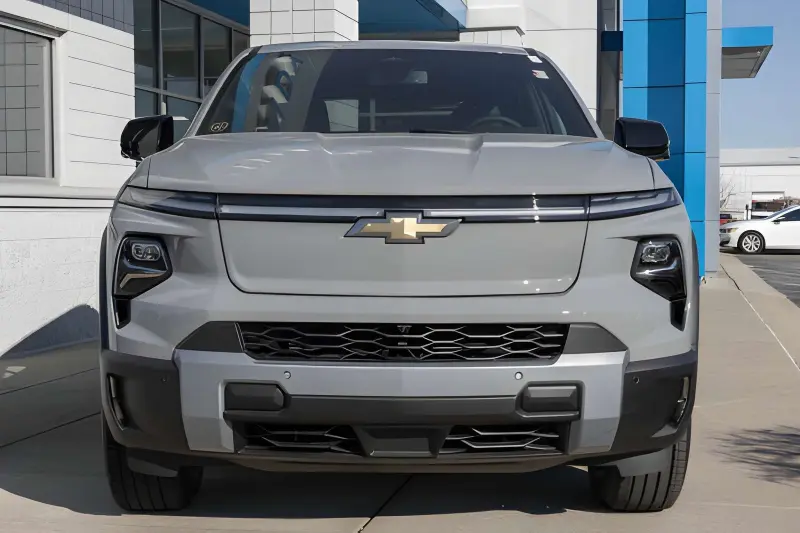
The 2024 Chevrolet Silverado EV supports bidirectional charging — Vehicle to Home (V2H) at up to 10.2kW and Vehicle to Vehicle (V2V) at up to 3.6kW. The V2H capability requires a compatible home energy management system and installation, which adds cost beyond the truck itself. However, for buyers in regions with frequent power outages or high electricity rates during peak hours, the V2H function turns the truck into a generator capable of running a household for two to three days at normal consumption. The V2V function lets you charge another EV in the field using the Silverado’s pack as the power source — a specific but genuinely useful capability for buyers with multiple electric vehicles in a fleet.
Charging network access covers the Ultium Charge 360 network, EVgo, Electrify America, ChargePoint, and — following the NACS transition — Tesla Supercharger stations with a compatible adapter or direct NACS port depending on production date. Coverage for buyers operating in major metro corridors is adequate for most route planning purposes.
2024 Silverado EV Towing and Payload: Real Numbers, Not Marketing Numbers
The 2024 Chevrolet Silverado EV’s 10,000-pound tow rating is real. It reflects a properly engineered hitch receiver, trailer brake controller integration, and suspension calibrated for load-carrying at that weight. What the marketing materials do not emphasize: towing 10,000 pounds at highway speed reduces range from 440 miles to approximately 200 miles. That number varies with grade, headwind, trailer aerodynamics, and speed, but 200 miles is the reasonable planning figure at maximum load.
Two hundred miles of towing range is workable for many trade routes. A contractor driving 80 miles to a job site and 80 miles back can complete the round trip without a charging stop. A buyer who tows 150 miles in one direction needs one charging stop each way. Where the range becomes a genuine constraint is for buyers who tow 250-plus miles in a single direction — the charging math requires two stops, and the time cost becomes real. For those use cases, the gas Silverado or a diesel remains the more practical tool.
Integrated trailer brake controller comes standard. Trailer sway control, automatic trailer length detection via cameras, and a 15-camera surround-view system that includes hitch guidance are included on the RST. The hitch camera system is practically useful — backing a trailer with the camera display requires less practice than a mirror-only approach, which matters for buyers who do not tow every day and benefit from the visual reference.
2024 Silverado EV Cargo and Work Features: Frunk, Mid-Gate, and On-Site Power
The 2024 Chevrolet Silverado EV’s 12.7-cubic-foot front trunk is the most useful frunk in any electric truck available in 2024. It opens and closes with a power release, drains when wet, and locks with the vehicle — making it a secure, weather-resistant storage compartment for tools, equipment, and valuables. For buyers who currently leave tools visible in an open truck bed or deal with tool box security, the frunk addresses that problem at zero additional cost.
The Multi-Flex tailgate folds in six configurations including a step position that reduces the lift height to the bed. For buyers who regularly load and unload heavy equipment by hand, the step function is more useful than it sounds — reducing the lift height from bed level to step height changes the ergonomics of loading significantly on a heavy-use day. The mid-gate — the rear wall between cab and bed — folds down to extend the bed length, allowing cargo up to 9 feet long to be carried with the tailgate closed. Standard bed length is 5’11” with the mid-gate closed.
The truck provides 10.2kW of available power from the energy management port, accessible to power tools and job site equipment. That output runs a circular saw, angle grinder, and compressor simultaneously without issue. For buyers who currently run a generator on job sites or carry a portable inverter generator in the bed, the Silverado EV’s onboard power eliminates that equipment and its associated fuel cost.
2024 Silverado EV Interior and Technology
The 2024 Chevrolet Silverado EV RST interior is competitive with a similarly priced gas Silverado High Country in material quality. Soft-touch surfaces cover the dashboard and door panels where hands regularly contact them. The center console is large, functional, and includes a covered storage area beneath the armrest adequate for a laptop or tablet. Overall fit and finish quality is consistent — panel gaps are tight and materials feel appropriately durable for a work vehicle that will see regular use.
The 17.7-inch infotainment display runs Google built-in, with wireless Apple CarPlay and Android Auto as alternatives. The interface responds quickly and the screen is large enough to view navigation clearly while wearing work gloves — a practical consideration that most interior reviews skip. Voice commands via Google Assistant handle navigation inputs without requiring a driver to touch the screen.
The 8-inch driver information cluster sits directly ahead of the steering wheel and shows charge level, range estimate, navigation guidance, and driver assistance status simultaneously. Range estimate accuracy is better than most EVs tested — the displayed remaining range within 30 miles of actual range in normal mixed-speed driving.
Silverado EV vs F-150 Lightning: The Honest Comparison
The F-150 Lightning Pro starts at $49,995 versus the Silverado EV RST at $75,195. That $25,200 gap is real and decisive for many buyers. Before accepting it as the final answer, the charging speed comparison deserves attention: the Lightning charges at up to 185kW, the Silverado EV at 350kW. On a 10–80% charge at a fast station, that gap translates to roughly 22 extra minutes per session. A buyer who makes two charging stops per week pays that 44-minute-per-week premium every week they own the Lightning versus the Silverado EV.
| Specification | Silverado EV RST | F-150 Lightning Pro | Advantage |
|---|---|---|---|
| Starting MSRP | $75,195 | $49,995 | LIGHTNING −$25,200 |
| EPA Range (unladen) | 440 mi | 230 mi (Std) / 320 mi (Ext) | SILVERADO |
| Peak DC Charging Rate | 350 kW | 185 kW | SILVERADO |
| 10–80% Charge Time | ~22 min | ~41–44 min | SILVERADO ~20 min faster |
| Maximum Tow Rating | 10,000 lb | 10,000 lb | Tied |
| Max Payload | 1,300 lb | 2,235 lb | LIGHTNING |
| Bidirectional Charging | Yes (10.2 kW V2H) | Yes (9.6 kW) | Tied |
| Frunk Storage | 12.7 cu ft | 14.1 cu ft | LIGHTNING (slightly) |
| Dealer Network | Chevy dealers | Ford dealers (larger network) | LIGHTNING (more locations) |
The Lightning wins on price, payload, frunk size, and dealer availability. The Silverado EV wins on unladen range and charging speed — by a large margin on both. For buyers who need maximum payload (2,235 lb on the Lightning versus 1,300 lb on the Silverado EV), the Lightning is the correct tool. For buyers who need to cover distance quickly and spend as little time at a charger as possible, the Silverado EV justifies its premium more effectively as the weekly charging time cost compounds.
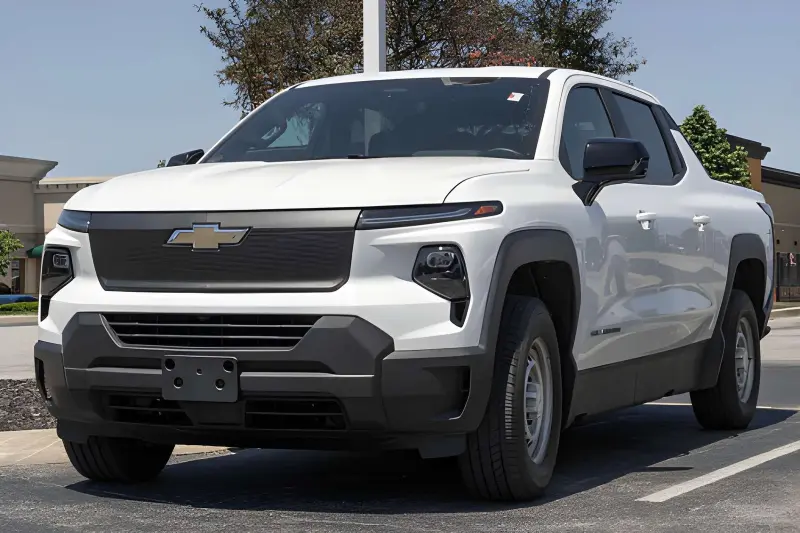
Who Should Buy the 2024 Chevrolet Silverado EV — and Who Shouldn’t
Buy the 2024 Chevrolet Silverado EV RST If…
- You drive 200–400 miles per workday and require en-route charging — the 350kW speed is worth its premium over the Lightning at this mileage
- You tow regularly but on routes under 200 miles — the 10,000 lb rating with 200-mile towing range works for most regional trade routes
- On-site power for tools matters — 10.2kW bidirectional output replaces a job site generator without fuel cost
- Home charging is available overnight — the 440-mile range means most buyers charge to full every 2–3 days, not daily
- You value charging speed over payload — buyers who need 2,000+ lb payload should look at the F-150 Lightning instead
Do Not Buy the Silverado EV If…
- You regularly tow 250-plus miles in one direction without a planned stop — two charging stops per leg changes the math on operational efficiency
- Maximum payload is a daily requirement — the Lightning’s 2,235 lb ceiling is 72% higher than the Silverado EV’s 1,300 lb
- Budget is the primary constraint — the $25,200 gap between the Lightning Pro and RST buys a lot of fuel for a gas truck
- You work primarily in remote areas without DC fast charging infrastructure — home charging speed limits daily operational range to overnight recharge capacity
- You need a fleet vehicle at retail pricing — the WT trim is not available to individual buyers, and the RST starts at $75,195
Methodology and Data Sources
Pricing data from Chevrolet media and verified dealer configurations for the 2024 model year. EPA range figures from fueleconomy.gov. Towing and payload ratings from GM’s official towing and trailering guide. Charging time estimates based on SAE testing methodology at the rated peak wattage; real-world times vary by state of charge at arrival, ambient temperature, and charger output capacity. F-150 Lightning comparison figures from Ford media and EPA fueleconomy.gov. The $7,500 federal EV tax credit applied to qualifying purchases through September 30, 2025 for MSRP-eligible configurations — it is not factored into the pricing figures above and is no longer available on new purchases as of the date of this review.
Frequently Asked Questions
How much does the 2024 Chevrolet Silverado EV cost?
The Work Truck (WT) starts at $39,900 but is sold exclusively to fleet customers through GM Fleet — individual buyers cannot order it from a retail dealer. The first trim available at retail is the RST at $75,195. The LTZ starts at approximately $89,000, the Trail Boss at approximately $80,000, and the First Edition launched at $107,495 but was fully allocated and is no longer available. For most buyers, the RST at $75,195 is the effective starting price.
What is the towing capacity of the 2024 Silverado EV?
The RST and WT trims are rated to tow up to 10,000 pounds. The Trail Boss is rated at 8,000 pounds due to its lifted suspension affecting hitch geometry. The First Edition matches the RST at 10,000 pounds. Maximum payload varies by configuration — verify the yellow Tire and Loading Information sticker in the door jamb on the specific vehicle, as payload varies by option content.
How long does it take to charge the 2024 Silverado EV?
On a compatible 350kW DC fast charger, the Silverado EV charges from 10% to 80% in approximately 22 minutes. Level 2 home charging at 11.5kW adds approximately 25 miles of range per hour — a full charge from a depleted battery overnight takes 15–18 hours on a standard Level 2 home charger. The truck accepts up to 19.2kW on Level 2 with the appropriate EVSE, reducing a full home charge to approximately 10–12 hours.
How far can the Silverado EV tow on a single charge?
Approximately 200 miles at maximum tow weight (10,000 lb) at highway speeds. This figure varies with trailer aerodynamics, grade, and speed — a well-aerodynamic trailer at 60 mph may achieve 220–230 miles; a flat-faced box trailer at 70 mph may fall below 180 miles. The unladen EPA range of 440 miles drops by roughly 50–55% under maximum load, consistent with towing range reduction across electric truck platforms.
Is the 2024 Silverado EV better than the F-150 Lightning?
It depends on what matters most. The Silverado EV leads on unladen range (440 vs 320 miles) and charging speed (350kW vs 185kW). The F-150 Lightning leads on starting price ($49,995 vs $75,195), maximum payload (2,235 vs 1,300 lb), and dealer network size. For buyers who drive high daily mileage and use public charging regularly, the Silverado EV’s charging speed advantage is worth money over time. For buyers who charge exclusively at home and prioritize payload or cost, the Lightning is the better financial decision.
Can the Silverado EV power a job site or tools?
Yes. The Silverado EV supports bidirectional charging with up to 10.2kW of usable output for external loads — enough to run multiple power tools simultaneously. Vehicle to Home (V2H) capability requires a compatible home energy management system and proper installation. Vehicle to Vehicle (V2V) charging at up to 3.6kW lets the Silverado charge another EV in the field. For buyers who currently run a portable generator on job sites, the Silverado EV’s onboard power eliminates that equipment without requiring a separate purchase.
Does the 2024 Silverado EV qualify for the federal EV tax credit?
The $7,500 federal EV tax credit under the Inflation Reduction Act applied to qualifying purchases of the 2024 Silverado EV through September 30, 2025, when the credit expired. The RST at $75,195 fell under the $80,000 MSRP cap for trucks. Income limits applied to buyers claiming the credit. As of May 2026, the federal credit is no longer available on new purchases. Buyers purchasing a used 2024 Silverado EV may be eligible for a separate used EV credit of up to $4,000 depending on purchase price, vehicle age, and buyer income — consult a tax professional to confirm eligibility.