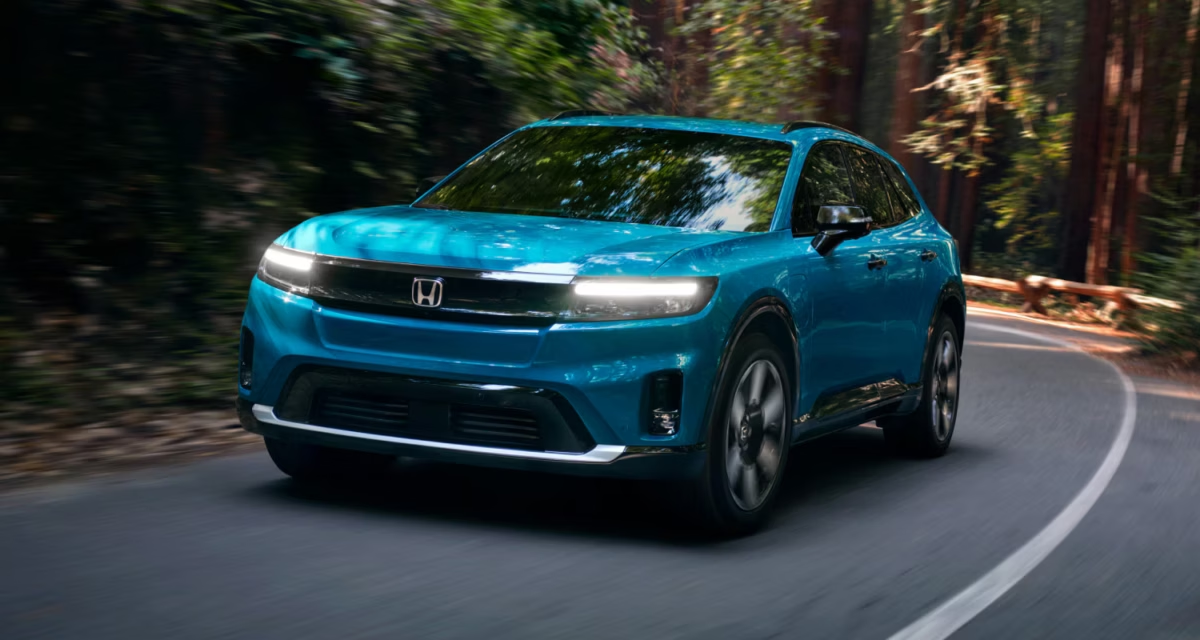
Honda has two electric cars on sale in the United States in 2026, and they are fundamentally different products. The Honda Prologue, which launched in 2024, runs on General Motors’ Ultium battery platform — the same architecture under the Chevrolet Blazer EV — and is built at a GM factory in Ramos Arizpe, Mexico. The Honda 0 SUV, which arrived at US dealers in spring 2026, runs on Honda’s own new architecture and marks the first electric vehicle Honda has engineered entirely from the ground up for the American market.
That distinction matters before you spend $47,400 on a Prologue. A Honda badge on an Ultium platform is still a Chevy underneath. Whether that matters to you — or whether Honda’s interior calibration, dealer network, and service relationship justify a $13,500 premium over the Chevrolet Equinox EV that shares the same core platform — is the actual purchase decision. Meanwhile, the Honda 0 SUV changes the equation with Honda’s own engineering at a more competitive price point. Consequently, this guide covers what each product actually is, where each one wins, and what to buy if neither fits your situation.
Two Honda EVs, Two Very Different Products — Here Is the Short Version
Honda sells two battery-electric vehicles in the US in 2026: the Prologue (starts at $47,400, 296 miles EPA, built on GM’s Ultium platform) and the new Honda 0 SUV (Honda’s first purpose-built American EV, arriving at dealers now). Neither qualifies for the expired $7,500 federal EV credit. The Prologue shares its core architecture with the Chevrolet Blazer EV. If platform loyalty to Honda matters, the 0 SUV is the more authentic choice. If you want the same Ultium technology for significantly less money, the Chevrolet Equinox EV starts at $33,900 with 319 miles of range.
Honda Electric Cars in 2026: What’s on Sale and What Just Arrived
Honda’s electrified lineup in 2026 spans four distinct powertrain categories, and only two of them are battery-electric vehicles available for purchase at a US dealership today. The distinction between “electric,” “plug-in hybrid,” and “hybrid” matters considerably when comparing Honda’s options — particularly because the CR-V e:PHEV and Accord Hybrid are often grouped into Honda’s “electrification” story even though they run on gasoline for the majority of most owners’ miles.
The full Honda electrified lineup, classified by powertrain
| Vehicle | Powertrain Type | Electric-Only Range | Starting MSRP | Full BEV? |
|---|---|---|---|---|
| Honda Prologue | Battery-electric (GM Ultium, 85 kWh) | 296 mi (FWD) / 273 mi (AWD) | $47,400 | Yes |
| Honda 0 SUV | Battery-electric (Honda 0 platform) | 300+ mi (announced target) | ~$40,900 | Yes |
| Honda CR-V e:PHEV | Plug-in hybrid (2.0L + electric) | 40 mi (electric only) | $38,050 | No — gas engine present |
| Honda Accord Hybrid | Self-charging hybrid (2.0L + electric) | 0 mi (no plug) | $30,945 | No — no plug-in capability |
| Honda CR-V Hybrid | Self-charging hybrid (2.0L + electric) | 0 mi (no plug) | $33,850 | No — no plug-in capability |
| Honda Civic Hybrid | Self-charging hybrid (2.0L + electric) | 0 mi (no plug) | $28,555 | No — no plug-in capability |
Section verdict: Honda’s full BEV lineup in 2026 consists of exactly two vehicles: the Prologue and the 0 SUV. Both are capable products — but they represent very different philosophies about what a Honda electric car should be.
The Honda Prologue: A Capable EV Built on Someone Else’s Platform
The Prologue is the product of a 2020 agreement between Honda and General Motors, in which Honda licensed GM’s Ultium battery platform as a bridge solution while Honda developed its own EV architecture. The result is a vehicle that is genuinely good in most of the ways that matter — competitive range, a premium interior, and reliable DC fast charging — but one whose engineering fundamentals belong to a different company. For some buyers, that is irrelevant. For others, it is the whole story.
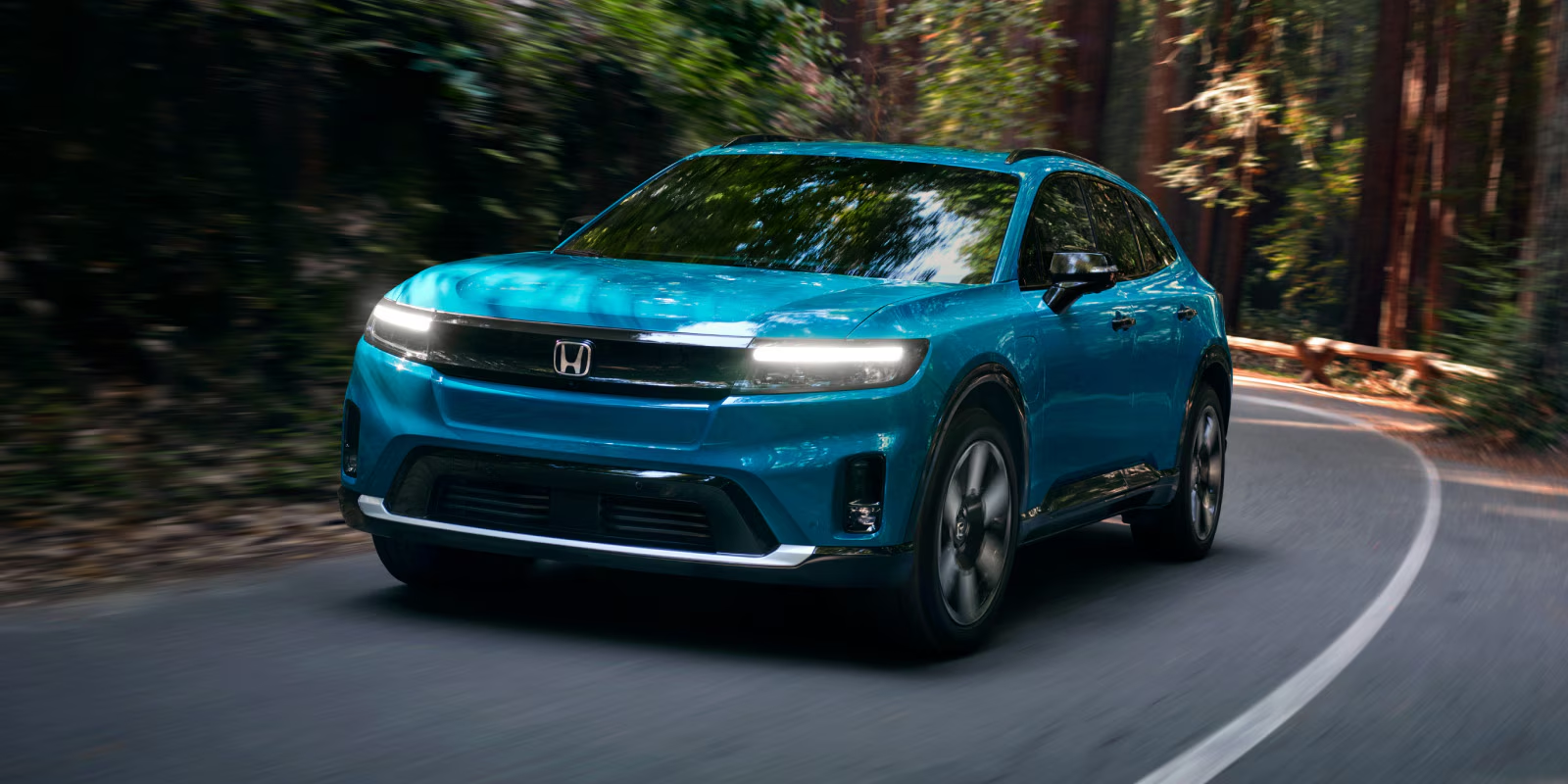
Honda Prologue specifications
| Spec | EX FWD | EX-L FWD | Elite AWD |
|---|---|---|---|
| Battery capacity | 85 kWh (82 kWh usable) | 85 kWh (82 kWh usable) | |
| EPA-rated range | 296 miles | 273 miles | |
| Est. real-world range (70 mph) | ~245–252 miles | ~226–233 miles | |
| Motor output | 212 hp (158 kW) | 288 hp (215 kW) | |
| 0–60 mph | ~6.2 sec | ~5.1 sec | |
| DC fast charging (max) | 150 kW (0–80% in approx. 30 min) | ||
| Platform | GM Ultium (shared with Chevrolet Blazer EV) | ||
| Manufacturing origin | GM factory, Ramos Arizpe, Mexico | ||
| Starting MSRP | $47,400 | $50,400 | $56,525 |
Where the Prologue earns its price
In particular, three things stand out. First, the interior is genuinely premium — Honda calibrated the Prologue’s cabin separately from the Blazer EV, with softer materials, a more restrained dashboard aesthetic, and a 11.3-inch infotainment screen running Google Built-In (Maps, Assistant, and Play Store natively). Second, at 296 miles of EPA range, the FWD Prologue beats the base Blazer EV FWD’s 247 miles by a meaningful margin, because Honda tuned the powertrain for efficiency over performance. Third, Honda dealers are — on average — more available and consistent in their service experience than Chevy dealers, which matters over a five-year ownership window. These are real advantages. Nevertheless, they come at a significant price premium.
Why the Prologue is a hard financial argument to make
At $47,400, the Prologue sits $13,500 above the Chevrolet Equinox EV — a vehicle that shares the same Ultium architecture and delivers 319 miles of range, 23 miles more than the Prologue. Furthermore, the Prologue sits $2,410 above the Tesla Model Y Long Range, which offers 320 miles and access to the largest fast-charging network in North America. Additionally, with the federal $7,500 EV tax credit expired as of September 30, 2025, neither the Prologue nor any of its competitors receive a purchase incentive at the federal level. Consequently, the Prologue’s price premium is fully out of pocket with no subsidy offset. The honest assessment: unless the Honda badge, dealer relationship, or specific interior choices matter to you in a concrete way, the Prologue is the most expensive path to Ultium-platform ownership.
The Honda 0 SUV: Honda’s First Purpose-Built American Electric Car
Indeed, the Honda 0 SUV is a genuinely different product from the Prologue — not just in styling, but in architecture, software, and what it signals about Honda’s long-term EV strategy. Unlike the Prologue, which Honda licensed from GM as a stopgap, the 0 SUV runs on Honda’s own 0 platform, developed internally and built at Honda’s own facilities. In essence, it is the first Honda EV that Honda actually engineered.
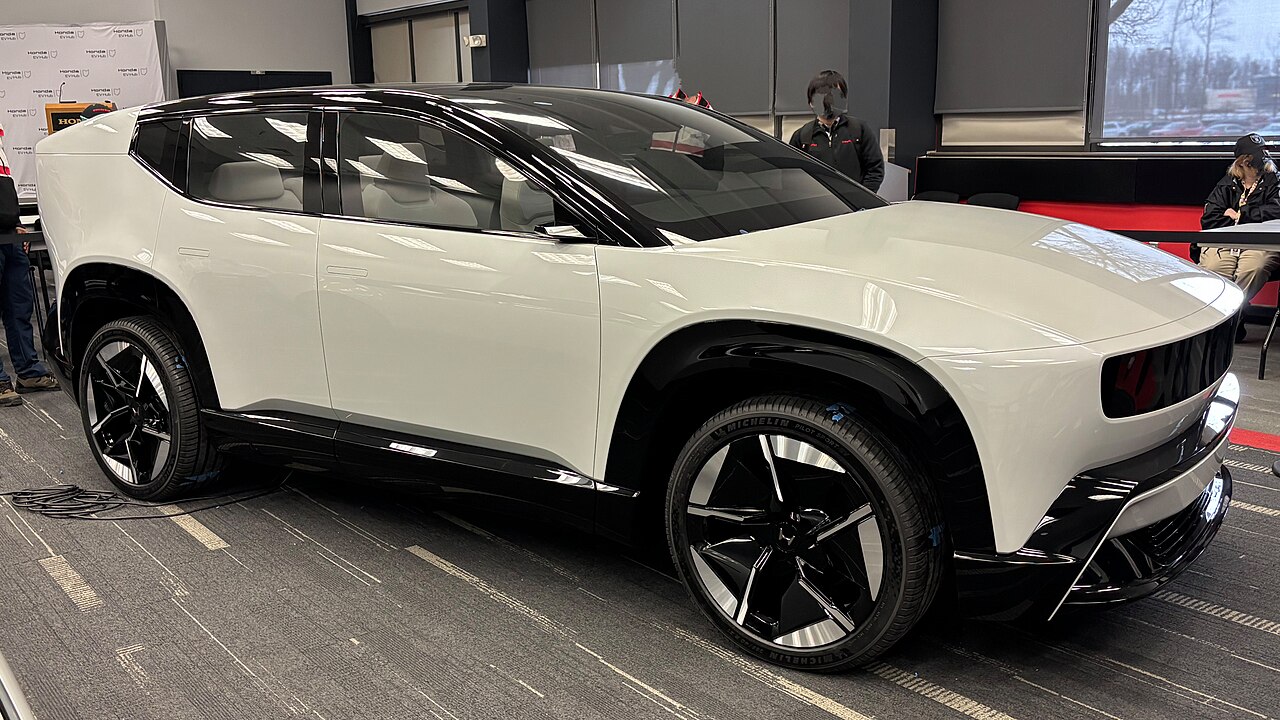
What makes the 0 SUV a different product from the Prologue
| Attribute | Honda Prologue | Honda 0 SUV |
|---|---|---|
| Platform origin | GM Ultium (licensed from GM) | Honda 0 platform (Honda-engineered) |
| Manufacturing | GM factory, Ramos Arizpe, Mexico | Honda facility |
| Software system | Google Built-In (third-party) | ASIMO OS (Honda-developed) |
| Drag coefficient | ~0.28 Cd | ~0.27 Cd (Honda announced) |
| EPA range target | 296 mi (confirmed, FWD) | 300+ mi (announced target) |
| Starting MSRP | $47,400 | ~$40,900 |
| Represents | Bridge product — GM engineering with Honda branding | Honda’s independent EV identity |
What Honda confirmed about the 0 SUV at launch
Honda announced the 0 Series at CES 2024 and confirmed US production launch for spring 2026. The 0 SUV uses Honda’s ASIMO OS software — named for Honda’s humanoid robot program — which Honda says will adapt to individual driver preferences over time through machine learning. Honda targeted a drag coefficient of 0.27 Cd, marginally better than the Prologue’s approximately 0.28, which contributes to the 300-plus mile range target. Furthermore, the 0 platform is Honda’s long-term EV foundation, meaning subsequent Honda EVs — including the 0 Saloon announced alongside the SUV — will share this architecture rather than reverting to a GM arrangement.
The starting price of approximately $40,900 positions the 0 SUV below the Prologue by roughly $6,500 at base trim. That gap, combined with the platform authenticity, makes the 0 SUV the more defensible choice for buyers specifically committed to buying a Honda electric vehicle in 2026. The caveat: as a first-generation product on a new platform, the 0 SUV carries the inherent risk of any EV generation one — software maturity, early reliability unknowns, and a service network that is still building experience with Honda’s proprietary systems.
Section verdict: The Honda 0 SUV is what the Prologue was always supposed to be a placeholder for. If you are buying a Honda EV specifically because you trust Honda’s engineering, the 0 SUV is the product that earns that trust. However, for buyers prioritizing proven reliability data over platform authenticity, the Prologue or a competitor alternative may be the lower-risk path in 2026.
Honda CR-V e:PHEV: The Bridge Option Between Gas and Full Electric
Indeed, not every buyer who searches “Honda electric car” is ready to commit to a battery-electric vehicle. For those buyers, the CR-V e:PHEV is the most practical Honda electrification option available — though it is important to be precise about what it actually is. The CR-V e:PHEV is a plug-in hybrid, not a battery-electric vehicle. It has a gasoline engine, a small battery pack (17.7 kWh, approximately 13.6 kWh usable), and an electric motor that provides 40 miles of all-electric range before the gas engine takes over.
Who the CR-V e:PHEV actually makes sense for
The 40-mile electric range covers the average American daily commute — 27.6 miles, per Bureau of Transportation Statistics data — with room to spare. Consequently, a buyer who charges nightly and drives primarily for commuting will run almost entirely on electricity, paying roughly $0.15/kWh at home versus $3.50-per-gallon gas. For longer trips, the gasoline engine handles range seamlessly without charging infrastructure planning. That combination — short-trip EV, long-trip gas — is genuinely useful for buyers who have home charging access but are not ready to depend entirely on the public charging network for road trips.
The CR-V e:PHEV starts at $38,050, which is $9,350 less than the Prologue and $2,850 less than the Honda 0 SUV at base price. However, buyers should be clear-eyed: if you plan to use primarily the gasoline engine — because you have no home charging, or because your daily mileage regularly exceeds 40 miles — the PHEV’s efficiency advantage shrinks considerably, and the Toyota RAV4 Prime ($43,510, 42 miles electric) or a conventional hybrid become more relevant comparisons.
Section verdict: The CR-V e:PHEV makes financial sense primarily for buyers with reliable home Level 2 charging and daily mileage under 40 miles. Without home charging, it is a premium hybrid with a complication — a battery that needs managing without delivering the full EV cost benefit.
Honda vs the Competition: How the Numbers Actually Stack Up
In particular, the Prologue’s price is the central problem. At $47,400, it sits in a segment where the competition is either more capable, more affordable, or both. The table below maps every major competitor in the mid-size electric crossover category, including the Blazer EV that shares the Prologue’s own platform.
Mid-size electric crossover comparison, 2026
| Vehicle | Starting MSRP | EPA Range | Platform | Notes |
|---|---|---|---|---|
| Honda Prologue EX FWD | $47,400 | 296 mi | GM Ultium | Premium interior; expensive entry for Ultium access |
| Honda 0 SUV | ~$40,900 | 300+ mi (target) | Honda 0 platform | Honda’s own engineering; first-gen risk applies |
| Chevrolet Blazer EV 1LT FWD | $44,995 | 324 mi | GM Ultium | Same platform as Prologue; longer range at lower price |
| Chevrolet Equinox EV LT | $33,900 | 319 mi | GM Ultium | Best-value Ultium option; $13,500 less than Prologue |
| Tesla Model Y Long Range | $44,990 | 320 mi | Tesla | Largest charging network; strongest residual values |
| Hyundai Ioniq 5 | $44,950 | 303 mi | Hyundai E-GMP | 800V ultra-fast charging; 18-min 10–80% |
| Kia EV6 | $42,600 | 310 mi | Hyundai E-GMP | Sportier alternative to Ioniq 5; same 800V platform |
| Toyota bZ4X | $43,070 | 252 mi | Toyota e-TNGA | Conservative but reliable; lowest depreciation risk among non-Tesla EVs |
The platform-twin argument: Chevrolet Blazer EV
Specifically, the most direct comparison to the Honda Prologue is the Chevrolet Blazer EV 1LT FWD: same Ultium platform, same battery, same factory, 28 more miles of EPA range, and a $2,405 lower starting price. The Blazer EV’s advantage narrows at higher trims where its RS AWD performance variant ($58,995) pulls away from the Prologue Elite AWD ($56,525) on performance. However, at the entry level, the Blazer EV is a more efficient use of the same engineering. For our analysis of how the Ultium platform performs across the GM family, see our Buick electric cars guide, which covers Ultium in detail.
The value argument: Chevrolet Equinox EV
The Equinox EV at $33,900 is the most difficult competitor for the Prologue to justify against. It runs on the same Ultium platform, delivers 319 miles of range (23 miles more than the Prologue FWD), and costs $13,500 less at the starting trim. Furthermore, its interior — while less premium in materials than the Prologue — includes the same Google Built-In system and the same DC fast-charging capability at 150 kW. Our analysis of the most reliable EV cars covers the Equinox EV’s early reliability data for buyers who want third-party verification before committing.
The range and charging argument: Tesla Model Y
Finally, the Tesla Model Y Long Range at $44,990 sits $2,410 below the Prologue with 320 miles of EPA range and access to Tesla’s Supercharger network of over 50,000 stalls globally. According to KBB May 2026 retention data, the Model Y retains approximately 8–12 percentage points more of its value at year five than the average non-Tesla EV. For buyers who prioritize depreciation risk, that gap is meaningful. However, the Model Y’s minimalist interior and Tesla’s divergent approach to software updates are genuine considerations for buyers who prefer a traditional ownership experience.
Section verdict: At $47,400, the Honda Prologue asks you to pay a Honda premium for GM engineering. That premium is justifiable if you specifically value Honda’s interior aesthetic and dealer network. It is not justifiable on the numbers alone — not when the Equinox EV delivers more range for $13,500 less on the same platform.
Home Charging: The Decision That Matters More Than Which Honda EV You Choose
Before comparing the Prologue to the 0 SUV, or either to a Tesla, there is a prior question that determines whether an electric vehicle saves you money at all. The single variable that changes the five-year economics more than brand, range, or battery chemistry is whether you have reliable Level 2 home charging access.
Why charging access outweighs the brand decision
In fact, the math is straightforward. At 15,000 miles per year, home charging at $0.15/kWh costs approximately $4,200 over five years. Public DC fast charging at $0.38/kWh — the national average per BloombergNEF — costs approximately $8,145 over five years for the same mileage. That $3,945 difference is not a small rounding error. It is the number that turns an EV from the cheapest total-cost vehicle in the comparison into the most expensive one. Confirm home charging access before the purchase — not after. The brand, the range, the colour — none of it matters as much as whether you can plug in at home tonight.
The buyer who discovers their apartment parking has no outlet the week after taking delivery is not a hypothetical. It is a pattern. Every EV cost analysis assumes home charging. If your situation does not include it, the analysis does not apply to you — and neither the Prologue nor the 0 SUV will save you money over a well-chosen hybrid.
Recommended Level 2 charger for Honda EVs
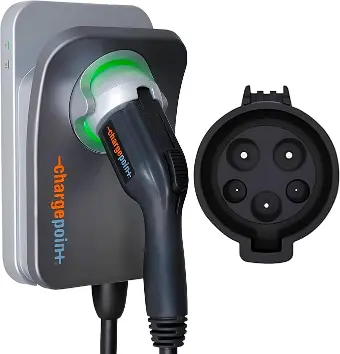
Notably, both the Prologue and the Honda 0 SUV accept J1772 Level 2 AC charging up to approximately 11.5 kW, meaning a standard 48-amp hardwired charger is sufficient for overnight replenishment. For a complete walkthrough of charger sizing, panel upgrade requirements, and installation cost ranges, our home EV charging setup guide covers the full decision in detail.
Should You Buy the Prologue, Wait for the 0 SUV, or Go a Different Direction?
In truth, this is the question most readers arrive at after reading the specs. The answer depends on three things: how strongly you prefer the Honda brand, whether you have home charging confirmed, and whether the 0 SUV’s first-generation risk concerns you.
If Honda brand loyalty is the starting point
- You want Honda’s own engineering, not a GM product with a Honda badge.
- A ~$40,900 starting price works better than the Prologue’s $47,400.
- You are comfortable with first-generation EV risk — new platform, new software, early service learning curve.
- You have confirmed home Level 2 charging access.
- You want a proven EV platform (Ultium has been in production since 2022) with Honda interior quality.
- You specifically want the Prologue’s premium interior trim levels and are willing to pay $47,400–$56,525 to get them.
- The Honda dealer relationship matters to you and you want consistency at every service visit.
- You have home charging confirmed and plan to keep the vehicle five or more years.
If the brand is flexible
- Price is a primary concern — the Chevrolet Equinox EV starts at $33,900 on the same Ultium platform as the Prologue.
- You want the most range per dollar in the segment — the Equinox EV’s 319 miles at $33,900 beats every option in this comparison on that metric.
- Depreciation risk concerns you — the Tesla Model Y consistently retains 8–12 percentage points more value than the average EV at year five.
- You need ultra-fast charging for long trips — the Hyundai Ioniq 5 and Kia EV6 charge at 800 volts, reaching 10–80% in approximately 18 minutes versus the Prologue’s 30 minutes at 150 kW.
- You have no home charging and cannot install it — in that case, consider the Honda CR-V Hybrid or Accord Hybrid instead, and revisit the EV question when your parking situation changes.
The most important condition to state plainly: do not buy any Honda EV — or any EV at all — without confirmed home charging access. Without it, the five-year energy cost rises from approximately $4,200 to $8,145, the EV finishes last in total cost of ownership, and the brand choice becomes irrelevant. Consequently, if you are comparing the Prologue against the 0 SUV while still uncertain about your charging situation, resolve the charging question first.
Methodology
Vehicles included: The full Honda US electrified lineup as of June 2026 (Prologue, 0 SUV, CR-V e:PHEV, Accord Hybrid, CR-V Hybrid, Civic Hybrid). Competitor BEVs in the mid-size crossover segment (Chevrolet Blazer EV, Equinox EV, Tesla Model Y, Hyundai Ioniq 5, Kia EV6, Toyota bZ4X) included for direct comparison.
Pricing source: Honda.com US configurator for the Prologue, CR-V e:PHEV, and Honda 0 SUV base pricing — all accessed June 2026. Honda 0 SUV pricing of approximately $40,900 reflects Honda’s confirmed US launch announcement; verify current pricing at Honda.com before purchase. Competitor pricing from respective manufacturer configurators, June 2026.
Range data: EPA figures from fueleconomy.gov for all US-market vehicles. Real-world estimates based on Edmunds highway range testing methodology (approximately 15–17% below EPA at 70 mph in mild weather). Honda 0 SUV range reflects Honda’s publicly announced target of 300-plus miles — official EPA certification pending.
Cost data: Five-year energy cost comparison uses DOE 2025 maintenance cost figures ($0.061/mile EV vs $0.101/mile gas). Charging cost assumes $0.15/kWh for home and $0.38/kWh for public DC fast charging per BloombergNEF 2026 national averages. Cold-weather range reduction of 41% at 20°F per AAA 2024 cold-weather EV range study.
Depreciation data: KBB five-year residual value data, May 2026. Tesla Model Y depreciation advantage cited as 8–12 percentage points over average non-Tesla EV at year five.
What was excluded: Honda models not sold in the US. State-level EV incentives (vary by state — check afdc.energy.gov/laws for current state incentives). Honda 0 Saloon (not yet on sale in the US as of this publication).
Tax credit status: The federal $7,500 EV tax credit (Section 30D) expired September 30, 2025 and is not applied to any pricing in this article.
FAQ: Honda Electric Cars in 2026
What Honda electric cars are available in the US in 2026?
Honda sells two battery-electric vehicles in the United States in 2026: the Honda Prologue and the Honda 0 SUV. The Prologue (from $47,400) launched in 2024 and is built on GM’s Ultium platform. The 0 SUV (from approximately $40,900) arrived at US dealers in spring 2026 and is Honda’s first purpose-built electric vehicle on Honda’s own architecture. Honda also sells the CR-V e:PHEV (plug-in hybrid, 40 miles electric range) and several self-charging hybrids, but those are not battery-electric vehicles.
Is the Honda Prologue worth buying in 2026?
The Prologue is a capable EV with 296 miles of EPA range (FWD), a well-appointed interior, and Honda’s service network. However, it starts at $47,400 — $13,500 more than the Chevrolet Equinox EV, which runs on the same Ultium platform and delivers 319 miles of range. With the Honda 0 SUV now available at approximately $40,900 on Honda’s own platform, the Prologue occupies a difficult position: it costs more than the 0 SUV, shares its engineering with a cheaper Chevy, and delivers less range than the Equinox EV. It is worth buying if you specifically value the Prologue’s premium interior trims and the Honda dealer experience — not if you are optimizing for range per dollar.
What is the Honda 0 SUV and when can I buy it?
The Honda 0 SUV is Honda’s first battery-electric vehicle built on Honda’s own 0 platform — not the GM Ultium arrangement used in the Prologue. It began arriving at US Honda dealers in spring 2026 and targets 300-plus miles of EPA range. It uses Honda’s ASIMO OS software platform and is positioned at a lower starting price (~$40,900) than the Prologue. As a first-generation product on a new platform, it carries early-adopter risk — but it is also the first Honda EV that represents Honda’s independent EV engineering direction.
Does the Honda Prologue use GM’s platform?
Yes. The Honda Prologue is built on General Motors’ Ultium battery platform, manufactured at GM’s Ramos Arizpe, Mexico factory — the same facility that produces the Chevrolet Blazer EV. The Prologue shares its battery architecture, electric motors, and DC fast-charging system with the Blazer EV. Honda differentiated it with its own exterior styling, interior design, and the Google Built-In infotainment system. The Honda 0 SUV, by contrast, uses Honda’s own platform with no GM involvement.
How does the Honda Prologue compare to the Chevrolet Blazer EV?
The Honda Prologue and Chevrolet Blazer EV share the same GM Ultium platform, battery, and factory. The Blazer EV 1LT FWD starts at $44,995 and delivers 324 miles of EPA range — both a lower price and more range than the Prologue EX FWD at $47,400 and 296 miles. The Prologue’s advantages are its distinctive Honda interior calibration and styling. Neither is the most efficient use of the Ultium platform — the Chevrolet Equinox EV starts at $33,900 with 319 miles of range on the same architecture.
What range does the Honda Prologue actually get in real-world driving?
The EPA rates the Prologue at 296 miles (FWD) and 273 miles (AWD Elite). In real-world highway driving at 70 mph in mild weather, expect approximately 245–252 miles (FWD) — roughly 15–17% below EPA, consistent with how most EVs perform on actual highways. In cold weather at 20°F with the heater on, the AAA 2024 cold-weather EV range study documents an average 41% range reduction across the EV segment, which would put the Prologue at approximately 175 miles under those conditions. Plan around 80% of the EPA figure as your realistic daily estimate; use 60% for winter trip planning in cold climates.
What are the best alternatives to Honda electric cars in 2026?
For buyers who want the same GM Ultium platform at a significantly lower cost, the Chevrolet Equinox EV ($33,900, 319 miles) is the most direct alternative. The Tesla Model Y Long Range ($44,990, 320 miles) offers the best charging infrastructure and lowest depreciation risk. The Hyundai Ioniq 5 ($44,950, 303 miles) and Kia EV6 ($42,600, 310 miles) both use 800-volt charging for faster replenishment than either Honda EV. For buyers who are not yet ready for a full BEV and have home charging, the Honda CR-V e:PHEV ($38,050, 40 miles electric) is the logical step before committing to a battery-electric vehicle.
Final Verdict
Overall, Honda’s electric car lineup in 2026 is a story of two different eras arriving simultaneously. Specifically, the Prologue is the tail end of the bridge-product strategy — GM-engineered, Honda-branded, and increasingly difficult to justify at $47,400 now that both a cheaper Ultium alternative (the Equinox EV) and a genuine Honda-platform EV (the 0 SUV) are on sale.
The Prologue’s position has weakened
Specifically, the Prologue made the most sense from 2024 into early 2026, when it was the only Honda EV available and buyers who wanted a Honda badge on an EV had no other choice. Consequently, that window has closed. With the 0 SUV arriving at dealers at a lower starting price and on Honda’s own platform, the Prologue’s premium over the 0 SUV is hard to defend unless you specifically prefer the Prologue’s trim levels, its proven Ultium reliability record, or its more established dealer service history. Furthermore, against the Equinox EV, the Prologue’s case never made financial sense — and it still does not.
The 0 SUV is the more interesting Honda EV — with caveats
In contrast, the Honda 0 SUV matters because it represents Honda’s actual EV strategy, not a licensing arrangement. Moreover, its lower price, Honda-owned software stack, and purpose-built architecture make it the more authentic Honda EV argument. However, first-generation products on new platforms carry real risk: ASIMO OS is unproven in long-term use, Honda’s service network is still building experience with the 0 platform, and early-production reliability data does not yet exist. If those risks concern you, waiting 12–18 months for early owner data is the lower-risk path.
What I would actually do with the money
Personally, if I were a Honda-loyal buyer with confirmed home charging and a budget around $40,000–$47,000, I would buy the Honda 0 SUV. The platform authenticity matters, the price is more competitive, and the range target is strong. Admittedly, I would accept the first-generation risk in exchange for buying a vehicle Honda actually engineered rather than one they assembled on someone else’s architecture.
On the other hand, if my budget ran to $45,000 and brand loyalty was flexible, the Chevrolet Equinox EV at $33,900 would free up $11,000 for home charging installation, winter tyres, and five years of electricity costs. After all, the Ultium platform is the same one the $47,400 Prologue uses — and 319 miles of range is 23 miles more than the Prologue delivers.
In summary: Honda’s EV story in 2026 is better than it was 12 months ago because the 0 SUV exists. However, it is not yet the clean recommendation it could become once early reliability data accumulates on the 0 platform. Therefore, if you are buying today, confirm your home charging access first, weigh the 0 SUV against the Equinox EV honestly, and do not pay the Prologue’s premium unless you have a specific reason that premium delivers value in your situation.
Last updated: June 14, 2026 — Honda Prologue and Honda 0 SUV US pricing and specs, CR-V e:PHEV MSRP, competitor EV pricing and EPA range figures verified. Honda 0 SUV EPA range certification pending at time of publication.