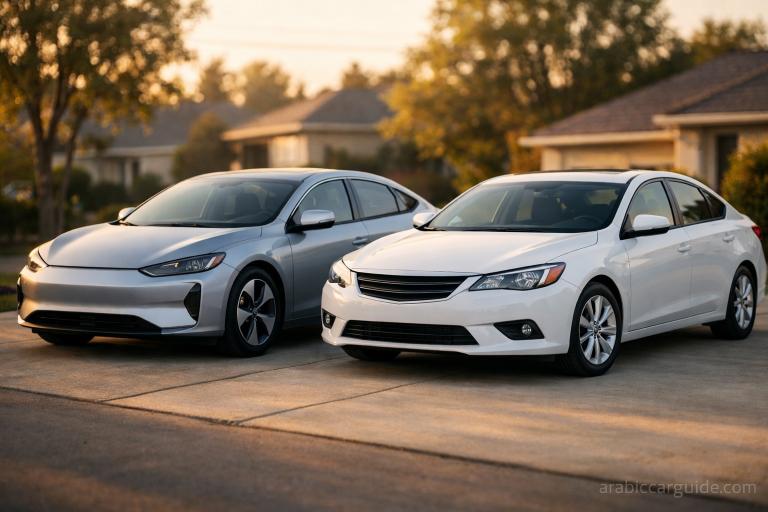
Any electric car total cost of ownership calculator that omits insurance and depreciation is showing you half the picture. And most of them do exactly that. The EV wins a five-year cost comparison against gas — but only by $1,802, and only if you charge at home. Not $10,000. Not “massive savings.” A margin of $1,802 over 60 months, which works out to $30 per month. One condition is attached that most buyers do not verify before signing: reliable Level 2 home charging access. Without it, the EV finishes last. Meanwhile, the hybrid — which almost nobody discusses in this context — finishes $141 ahead of gas in nearly every scenario and requires no charging infrastructure at all.
Why Most Electric Car Total Cost of Ownership Calculators Get It Wrong
This guide walks through every category of a true electric car total cost of ownership calculator — purchase price, fuel, maintenance, insurance, and depreciation — with real numbers, the sources behind them, and the assumptions that change the answer. I built it because most EV cost calculators online include only fuel and maintenance savings while ignoring the two largest cost categories entirely. As a result, they omit more than $20,000 of a five-year cost, which makes the EV look far cheaper than it actually is.
Over five years at 15,000 miles/year, the EV SUV costs $37,222 with home charging — $1,802 less than the gas equivalent at $39,024, and $1,661 less than the hybrid at $38,883. Without home charging, however, the EV jumps to $41,167 and finishes last. The $7,500 federal credit expired September 30, 2025 — so it is not in this math. If you have home charging and plan to keep the car five years or more, then the EV is the rational financial choice. If you do not have home charging, the hybrid is the lowest-risk option by a clear margin. Most online electric car total cost of ownership calculators omit insurance (EVs cost 18% more) and depreciation (EVs lose $3,703 more than gas over five years). Consequently, those omissions make the EV look far cheaper than it actually is.
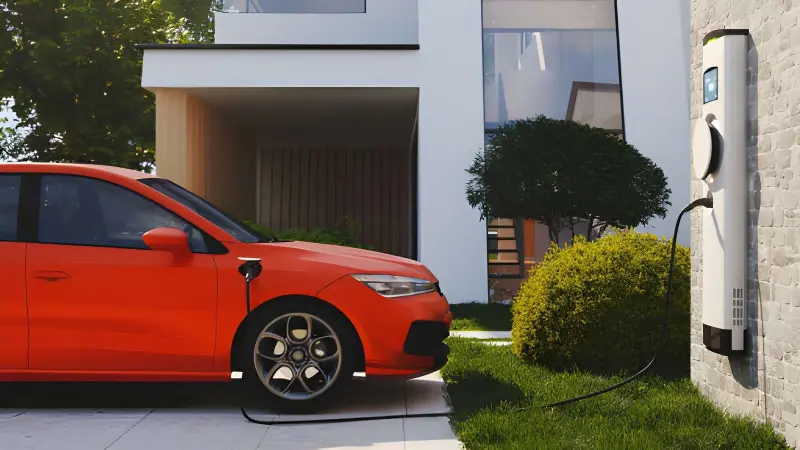
Home charging access is the single variable that determines whether an electric car total cost of ownership calculator shows savings or losses over five years.
What an Electric Car Total Cost of Ownership Calculator Should Include
A total cost of ownership calculation answers one question: how much will this vehicle actually cost me over the time I own it? Not the sticker price. Not the monthly payment. Instead, it captures the entire cost — from the day you drive it off the lot to the day you sell it or trade it in.
That calculation has five components, although most online tools only cover the first three:
| Cost Category | What It Covers | Typical 5-Year Amount (SUV) | Included in Most Calculators? |
|---|---|---|---|
| Purchase price | MSRP or financed cost | $30,000–$35,000 | Yes |
| Fuel / energy | Gas, electricity, or both | $4,200–$8,200 | Yes |
| Maintenance | Scheduled service, tyres, brakes | $4,575–$7,575 | Yes |
| Insurance | Annual premiums over ownership | $8,750–$10,250 | Often missing |
| Depreciation | Value lost from purchase to sale | $14,494–$18,197 | Often missing |
Insurance and depreciation combined account for $23,000 to $28,000 of a five-year cost. Therefore, any calculator that omits them is showing you half the picture while presenting it as the whole thing. That is how a $4,000 EV fuel saving gets reported as a $4,000 net advantage, when in reality the net advantage — after accounting for higher insurance and steeper depreciation — is $1,802.
Every number in this electric car total cost of ownership calculator guide uses the same three vehicles for consistency: the 2026 Toyota RAV4 LE (gas), the 2026 Toyota RAV4 Hybrid LE (hybrid), and the 2026 Chevrolet Equinox EV LT (EV). All three sit in the same vehicle class and the same price bracket, but each uses a different powertrain. That is the only fair comparison.
5-Year EV vs Gas vs Hybrid Cost of Ownership Calculator: The Full Numbers
This is the table that matters. Every claim in the article traces back to it, and it represents the core output of any honest electric car total cost of ownership calculator.
| Cost Category | Gas RAV4 LE | Hybrid RAV4 LE | Equinox EV (Home Charging) | Equinox EV (Public Only) |
|---|---|---|---|---|
| MSRP | $30,195 | $34,995 | $34,995 | $34,995 |
| 5-Year Fuel/Energy | $8,205 | $6,735 | $4,200 | $8,145 |
| 5-Year Maintenance | $7,575 | $6,600 | $4,575 | $4,575 |
| 5-Year Insurance | $8,750 | $9,100 | $10,250 | $10,250 |
| 5-Year Depreciation | $14,494 | $16,448 | $18,197 | $18,197 |
| TOTAL 5-YEAR COST | $39,024 | $38,883 | $37,222 | $41,167 |
| Verdict | 3rd with home charging; 2nd without | 2nd — always competitive | 1st — with home charging | Last — most expensive option |
The numbers tell a clear but conditional story. While the EV with home charging wins, the margin is not dramatic — $30 per month over gas, $28 per month over hybrid. In contrast, the hybrid finishes $141 ahead of gas in nearly every scenario and asks nothing of your parking situation. Yet the EV without home charging is the worst outcome of all four options, because its energy costs nearly match gasoline while insurance and depreciation remain higher.
One thing I did not expect when I first ran these numbers: how close the hybrid and gas finish to each other. The hybrid’s $4,800 premium over the gas RAV4 is recovered entirely within the ownership window. As a result, it pays back faster than most buyers assume — approximately two years at $3.50/gallon and 15,000 miles.
Purchase Price in Your Electric Car Total Cost of Ownership Calculator
Both the EV and hybrid start at the same MSRP: $34,995. By comparison, the gas RAV4 starts at $30,195. That creates a $4,800 purchase premium for both the hybrid and the EV over the gas baseline.
In 2024, the $7,500 federal Clean Vehicle Credit offset most of that premium. However, in 2026, it does not exist. The credit expired September 30, 2025 under the One Big Beautiful Bill Act. It is not in this math, and consequently any TCO calculator still including it is giving you a number that does not apply to a vehicle purchased today.
State incentives, on the other hand, are still active in several markets. For instance, Colorado offers $5,000, California up to $7,500 (income-qualified), and Oregon up to $7,500. If you are in one of those states, then the EV’s purchase premium effectively disappears. For a full breakdown of current state EV incentives, check the dedicated guide.
For everyone else, the EV starts $4,800 behind the gas car and therefore needs to earn that difference back through lower fuel, maintenance, and operating costs over the ownership period. Whether it does depends entirely on one variable.
Fuel and Energy Costs: Where Home Charging Changes the Calculator
This is the category that decides the outcome of any electric car total cost of ownership calculator. Not because the numbers are the largest — since depreciation and insurance are both bigger — but because this is the one category where the gap between the best and worst EV scenario reaches $3,945.
| Powertrain | Efficiency | 5-Year Energy Cost | Cost per Mile |
|---|---|---|---|
| Gas RAV4 (32 mpg) | 32 mpg combined | $8,205 | $0.109 |
| Hybrid RAV4 (39 mpg) | 39 mpg combined | $6,735 | $0.090 |
| EV — home charging | 3.4 mi/kWh | $4,200 | $0.056 |
| EV — public only | 3.4 mi/kWh | $8,145 | $0.108 |
With home charging, the EV’s fuel cost is roughly half the gas car’s. That is real, and it represents $4,005 saved over five years in fuel alone. But if you switch to public DC fast charging at $0.38/kWh, then the EV’s energy cost ($8,145) nearly matches the gas car’s fuel bill ($8,205). At that point, the EV is spending essentially the same amount on energy while still carrying higher insurance and depreciation costs. As a result, that combination makes it the most expensive powertrain to own.
The buyer who discovers their parking has no outlet the week after taking delivery is not a hypothetical. It is a pattern. Every EV cost analysis assumes home charging, so if your situation does not match that assumption, then the analysis does not apply to you. Confirm home charging access before the purchase — not after.
For a full guide on setting up home EV charging, including Level 2 installation costs and the best home chargers, see the dedicated article.

Home charging at $0.15/kWh costs $4,200 over five years. Public-only charging at $0.38/kWh costs $8,145. Same car, same miles — yet a $3,945 difference that changes the entire calculator output.
Electric Car Maintenance Costs: The EV’s Clearest Advantage in Any Calculator
This is the one category where the EV wins unambiguously, regardless of how you charge it.
The DOE’s 2025 per-mile maintenance figures tell the story plainly. An EV costs $0.061 per mile to maintain, while a hybrid costs $0.088 and a gas vehicle costs $0.101. Over five years at 15,000 miles annually, that produces a $3,000 gap between the EV and gas, along with a $975 gap between the hybrid and gas.
Why such a large difference? EVs have no engine oil, no transmission fluid, no timing belt, and no exhaust system. In addition, regenerative braking captures kinetic energy during deceleration, which means brake pads last 100,000 miles or more instead of the typical 30,000–50,000 on a gas car. The EV maintenance checklist is therefore shorter than any gas vehicle’s by a significant margin.
There is, however, one offset. EVs weigh more — the Equinox EV is roughly 1,000 lbs heavier than the gas RAV4 — and that extra weight accelerates tyre wear. Over five years, expect to spend approximately $200 more on tyres for the EV. Although the $3,000 maintenance saving absorbs that easily, it is important to note because some calculators ignore tyre costs entirely.
The maintenance advantage is the EV’s most durable financial argument in any electric car total cost of ownership calculator. It does not depend on gas prices, electricity rates, or charging access. Instead, it compounds over time, which is the primary reason long-term EV owners — those who keep the car past year five — see the best financial outcomes.
Insurance Costs: The Category Most EV Cost Calculators Ignore
EVs cost approximately 18% more to insure than equivalent gas vehicles, according to the Insurance Information Institute’s 2025 data. Over five years, that translates to $10,250 for the Equinox EV compared to $8,750 for the gas RAV4. The hybrid, meanwhile, falls in between at $9,100.
The premium difference is driven by three factors: higher repair costs because EV body panels and battery-adjacent components are more expensive to fix, fewer qualified repair shops which increases labour rates, and higher replacement cost in a total-loss scenario since the battery pack alone accounts for 30–40% of the vehicle’s value.
This $1,500 gap over five years matters because it directly erodes the EV’s fuel saving. While the EV saves $4,005 on fuel compared to gas, $1,500 of that goes back out in higher insurance. As a result, the net fuel-plus-insurance advantage is actually $2,505, not $4,005. Calculators that omit insurance therefore overstate the EV’s financial case by about 37%.
For a deeper breakdown of EV insurance costs compared to gas vehicles, including brand-by-brand rates, see the dedicated analysis.
Depreciation: The Largest Cost Missing From Most EV Calculators
Depreciation is the single largest cost category for every powertrain, yet it is also the one category where the EV performs worst.
Over five years, the Equinox EV retains approximately 48% of its MSRP — a depreciation cost of $18,197. In contrast, the gas RAV4 retains 52%, losing $14,494. The hybrid retains 53% at $16,448. Consequently, the EV depreciates $3,703 more than the gas car over the same period.
Three forces drive faster EV depreciation in the current market. First, the expiry of the federal credit depressed used EV demand, because a new EV no longer carries a $7,500 buyer incentive that used EVs had been priced against. Second, rapid technology improvement accelerates obsolescence — a 2026 EV with 319 miles of range will compete on the used market against 2028 models with potentially 400+ miles. Third, EV supply has increased faster than demand through 2025–2026, which pushes used prices down.
This matters most for short-cycle buyers. If you trade in every three years, then the EV has paid back less of its purchase premium, has depreciated more steeply than the gas alternative, and has not accumulated enough maintenance savings to close the gap. The EV makes financial sense if you plan to keep it five years or more. However, if you trade in every three years, then the depreciation curve and the upfront premium work against you. The hybrid is therefore the better short-cycle choice.
How Gas Price Changes the Total Cost of Ownership Calculation
The EV’s total cost stays fixed at $37,222 regardless of gas prices, since electricity rates are more stable and less correlated with petroleum markets. The gas and hybrid costs, on the other hand, move with the pump price. As a result, the EV’s advantage grows as gas gets more expensive and shrinks as gas gets cheaper.
| Gas Price ($/gal) | Gas RAV4 TCO | Hybrid RAV4 TCO | EV Advantage vs Gas | EV Advantage vs Hybrid |
|---|---|---|---|---|
| $3.00 | $38,858 | $38,350 | $1,636 | $1,128 |
| $3.50 | $39,024 | $38,883 | $1,802 | $1,661 |
| $4.00 | $40,195 | $39,345 | $2,973 | $2,123 |
| $4.50 | $41,366 | $39,808 | $4,144 | $2,586 |
At $3.00/gallon, the EV still wins with home charging, although the margin is thin — $1,636 over five years, or $27 per month. At $4.50/gallon, however, the advantage grows to $4,144 — a much more meaningful number. If you live in a market where $4.00+ fuel is the norm (such as California, Hawaii, or parts of the Northeast), then the EV case is substantially stronger than the national average suggests.
The hybrid’s advantage over gas also grows with fuel prices, which makes it a particularly strong choice in high-fuel-cost markets where home charging is not available. At $4.50/gallon, for example, the hybrid saves $1,558 compared to gas — all without requiring any charging infrastructure.
Annual Mileage: When Each Powertrain Wins in a Cost of Ownership Calculator
How much you drive determines which powertrain works hardest in your favour. Because the fuel and maintenance savings that make the EV competitive are per-mile numbers, the rule is simple — drive more, save more.
The gas SUV is the rational choice at this mileage level. With low annual driving, the hybrid cannot recover its $4,800 purchase premium within the ownership window. Similarly, the EV’s fuel and maintenance savings are too small to offset its higher insurance and depreciation. If you work from home or have a very short commute, then the base gas model costs less to own across every other category.
8,000–20,000 miles per yearThe hybrid is the lowest-risk bet in this range. It recovers its premium through fuel savings, carries lower insurance than the EV, and also depreciates less steeply. While the EV with home charging wins this range narrowly, the hybrid wins it without requiring any infrastructure or charging behaviour changes. For the best hybrid options for high-mileage drivers, see the ranked guide.
At this mileage, the EV wins decisively. With 20,000+ miles annually, the fuel saving rises to approximately $5,600 and the maintenance saving reaches $4,000 compared to gas — combined, that is a $9,600 advantage that overwhelms the insurance and depreciation penalties. Accordingly, high-mileage commuters, rideshare drivers, and anyone covering 25,000+ miles per year should not be considering gas at all if they have home charging. The best EVs for long daily commutes are optimised for exactly this use case.
5-Year Total Cost of Ownership by Annual Mileage
EV assumes home charging. Based on EPA/DOE/KBB data. All costs in USD.
At 15,000 miles/year, the EV wins by $1,802 with home charging. At 20,000+ miles, the margin widens to over $4,300.
Which Powertrain Should You Actually Buy?
The data from this electric car total cost of ownership calculator points to three distinct buyer profiles. The right answer depends on your infrastructure, your mileage, and how long you keep a car — not on which powertrain is “better” in the abstract.
- You have reliable Level 2 home charging (or can install it for $500–$2,000)
- You drive 12,000+ miles per year
- You plan to keep the car at least five years
- You live in a state with active EV incentives (Colorado, California, Oregon)
- Gas prices in your area consistently exceed $3.50/gallon
- You have no home charging access and no realistic way to install it
- You drive 8,000–20,000 miles per year
- You want the lowest-risk financial outcome without any infrastructure requirements
- You road-trip regularly and want zero charging planning
- You trade in every 3–4 years (hybrid depreciation is more predictable)
- You drive under 8,000 miles per year
- You prioritise the lowest possible upfront cost
- Gas prices in your area are consistently below $3.00/gallon
- You keep cars 3 years or fewer (the gas car’s lower depreciation helps short-cycle buyers)
The hybrid is not the consolation prize. For buyers without home charging, below 15,000 miles a year, or in markets with unreliable public charging infrastructure, it is the financial winner — and it asks nothing of your parking situation. The hybrid is the most underrated choice in this comparison. The RAV4 Hybrid finishes $1,661 behind the EV with home charging over five years — yet it requires zero of the infrastructure the EV demands.
When the Electric Car Total Cost of Ownership Calculator Says “Don’t Buy”
Do not buy an EV to save money if:
- You cannot confirm Level 2 home charging access before signing. Not “I’ll figure it out” — confirmed, with an outlet or panel capacity verified by an electrician
- You trade cars every 2–3 years. Because the maintenance savings and fuel advantage compound past year five, shorter ownership periods rarely break even. The depreciation hit is steepest early
- You are looking at a first-model-year EV on a new platform. The reliability data on new platforms consistently improves by model year three
- Your annual mileage is under 8,000. At that level, there simply are not enough driven miles to generate meaningful fuel and maintenance savings
I know that is not what most EV content says. But the numbers from this electric car total cost of ownership calculator do not support the blanket claim that EVs always save money. They save money under specific, verifiable conditions. When those conditions are met, then the case is real. When they are not, you end up paying more — not less — for the privilege of plugging in instead of pumping gas.
Methodology
- 2026 Toyota RAV4 LE (gas) — MSRP $30,195
- 2026 Toyota RAV4 Hybrid LE — MSRP $34,995
- 2026 Chevrolet Equinox EV LT — MSRP $34,995
- EPA fueleconomy.gov — combined MPG and kWh/100mi ratings for all three vehicles
- DOE Alternative Fuels Data Center (AFDC) — per-mile maintenance cost by powertrain ($0.061/mi EV, $0.088/mi hybrid, $0.101/mi gas)
- KBB 5-year residual value projections — depreciation rates for each powertrain class
- Insurance Information Institute (2025) — EV vs gas insurance premium differential (18% higher for EVs)
- EIA (U.S. Energy Information Administration) — national average residential electricity rate
- 15,000 miles per year (U.S. national average)
- Gas price: $3.50/gallon (2026 national average)
- EV home charging: 80% of energy at $0.15/kWh, 20% at $0.38/kWh (public DC fast charging)
- EV public-only scenario: 100% at $0.38/kWh average
- 5-year ownership period
- No financing costs included (cash purchase assumed for simplicity)
- Federal EV tax credit — expired September 30, 2025. Not available for 2026 purchases
- State incentives — vary by state; noted where applicable but not included in the base calculation
- Financing costs — interest rates vary by buyer credit; including them would add $2,000–$5,000 to each powertrain proportionally
- Home charger installation cost — $500–$2,000 depending on existing electrical capacity. A one-time cost that does not recur
Date verified: May 31, 2026
Electric Car Total Cost of Ownership Calculator FAQ
Is an electric car cheaper to own than a gas car over 5 years?
With home charging, yes — by $1,802 over five years comparing the Equinox EV ($37,222) to the gas RAV4 ($39,024) at 15,000 miles/year and $3.50/gallon. Without home charging, however, the EV costs $41,167, making it $2,143 more expensive than gas. The margin is smaller than most buyers expect, and charging access is the determining variable in any electric car total cost of ownership calculator.
What costs should I include in an electric car total cost of ownership calculator?
Five categories cover 95% of the real cost: purchase price, fuel or energy, maintenance, insurance, and depreciation. Insurance and depreciation alone account for more than $20,000 of a five-year ownership cost. Therefore, any calculator that omits them is showing you roughly half the picture. Most free online calculators only include the first three categories.
How much does it cost to charge an EV at home vs public charging?
Home charging at $0.15/kWh costs approximately $4,200 over five years at 15,000 miles/year. In contrast, public DC fast charging at $0.38/kWh average costs $8,145 — a $3,945 penalty. For the cheapest ways to charge an EV, including time-of-use rate strategies, see the dedicated guide.
Is the federal EV tax credit still available in 2026?
No. The $7,500 federal Clean Vehicle Credit expired September 30, 2025. State incentives, however, remain active in Colorado ($5,000), California (up to $7,500 income-qualified), Oregon (up to $7,500), and others. Current programs are listed at afdc.energy.gov/laws.
How much do EVs depreciate compared to gas cars?
The Equinox EV retains approximately 48% of its MSRP after five years, which means it loses $18,197 in depreciation. The gas RAV4, by comparison, retains 52% and loses $14,494. That $3,703 gap is driven by the expired federal credit (which depressed used EV demand), rapid technology improvement, and supply outpacing demand through 2025–2026.
At what gas price does an EV become cheaper than a gas car?
With home charging, the EV wins at any gas price above approximately $2.80/gallon. At $3.00/gal, the EV saves $1,636, while at $4.50/gal, it saves $4,144. Without home charging, however, the EV loses at every gas price below approximately $5.50/gallon — a price not seen nationally in the United States.
How much cheaper is EV maintenance than gas car maintenance?
EVs cost $0.061/mile to maintain vs $0.101/mile for gas vehicles (DOE 2025). Over five years at 15,000 miles/year, that is $4,575 for the EV vs $7,575 for gas — a $3,000 saving. Because EVs require no oil changes, no transmission service, and regenerative braking extends brake pad life past 100,000 miles, this is their most reliable cost advantage. The only offset: tyres wear about $200 faster due to heavier vehicle weight.
The Real Math Behind Your Electric Car Total Cost of Ownership Calculator
The EV saves money. With home charging, at average gas prices, for a buyer who keeps the car five years, the numbers work. Not by the margin you will see in most headlines — $1,802, not $10,000 — but they work.
Strip away the assumptions that do not apply to your life and what remains is a conditional answer. The condition is home charging. With it, the EV wins. Without it, the EV finishes last. The brand, the range, the colour — none of those factors matters as much as whether you can plug in at home tonight.
If you cannot, then the hybrid is not the compromise. It is the right answer.
Last updated: May 31, 2026
James has spent over a decade analysing automotive markets, EV total cost of ownership, and the structural economics behind vehicle pricing. He builds every cost comparison from primary sources — EPA ratings, DOE maintenance data, and KBB residual projections — because the conclusions should come from the numbers, not the other way around.