The $7,500 federal EV tax credit is gone. It expired September 30, 2025, and it’s not coming back. If you’re searching for “best EV tax credits 2026,” here’s what you need to know immediately: the incentive landscape has fundamentally changed. The old IRA Clean Vehicle Credit — the one that knocked $7,500 off a new Tesla or Chevy at the dealership — was eliminated by the One Big Beautiful Bill Act (OBBBA). What replaced it is different in structure, eligibility, and value. This guide covers exactly what’s available in April 2026 and how to maximize every dollar.
EV Incentives in 2026 — What Actually Exists: The $7,500 federal credit expired Sept 30, 2025. What replaced it: OBBBA Auto Loan Interest Deduction — deduct up to $10,000/year in loan interest on new, U.S.-assembled vehicles through 2028. This is a deduction (reduces taxable income), not a credit (dollar-for-dollar). Income phase-out begins at $100K single / $200K joint. State incentives are now the primary savings lever: Colorado up to $9,000 (VXC, income-qualified), New Jersey $4,000, Massachusetts $3,500, Illinois $4,000. The 30C home charger credit (30%, up to $1,000) remains active through June 30, 2026.
What Changed: The $7,500 Federal EV Credit Is Gone

The Inflation Reduction Act’s Clean Vehicle Credit (Section 30D) — which provided up to $7,500 for new EVs and $4,000 for used EVs (Section 25E) — was repealed by the One Big Beautiful Bill Act, signed July 4, 2025. The credit remained available for vehicles purchased on or before September 30, 2025. After that date, the point-of-sale transfer, MSRP caps, battery sourcing rules, and income limits associated with the old credit are all gone — because the credit itself no longer exists.
The OBBBA Auto Loan Interest Deduction — How It Actually Works
The replacement isn’t a credit — it’s a deduction. That distinction matters enormously. A $7,500 credit reduced your taxes by $7,500. A $10,000 deduction reduces your taxable income by $10,000 — which saves you $10,000 multiplied by your marginal tax rate. For someone in the 22% bracket, a $10,000 deduction saves $2,200 per year. Over a 3-year loan, that totals ~$6,600 — comparable to the old credit but spread over time rather than applied at purchase.
OBBBA Eligibility Requirements
The vehicle must be new (used vehicles don’t qualify), assembled in the United States (VIN starts with 1, 4, or 5 — not 2, 3, J, W, or S), and purchased for personal use. Leased vehicles don’t qualify. The loan must have originated after December 31, 2024, and the deduction expires after tax year 2028. There is no MSRP cap — any price qualifies. This is an above-the-line deduction, meaning you can claim it even if you take the standard deduction.
Income Phase-Out
The deduction phases out at a 20% rate for single filers earning above $100,000 and joint filers above $200,000. For every $1,000 over the threshold, your maximum deduction drops by $200. A single filer earning $110,000 has a maximum deduction of $8,000 instead of $10,000. Above $150,000 single / $250,000 joint, the deduction is fully phased out.
| Feature | Old IRA Credit (expired) | OBBBA Loan Deduction (active) |
|---|---|---|
| Type | Tax credit (dollar-for-dollar) | Tax deduction (reduces taxable income) |
| Maximum value | $7,500 one-time | $10,000/year through 2028 |
| Real savings (22% bracket) | $7,500 | ~$2,200/year (~$6,600 over 3 years) |
| Applied when? | At purchase (POS) or tax filing | Annual tax filing only |
| Vehicle requirement | North America assembly + battery sourcing | U.S. assembly only (VIN check) |
| Income limit | $150K single / $300K joint | Phase-out starts $100K / $200K |
| New/Used | Both (separate credits) | New only |
| Leases | Commercial credit (no income limit) | Not eligible |
| MSRP cap | $55K cars / $80K SUVs | No cap |
Sources: IRS OBBBA Guidance, H&R Block analysis, TurboTax guide.
State EV Incentives in 2026 — Where the Real Savings Are Now
With the federal credit gone, state incentives are no longer supplementary — they’re the main event. Several states increased their programs in late 2025 specifically to offset the federal credit loss. Colorado’s Vehicle Exchange Colorado program increased rebates from $6,000 to $9,000 for new EVs in November 2025.
| State | Incentive | Amount | Type | Key Requirement |
|---|---|---|---|---|
| Colorado | VXC + IMVC combined | Up to $9,750 | POS rebate + tax credit | Income-qualified, trade-in required for VXC |
| New Jersey | Charge Up NJ | Up to $4,000 | POS rebate + sales tax exempt | MSRP under $55K |
| Illinois | IL EPA EV Rebate | $4,000 | Post-purchase rebate | Until June 30, 2026; then $2,000 |
| Massachusetts | MOR-EV | Up to $3,500 | POS or post-purchase | Income-qualified adders available |
| New York | Drive Clean Rebate | Up to $2,000 | POS rebate | MSRP under $42K |
| California | Clean Cars 4 All | Up to $12,000 | Grant (income-qualified) | Must scrap older vehicle, low-income only |
| Oregon | Standard / income-qualified | $2,500–$5,000 | Rebate | Subject to funding availability |
| Connecticut | CHEAPR | $2,250–$4,250 | Rebate | Income-based tier |
States without meaningful EV purchase incentives as of April 2026 include Alabama, Alaska, Indiana, Iowa, Kansas, Kentucky, Mississippi, Missouri, Nebraska, Oklahoma, Tennessee, and Wyoming. If you live in one of these states, the OBBBA loan deduction is your only federal-level benefit.
Home Charger Credit — Act Before June 30, 2026
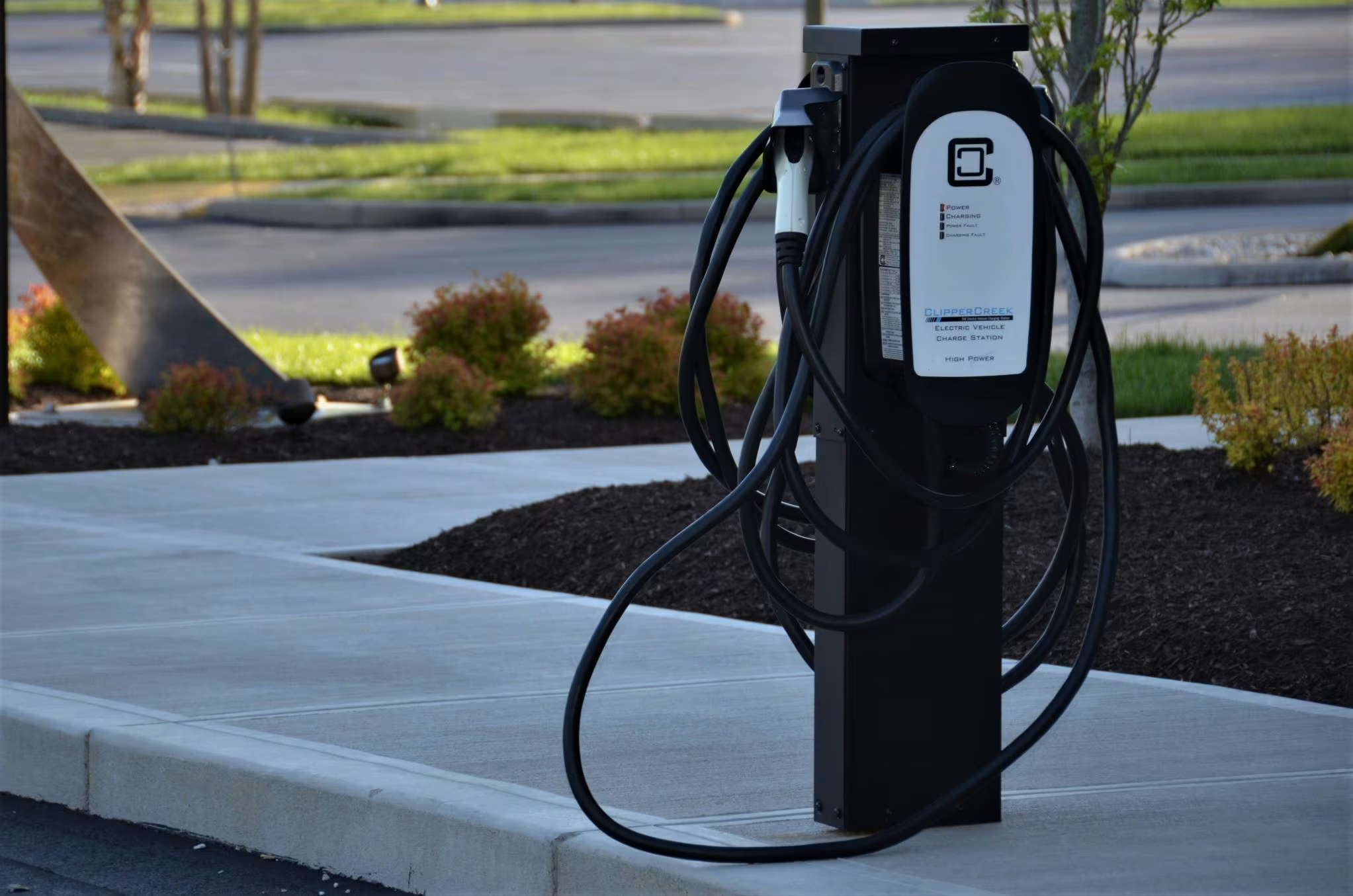
The 30C Alternative Fuel Refueling Property Credit remains active through June 30, 2026. It provides a 30% credit (up to $1,000) on home charger purchase and installation costs. You must live in an eligible census tract (non-urban or low-income area). Check eligibility using the DOE 30C eligibility tool. If your location qualifies, install before the deadline — this credit has no announced extension.
How to Stack Incentives for Maximum Savings in 2026
The buyers who save the most in 2026 are those who stack every eligible layer. Here are two realistic scenarios:
Best Case: Income-Qualified Colorado Buyer
Colorado VXC rebate: $9,000 + IMVC state credit: $750 + OBBBA interest deduction (3 years, 22% bracket): ~$6,600 + 30C charger credit: $1,000 = up to ~$17,350 in total incentives. This requires income qualification for VXC, a qualifying trade-in vehicle, U.S.-assembled EV, and eligible census tract for 30C.
Typical Case: Middle-Income Buyer, No State Program
OBBBA interest deduction (3 years, 22% bracket): ~$6,600 + 30C charger credit (if eligible): $1,000 = ~$7,600 in total incentives. Still meaningful — roughly equivalent to the old $7,500 credit over the loan term, but received through annual tax filings rather than at purchase.
Which Vehicles Qualify Under the New Rules?
The OBBBA loan deduction has simpler vehicle requirements than the old IRA credit: the vehicle must be new, assembled in the United States (not just North America — U.S. specifically), and purchased for personal use. There are no battery sourcing rules and no MSRP cap. This means more vehicles qualify, but only if they’re built in the U.S.
| Vehicle | U.S. Assembled? | OBBBA Eligible? | Note |
|---|---|---|---|
| Tesla Model 3 | Yes (Fremont, CA) | Yes | All trims qualify |
| Tesla Model Y | Yes (Austin, TX) | Yes | All trims qualify |
| Chevy Equinox EV | Yes (Ramos Arizpe — Mexico) | No | Mexico assembly disqualifies |
| Ford F-150 Lightning | Yes (Dearborn, MI) | Yes | All trims qualify |
| Rivian R1T / R1S | Yes (Normal, IL) | Yes | All trims qualify |
| Hyundai Ioniq 5/6 | Yes (GA — 2025+ MY) | Yes (GA-built) | Verify VIN — some trims Korean-built |
| BYD Seal / Dolphin | No (China) | No | 100% tariff + no OBBBA |
Key change: the Chevy Equinox EV — one of the most popular IRA credit recipients — is assembled in Mexico and does not qualify for the OBBBA deduction (U.S. assembly required, not just North America). This is a critical difference from the old rules. Always verify using the NHTSA VIN Decoder before purchase.
FAQ — EV Incentives and Tax Savings 2026
Is the $7,500 EV tax credit still available in 2026?
No. The $7,500 Clean Vehicle Credit (Section 30D) expired September 30, 2025 under the One Big Beautiful Bill Act. Vehicles purchased after that date are not eligible. What replaced it: the OBBBA auto loan interest deduction of up to $10,000/year for new, U.S.-assembled vehicles through 2028.
What is the OBBBA car loan interest deduction?
An above-the-line tax deduction allowing you to deduct up to $10,000/year in interest paid on a loan for a new, U.S.-assembled vehicle. It reduces taxable income, not taxes directly. At a 22% tax bracket, a $10,000 deduction saves ~$2,200/year. Active through tax year 2028. Income phase-out begins at $100K single / $200K joint.
Do used EVs get any federal incentive in 2026?
No. The $4,000 Used Clean Vehicle Credit (Section 25E) also expired September 30, 2025. There is no federal purchase incentive for used EVs in 2026. Some state programs (Colorado VXC: $6,000, Illinois: $4,000) still offer used EV rebates.
Can I deduct EV loan interest if I lease?
No. The OBBBA deduction applies only to purchased vehicles, not leases. Under the old IRA rules, leased vehicles qualified through the Commercial Clean Vehicle Credit — that credit also expired. Lease deals may still reflect manufacturer incentives but no federal tax benefit passes to the lessee in 2026.
Does Tesla qualify for the OBBBA deduction?
Yes — Tesla Model 3 (Fremont, CA) and Model Y (Austin, TX) are U.S.-assembled and qualify. Tesla Cybertruck (Austin, TX) also qualifies. Always verify assembly location via VIN before purchase.
What about the home charger tax credit?
The 30C Alternative Fuel Refueling Property Credit provides 30% (up to $1,000) on home charger purchase and installation. It expires June 30, 2026, and requires you to live in an eligible census tract. Install before the deadline — no extension has been announced.
Which states offer the best EV incentives in 2026?
Colorado leads with up to $9,750 combined (VXC + IMVC, income-qualified). New Jersey offers $4,000 + sales tax exemption. Illinois provides $4,000 (until June 2026). Massachusetts: $3,500 via MOR-EV. California’s Clean Cars 4 All reaches $12,000 for low-income buyers scrapping older vehicles.
Is the OBBBA deduction better or worse than the old $7,500 credit?
Different, not clearly better or worse. The old credit was $7,500 applied immediately at purchase. The OBBBA deduction saves ~$2,200/year (22% bracket) over multiple years — potentially totaling $6,600–$8,800 over a 3–4 year loan. The old credit was simpler and more impactful upfront. The new deduction benefits buyers with higher loan interest and multi-year financing.
This article is for informational purposes only and does not constitute tax or legal advice. Tax rules are subject to change. Consult a qualified tax professional to confirm eligibility. All information current as of April 2026.
- IRS OBBBA Guidance (IR-2025-129) — Official deduction rules and eligibility
- H&R Block — OBBBA provisions analysis
- TurboTax — Claiming rules and documentation
- Colorado Energy Office (VXC) — State rebate program details
- Bipartisan Policy Center — Income phase-out analysis
- NHTSA VIN Decoder — Vehicle assembly verification