Electric Cars to Avoid in 2026 If You Care About Value
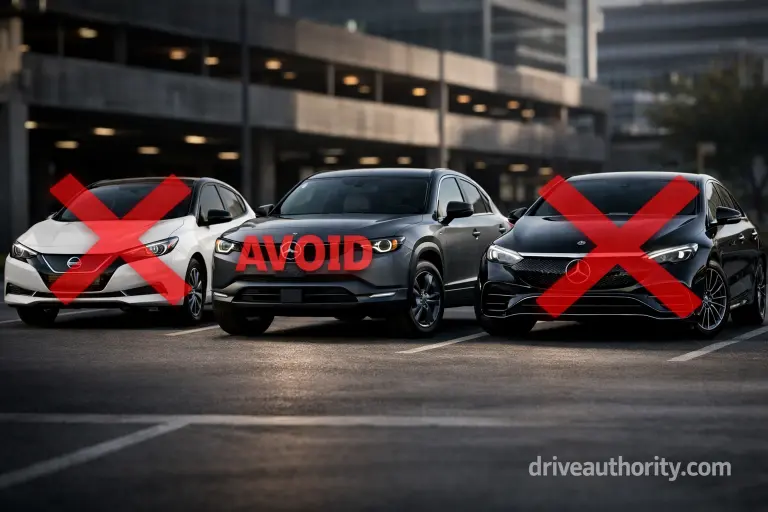
Avoid the Nissan Leaf, Mazda MX-30, and any luxury EV over $70,000 in 2026 if you’re a value-focused buyer. These electric cars to avoid either use outdated technology that kills resale value, offer absurdly limited range for the price, or depreciate so aggressively you’ll lose $20,000+ the moment you drive off the lot. This guide is for practical buyers who want an EV that makes financial sense—not early adopters chasing status symbols or buyers loyal to brands at any cost.
This isn’t for wealthy buyers who lease luxury EVs and swap every three years. It’s for people spending their own money who expect their car to retain reasonable value.
The Nissan Leaf’s Fatal Battery Flaw

The Nissan Leaf remains one of the worst value propositions in the EV market, despite its affordable $28,140 starting price. The core problem is the air-cooled battery—technology that’s been obsolete since 2018.
Without active liquid cooling, the Leaf’s battery degrades faster than any mainstream EV on the market. Real-world owner data shows 15-20% capacity loss after just 50,000 miles in hot climates like Arizona or Texas. Compare that to liquid-cooled EVs (Tesla, Chevy, Hyundai) that typically lose only 5-8% over the same distance.
This degradation murders resale value. A three-year-old Leaf retains just 35-42% of its original value, according to industry data. Meanwhile, a Chevy Bolt EUV or Hyundai Kona Electric holds 55-62% over the same period.
Beyond battery issues, the Leaf uses CHAdeMO fast charging—a dying standard being phased out across North America and Europe. Electrify America is already removing CHAdeMO connectors from new stations. You’re buying into a charging infrastructure that’s actively disappearing.
The newer Leaf Plus with 212 miles of range doesn’t fix these fundamental problems. It’s still air-cooled, still uses CHAdeMO, and still depreciates like a stone. For similar money, the Chevy Equinox EV delivers 319 miles of range, modern liquid-cooled batteries, and CCS charging compatibility.
Why the Mazda MX-30 Fails Value Buyers
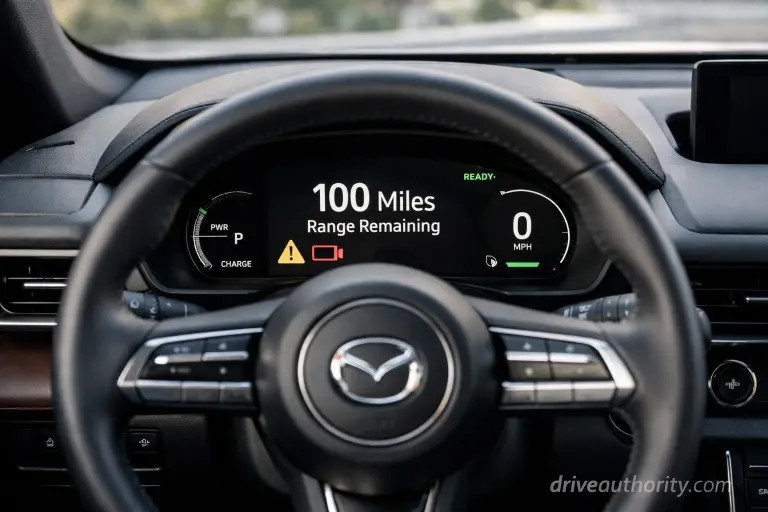
The Mazda MX-30 might be the most baffling EV on sale in 2026. It costs $34,110 and delivers just 100 miles of EPA range. That’s not a typo—one hundred miles from a 35.5 kWh battery in an era when $28,000 EVs routinely exceed 250 miles.
Mazda claims this matches “real-world daily driving needs,” which is corporate speak for “we couldn’t engineer a competitive EV.” In practice, that 100-mile rating becomes 75-80 miles in cold weather or highway driving. You’re living on the edge of range anxiety every single day.
The interior is genuinely nice, with quality materials and Mazda’s trademark craftsmanship. But you’re paying luxury car money for economy car capability. For $1,000 less, the Hyundai Kona Electric delivers 261 miles of range. That’s 2.6 times more range for less money.
Resale value is predictably catastrophic. Two-year-old MX-30s are selling for $16,000-$19,000, representing 45-50% depreciation. Buyers shopping used EVs recognize that 100 miles of range is functionally insufficient in 2026.
Even Mazda seems embarrassed by this car. It’s sold in limited markets with minimal marketing support. That should tell you everything about the company’s confidence in the product.
Luxury EVs Over $70,000: The Depreciation Reality

High-end electric cars from Mercedes, Audi, and BMW are bleeding value faster than any segment in automotive history. The Mercedes EQS, Audi e-tron GT, and BMW iX are all losing $25,000-$35,000 in their first two years.
Here’s why: Tesla’s aggressive price cuts in 2023-2024 reset market expectations for EV pricing. A $110,000 Mercedes EQS now competes with a $75,000 Tesla Model S that offers comparable range, better charging infrastructure, and superior software. The market has adjusted accordingly.
According to Automotive News depreciation data, luxury EVs are depreciating 15-20% faster than their gas-powered equivalents. A $95,000 BMW iX loses roughly $32,000 in two years, while a comparable X5 loses $22,000. That’s a $10,000 penalty just for choosing electric.
The software experience compounds this problem. Legacy luxury brands are still years behind Tesla in over-the-air updates, user interface design, and charging integration. You’re paying luxury prices for frustrating technology experiences.
Furthermore, these vehicles often require expensive dealer service for even minor issues. Tesla’s mobile service model isn’t perfect, but it’s considerably more convenient than booking appointments at a BMW dealership for software glitches.
If you want luxury and electric, lease these vehicles—never buy. Let someone else absorb the depreciation hit while you enjoy the car for three years and walk away.
Smart Alternatives Worth Considering
Instead of the Nissan Leaf, consider the Chevrolet Equinox EV ($35,000, 319 miles) or Hyundai Kona Electric ($32,875, 261 miles). Both use modern battery technology and hold value significantly better.
Instead of the Mazda MX-30, buy literally any other EV in this price range. The Kona Electric costs less and gives you 161 more miles of range.
Instead of luxury EVs over $70,000, look at the Genesis Electrified GV70 ($65,850) or Polestar 3 ($73,400). You get luxury features with less dramatic depreciation, or simply buy a Tesla Model S and save $20,000-$30,000 while getting better technology.
For detailed comparisons and total cost of ownership calculations, check our complete EV buying guide before making your final decision.
The Bottom Line on Value-Destroying EVs
The electric cars to avoid in 2026 share common traits: outdated battery technology, absurdly limited range for the price, or catastrophic depreciation that erases tens of thousands in value. The Nissan Leaf’s air-cooled battery is a known failure point. The Mazda MX-30’s 100-mile range is inexcusable at $34,000. And luxury EVs over $70,000 are losing value faster than ice melts in summer.
Your next step is simple: cross these models off your list permanently. Then test drive the alternatives mentioned above. Calculate your real-world range needs, verify charging availability in your area, and run the total cost of ownership numbers including projected resale value. The right EV exists for your budget—it’s just not one of these three categories.