Last Verified: March 2026
Knowing how to maximize EV battery life is the single most financially valuable thing an EV owner can learn — because the battery pack is the most expensive component in the vehicle, typically representing $10,000–$20,000 of replacement cost. How you charge, park, and drive determines whether your battery retains 90% of its original capacity at 100,000 miles or degrades to 75% in half that distance. The difference isn’t luck. It’s daily habit. Every tip in this guide draws from battery degradation research, real-world fleet data, or OEM technical documentation — not forum speculation or recycled owner’s manual advice.
Why Most Battery Advice Gets This Wrong
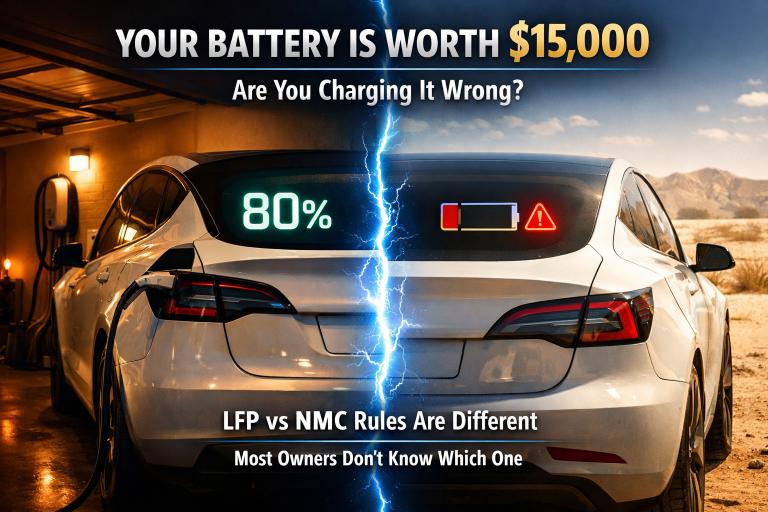
The biggest problem with EV battery content is chemistry conflation. LFP (lithium iron phosphate) and NMC (nickel manganese cobalt) batteries follow different rules — and advice written for one can actively harm the other. Specifically, telling an LFP owner to limit charging to 80% is unnecessary and wastes range. Telling an NMC owner to charge to 100% daily accelerates degradation. Throughout this guide, tips that differ by chemistry carry an explicit flag — because getting this distinction wrong is the most common mistake I see EV owners make.
How to Maximize EV Battery Life — Key Rules:
The three highest-impact habits are: charge to 80% daily on NMC batteries (LFP can tolerate 100%), keep the battery above 20% in daily use, and avoid parking in direct heat above 35°C (95°F). According to Recurrent Auto fleet data, average EV battery degradation runs approximately 2.3% per year — meaning consistent good habits can keep a battery above 90% SOH at five years where poor habits push it toward 80% or below.
⚡ Top 5 Ways to Extend EV Battery Life
- Charge to 80% daily — NMC batteries only; LFP can charge to 100%
- Avoid sustained heat above 35°C (95°F) — park in shade or garage whenever possible
- Keep battery above 20% SOC — deep discharge causes irreversible lithium plating
- Limit DC fast charging — use Level 2 home charging as your daily baseline
- Pre-condition before cold-weather charging — warm the battery before fast charging sessions
🟢 LFP Battery (Tesla SR · BYD)
Charge to 100% daily — Tesla recommends this to calibrate the BMS. LFP chemistry is more stable and tolerates full charges without meaningful degradation penalty.
🟡 NMC Battery (Tesla LR · Hyundai/Kia · Most EVs)
Limit daily charge to 80%. NMC is more energy-dense but more sensitive to sustained high SOC. Daily 100% charging accelerates cathode degradation by 5–8% over 5 years.
Why EV Battery Degradation Happens — and Why It Matters
Understanding why degradation happens makes every tip in this article feel logical rather than arbitrary. The science is accessible — and knowing it helps you apply the guidance confidently rather than following rules you don’t understand.
What Battery Degradation Actually Is
State of Health (SOH) is the metric that defines how much of your battery’s original capacity remains. A battery at 100% SOH delivers its rated range. At 85% SOH, you get 85% of that original range — every time, permanently. Degradation happens through three main mechanisms: lithium plating (metallic lithium deposits on the anode when charging too fast or at low temperatures), SEI layer growth (a resistance-building film that forms on cell surfaces over thousands of charge cycles), and active material loss (cathode and anode materials losing their ability to store lithium ions over time). According to Recurrent Auto’s fleet analysis of over 15,000 EVs, the average degradation rate is approximately 2.3% per year — however climate, chemistry, and charging habits push individual vehicles significantly above or below that average.
How Long Does an EV Battery Last With Proper Care?
With consistent good habits, most mainstream EV batteries retain above 80% SOH at 150,000–200,000 miles — the threshold at which range loss becomes noticeable in daily driving. Toyota’s NiMH hybrid battery data from rideshare fleets demonstrates 200,000–300,000-mile longevity at under 1.5% failure rates, and modern lithium-based EV batteries are showing similar durability in high-mileage fleet data. Poor habits — specifically frequent DC fast charging as the primary method, hot-climate parking, and daily 100% NMC charging — can push degradation to 3–4% annually, cutting effective battery life roughly in half. The gap between best-practice and worst-practice ownership at 100,000 miles is approximately 10–15% SOH — a difference worth $1,500–$3,000 in residual battery value.
LFP vs. NMC: Does Chemistry Change What You Should Do?
Yes — and this is the distinction that most generic battery advice ignores. LFP (lithium iron phosphate) batteries, used in Tesla Standard Range models and all BYD vehicles, have a more stable chemistry that tolerates regular 100% charging and handles temperature extremes better than NMC. As a result, LFP owners don’t need to limit daily charging to 80% — in fact, Tesla specifically recommends charging LFP vehicles to 100% regularly to calibrate the BMS. By contrast, NMC (nickel manganese cobalt) batteries — used in Tesla Long Range models, most Hyundai/Kia EVs, and premium European EVs — are more energy-dense but more sensitive to sustained high SOC and heat. Therefore, when a tip in this guide differs between chemistries, it will say so explicitly. Check your owner’s manual or the vehicle’s spec sheet to confirm which chemistry your EV uses.
Tips 1–3: Charging Habits That Protect Your Battery Daily
Charging behavior is the single largest controllable variable in battery degradation. These three tips address the habits that compound over thousands of charge cycles — which is specifically why they deliver more long-term impact than any other category in this guide.
Tip 1: Charge to 80%, Not 100% (Unless You Need It)
⚡ NMC batteries only — LFP can charge to 100% regularly. Keeping an NMC battery at or below 80% SOC dramatically reduces cathode stress and slows SEI layer growth. Geotab’s multi-fleet EV battery study found that vehicles regularly charged to 100% SOC showed statistically higher degradation rates than those limited to 80% at equivalent mileage. The practical degradation difference over five years is approximately 5–8% additional SOH loss on NMC batteries charged daily to 100% versus 80%. Set a charge limit in your vehicle’s settings — Tesla, Hyundai/Kia, Ford, and GM all provide this in the charging menu. The exception is clear: charge to 100% the night before a long road trip. Occasional 100% charges are fine. Daily 100% is the pattern that compounds.
Tip 2: Avoid Regularly Depleting Below 20% SOC
Deep discharge creates lithium plating risk at the anode — specifically when the cell voltage drops below its safe floor. That plating is irreversible. In practice, 20% SOC is the daily floor to respect in normal use conditions. The problem is that range anxiety drives deep-discharge behavior — owners who worry about running out push the battery harder than needed. Trip planning apps like A Better Route Planner (ABRP) and the OEM route planners in Tesla, Hyundai, and Kia EVs solve this specifically by calculating charge stops before you start, removing the anxiety that leads to deep discharge. Use them. The 15 seconds of planning prevents the kind of battery stress that accumulates over years.
Tip 3: Avoid Leaving the Battery at 100% or Near-0% for Extended Periods
Calendar aging — degradation that occurs simply from time spent at extreme SOC levels — is real and measurable. Battery research published by Argonne National Laboratory confirms that lithium-ion cells stored at high SOC experience accelerated electrolyte oxidation even when the vehicle is parked and not charging. The sweet spot for extended parking is 50–80% SOC. Practical scenarios include airport trips (set a departure time and let the car top up just before you leave), seasonal storage, and work trips longer than a week. Tesla, Hyundai, Kia, and Ford all offer scheduled departure settings that prevent the battery from sitting at 100% for extended periods after reaching full charge — use them.
← Scroll to see full table on mobile
| Habit | Recommended Practice | Why It Works | LFP? | NMC? |
|---|---|---|---|---|
| Tip 1: Daily charge limit | 80% ceiling daily | Reduces cathode stress, slows SEI growth | 100% OK LFP TOLERATES | Limit to 80% NMC SENSITIVE |
| Tip 2: Daily discharge floor | Stay above 20% SOC | Prevents lithium plating at low voltage | ✅ Apply | ✅ Apply |
| Tip 3: Extended parking SOC | Park at 50–80% | Reduces calendar aging and electrolyte stress | ✅ Apply | ✅ Apply (critical) |
Tips 4–5: Temperature Management — Heat and Cold Are the Invisible Threat
Temperature is the most underappreciated degradation driver in EV battery ownership. Heat damage accumulates silently — there’s no dashboard warning for “your battery aged 0.3% extra this week because you parked in direct sun.” By the time the range loss becomes noticeable, the damage is already done.
Tip 4: Park in the Shade or Garage — Heat Degrades Faster Than Miles Do
Geotab’s multi-fleet EV battery study found that EVs operated in hot climates like Arizona experienced meaningfully higher degradation rates than comparable vehicles in temperate Pacific Northwest climates — with some hot-climate fleets showing 2× the degradation rate over equivalent mileage. The mechanism is straightforward: above approximately 40°C (104°F) battery cell temperature, electrolyte breakdown accelerates and the SEI layer grows faster. While driving, the thermal management system actively cools cells. However, when parked — specifically in direct sun on a hot day — that cooling stops, and battery temperatures in unshaded vehicles can reach 50°C+ in peak summer heat. Garage parking, shaded spots, and avoiding sun-baked DC fast charging stations during peak heat hours are all practical actions that compound significantly over years of ownership.
Tip 5: Pre-Condition Before Cold-Weather Charging and Driving
Cold batteries face a different risk: lithium plating during charging. When battery cells are below approximately 10°C (50°F), lithium ions can deposit as metallic lithium on the anode rather than intercalating correctly — and that plating is permanent capacity loss. The solution is pre-conditioning: warming the battery while still plugged in, before you drive or fast charge. This is specifically important before DC fast charging sessions in winter — arriving at a charger with a cold battery and immediately pushing maximum charge rate creates plating risk. By contrast, pre-conditioning to 20°C before charging removes that risk entirely. Tesla’s navigation system triggers automatic battery heating when you route to a Supercharger. Hyundai and Kia offer departure time scheduling that warms the battery before you leave. Ford and GM have equivalent features in their charging apps. Use them every time you plan a winter fast charge session.
Tips 6–7: DC Fast Charging — When It Helps and When It Hurts
Every article on this topic says DC fast charging damages batteries. I disagree with that framing — and here’s the data that shaped my thinking. Occasional DCFC on a road trip is not the problem. It’s using fast charging as your primary daily charging method that creates the degradation pattern worth avoiding.
Tip 6: Limit DC Fast Charging to When You Actually Need It
Recurrent Auto’s analysis of over 15,000 EVs found that vehicles using DC fast charging occasionally — defined as less than 25% of total charge sessions — showed no statistically significant additional degradation versus Level 2 home chargers at equivalent mileage. However, vehicles using DCFC as their primary charging method showed measurably higher degradation rates, approximately 10–15% faster SOH decline over 50,000 miles. The mechanism is heat: DC fast charging generates significantly more cell heat than Level 2 charging, and as noted in Tip 4, heat is the primary degradation accelerator. Level 2 home charging is therefore the baseline to aim for, with DCFC reserved for road trips and situations where L2 isn’t available. Apartment dwellers without home charging access face a real constraint here — if DCFC is your only option, pre-conditioning before sessions and avoiding charging above 80% at fast chargers mitigates the impact.
Tip 7: Pre-Condition the Battery Before Every DC Fast Charge Session
Pre-conditioning before a fast charge session delivers two benefits: faster charging and less battery stress. Specifically, a battery pre-conditioned to 25–30°C accepts charge at a higher rate without triggering thermal throttling, while a cold battery forces the BMS to reduce charge rate to protect cell integrity. Tesla’s in-car navigation automatically activates battery heating when you route to a Supercharger — the most seamless implementation. Hyundai Ioniq 5/6 and Kia EV6/EV9 support route-based pre-conditioning through the OEM navigation app. Ford Mach-E and Lightning offer departure scheduling that warms the pack before long trips. For vehicles without automatic pre-conditioning, the manual workaround is simple: use the vehicle’s climate system or a 10–15 minute driving warm-up before arriving at the charger.
← Scroll to see full table on mobile
| Charging Scenario | Degradation Risk | Recommended Frequency | Pre-Condition Required? |
|---|---|---|---|
| Level 2 home charging | LOWEST | Daily baseline — ideal | Not needed |
| Occasional DCFC (road trip) | Low — negligible per trip | <25% of sessions is fine | ✅ Recommended |
| Weekly DCFC | Moderate — cumulative | Minimize where L2 accessible | ✅ Every time |
| Daily DCFC as primary | HIGHER — 10–15% faster SOH loss | Only if no L2 access | ✅ Critical |
| Cold battery DCFC (no warm-up) | HIGH — lithium plating risk | Avoid entirely | ⛔ Never skip |
Tips 8–9: Software Updates and Driving Habits That Matter
These two tips are the most overlooked in standard battery longevity guides — because neither involves a charging cable. However, together they affect thermal load, energy recovery, and BMS optimization in ways that compound meaningfully over a vehicle’s lifetime.
Tip 8: Keep Software Updated — OTA Improves Battery Management
OEM software updates regularly refine the Battery Management System (BMS) — specifically adjusting charge curves, thermal management thresholds, and regeneration calibration based on real-world fleet data collected since the vehicle launched. Tesla has issued multiple OTA updates that adjusted charge curve behavior to reduce thermal stress at high SOC on specific battery cohorts. Hyundai issued a notable 2023 BMS update for the Ioniq 5 that improved thermal management during DC fast charging. As a result, a vehicle running outdated software may operate on older, less-optimized BMS parameters that increase degradation compared to the current software version. Verify your vehicle’s software currency in the settings menu — Tesla shows this under Software, Hyundai/Kia under My Car, Ford under the FordPass app, and GM through MyChevy. Accept updates when prompted. Don’t delay them.
Tip 9: Smooth Driving and Maximum Regenerative Braking Use
Aggressive acceleration creates thermal spikes inside battery cells — specifically, high-current discharge events raise cell temperature faster than the thermal management system can dissipate. Over thousands of acceleration events, those spikes contribute to accelerated SEI layer growth. By contrast, smooth acceleration keeps current draw moderate and cell temperatures stable. Regenerative braking delivers a dual benefit: it reduces physical brake wear significantly (EV brake pads typically last 70,000–100,000 miles vs. 30,000–70,000 on gas cars) while recovering energy that would otherwise radiate as heat from friction brakes. Maximum regen setting recaptures approximately 15–20% more energy than minimal regen in urban driving, according to EPA efficiency testing methodology. One-pedal driving maximizes this recovery. Use it as your default, specifically in city and suburban conditions where deceleration events are frequent.
Tip 10: How to Monitor Your Battery Health Over Time
The 9 tips above are only as valuable as your ability to verify they’re working. Tracking SOH gives you the feedback loop that turns good habits into confirmed results — and catches unexpected degradation before it becomes a warranty claim you missed.
Tools and Apps for Tracking EV Battery State of Health
Recurrent Auto is the most accessible third-party SOH tracking tool for most EV owners — it connects to your vehicle through the OEM API (no hardware required) and tracks SOH against a fleet of comparable vehicles, so you can see whether your battery is degrading faster or slower than average. Coverage includes Tesla, Rivian, Ford, GM, Hyundai, Kia, and most major brands. Annual subscription costs approximately $9.99/month. OEM native displays vary significantly: Tesla shows battery health data through the OBD-accessible API and third-party apps like Stats; Hyundai and Kia show a degradation indicator in the instrument cluster on most current models. OBD-II based apps like Leaf Spy (Nissan Leaf-specific) and SoulSpy (Kia Soul EV) work for older models without API access — they require a $20–$30 Bluetooth OBD-II adapter and provide cell-level SOH data that OEM apps don’t expose.
What to Do If Your Battery Degrades Faster Than Expected
Federal law requires a minimum battery warranty of 8 years / 100,000 miles at 70% SOH. However, many manufacturers exceed this — Hyundai and Kia warranty at 70% SOH, while Tesla warrants at 70% and some premium brands warrant at 80%. Check your specific brand’s threshold in the warranty documentation, because the difference between a 70% and 80% claim threshold is significant. To file a warranty claim: document the SOH using a verifiable tool (Recurrent or OEM diagnostic), present the data to a certified dealer with a timestamp, and request a BMS diagnostic. If the dealer disputes your SOH reading, an independent EV battery specialist can provide a second diagnostic opinion for approximately $150–$250 — and that documentation strengthens your warranty position if you escalate.
← Scroll to see full table on mobile
| Tool | Compatible EVs | SOH Accuracy | Cost | Best For |
|---|---|---|---|---|
| Recurrent Auto BEST ALL-AROUND | Tesla, Ford, GM, Hyundai, Kia, Rivian | Fleet-compared · high | ~$9.99/mo | Most EV owners, ongoing tracking |
| OEM Native App | Brand-specific | Varies by brand | Free | Quick checks, no subscription |
| Leaf Spy / SoulSpy | Nissan Leaf / Kia Soul EV | Cell-level · high | ~$5 app + $25 OBD adapter | Older EVs without API access |
| Dealer BMS Diagnostic | All brands | Official · highest | ~$0–$150 | Warranty claims, pre-purchase checks |
The 10 Tips at a Glance: Quick Reference Summary
Bookmark this section. It’s the reference card you return to — without rereading the full article each time.
← Scroll to see full table on mobile
| # | Action | Impact Level | LFP? | NMC? |
|---|---|---|---|---|
| 1 | Charge to 80% daily (road trips: 100% OK) | HIGH | 100% fine | ✅ Limit 80% |
| 2 | Keep above 20% SOC in daily use | HIGH | ✅ Apply | ✅ Apply |
| 3 | Park at 50–80% for extended periods | Medium-High | ✅ Apply | ✅ Apply |
| 4 | Park in shade/garage — heat is #1 threat | HIGH | ✅ Apply | ✅ Apply |
| 5 | Pre-condition before cold-weather charging | Medium-High | ✅ Apply | ✅ Apply |
| 6 | Limit DCFC to road trips and necessity | Medium | ✅ Apply | ✅ Apply |
| 7 | Pre-condition before every DCFC session | Medium | ✅ Apply | ✅ Apply |
| 8 | Accept and install OTA updates promptly | Medium | ✅ Apply | ✅ Apply |
| 9 | Use max regen + smooth acceleration | Low-Medium | ✅ Apply | ✅ Apply |
| 10 | Track SOH annually with Recurrent or OEM tool | Monitoring | ✅ Apply | ✅ Apply |
FAQ: How to Maximize EV Battery Life
Should I charge my EV to 100% every night?
It depends on your battery chemistry. LFP batteries (Tesla Standard Range, all BYD vehicles) tolerate regular 100% charging — Tesla specifically recommends this for LFP to calibrate the BMS. NMC batteries (Tesla Long Range, Hyundai/Kia EVs, most European EVs) benefit from a daily limit of 80%, because sustained high SOC accelerates cathode degradation. Check your owner’s manual or spec sheet to confirm which chemistry your vehicle uses before applying either rule.
Does DC fast charging damage EV batteries?
Occasional DCFC has minimal measurable impact — Recurrent Auto’s fleet data of 15,000+ EVs shows no significant additional degradation for vehicles using DCFC for less than 25% of charge sessions. However, vehicles using DCFC as their primary daily charging method show approximately 10–15% faster SOH decline over 50,000 miles compared to Level 2 home charging. The damage mechanism is heat, not voltage — therefore pre-conditioning before DCFC sessions mitigates the risk significantly by preventing thermal spikes during high-current charging.
How much range does an EV battery lose per year on average?
According to Recurrent Auto’s analysis of over 15,000 real-world EVs, average battery degradation runs approximately 2.3% per year. That means a 300-mile EPA range vehicle loses roughly 7 miles of range annually under average conditions. Climate and charging habits push this significantly above or below average — hot-climate vehicles with frequent DCFC use can degrade at 3–4% annually, while temperate-climate owners following best practices consistently see degradation below 2% per year.
What is the biggest threat to EV battery life?
Heat is the #1 degradation accelerator — specifically sustained exposure to temperatures above 35–40°C (95–104°F), whether from ambient climate or parking in direct sun. High-SOC storage is #2, causing calendar aging through electrolyte oxidation even when the vehicle sits unused. Frequent DC fast charging as a primary charging method ranks third, primarily because of the thermal load it places on cells. Addressing heat exposure and daily charge limits therefore delivers more battery longevity benefit than any other combination of habits.
The Bottom Line on Maximizing EV Battery Life
Battery longevity isn’t luck — it’s the cumulative result of consistent daily decisions. If you can only change one behavior, start with Tips 1–3: set your daily charge limit to 80% on NMC, respect the 20% floor, and use scheduled departure to prevent extended high-SOC parking. Those three habits address the three largest degradation drivers simultaneously. Confirm your battery chemistry first — LFP and NMC don’t follow identical rules, and applying NMC guidance to an LFP vehicle costs you range unnecessarily. Then set up Recurrent Auto or your OEM app to track SOH annually, so you can verify the habits are working and catch any unexpected degradation before your warranty window closes. Understanding the total monthly cost of EV ownership — including what battery care and maintenance actually contribute — completes the financial picture that these habits are protecting.