Last Updated: March 2026 — Pricing reflects current U.S. dealer and third-party replacement cost data
EV battery replacement cost is the number one fear keeping buyers from committing to an electric vehicle — and in most cases, that fear is built on outdated information. Real-world replacement rates are far lower than headlines suggest, and when replacement does happen, the cost in 2026 is significantly lower than it was five years ago. This guide breaks down actual EV battery replacement costs for Tesla, Nissan Leaf, and Chevy EVs, explains what drives those costs, and gives you a clear picture of what you’re realistically looking at as an EV owner in 2026.
EV Battery Replacement Cost in 2026 — Quick Summary:
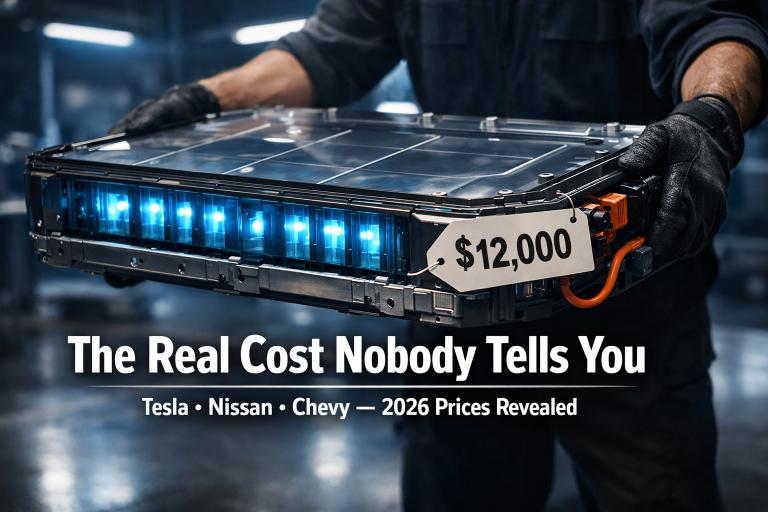
EV battery replacement costs range from $3,500–$20,000+ depending on vehicle size and brand. A Tesla Model 3 battery replacement runs approximately $10,000–$15,000 (parts + labor). A Nissan Leaf costs $3,500–$8,500. A Chevy Bolt runs $8,000–$16,000. Most EV batteries are covered by an 8-year / 100,000-mile warranty — meaning most owners will never pay out-of-pocket for replacement.
Average EV Battery Replacement Cost in 2026
Typical Price Range for Modern EV Batteries
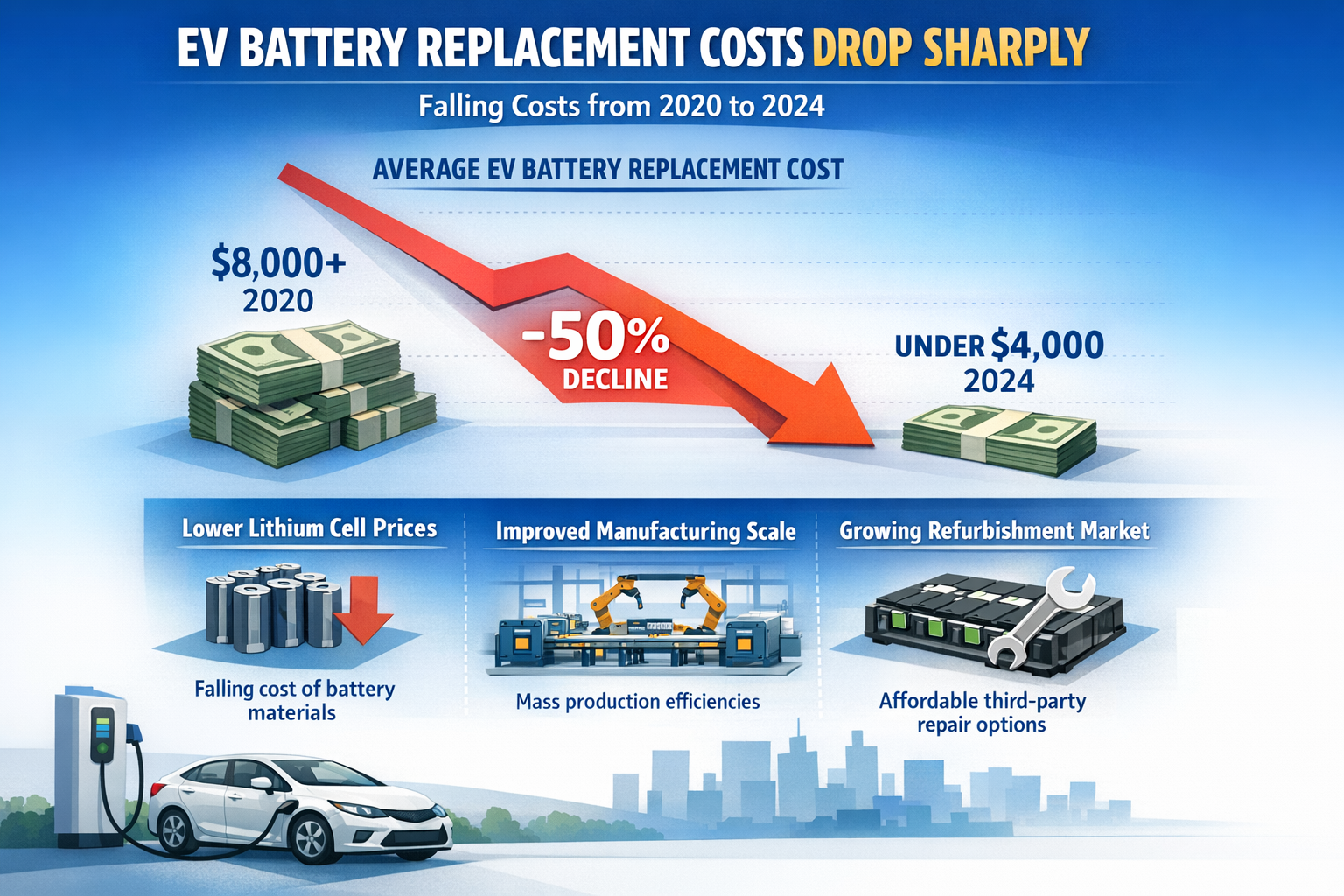
A full EV battery pack replacement in 2026 typically costs between $3,500 and $20,000 — a wide range that reflects differences in battery size (kWh), chemistry, brand service pricing, and whether OEM or third-party options are used. Labor adds $1,000–$3,000 on top of parts costs in most cases. The good news for current EV owners is that this range represents a meaningful decline from 2020–2021 pricing, driven primarily by falling lithium cell costs which have dropped from over $130/kWh to approximately $80–$100/kWh by 2026.
Why EV Battery Costs Are Falling Over Time
Three structural forces are pushing EV battery replacement costs lower year over year in 2026. First, global lithium-ion cell production capacity has expanded dramatically — particularly in China and the U.S. — driving raw material and manufacturing costs down. Second, growing battery refurbishment and remanufacturing market gives owners alternatives to full OEM replacements: third-party providers like Greentec Auto and EV Battery Solutions offer refurbished packs at 30–50% below OEM pricing for Nissan Leaf and older Chevy Bolt models. Third, automakers facing increased used EV competition are beginning to offer more competitive battery replacement pricing to maintain residual value — Tesla’s cell-level repair approach being the most notable example.
Tesla Battery Replacement Cost in 2026 — Model 3, Y, S, and X
Tesla Model 3 and Model Y Battery Replacement Price
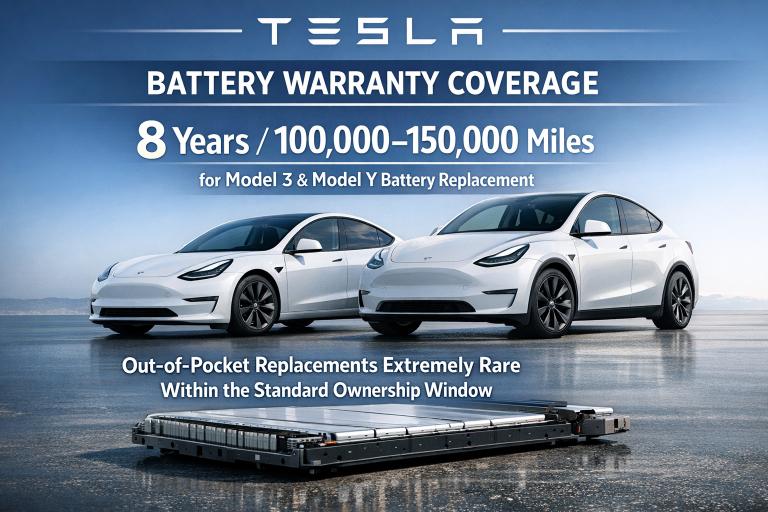
Tesla does not publish official battery replacement pricing, but costs reported by Tesla Service centers and third-party repair shops in 2026 cluster in a consistent range. A full battery pack replacement for the Model 3 Standard Range (60 kWh) runs approximately $8,000–$12,000 for parts, with $1,500–$2,500 in labor — bringing the total to $9,500–$14,500. The Model 3 Long Range (82 kWh) and Model Y Long Range (82 kWh) cost slightly more: estimated $10,000–$15,000 total including labor.
Tesla’s battery warranty covers Model 3 Standard for 8 years / 100,000 miles and Long Range / Performance trims for 8 years / 150,000 miles, with a guaranteed 70% capacity retention floor. In practice, most Tesla owners within the warranty window who experience significant degradation receive warranty service — and out-of-warranty replacement before 150,000 miles is rare based on aggregated owner data.
Tesla Model S and Model X Battery Cost
The larger battery packs in Model S and Model X make replacement significantly more expensive. A full battery replacement for a pre-2021 Model S (75–100 kWh depending on configuration) is estimated at $13,000–$20,000 including labor at a Tesla Service center. The refreshed 2021+ Model S Plaid uses a new structural battery architecture that is not yet widely replaceable outside Tesla — third-party options are limited. For older Model S and Model X owners whose batteries are out of warranty, the refurbishment market offers some relief: third-party rebuilt packs for pre-2019 Model S can be sourced for $7,000–$11,000, though warranty support varies by provider.
| Tesla Model | Battery Size | Warranty | Est. Replacement Cost (OEM) | Third-Party Option |
|---|---|---|---|---|
| Model 3 Standard RWD | ~60 kWh | 8yr / 100K mi | $9,500–$14,500 | Limited |
| Model 3 Long Range AWD | ~82 kWh | 8yr / 150K mi | $10,000–$15,000 | Limited |
| Model Y Long Range AWD | ~82 kWh | 8yr / 150K mi | $10,000–$15,500 | Limited |
| Model S Long Range (pre-2021) | ~100 kWh | 8yr / 150K mi | $13,000–$20,000 | $7,000–$11,000 AVAILABLE |
| Model X Long Range (pre-2021) | ~100 kWh | 8yr / 150K mi | $14,000–$21,000 | $8,000–$12,000 AVAILABLE |
Nissan Leaf Battery Replacement Cost in 2026
Replacement Cost for Older Nissan Leaf Models
The Nissan Leaf has the longest production history of any mainstream EV — which means more Leaf batteries have reached replacement territory than any other model. Early 2011–2017 Leaf models used a 24 kWh or 30 kWh battery without active thermal management, making them significantly more prone to degradation than modern EVs. Owners of these generations have faced the most frequent battery replacement decisions, and the market has responded with a competitive third-party replacement ecosystem.
A new OEM Nissan Leaf battery replacement (40 kWh pack for 2018+ models) costs approximately $5,500–$8,500 including labor at a Nissan dealer. The older 24 kWh pack for pre-2018 models is no longer available new from Nissan — owners must use refurbished or third-party packs priced at $2,500–$5,000 depending on condition and supplier. The 62 kWh e+ pack available in 2019+ higher-spec models runs $8,000–$12,000 for OEM replacement.
Nissan Leaf Battery Upgrade Options and Availability
One of the most practical aspects of the Leaf’s long market presence is the upgrade path available through third-party suppliers. Companies like Greentec Auto and Battery Pete offer refurbished Leaf packs with 12-month warranties — giving owners of older Leafs a cost-effective path to restoring range without paying OEM prices. Some shops also offer upgraded capacity swaps (e.g., fitting a 40 kWh pack into a 24 kWh Leaf body) for $4,000–$6,500 — an option that effectively modernizes an older Leaf at a fraction of new-car cost.
Chevy EV Battery Replacement Cost — Bolt and Equinox EV
Chevy Bolt Battery Replacement Cost
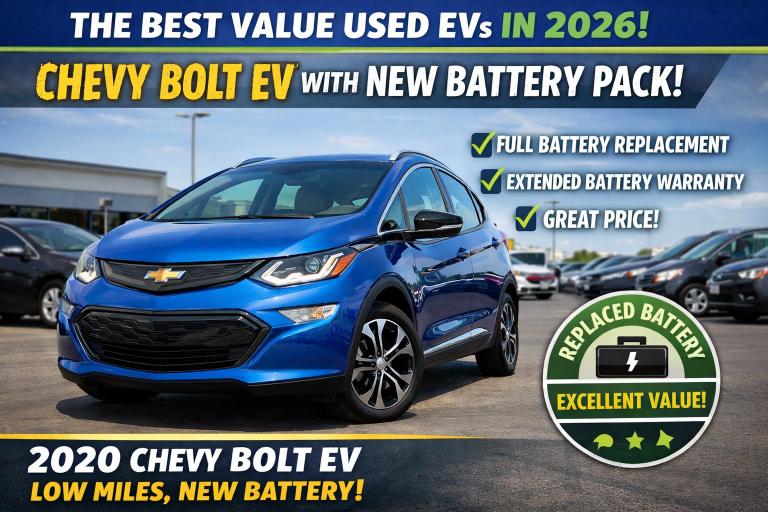
The Chevy Bolt EV uses an LG Energy Solution battery pack — 65 kWh in the standard Bolt and 65 kWh in the Bolt EUV. A full OEM battery replacement at a Chevrolet dealer is estimated at $8,000–$16,000 including labor, depending on model year and whether the pack is new or remanufactured. The wide range reflects significant variation in parts availability and labor rates by region. Third-party options for the Bolt are growing in availability and typically run $5,000–$9,000 for a refurbished pack with a 12-month warranty.
Warranty Coverage and Recall Impact on Chevy Bolt Owners
The 2021–2022 Chevy Bolt battery recall — issued due to fire risk from LG Energy Solution cell defects — resulted in free full battery replacements for affected vehicles under NHTSA recall coverage. This means a significant portion of 2017–2022 Bolt EVs on the used market today carry brand-new OEM battery packs installed under the recall — effectively resetting battery age and capacity regardless of vehicle mileage. For used Bolt buyers, confirming whether the recall battery replacement was completed (via VIN check at NHTSA.gov) is one of the highest-value pre-purchase checks available, as a completed recall replacement adds $8,000–$16,000 in implied value to the vehicle.
Factors That Affect EV Battery Replacement Cost in 2026
Battery Size, Chemistry, and Technology
The single largest cost driver is battery pack size measured in kWh. A 24 kWh Nissan Leaf pack costs roughly a third of what an 82 kWh Tesla Model Y pack costs — because you’re buying proportionally less energy storage. Chemistry also matters: LFP (lithium iron phosphate) packs used in Tesla Standard Range and BYD vehicles are generally cheaper per kWh than NMC (nickel-manganese-cobalt) packs in larger Tesla Long Range and Chevy Bolt models, because LFP doesn’t use cobalt — historically the most expensive battery material. Structural battery packs in newer vehicles (Tesla 4680 cell architecture, some BYD models) are significantly harder to replace as standalone units and will carry premium labor costs when they eventually require service.
Labor, Warranty, and Manufacturer Service Policies
Labor for EV battery replacement typically runs $1,000–$3,000 at dealer rates (8–20 hours at $80–$150/hour depending on market). Independent EV shops charge less — $600–$1,500 for equivalent labor — but may not have access to OEM parts. Manufacturer policies vary significantly: Tesla requires service center involvement for any battery replacement and doesn’t sell packs directly to third parties, limiting the refurbishment market for newer models. Nissan and GM have more open parts availability policies, enabling the third-party market that keeps replacement costs lower for Leaf and Bolt owners.
| Brand / Model | Battery Size | OEM Replacement (Parts + Labor) | Third-Party Option | Warranty |
|---|---|---|---|---|
| Tesla Model 3 LR | 82 kWh | $10,000–$15,000 | Limited RESTRICTED | 8yr / 150K mi |
| Tesla Model Y LR | 82 kWh | $10,000–$15,500 | Limited RESTRICTED | 8yr / 150K mi |
| Nissan Leaf (40 kWh) | 40 kWh | $5,500–$8,500 | $3,000–$5,500 AVAILABLE | 8yr / 100K mi |
| Nissan Leaf (24 kWh) | 24 kWh | OEM unavailable | $2,500–$5,000 AVAILABLE | Likely expired |
| Chevy Bolt EV | 65 kWh | $8,000–$16,000 | $5,000–$9,000 GROWING | 8yr / 100K mi |
Do Most EV Owners Ever Replace the Battery?
Real-World Battery Lifespan and Degradation Data
The short answer is no — and by a wide margin. Based on aggregated third-party data from EV fleet managers, owner survey studies, and used EV market analysis, battery replacement rates among EV owners within 10 years of ownership are estimated below 2% for modern EVs (2018 and newer). This includes warranty replacements, out-of-warranty replacements, and recall-related replacements. Even for older, first-generation EVs like the 2011–2013 Nissan Leaf — the most degradation-prone mainstream EV ever produced — outright failure requiring replacement before 100,000 miles was the exception rather than the rule.
Modern EV battery degradation follows a predictable pattern: approximately 2–3% capacity loss in year one, slowing to less than 1% per year from years 2–10 under normal use. A Tesla Model 3 with 100,000 miles typically retains 88–93% of its original range capacity. At that level, replacement isn’t warranted — the vehicle still functions normally with a modest range reduction.
When EV Battery Replacement Actually Happens
Replacement becomes economically rational in three scenarios: when a battery fails outright (rare, typically covered under warranty), when degradation drops below a personally unacceptable threshold (usually below 70–75% capacity), or when a vehicle is involved in a collision that damages the pack. The third category — collision damage — is actually the most common real-world trigger for battery replacement outside warranty claims. For owners making normal use of a well-maintained 2018+ EV, reaching a degradation level that requires replacement before the battery warranty expires is genuinely unlikely.
How to Avoid Expensive EV Battery Replacement
Charging Habits That Protect Battery Health
The single most impactful factor in long-term EV battery health is daily charge level. Setting your EV to charge to 80% for daily use rather than 100% meaningfully reduces long-term degradation — particularly for NMC chemistry batteries used in most Tesla Long Range, Hyundai Ioniq, and Chevy Bolt models. LFP chemistry batteries (Tesla Standard Range, BYD) can be safely charged to 100% daily without the same degradation risk. Limiting frequent DC fast charging is the second most impactful habit: occasional Supercharger or CCS fast charging has minimal impact, but daily DC fast charging over years accelerates degradation measurably compared to regular Level 2 home charging.
✅ Habits That Protect Battery Life
- Charge to 80% for daily use (NMC batteries)
- Use Level 2 home charging as primary method
- Avoid leaving at very low charge (<10%) for days
- Pre-condition battery before DC fast charging in cold
- Store at 50–80% if not driving for extended periods
⚠️ Habits That Accelerate Degradation
- Daily 100% charging on NMC battery vehicles
- Frequent DC fast charging as primary charging method
- Leaving battery at 100% charge for days at a time
- Repeated deep discharge below 10%
- Parking in extreme heat without climate control
What to Check Before Buying a Used EV
When purchasing a used EV, a battery state-of-health (SOH) check is the single most important pre-purchase step. For Tesla, access to the app shows estimated full-charge range — compare this to the original EPA figure for a rough degradation estimate. For Nissan Leaf, a dealer or specialist can run a Leaf Spy diagnostic that shows SOH as a percentage directly. For Chevy Bolt, confirm via VIN whether the recall battery replacement was completed at nhtsa.gov. A battery with above 88–90% SOH at 50,000–80,000 miles is in good condition and should not require replacement for many years under normal use.
FAQ — EV Battery Replacement Cost (2026)
How much does an EV battery replacement cost in 2026?
EV battery replacement costs in 2026 range from approximately $3,500 to $20,000+ depending on vehicle brand, battery size, and whether OEM or third-party options are used. A Tesla Model 3 or Model Y replacement runs $10,000–$15,500 (parts + labor) at a Tesla Service center. A Nissan Leaf 40 kWh replacement runs $5,500–$8,500 OEM or $3,000–$5,500 via third-party. A Chevy Bolt replacement costs $8,000–$16,000 OEM or $5,000–$9,000 via third-party refurbishment.
Do Tesla batteries need replacement often?
No — Tesla battery replacement is rare among owners within the standard ownership window. Based on aggregated owner data, Tesla Model 3 and Model Y batteries retain approximately 88–93% capacity at 100,000 miles under normal charging habits — well above the 70% warranty threshold. Tesla’s 8-year / 100,000–150,000 mile battery warranty covers capacity drops below 70%, and most owners do not reach this threshold within the warranty period. Out-of-warranty replacement before 150,000 miles is uncommon in real-world owner communities.
Is replacing an EV battery worth it?
It depends on the vehicle’s value and remaining battery capacity. For a Tesla Model Y worth $28,000–$35,000 used, a $12,000 battery replacement that restores full range may be worth it if the car is otherwise in good condition. For a first-generation Nissan Leaf worth $6,000–$9,000, a $5,000–$8,500 OEM replacement is rarely cost-effective — a third-party refurbished pack at $2,500–$4,000 is the more practical option. Always compare replacement cost against the vehicle’s current market value before committing.
How long do EV batteries typically last?
Modern EV batteries (2018 and newer) typically last 150,000–200,000+ miles before reaching a degradation level that most owners consider problematic (below 75–80% capacity). Under normal charging habits — daily Level 2 home charging, occasional DC fast charging — Tesla, Hyundai, and Chevy Bolt batteries consistently show less than 15% total capacity loss over 10 years in real-world owner data. The 8-year battery warranty standard across major EV brands guarantees a minimum 70% capacity — a threshold most owners don’t reach within the warranty period.