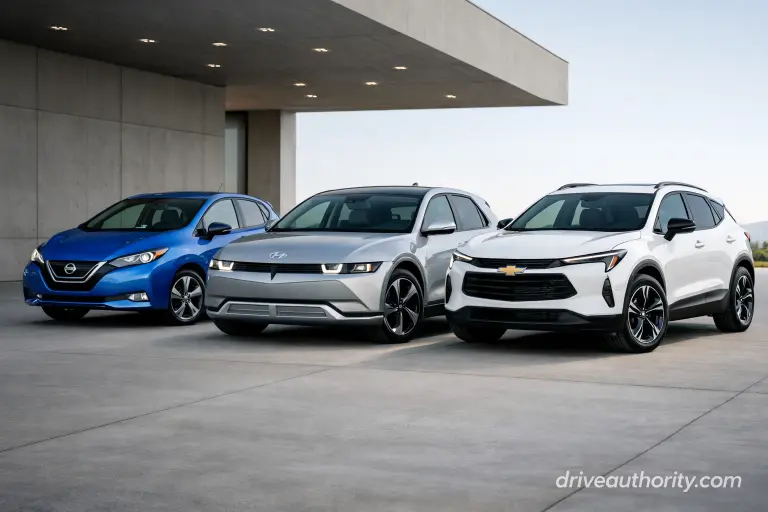
Home charging takes 6-10 hours overnight with a Level 2 charger, while DC fast charging delivers 10-80% in 25-45 minutes, but neither matters as much as you think for daily driving. The real answer to how long EV charging takes depends entirely on whether you can charge at home—if you can, you’ll spend less time “refueling” than with a gas car because you start every day with a full battery. This guide is for practical buyers trying to understand real-world charging times, not EV enthusiasts who already know the drill.
This isn’t for fleet managers or commercial drivers with different charging needs and schedules.
Home Charging: The Time That Doesn’t Matter
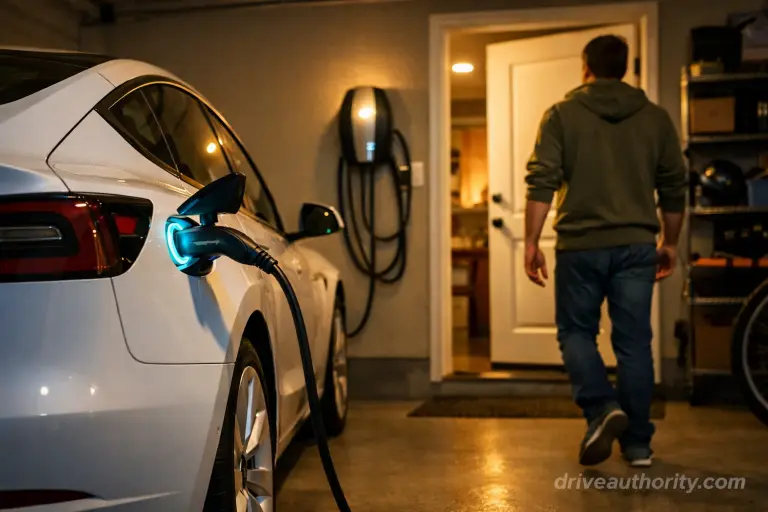
Here’s what surprised me most after switching to an EV: I stopped thinking about refueling time entirely. With a 240V Level 2 home charger, my Tesla Model 3 adds roughly 30 miles of range per hour plugged in.
When you plug in at 10 PM with 120 miles remaining and wake up at 6 AM, you’ve added 240 miles of range. Total “time spent charging” from your perspective? About 15 seconds to plug in and 10 seconds to unplug. That’s it.
Compare this to gas cars where you’re spending 5-7 minutes at the pump weekly, plus driving to and from the station (another 10-15 minutes with typical detours). Over a year, that’s 13-18 hours of your life at gas stations. With home charging, it’s effectively zero active time.
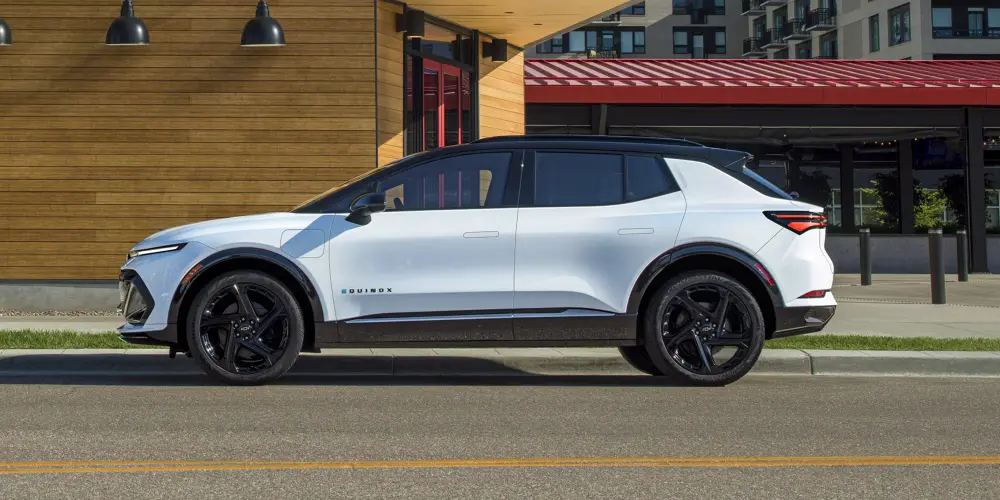
The actual charging duration is 6-10 hours for most EVs to go from 20% to 100%, but you’re asleep or working during this time. It’s completely passive. A Chevy Equinox EV with its 85 kWh battery takes about 8.5 hours on a 40-amp Level 2 charger (9.6 kW) from nearly empty to full. A Hyundai Ioniq 6 with a smaller 77.4 kWh battery takes roughly 7 hours.
The critical factor isn’t duration—it’s whether you have access to overnight charging at all. If you do, the question “how long does EV charging take” becomes irrelevant to your daily routine.
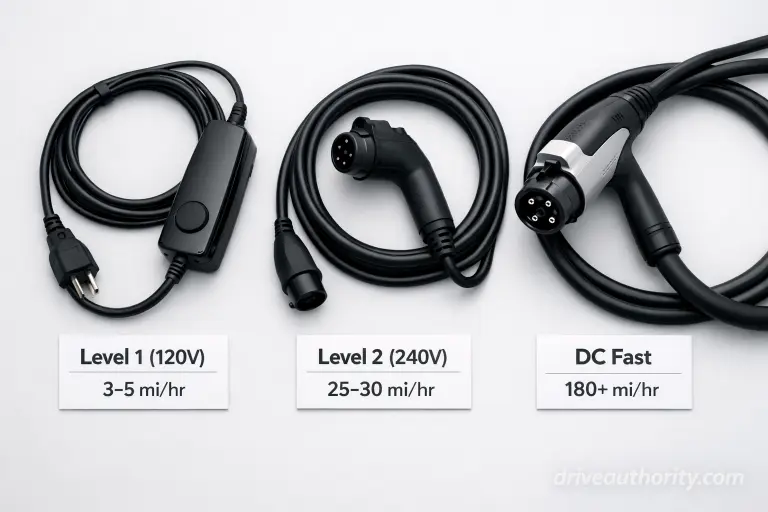
Level 1 charging (standard 120V outlet) is painfully slow—adding only 3-5 miles per hour. This works for plug-in hybrids or people driving under 30 miles daily, but it’s insufficient for full EV ownership. You’d need 24+ hours to fully charge most EVs, making it impractical except as emergency backup.
Public Fast Charging: When Time Actually Matters
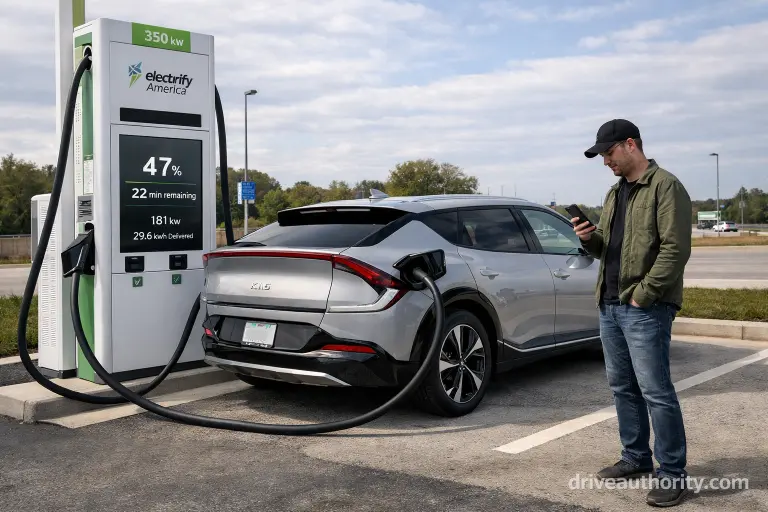
DC fast charging is where time becomes a real consideration, and the numbers vary dramatically by vehicle and station capability.
Modern EVs with 800V architecture (Hyundai Ioniq 5/6, Kia EV6, Genesis GV60, Porsche Taycan) achieve 10-80% charge in 18-25 minutes at 350 kW stations. That’s genuinely fast—comparable to a gas station stop if you factor in payment and bathroom breaks.
Most mainstream EVs use 400V systems and max out at 150-250 kW charging speeds. A Tesla Model 3/Y takes about 27-35 minutes for 10-80% at a Supercharger. A Chevy Bolt EUV needs 45-55 minutes due to its slower 55 kW max charging speed.
The “80%” target matters because charging slows dramatically above 80% to protect battery health. Going from 80-100% often takes as long as 10-80%, making it inefficient for road trips. Experienced EV drivers charge to 80% and move on.
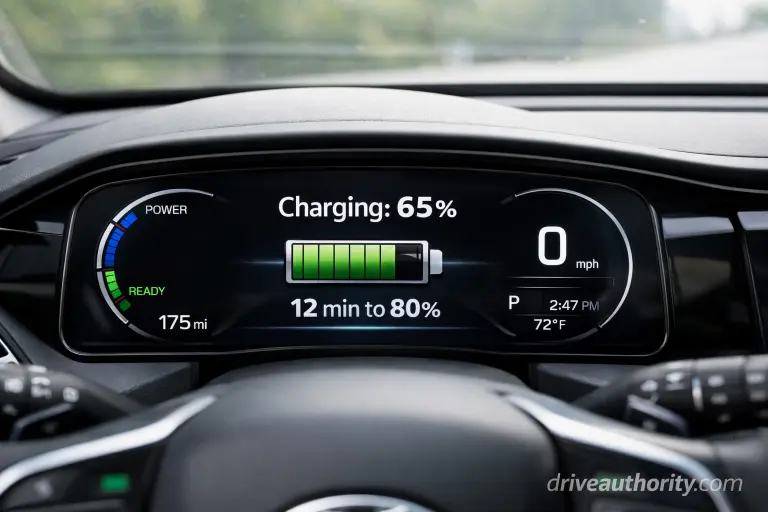
Here’s the real-world frustration: advertised charging times assume ideal conditions that rarely exist. Cold weather can reduce charging speeds by 30-50%. A “350 kW” station might only deliver 150 kW if it’s shared between multiple vehicles or experiencing technical issues. Your car’s maximum charging speed decreases as the battery warms up or if you arrive with a very cold or very hot battery.
According to research from Idaho National Laboratory, actual fast charging sessions average 35-45 minutes in real-world conditions, compared to the 20-30 minute claims in marketing materials.
I’ve experienced this repeatedly on road trips. A planned 25-minute charging stop becomes 40 minutes because the station is delivering lower power than expected, or I arrived with a battery temperature that limits charging speed.
The Charging Time Reality for Different Use Cases
Daily commuters with home charging: Charging time is essentially zero from your active perspective. Plug in when you arrive home, unplug when you leave. Total hands-on time per week: 2 minutes.
Apartment dwellers without home charging: This is where EV ownership becomes problematic. If you’re relying on public Level 2 chargers (adding 15-25 miles per hour), you’re spending 2-4 hours weekly sitting at charging stations. That’s 100-200 hours annually—a massive time tax that erases the EV ownership benefit.
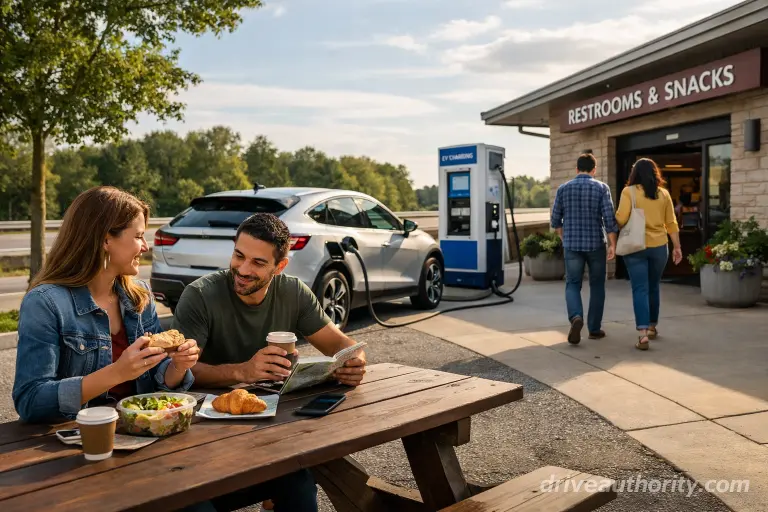
Road trippers: Plan for 30-45 minutes per charging stop every 200-250 miles. On a 600-mile trip, that’s two stops totaling 60-90 minutes versus 10-15 minutes for two gas fill-ups. The time penalty is real but manageable if you plan stops around meals or breaks.
Mixed urban/highway drivers: You’ll charge at home 90% of the time (zero active time) and fast charge occasionally (30-40 minutes per session). The occasional time inconvenience is offset by never visiting gas stations for routine driving.
| Charging Type | Speed | Time (10-80%) | Best For |
|---|---|---|---|
| Level 1 (120V) | 3-5 mi/hr | 24+ hours | Emergency only |
| Level 2 (240V) | 25-30 mi/hr | 6-10 hours | Overnight home charging |
| DC Fast (150 kW) | — | 35-45 min | Road trips |
| DC Fast (350 kW) | — | 18-25 min | Road trips (800V EVs) |
Make Your Charging Time Decision
Before buying an EV, honestly assess your charging access:
- Can you install Level 2 charging at home? If yes, charging time becomes a non-issue. If no, seriously reconsider EV ownership.
- How often do you drive 250+ miles in a day? If it’s weekly, you’ll spend significant time fast charging. If it’s monthly or less, the occasional 30-40 minute stop is manageable.
- Test the reality: Find a local DC fast charging station and sit there for 35 minutes. If that feels unbearable, EVs might not fit your lifestyle yet.
For detailed charging infrastructure maps and installation costs, check our complete EV charging guide before making your decision.
The Bottom Line on EV Charging Time
How long does EV charging take? With home charging, it takes zero active time in your daily routine—you’re doing other things while the car charges overnight. Without home charging, you’re spending 2-4 hours weekly at public chargers, which fundamentally changes the ownership experience.
Road trip charging adds 30-45 minutes every 200-250 miles compared to 5-minute gas stops. That’s the trade-off for lower fuel costs and emissions. If you can charge at home and road trip occasionally, the time equation favors EVs. If you’re dependent on public charging for daily use, the time penalty makes EV ownership considerably less convenient than gas cars.
Your next step: verify home charging installation feasibility before test driving EVs. The charging time question answers itself once you know where you’ll plug in.