1. Introduction: The Future Isn’t Just Electric — It’s Varied
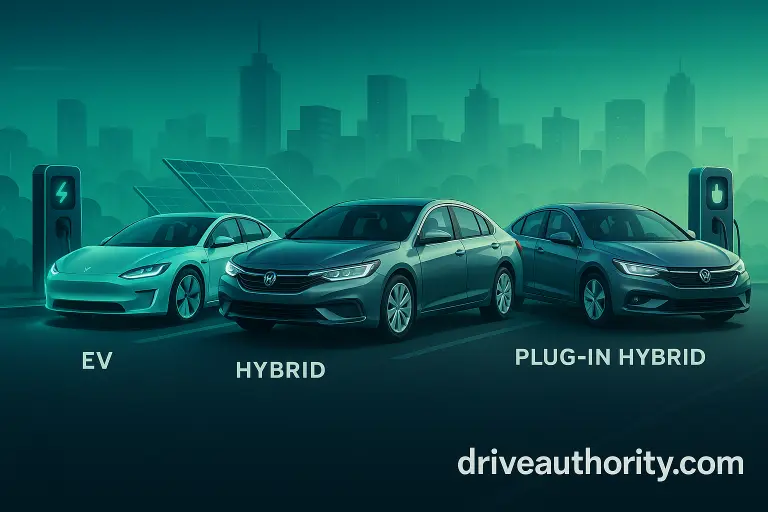
The debate around EV vs Hybrid vs Plug-in Hybrid has never been more relevant. As the automotive world accelerates toward electrification, drivers are faced with an important question: which type of “electrified” car truly fits their needs? While all three options share the goal of reducing emissions and fuel costs, they operate in very different ways.
From fully electric vehicles (EVs) that rely entirely on battery power, to traditional hybrids that combine gasoline and electric energy, and plug-in hybrids that act as the perfect bridge between both — each technology offers a unique driving experience. This guide breaks down their key differences so you can confidently decide which one suits your lifestyle best.
2. Understanding the Basics: How Each Powertrain Works
When comparing EV vs Hybrid vs Plug-in Hybrid, it helps to start with the fundamentals — how each powertrain actually moves the car. While all three use electricity in some form, their energy sources and operating methods differ significantly.
⚡ 2.1 Electric Vehicles (EVs)
Definition:
Electric Vehicles are 100% electric, meaning they rely entirely on battery power and electric motors to drive. There’s no gasoline engine involved — just a powerful battery pack, inverter, electric motor, and an onboard charger.
How it works:
Energy stored in the battery powers the electric motor, which turns the wheels. When the battery runs low, you simply plug the car into a charging station to recharge.
Pros:
- Zero tailpipe emissions — completely clean operation.
- Instant torque and smooth acceleration.
- Lower maintenance costs (fewer moving parts).
Cons:
- Limited driving range compared to gas-powered vehicles.
- Longer “refueling” time during charging.
- Requires reliable access to charging infrastructure.
⛽ 2.2 Hybrid Vehicles (HEVs)
Definition:
Hybrid Electric Vehicles use a combination of a gasoline engine and a small electric motor, but they can’t be plugged in. Instead, they recharge their small battery through regenerative braking — capturing energy whenever you slow down — and by the engine itself.
How it works:
The vehicle automatically switches between electric and gasoline power depending on driving conditions. At low speeds, it often runs on electric power; at higher speeds, the gasoline engine takes over.
Pros:
- Excellent fuel efficiency compared to traditional cars.
- No need to plug in or worry about charging.
- Proven, reliable technology with wide availability.
Cons:
- Limited electric-only range (usually just a few kilometers).
- Doesn’t eliminate fuel dependency entirely.
- Slightly more complex maintenance than a conventional vehicle.
🔌 2.3 Plug-in Hybrids (PHEVs)
Definition:
Plug-in Hybrid Electric Vehicles combine the best of both worlds — a gasoline engine and a larger rechargeable battery that can be plugged in.
How it works:
PHEVs can drive in all-electric mode for short trips (typically 30–60 km), then automatically switch to hybrid mode once the battery is depleted, using the gasoline engine for longer distances.
Pros:
- Ideal for city driving with zero-emission short trips.
- Flexibility to use gas for long journeys.
- Lower fuel costs and emissions when charged regularly.
Cons:
- Higher upfront cost than standard hybrids.
- Heavier due to the larger battery.
- Charging may be inconvenient without home access to a plug.
Each of these powertrains — EV, Hybrid, and Plug-in Hybrid — offers a distinct balance between performance, cost, and sustainability. The next sections will help you decide which one fits your driving lifestyle best.
📊 Table: Comparing EV vs Hybrid vs Plug-in Hybrid Side by Side
Understanding the distinctions between EV vs Hybrid vs Plug-in Hybrid becomes much easier when you see how they compare directly. The table below highlights the main differences in performance, practicality, and cost — helping you quickly identify which option best suits your driving needs.
| Feature / Type | Electric Vehicle (EV) | Hybrid Vehicle (HEV) | Plug-in Hybrid (PHEV) |
|---|---|---|---|
| Power Source | 100% electric – powered solely by a battery and electric motor | Combination of gasoline engine + small electric motor (non-plug-in) | Gasoline engine + larger rechargeable battery (plug-in capable) |
| Range | Typically 250–500 km on a full charge | 800–1,000 km using gas and electric assist | 30–60 km electric range + 500–800 km hybrid mode |
| Charging Needs | Must be plugged into a home or public charger | No charging required; battery recharges automatically | Needs to be plugged in to maximize benefits, but can still run on gas |
| Maintenance | Lower — fewer moving parts, no oil changes | Moderate — includes both gas and electric systems | Higher — combines both powertrains and charging components |
| Emissions | Zero tailpipe emissions | Reduced emissions compared to gasoline-only cars | Very low emissions when driven mostly in electric mode |
| Cost | Higher upfront cost, lower long-term running cost | Lower purchase price, minimal tech investment | Mid-to-high price range depending on battery size |
| Ideal User | Eco-conscious drivers with access to charging stations | Drivers seeking better fuel economy without changing habits | Those wanting electric driving for short trips and gas backup for long drives |
Each type has its strengths: EVs lead in sustainability, Hybrids excel in simplicity, and Plug-in Hybrids offer the best of both worlds. Your choice ultimately depends on your budget, commute length, and charging access.
4. Performance and Driving Experience
When it comes to EV vs Hybrid vs Plug-in Hybrid, performance isn’t just about speed — it’s about how each powertrain feels on the road. From instant acceleration to smooth transitions and overall responsiveness, every type delivers a unique driving experience.
⚡ Electric Vehicles (EVs): Instant Power and Seamless Acceleration
EVs are known for their instant torque, meaning power is delivered to the wheels the moment you press the accelerator. There’s no delay, no gear shifting — just smooth, continuous thrust. This creates a quiet, almost effortless driving experience, especially in city traffic.
- Acceleration: Instant and strong; perfect for quick overtakes.
- Ride Feel: Silent, vibration-free, and fluid.
- Example: The Tesla Model 3 can sprint from 0 to 100 km/h in under 6 seconds — smoother and faster than most gasoline cars.
⛽ Hybrid Vehicles (HEVs): Balanced and Efficient
Hybrids prioritize fuel economy and practicality over raw power. The gasoline engine and electric motor work together intelligently — the motor assists during acceleration, while the engine takes over at higher speeds.
- Acceleration: Moderate; less punchy but consistent.
- Ride Feel: Smooth transitions between gas and electric modes, though sometimes noticeable when switching.
- Example: The Toyota Prius remains a symbol of balanced performance — calm, predictable, and impressively efficient for everyday driving.
🔌 Plug-in Hybrids (PHEVs): Versatility in Motion
PHEVs offer a dual experience — electric when you want it, and gasoline when you need it. In all-electric mode, they deliver the same instant torque as EVs for short trips. Once the battery depletes, the gasoline engine kicks in seamlessly for longer journeys.
- Acceleration: Strong at low speeds (electric), steady on highways (hybrid mode).
- Ride Feel: Smooth and adaptive; the best of both worlds.
- Example: The Kia Niro PHEV provides up to 60 km of all-electric driving, then switches effortlessly to hybrid mode — perfect for commuters who want both efficiency and flexibility.
In short:
- EVs excel in performance and smoothness.
- Hybrids offer a reliable, efficient balance.
- Plug-in Hybrids combine both power and practicality for drivers who crave flexibility.
5. Cost of Ownership: Purchase Price, Fuel, and Maintenance
When evaluating EV vs Hybrid vs Plug-in Hybrid, it’s important to look beyond the sticker price. The true cost of ownership includes initial purchase, fuel or charging costs, maintenance, and long-term savings — and these vary dramatically among the three.
💰 Initial Purchase Price
- EVs: Typically the most expensive upfront due to the cost of their large battery packs. However, government incentives and tax credits (such as those listed on Energy.gov or Fueleconomy.gov) can significantly reduce the overall cost.
- Hybrids (HEVs): Usually the most affordable electrified option. They don’t require large batteries or charging systems, making them closer in price to traditional gas cars.
- Plug-in Hybrids (PHEVs): Fall in the middle — more expensive than hybrids but cheaper than most EVs, especially after incentives.
⛽ Fuel vs Electricity Costs
- EVs: Electricity costs are considerably lower than gasoline. Charging at home overnight can cut “fuel” expenses by more than half compared to fueling a gas car.
- Hybrids: Offer excellent fuel economy since they switch between electric assist and gasoline. Perfect for drivers who don’t want to deal with charging but still want to save at the pump.
- Plug-in Hybrids: Deliver maximum savings when charged regularly, allowing short trips on electric power and gas only for long drives.
🛠️ Maintenance and Repairs
One of the biggest advantages of EVs is their simplicity. With no oil changes, no exhaust systems, and fewer moving parts, their maintenance needs (and costs) are much lower than combustion or hybrid engines.
- EVs: Minimal maintenance — mainly tire rotations, brake fluid, and software updates.
- Hybrids: Slightly more complex due to having both a gas engine and electric system. Regular oil changes still required.
- Plug-in Hybrids: Most complex mechanically, combining both full systems. Maintenance costs can be higher if not serviced properly.
⚖️ Overall Cost Perspective
While EVs often cost more upfront, their lower running and maintenance costs, combined with government rebates, can make them cheaper in the long run — especially for those who drive frequently or have home charging access.
In summary:
- EVs: Higher initial price, lowest long-term cost.
- Hybrids: Affordable entry point, steady fuel savings.
- Plug-in Hybrids: Balanced option with good efficiency and flexibility.
Your ideal choice depends on how far you drive daily, your access to charging, and whether short-term affordability or long-term savings matter most to you.
6. Environmental Impact and Sustainability
Beyond performance and cost, the question of EV vs Hybrid vs Plug-in Hybrid often comes down to one powerful factor — their impact on the planet. As climate concerns rise, understanding how each vehicle type affects the environment — from tailpipe emissions to battery production — is essential for making a truly sustainable choice.
🌍 Emissions: From Zero to Reduced
- Electric Vehicles (EVs):
EVs produce zero tailpipe emissions, making them the cleanest option during daily use. According to the U.S. Environmental Protection Agency (EPA), driving an EV can cut greenhouse gas emissions by more than 50% compared to gasoline vehicles, even when accounting for electricity generation. - Hybrid Vehicles (HEVs):
Hybrids significantly reduce emissions compared to traditional gas cars, but they still rely on fossil fuels. The electric assist helps improve efficiency and lower CO₂ output, particularly in city driving, where stop-and-go traffic allows the electric motor to take over more often. - Plug-in Hybrids (PHEVs):
PHEVs offer flexibility — when driven mostly on electric mode, their emissions are nearly zero. However, if owners rarely charge them and rely mostly on gasoline, their environmental advantage decreases. Proper charging habits are key to maximizing sustainability.
🔋 Lifecycle Footprint: The Hidden Side of Clean Mobility
While EVs shine on the road, their battery production carries a higher initial environmental footprint. The manufacturing of lithium-ion batteries requires energy-intensive mining of materials such as lithium, cobalt, and nickel. However, studies by the International Energy Agency (IEA) show that over a vehicle’s lifetime, EVs still emit far less CO₂ overall than conventional or hybrid cars — especially as the electricity grid becomes cleaner.
Moreover, major automakers and recycling firms are now investing in battery recycling and reuse programs, which can recover up to 95% of key materials, further reducing long-term environmental impact.
🌱 The Bottom Line
| Vehicle Type | Tailpipe Emissions | Lifecycle Emissions | Sustainability Outlook |
|---|---|---|---|
| EV | Zero | Lowest overall after several years of use | Excellent — improves as renewable energy grows |
| Hybrid (HEV) | Low | Moderate | Good — transitional solution |
| Plug-in Hybrid (PHEV) | Very low (if charged often) | Moderate to low | Very good — depends on usage and charging habits |
In short, EVs lead in environmental performance, especially as clean energy expands. Hybrids serve as a practical step toward greener driving, while Plug-in Hybrids offer an adaptable middle ground — proving that sustainability can take many forms on the road to a cleaner future.
7. Charging and Convenience
One of the most practical factors when comparing EV vs Hybrid vs Plug-in Hybrid is how — and whether — each one needs to be charged. For some drivers, the convenience of plugging in at home is a major perk; for others, it’s a potential barrier. Let’s explore how each type fits into real-world daily use.
⚡ Electric Vehicles (EVs): Charging Is a Lifestyle
EVs rely entirely on electricity, which means charging is part of ownership. The good news? There are several convenient options:
- Level 1 Charging (Standard Home Outlet):
Uses a typical 120-volt household outlet. It’s the slowest method — adding around 5–8 km of range per hour — but perfect for overnight top-ups or low-mileage drivers. - Level 2 Charging (Home or Public Station):
Uses a 240-volt outlet, like one for an electric dryer. Adds 25–40 km of range per hour and can fully charge most EVs overnight. Many owners install a Level 2 charger at home for maximum convenience. - DC Fast Charging (Public Network):
The quickest option, available at highway stations. Can charge most EVs to 80% in 20–40 minutes, making long trips feasible — though availability varies by region.
Real-world insight: As of 2025, the U.S. and Europe have rapidly expanding charging networks, yet rural areas still lag behind. Planning ahead remains essential for long journeys.
⛽ Hybrid Vehicles (HEVs): No Plug, No Problem
Hybrids offer the simplest ownership experience — they never need to be plugged in. Their small batteries recharge automatically through regenerative braking and the gasoline engine.
This makes them ideal for:
- Drivers without access to home or public chargers.
- Those who prioritize convenience and fuel savings without lifestyle changes.
Real-world insight: Since hybrids refuel at any gas station, range anxiety isn’t an issue. Maintenance is also straightforward, similar to owning a traditional car.
🔌 Plug-in Hybrids (PHEVs): The Flexible Middle Ground
PHEVs combine the best of both worlds: they can be charged like EVs, but also run on gasoline when needed. This flexibility allows drivers to enjoy electric driving for short commutes and rely on gas for longer trips.
- Charging Options:
- Level 1: 6–8 hours for a full charge.
- Level 2: 2–3 hours, depending on battery size.
- Best Practice: Plug in daily to maximize fuel savings and emission benefits.
Real-world insight: Most PHEV owners find that home charging overnight completely covers their daily driving range, rarely needing gasoline except for road trips.
🚗 Convenience Summary
| Vehicle Type | Charging Required | Typical Charge Time | Long-Trip Readiness | Best For |
|---|---|---|---|---|
| EV | Yes – essential | 8–10 hrs (home), 30–40 min (fast) | Good with planning | Drivers with home charging access |
| Hybrid (HEV) | No | N/A | Excellent | Anyone seeking maximum convenience |
| Plug-in Hybrid (PHEV) | Optional, but recommended | 2–6 hrs (home) | Excellent | Drivers who want electric efficiency + gas backup |
Bottom line:
- EVs require the most charging commitment but reward you with low running costs and smooth performance.
- Hybrids remain the most convenient for those who prefer a “fuel and go” approach.
- Plug-in Hybrids strike the ideal balance, letting you enjoy electric driving without worrying about being stranded.
8. Which Is Right for You? (Decision Framework)
When comparing EV vs Hybrid vs Plug-in Hybrid, there’s no one-size-fits-all winner — the best choice depends on your lifestyle, driving habits, and priorities. Below is a practical decision framework to help you identify which type of electrified vehicle truly fits you.
⚡ Choose an Electric Vehicle (EV) if…
- You drive mostly in cities or short daily commutes and can easily recharge overnight.
- You have access to home or workplace charging and want to reduce reliance on gas entirely.
- You value zero tailpipe emissions, smooth acceleration, and the latest in modern tech.
- You’re comfortable planning longer trips around charging stops.
Best for: Eco-conscious drivers and tech enthusiasts who want a fully electric lifestyle with minimal maintenance and maximum sustainability.
⛽ Choose a Hybrid Vehicle (HEV) if…
- You want better fuel economy but aren’t ready to change your refueling habits.
- You don’t have access to charging stations or prefer a “fill and go” convenience.
- You value proven reliability and long driving range without worrying about plugs.
- You mostly drive mixed routes — city and highway — and want a stress-free transition from gas to electrified driving.
Best for: Practical drivers seeking efficiency, simplicity, and lower fuel bills without altering their routine.
🔌 Choose a Plug-in Hybrid (PHEV) if…
- You want flexibility — electric power for short commutes and gasoline backup for long trips.
- You have access to home charging, but don’t want to depend on it every day.
- You’re looking to reduce fuel costs and emissions while keeping long-distance capability.
- You appreciate versatility and want the “best of both worlds” driving experience.
Best for: Drivers who want to embrace electric mobility without sacrificing range or convenience.
🧭 Quick Decision Checklist
If you’re still unsure, ask yourself these three questions:
- Can I easily charge at home or work?
- Yes → Consider an EV or PHEV
- No → Go for a Hybrid
- How far do I usually drive daily?
- Under 60 km → PHEV or EV makes perfect sense.
- Over 200 km regularly → Hybrid offers the most flexibility.
- What matters most to me — convenience, savings, or sustainability?
- Sustainability → EV
- Convenience → Hybrid
- Balanced savings → PHEV
Final Thought:
Each technology — EV, Hybrid, and Plug-in Hybrid — represents a different stage on the road to a cleaner, more efficient future. The “right” choice isn’t about what’s newest, but what’s smartest for you. Align your vehicle with your daily life, and you’ll enjoy both savings and sustainability with every drive.
9. The Future of Electrified Mobility
The debate around EV vs Hybrid vs Plug-in Hybrid is not just about today’s choices — it’s about where the world is heading tomorrow. As technology evolves, the future of mobility is shaping into one defined by cleaner energy, smarter infrastructure, and more sustainable transportation systems.
⚙️ Breakthrough Technologies: Solid-State Batteries and Smarter Power
One of the most exciting advancements on the horizon is the rise of solid-state batteries — a next-generation energy storage technology promising faster charging, longer range, and enhanced safety compared to current lithium-ion designs. Major automakers like Toyota, BMW, and Nissan are investing heavily in this innovation, with early models expected to appear later this decade.
Solid-state batteries could double driving range and slash charging times, addressing two of the biggest concerns for electric vehicle adoption. Combined with improved recycling and material sourcing, they represent a major leap toward making EVs more accessible, durable, and sustainable.
⚡ Expanding Charging Networks and Lower Battery Costs
Global charging infrastructure is expanding at a remarkable pace. Governments and private companies are installing millions of public charging points, from urban hubs to remote highways. According to the International Energy Agency (IEA), the number of public chargers worldwide is set to triple by 2030, making range anxiety increasingly irrelevant.
Meanwhile, the cost of lithium-ion batteries — once the biggest barrier to EV affordability — has fallen by nearly 90% since 2010, and continues to decline. As battery technology improves and economies of scale grow, electric vehicles are expected to reach price parity with gasoline cars within the next few years.
🏛️ Policy and Regulation: The Global Shift Away from Combustion
Governments around the world are accelerating the transition. The European Union plans to ban sales of new gasoline and diesel cars by 2035, while countries like the UK, Canada, and Japan have announced similar timelines. Even major automakers — including GM, Volvo, and Mercedes-Benz — have pledged to phase out internal combustion engines entirely by the mid-2030s.
This coordinated global push signals that electrification is no longer optional — it’s inevitable. As policies tighten and incentives expand, the balance between EVs, Hybrids, and Plug-in Hybrids will continue to evolve, gradually tipping toward full electric mobility.
🌍 Looking Ahead: A Cleaner, Smarter Road Ahead
The road to the future isn’t linear — it’s a journey of continuous innovation. Hybrids and Plug-in Hybrids are bridging today’s drivers into tomorrow’s all-electric world, while breakthroughs in battery chemistry, smart grids, and renewable energy are setting the foundation for a truly sustainable transportation ecosystem.
In the coming decade, electrified vehicles won’t just be an alternative — they’ll be the default. Cleaner air, quieter cities, and smarter roads are no longer distant dreams but emerging realities powered by human ingenuity and environmental responsibility.
The age of electrified mobility is here — and every choice we make today brings us one charge closer to a sustainable tomorrow.
10. Conclusion: The Road Ahead
The future of driving is electrified — but it’s not one-size-fits-all. Each option along the EV vs Hybrid vs Plug-in Hybrid spectrum offers its own strengths and trade-offs, designed to fit different lifestyles and priorities.
- Electric Vehicles (EVs): Deliver the cleanest, smoothest, and most future-ready driving experience — perfect for those ready to go fully electric and embrace zero-emission mobility.
- Hybrid Vehicles (HEVs): Provide exceptional fuel efficiency and convenience, ideal for drivers who want to save fuel without changing their habits or worrying about charging.
- Plug-in Hybrids (PHEVs): Offer unmatched flexibility — electric for daily commutes, gasoline for long trips — striking the perfect balance between efficiency and practicality.
In the end, the best choice depends on your driving habits, location, and long-term priorities. Whether you’re motivated by sustainability, convenience, or cost efficiency, there’s an electrified path designed just for you.
Understanding EV vs Hybrid vs Plug-in Hybrid is the first step — now it’s time to decide which electrified future drives you.