Finding the best EV for long daily commutes is a fundamentally different exercise from choosing any other kind of electric vehicle. A 50-mile daily commute — round trip — is manageable with almost any modern EV. A 75-mile commute on motorways in mixed weather starts narrowing the field significantly. A 100-mile daily drive in winter, at highway speeds, with no reliable workplace charging, makes the choice genuinely consequential. The best EV for long daily commutes must deliver real-world range that absorbs your journey with margin to spare, charge fast enough to recover overnight without stress, maintain efficiency at 70–80 mph, and sustain that performance as the battery ages over five or more years of high-mileage use. This guide covers each dimension with the data needed to make the right call — not based on brochure numbers, but on what these vehicles actually deliver on the kind of drive you make every working day.
Before selecting a model, understanding how advertised range translates to real-world highway performance is essential — our EV range vs advertised range guide explains the gap and how to calculate your personalised planning range. For charging setup context, our home EV charging setup guide covers what to install and what it costs. For broader real-world battery performance data, the IEA Global EV Outlook provides authoritative fleet efficiency benchmarks referenced throughout.
Jump To Section
- What Makes an EV Ideal for a 50+ Mile Daily Commute?
- Minimum Range Needed for Long Daily Commutes
- Best EV for Long Daily Commutes – Top Picks by Category
- Real-World Efficiency Comparison for Highway Drivers
- Charging Strategy for Long Daily Commutes
- Total Cost of Ownership for High-Mileage Drivers
- Comfort & Fatigue Factors for 1+ Hour Daily Commutes
- Who Should NOT Buy an EV for Long Daily Commutes?
- FAQs
- Final Verdict
What Makes an EV Ideal for a 50+ Mile Daily Commute?
Not every EV with impressive headline figures translates into a stress-free long-commute tool. Four specific characteristics determine whether a vehicle genuinely suits high-mileage daily driving — and they must be evaluated together, not individually.
Real-World Range vs Advertised Range
The advertised range — whether EPA, WLTP, or CLTC — is a laboratory figure that consistently overstates what you will see at 70 mph on a winter commute. For long-commute buyers, the only relevant number is real-world highway range under realistic conditions: typically 15–25% below the WLTP figure in temperate weather and 30–40% below in cold conditions. A vehicle rated at 300 miles WLTP may deliver 220–240 miles on a sustained motorway run in moderate weather. That gap determines whether your commute fits comfortably within a single charge or creates daily range stress. Always calculate your personalised planning range — not the sticker number — before selecting a model.
Fast Charging Capability (DC Fast Charging 2026 Standards)
For commuters who cannot charge at work, fast charging capability determines how efficiently they can top up during the working week. 800V architecture — now available across an expanding range of mid-market and premium EVs in 2026 — enables 100–200+ kW charging rates that can add 100 miles of range in 15–20 minutes. 400V architecture vehicles typically charge at 50–150 kW. The practical difference for a commuter who needs a midweek top-up is 20 minutes versus 40+ minutes — a weekly time cost that compounds significantly over a year of high-mileage use.
Highway Efficiency (kWh per 100 Miles)
Highway efficiency — measured in kWh consumed per 100 miles at 70–80 mph — directly determines both your real-world commute range and your annual electricity cost. A vehicle consuming 3.2 miles per kWh at highway speed will cost approximately 30% less to run annually than one consuming 2.4 miles per kWh on the same route. Aerodynamic drag coefficient, weight, motor efficiency, and thermal management all feed into this figure. For high-mileage commuters driving 20,000+ miles annually, a 0.5 miles/kWh efficiency difference equates to $400–$700 in annual running cost at typical electricity rates.
Comfort & Driver Assistance for Long Drives
A commuter spending 1–2 hours daily behind the wheel accumulates significant fatigue over a working year. Seat ergonomics, adaptive cruise control quality, lane-centering accuracy, and cabin noise levels at highway speed are not luxury concerns — they are occupational health factors that affect concentration and wellbeing. The best EV for long daily commutes must score well on all four, not just on range and charging speed.
| Commuter Requirement | Minimum Threshold | Recommended Standard | Premium Standard |
|---|---|---|---|
| Real-world highway range | 180 miles | 230 miles | 280+ miles |
| DC fast charge speed | 50 kW | 100 kW | 150–250 kW |
| Highway efficiency | 2.8 mi/kWh | 3.2 mi/kWh | 3.6+ mi/kWh |
| Heat pump fitted | Optional | Standard | Standard + preconditioning |
| Adaptive cruise control | Basic ACC | ACC + lane centering | Full highway pilot |
| Battery warranty | 6 yrs / 60k mi | 8 yrs / 100k mi | 8–10 yrs + capacity floor |
Minimum Range Needed for Long Daily Commutes
The right minimum range for your commute depends on three variables: your daily mileage, your climate, and your charging access. Getting this calculation right at purchase is more important than any other single specification decision.
Why 250+ Miles EPA Range Is the New Baseline
For a 50-mile daily commute, a 150-mile real-world range EV is theoretically adequate — three full days of driving before a home charge is needed. In practice, the buffer evaporates quickly when weather, detours, and traffic are factored in. The recommended baseline for a 50-mile daily commuter in 2026 is 250 miles EPA-rated range, which typically delivers 210–230 miles at highway speeds in moderate weather — providing a comfortable margin without daily charging anxiety. For 75-mile commuters, 300 miles EPA is the practical minimum. For 100-mile daily drivers, 320+ miles EPA or a workplace charging option is essentially non-negotiable for stress-free operation year-round.
Winter Range Loss Considerations
Cold climate commuters face the sharpest range reduction of any driving condition. At 23°F / -5°C, a vehicle without a heat pump loses 30–40% of its rated range. A 300-mile EPA vehicle becomes a 180–200-mile practical vehicle in sustained cold conditions with resistance heating. A heat pump-equipped equivalent in the same conditions retains 220–240 miles — a difference of 40 miles that, for a 100-mile round-trip commuter, separates comfortable operation from daily stress. For cold-climate commuters, heat pump fitment should be treated as a hard requirement, not an upgrade option. Our guide on managing EV range anxiety covers cold-weather planning strategies in detail.
Charging Buffer Strategy (10–20% Reserve)
Never plan your commute to the bottom of the battery. A 15% operational reserve — arriving home with at least 15% charge remaining — protects against unexpected detours, provides cold-weather contingency, and slows battery degradation by avoiding deep discharge cycles. Build this buffer into your range calculation at the point of model selection: your planning range should comfortably cover your daily round trip with 15% remaining, not just barely reach home at 2%.
| Daily Commute Distance | Min. EPA Range (Temperate) | Min. EPA Range (Cold Climate) | Recommended Buffer |
|---|---|---|---|
| 50 miles/day | 220 miles | 270 miles | 15% |
| 75 miles/day | 270 miles | 330 miles | 15–20% |
| 100 miles/day | 310 miles | 380 miles (or workplace charging) | 20% |
| 120+ miles/day | 350+ miles or en-route charging | Workplace charging essential | 20%+ |
Best EV for Long Daily Commutes – Top Picks by Category
The recommendations below are based on real-world highway range data, charging architecture, long-term reliability records, and commuter-relevant comfort specifications — not on advertising claims or manufacturer-supplied test data.
Best Overall EV for 50–100 Mile Daily Driving
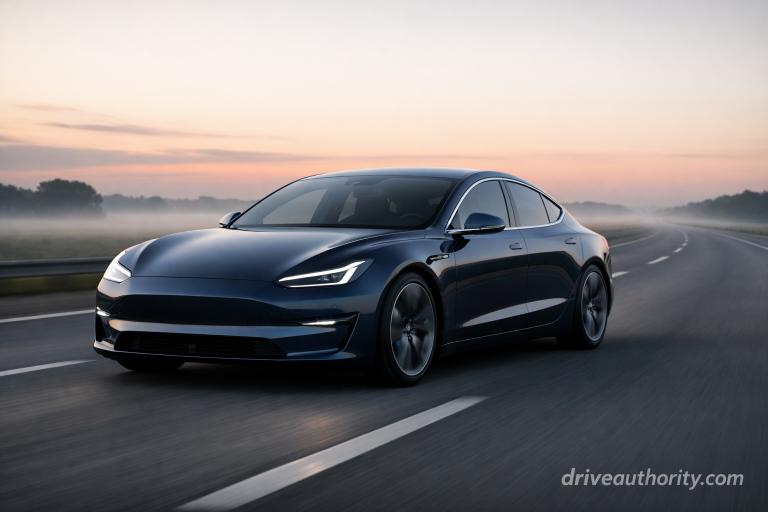
The Hyundai Ioniq 6 (Standard Range RWD) and Ioniq 6 Long Range RWD lead this category in 2026 for buyers who prioritise efficiency above all else. With a drag coefficient of 0.21 and an 800V charging architecture enabling 220 kW peak DC charging, the Ioniq 6 Long Range delivers real-world highway range of 240–265 miles in moderate conditions — and charges from 10–80% in approximately 18 minutes at a compatible ultra-rapid charger. Highway efficiency of 3.8–4.1 miles per kWh makes it the most cost-effective long-commute tool in its segment. Heat pump is standard. The Tesla Model 3 Long Range AWD remains a strong alternative, offering a mature Supercharger network with high reliability, real-world range of 310–330 miles in mixed conditions, and strong highway efficiency at 3.5–3.8 miles per kWh.
Best Overall Pick – Commuter Snapshot
- EPA Range: 361 miles (Ioniq 6 LR RWD) / 358 miles (Model 3 LR AWD)
- Real-World Highway Range: 255–270 miles / 310–325 miles
- DC Fast Charge Speed: 220 kW (800V) / 250 kW
- Efficiency (highway): 3.9 mi/kWh / 3.6 mi/kWh
- Heat Pump: Standard on both
- Est. 5-Year Commute Energy Cost (20k mi/yr): $4,800–$5,600
Best Budget EV for Long Commutes
The Chevrolet Equinox EV (rear-wheel drive, standard range) hits the budget category for US buyers at around $34,995 before incentives, with real-world highway range of 210–230 miles and 150 kW DC fast charging. For European buyers, the BYD Seal or MG4 Extended Range offer strong efficiency and LFP battery longevity at competitive price points. The MG4 Extended Range delivers real-world motorway range of 220–240 miles and benefits from LFP chemistry’s tolerance of daily 100% charging — important for commuters who need a full battery every morning. For detailed MG4 real-world performance, see our MG4 vs BYD Dolphin comparison.
Best Long-Range EV for 75+ Mile Daily Drivers
Drivers covering 75+ miles daily need genuine long-range capability — not just an impressive EPA number, but strong sustained highway efficiency and reliable real-world delivery. The Mercedes EQS 450+ and BMW i5 eDrive40 lead this category on pure range delivery, with real-world highway figures of 320–360 miles and 280–310 miles respectively. For buyers who want long range without the premium price, the Tesla Model Y Long Range AWD remains the strongest value proposition — real-world highway range of 270–290 miles, 250 kW charging, and the most mature DC charging network in most markets. See also: longest range electric cars ranked by real-world performance.
Best Luxury EV for Long Highway Commutes
For commuters who spend 90+ minutes daily in their vehicle and prioritise fatigue reduction as highly as range, the BMW i5 eDrive40 and Genesis GV80 Electrified stand out. Both combine genuine long-range capability (270–310 miles real-world highway) with exceptional seat ergonomics, low cabin noise at motorway speed, and high-quality adaptive cruise and lane-centering systems that genuinely reduce driver fatigue over extended commutes. The Porsche Taycan 4S, while expensive, offers 800V charging and the most precise driver-assistance system in its category — for a commuter who values active engagement alongside comfort, it remains in a class of its own. For broader context on luxury EV reliability and ownership costs, see our luxury car brand reliability and ownership cost guide.
Best EV for Cold Climate Long Commutes
Cold climate commuters need heat pump fitment, strong battery preconditioning, and an LFP or well-managed NMC chemistry pack that retains usable capacity at low temperatures. The Kia EV6 Long Range RWD with heat pump leads this category — its 800V architecture allows rapid battery preconditioning before highway charging stops, and its real-world cold weather range of 230–250 miles at -5°C outperforms most competitors at its price point. The Volvo EX30 Extended Range, while smaller, delivers exceptional cold-weather efficiency for urban-to-suburban commuters in Scandinavian or Canadian conditions. For winter commuters with longer distances, the Ioniq 6 Long Range’s heat pump system and thermal management architecture consistently deliver best-in-class cold-weather range retention.
| Category | Top Pick | EPA Range | Real-World Highway Range | DC Charge Speed | Heat Pump |
|---|---|---|---|---|---|
| Best Overall | Hyundai Ioniq 6 LR RWD | 361 mi | 255–270 mi | 220 kW | Standard |
| Best Budget | Chevrolet Equinox EV / MG4 XR | 319 / 281 mi | 210–230 mi | 150 / 140 kW | Optional / Standard |
| Best Long Range | Tesla Model Y LR AWD | 320 mi | 270–290 mi | 250 kW | Standard |
| Best Luxury | BMW i5 eDrive40 | 295 mi | 265–285 mi | 205 kW | Standard |
| Best Cold Climate | Kia EV6 LR RWD | 310 mi | 230–255 mi (cold) | 233 kW | Standard |
Real-World Efficiency Comparison for Highway Drivers
For high-mileage commuters, efficiency at sustained highway speed is the metric that most directly controls annual running costs and real-world range. It varies more between models than any other specification.
Aerodynamics & Drag Coefficient
Aerodynamic drag is the dominant energy consumer at highway speeds. At 75 mph, overcoming air resistance accounts for approximately 60–70% of total energy consumption. A vehicle with Cd 0.21 (Ioniq 6) consumes roughly 30% less energy at highway speed than one with Cd 0.33 (typical mid-size SUV EV). This translates directly into range and running cost differences that dwarf other efficiency factors. For long-commute buyers, the drag coefficient — not the battery size — is the primary determinant of sustainable highway range.
70–80 MPH Efficiency Drop
Every EV loses efficiency as speed increases above 60 mph — but the rate of loss varies significantly by model. Aerodynamically optimised sedans (Ioniq 6, Model 3, Taycan) lose approximately 15–20% efficiency between 60 and 75 mph. Larger SUVs and crossovers lose 22–30%. At 85 mph, efficiency losses of 30–40% versus the rated combined figure are common across all segments. For motorway commuters, the practical implication is clear: a vehicle that is adequate at 65 mph may be genuinely range-limited at 80 mph. Always evaluate the model’s specific highway efficiency figures, not its combined rating.
Tire Selection & Rolling Resistance
Tire specification has a measurable impact on highway efficiency that compounds significantly over a 20,000-mile annual commute. EV-specific low-rolling-resistance tires — fitted as standard on efficiency-focused models — can contribute 3–6% better efficiency versus all-season alternatives. When original tires wear out, specifying equivalent LRR replacements rather than defaulting to standard all-season compounds preserves the vehicle’s highway efficiency rating. Over a 5-year high-mileage ownership period, the cumulative electricity cost difference from tire choice alone can reach $300–$500.
Charging Strategy for Long Daily Commutes
The right charging strategy for a long commuter is different from a short-trip EV owner. Volume, speed, and degradation management all matter more at high annual mileage.
Level 2 Home Charging Setup (240V)
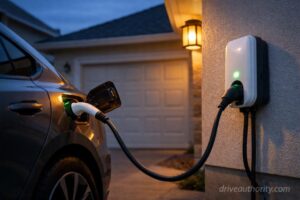
A 11 kW Level 2 home charger is the foundation of stress-free long-commute EV ownership. At 11 kW, a vehicle consuming 70 miles of range daily (approximately 25 kWh) recovers fully in 2–3 hours of overnight charging. For commuters with longer drives, a 7 kW charger running overnight from 11pm to 6am provides 49 kWh of recovery — sufficient for most 100-mile round trips. Specifying the correct charger capacity for your vehicle and commute at installation removes the risk of arriving at an under-specified home setup. Full installation cost guidance is in our home EV charging setup guide.
800V Fast Charging Benefits in 2026
For commuters who occasionally need a midweek top-up or regularly cover longer distances, 800V architecture provides a meaningful practical advantage over 400V systems. At a 350 kW ultra-rapid charger, an 800V vehicle adds 100 miles of range in 12–15 minutes versus 25–35 minutes for a 400V vehicle charging at 150 kW. Over a working year of weekly fast charges, that difference accumulates to hours of recovered time — a real quality-of-life benefit for high-mileage commuters. The best EV for long daily commutes in 2026 increasingly means an 800V-capable vehicle for buyers who expect to use public charging regularly. Our overview of the best EV charging companies in 2026 covers network reliability and coverage across major markets.
Public Charging Network Reliability
Network reliability is the final charging variable — and the one most buyers discover only after purchase. A fast charger that is frequently out of service, queued, or payment-system unreliable destroys the efficiency advantage of high-speed charging capability. Tesla’s Supercharger network consistently leads reliability surveys in most markets. IONITY and major national networks have improved substantially since 2022 but still show meaningful reliability variance by region. For commuters who depend on public charging, checking network coverage and uptime data for your specific corridor before purchase is essential, not optional. Our public EV charging cost breakdown includes network-by-network reliability context.
| Charging Scenario | Equipment Needed | Recovery Speed | Est. Cost per 100 Miles |
|---|---|---|---|
| Home overnight (11 kW L2) | Home charger + installation | ~8–10 hrs full charge | $3.00–$5.50 |
| Workplace L2 (7–22 kW) | Employer-provided or paid | Partial top-up during work day | $2.50–$6.00 |
| Public DC fast (50–150 kW) | CCS / CHAdeMO / NACS | 100 mi in 25–45 mins | $9.00–$16.00 |
| Ultra-rapid DC (150–350 kW) | 800V capable vehicle required | 100 mi in 10–18 mins | $10.00–$18.00 |
Total Cost of Ownership for High-Mileage Drivers
At 20,000+ miles annually, total cost of ownership diverges significantly between EVs and combustion alternatives — and between efficient and less efficient EVs within the electric category.
Electricity Cost per 15,000–25,000 Miles Per Year
At an average home electricity rate of $0.14/kWh and 3.2 miles per kWh highway efficiency, a 20,000-mile annual commuter spends approximately $875 per year on electricity. At public fast-charge rates averaging $0.35/kWh for the same efficiency, the cost rises to $2,188 — a $1,313 annual difference that strongly incentivises home charging. A less efficient EV at 2.4 miles per kWh costs $1,167 at home rates — $292 more per year than the efficient alternative. Over five years at high mileage, efficiency differences compound into $1,000–$2,000 in additional running cost that purchase price comparisons ignore. Our monthly EV ownership cost breakdown models these scenarios across usage patterns.
Battery Degradation Impact
High-mileage commuters degrade their batteries faster than low-mileage owners — simply because more charge cycles accumulate per year. The best EV for long daily commutes for a buyer covering 20,000+ miles annually is one with LFP chemistry (most degradation-tolerant) or a proven NMC thermal management system with a strong capacity retention warranty. At 100,000 miles of high-mileage commuting — typically 5 years at 20,000 miles annually — an LFP-chemistry vehicle should retain 88–92% of original capacity. A poorly managed NMC vehicle at the same mileage may retain 78–83%. That 10% capacity gap equates to a meaningful reduction in real-world range precisely when the vehicle’s warranty may be approaching expiry. For detailed battery longevity data, see our EV battery lifespan guide.
Maintenance Savings vs Gas Vehicles
High-mileage EV ownership delivers proportionally greater maintenance savings than low-mileage ownership — because every mile is a mile without an oil change, spark plug, air filter, or timing belt service. A petrol vehicle covering 20,000 miles annually might accumulate $1,200–$1,800 in annual maintenance. An equivalent EV accumulates $400–$700 — brake fluid, tire rotation, cabin air filter, and occasional wiper blade replacement. Over five years, the maintenance saving for a high-mileage commuter runs $4,000–$5,500 — a figure that significantly improves the EV’s total cost of ownership case even before fuel savings are calculated.
Depreciation Considerations
High mileage accelerates depreciation on any vehicle, but EVs from established brands with strong reliability records — Tesla, Hyundai, Kia — have demonstrated better residual value retention at high mileage than many petrol alternatives, particularly as battery health certification infrastructure matures. A high-mileage EV with a documented battery health above 85% commands a meaningful resale premium over an equivalent vehicle without certification. For commuters planning to sell at the 5-year mark, choosing a brand with strong resale data and investing in battery health documentation before sale is a real financial decision worth planning for at purchase.
| Cost Category | Efficient EV (20k mi/yr) | Petrol Equivalent (20k mi/yr) |
|---|---|---|
| Annual fuel / energy cost | $875–$1,200 (home charging) | $3,200–$4,500 |
| Annual maintenance | $400–$700 | $1,200–$1,800 |
| 5-year fuel + maintenance saving | $17,000–$24,000 in EV’s favour | |
| 5-year depreciation (est.) | $18,000–$26,000 | $14,000–$20,000 |
| 5-year net cost advantage (EV) | $6,000–$14,000 depending on model and fuel prices | |
Comfort & Fatigue Factors for 1+ Hour Daily Commutes
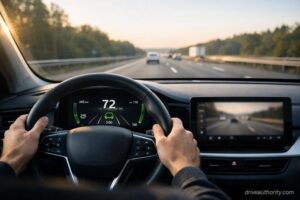
A commuter spending 500+ hours annually in their vehicle is making a quality-of-life decision as much as a financial one. The best EV for long daily commutes scores well on every fatigue-reduction dimension.
Seat Ergonomics
Lumbar support quality, seat base length relative to leg length, side bolster firmness for motorway holds, and seat ventilation availability are all measurably important for drivers sitting in the same position for 45–90 minutes twice daily. The BMW i5, Genesis GV80 Electrified, and Hyundai Ioniq 6 all receive consistently high marks in long-duration seating comfort assessments. Budget EVs frequently compromise seat cushioning depth and lumbar adjustability — a specification gap that is unnoticeable on a test drive and significant over a commuting career.
Adaptive Cruise Control & Lane Centering
A high-quality adaptive cruise control system with smooth following distance management and accurate lane centering on motorways reduces cognitive load and physical fatigue measurably over a 60-minute drive. Systems vary significantly in quality. Tesla’s Autopilot remains the benchmark for lane-centering smoothness on well-marked motorways. The Kia and Hyundai Highway Driving Assist system is among the best in its price tier. BMW’s Driving Assistant Professional and Mercedes’ Drive Pilot system lead at the premium level. Poor adaptive cruise — systems that brake sharply, hunt for lane position, or require constant override — increases rather than reduces fatigue.
Cabin Noise at Highway Speed
EVs are inherently quieter than combustion cars at low speeds, but wind and tire noise at 70+ mph vary significantly by model. Double-glazed side windows (standard on BMW i5, Mercedes EQE, Ioniq 6 SR) reduce wind noise meaningfully. Acoustic laminated glass on the windscreen further reduces road noise intrusion. Tire selection also contributes — performance tires increase road noise at highway speed while EV-specific LRR tires are engineered to minimise it. For commuters spending significant time above 65 mph, specifying acoustic glass and checking independent cabin noise measurements before purchase is worthwhile.
Infotainment & Connectivity Reliability
An infotainment system that requires daily phone pairing, loses navigation signal on familiar routes, or crashes and reboots mid-journey is a quality-of-life failure for a daily commuter regardless of how impressive the range figures are. System reliability varies significantly — Tesla’s infotainment architecture is among the most stable; some budget EV systems show higher rates of lag and connectivity dropouts at the 2–3 year mark. Check owner forum reports for your specific model before committing.
Who Should NOT Buy an EV for Long Daily Commutes?
Apartment Dwellers Without Reliable Charging
A long daily commuter who cannot home-charge faces a structurally difficult ownership proposition. Relying on public fast charging for daily recovery adds $1,200–$2,000 annually in charging cost over home rates, introduces schedule dependency on charger availability, and increases battery degradation from frequent DC fast charging. If workplace charging is also unavailable, the best EV for long daily commutes simply cannot fulfil the role cost-effectively without home charging access. In this situation, a plug-in hybrid or full hybrid is a more practical daily commuter than a pure EV — the combustion backup eliminates the charging dependency that makes pure EV commuting work.
Drivers Without DC Fast Charging Access on Their Route
Commuters whose journey runs through regions with sparse public charging infrastructure — rural corridors, less-developed motorway networks — face disproportionate range risk if real-world range falls short of their commute distance. The consequences of running low on charge where the nearest charger is 40 miles away are far more severe than the equivalent situation in an urban area. These buyers should either select a vehicle with generous range margin or consider whether a hybrid better suits their infrastructure reality. Our guide on electric cars to avoid in 2026 flags models with documented real-world range shortfalls relevant to this scenario.
Extreme Cold Rural Drivers
Buyers in northern rural markets — northern Canada, Scandinavia outside major cities, high-altitude rural US — who combine long daily distances with extreme cold and sparse public charging face the convergence of every EV challenge simultaneously. Winter range loss of 35–45%, minimal public charging fallback, and potentially long emergency response times create a risk profile that current EV technology handles less well than a conventional combustion or hybrid vehicle. These buyers should carefully evaluate whether even the best long-range, heat-pump-equipped EV provides sufficient margin for their specific corridor before committing.
Buyer Risk Checklist – Is a Long-Commute EV Right for You?
- ✅ Home charging available (Level 2 preferred)
- ✅ Real-world planning range comfortably exceeds daily round trip + 20% buffer
- ✅ At least one reliable DC fast charger within 10 miles of home or workplace
- ✅ Heat pump fitted if you regularly drive below 40°F / 5°C
- ✅ Battery warranty covers minimum 8 years with stated capacity floor
- ⚠️ No home charging — evaluate PHEV or hybrid as primary commuter
- ⚠️ Rural route with sparse charging — build 30%+ range buffer or reconsider
- ⚠️ Sustained sub-zero winter commutes — require heat pump + cold-rated battery as non-negotiable
FAQs – Best EV for Long Daily Commutes
What is the best EV for long daily commutes over 50 miles?
The Hyundai Ioniq 6 Long Range RWD leads overall for its combination of exceptional highway efficiency (3.9 mi/kWh), 800V fast charging, and strong real-world range of 255–270 miles. The Tesla Model 3 Long Range is the strongest alternative with a more mature charging network. For budget buyers, the MG4 Extended Range offers genuine long-commute capability at a substantially lower price point.
How much range do I need for a 60-mile daily commute?
A 60-mile round trip requires a minimum 220 miles EPA-rated range in temperate conditions — building in a 15% operational buffer and accounting for 15–20% highway efficiency reduction from the rated figure. In cold climates, raise this to 270+ miles EPA. If your commute is predominantly motorway driving above 65 mph, prioritise highway efficiency (mi/kWh) as highly as headline range.
Is 250 miles of range enough for highway commuting?
For a 70-mile daily round trip in temperate conditions, 250 miles EPA is adequate with a comfortable buffer. At motorway speeds, 250 miles EPA typically delivers 200–215 miles real-world — still sufficient for most 70-mile commutes with a 15% reserve. In cold weather, 250 miles EPA can compress to 165–185 miles, which may create daily range stress for 70+ mile commuters without home charging access.
Do EVs lose range in winter commuting?
Yes — significantly. Cold battery chemistry, cabin heating demand, and reduced regenerative braking efficiency combine to reduce real-world range by 20–40% in cold conditions, depending on temperature and whether a heat pump is fitted. Heat pump-equipped vehicles lose 20–28% in cold weather versus 35–45% for resistance-heated equivalents. Pre-conditioning the battery while plugged in before departure partially mitigates cold-start range loss.
How often will I need to charge with a 70-mile daily commute?
With home Level 2 charging, a 70-mile daily commuter needs to charge every night — but each session takes only 2–4 hours on an 11 kW charger, recoverable during any evening at home. A vehicle with 300+ miles of real-world range in temperate conditions could technically skip a night’s charging occasionally, but daily overnight top-up is the recommended routine for consistent battery health and morning range confidence.
What is the cheapest EV for a long commute?
The Chevrolet Equinox EV (from ~$35,000 before incentives in the US) and MG4 Extended Range (from approximately £28,000 in the UK) represent the strongest budget long-commute options in their respective markets in 2026. Both offer real-world highway range above 200 miles, adequate fast charging, and manufacturer warranties covering 8 years. See our best EVs under $40,000 guide for a broader budget comparison.
Is fast charging necessary for daily commuting?
Not if you have reliable home Level 2 charging and your vehicle’s real-world range comfortably exceeds your daily round trip. Home charging at 11 kW overnight recovers a 60–80 mile daily commute in 2–3 hours with no fast charging needed. Fast charging becomes essential if you commute without home charging access, drive longer daily distances, or need midweek top-ups on high-mileage weeks. For high-mileage commuters, 800V fast charging capability provides a significant quality-of-life advantage for occasional public charging stops.
Final Verdict – How to Choose the Best EV for Your Daily Drive
The best EV for long daily commutes is not a single model — it is the model whose real-world highway range, charging architecture, thermal management, and comfort specification best match your specific commute distance, climate, and charging access. The framework is straightforward: calculate your personalised planning range using our four-step method, match it to a vehicle whose real-world highway figure provides a comfortable margin, confirm heat pump fitment if you are in a cold climate, and verify home charging feasibility before purchase.
By commute distance tier, the recommendations resolve clearly. For 50-mile daily commuters with home charging in temperate climates, a broad range of current EVs qualify — the budget-conscious choice is the MG4 Extended Range or Equinox EV; the efficiency-optimised choice is the Ioniq 6. For 75-mile daily commuters, the field narrows to vehicles with 280+ miles of real-world highway range and 800V charging — the Ioniq 6 Long Range, Tesla Model 3 Long Range, and Kia EV6 Long Range all qualify. For 100-mile daily drivers, only the longest-range vehicles with the most efficient thermal management — Model Y LR, BMW i5, Mercedes EQE — provide adequate margin year-round without workplace charging support.
To compare specific models on real-world efficiency and total commute cost, explore our best electric cars for the money rankings, review first-time EV buyer mistakes before committing, and use our EV total cost of ownership calculator guide to model your specific annual mileage and electricity rate.