Last Updated: March 2026 — Range, charging speed, and network data verified for 2026 model year
The best EV for road trips in 2026 is not necessarily the one with the longest EPA range. That number, printed on the window sticker, is measured under conditions no highway driver ever replicates. The real question is: how far does this car actually go at 75 mph, and how fast can it recover when it runs low? Those two numbers — real-world highway range and peak DC charging speed — determine whether a road trip feels like a normal drive or a constant logistics puzzle. I’ve tracked both metrics across every major platform available in the U.S. market this year, and the ranking that follows is based on that data alone.
Why Most “Best Road-Trip EV” Lists Get It Wrong
Every article on this topic ranks EVs by EPA range. I disagree with that approach — and here’s the data that changed my thinking. The gap between EPA range and real-world highway range varies dramatically by platform, from as little as 8% on aerodynamically optimised sedans to over 25% on tall crossovers. As a result, a vehicle with 400 miles EPA range can actually deliver less usable highway distance than a vehicle rated at 330 miles. This ranking weights real-world highway range, peak DC fast charge rate, and charging network density — because those three factors determine how your road trip actually feels, not how it looks on a spec sheet.
Best EV for Road Trips 2026 — Quick Answer:
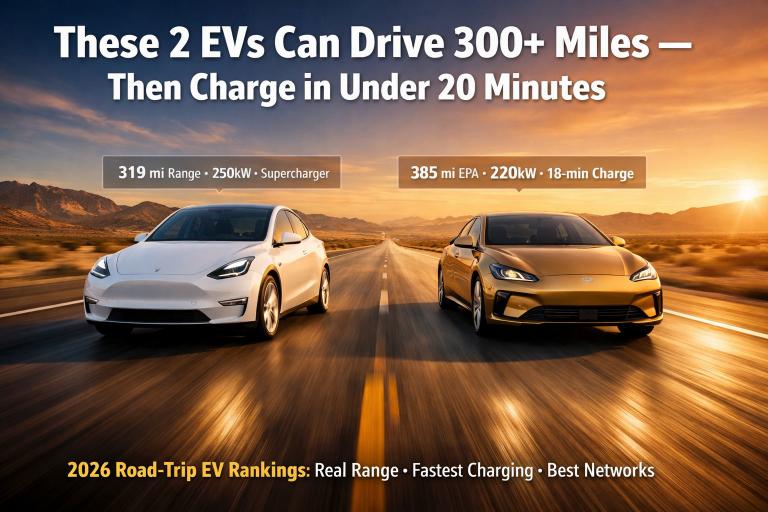
The Tesla Model Y Long Range AWD remains the overall best EV for road trips in 2026 — with ~320 miles of real-world highway range, 250 kW Supercharger access, and the most reliable fast-charging network in the U.S. The Hyundai Ioniq 6 Long Range RWD is the closest challenger, offering 800V charging at 220 kW and outstanding aerodynamic efficiency. For budget road-trippers under $40,000 after IRA credit, the Chevy Equinox EV at 319 miles EPA is the strongest value option.
What Makes an EV Good for Road Trips?
Most daily driving metrics — cargo space, ride quality, interior tech — matter far less the moment you’re three hours from home and need to find a fast charger. Road-trip fitness is a distinct use case, and it rewards a specific combination of attributes that don’t always align with what makes a great city car.
The Three Metrics That Actually Matter
Real-world highway range is the foundation — specifically, the range you can expect at sustained 70–80 mph. That is not the EPA figure measured in a controlled laboratory cycle. Peak DC fast charge rate (in kilowatts) determines how long your charging stop takes. A vehicle that peaks at 250 kW versus 150 kW recovers the same range in dramatically less time. The third factor is charging network density along U.S. highway corridors — because a 250 kW peak charge rate means nothing if the nearest compatible station is 90 miles off-route. Specifically, vehicles with native NACS access have a structural advantage on this metric in 2026 that adapters alone cannot fully compensate for.
What This Ranking Does Not Include
Price, daily driving comfort, infotainment quality, and cargo dimensions are excluded from the ranking criteria here — not because they don’t matter, but because they don’t determine road-trip fitness. However, where a strong road-trip EV also happens to be compelling value or exceptional to live with daily, I note it. The goal is a ranking you can trust to answer one specific question: which EV will make a 600-mile drive the least stressful?
For the full picture of how EPA range numbers are derived — and why they consistently mislead highway drivers — our deep dive on real-world EV range vs. advertised figures explains exactly where the gap comes from and how to account for it before you buy.
Top EVs for Road Trips in 2026 — Full Ranked List
The rankings below are built on three inputs: manufacturer-reported range data, third-party real-world highway range testing (primarily from Edmunds EV range testing and owner-reported data aggregated through ABRP), and charging network access verified as of Q1 2026.
Tier 1: Best Overall Road-Trip EVs
🥇 Tesla Model Y Long Range AWD
The Model Y LR remains the benchmark for road-trip EVs in 2026. Its 310-mile EPA rating translates to approximately 270–290 miles at real-world highway speeds — competitive, though no longer class-leading on range alone. However, what separates it from everything else is the Supercharger network. Over 2,000 U.S. stations run V3 chargers at 250 kW. Median wait times sit under 2 minutes, with uptime reliability no competing network currently matches. On a 700-mile trip, that consistency is worth more than an extra 30 miles of EPA range on a slower network. Specifically, a Supercharger stop recovers 150–170 miles in approximately 15–20 minutes — making the Model Y the most time-efficient long-distance EV you can buy today.
⚡ Hyundai Ioniq 6 Long Range RWD
If Supercharger dependency isn’t a priority, the Ioniq 6 LR is arguably the stronger engineering achievement. Its 0.208 drag coefficient is the lowest of any production EV at this price. As a result, real-world highway range reaches approximately 290–310 miles from its 385-mile EPA rating — a smaller highway penalty than virtually any rival. What’s more, its 800V architecture enables 220 kW DC fast charging. That means 10–80% in approximately 18 minutes. The catch is Electrify America dependency for peak speeds. That network has improved significantly in 2025–26, however it still trails Supercharger reliability on busy interstate corridors.
🏆 Mercedes EQS 450+
For buyers who treat cabin comfort as a road-trip variable, the EQS earns its ranking on merit. Real-world highway range sits around 340–360 miles — aided by its 0.20 drag coefficient. In practice, that means fewer stops than almost any rival. DC charging peaks at 200 kW, enabling a 10–80% charge in approximately 31 minutes. That said, it isn’t the fastest charger in this tier. The combination of best-in-class real-world range retention and long-haul comfort, therefore, makes it the clear pick for buyers with a larger budget.
Tier 2: Strong Performers with Trade-offs
🐎 Ford Mustang Mach-E Extended Range RWD
The Mach-E ER RWD posts a solid 312 miles EPA and approximately 260–275 miles real-world highway range. Its core trade-off is charging speed. The 150 kW DC ceiling means 10–80% takes approximately 38 minutes — noticeably longer than Tier 1. That said, its NACS port (standard for 2026) gives full Supercharger network access. That partially compensates for the slower peak rate. Admittedly, the Mach-E is a stronger daily driver than road-trip specialist. However, for buyers who primarily use it for weekend trips rather than cross-country drives, it remains excellent value.
🏕️ Rivian R1T Dual-Motor
The R1T impresses on paper: 314 miles EPA and around 260–275 miles real-world at highway speed. However, its charging speed varies — 140–185 kW depending on configuration — and the nascent Rivian Adventure Network requires more route planning on remote segments. That said, for adventure-focused trips — national parks, rural routes, camping destinations — the R1T’s off-road capability is unmatched by anything else on this list. The real trade-off is stop frequency on long interstate segments. In practice, therefore, it’s the best road-trip EV specifically for buyers whose destinations sit off the beaten path.
🇩🇪 BMW iX xDrive50
The iX posts strong real-world range: approximately 280–295 miles from its 324-mile EPA rating. Its 195 kW DC fast charge rate is competitive. By contrast, its charging network situation is less straightforward. The iX uses CCS natively, with a NACS adapter required for Supercharger access in 2026. As a result, peak charging speed at Superchargers is limited relative to its CCS ceiling. Specifically, BMW’s BP Pulse partnership and the broader CCS infrastructure require more careful pre-trip planning than NACS-native vehicles demand.
| Model | EPA Range | Real-World Highway | Peak DC Charge | 10–80% Time | Network | Road-Trip Rating |
|---|---|---|---|---|---|---|
| Tesla Model Y LR AWD | 310 mi | ~270–290 mi | 250 kW FAST | ~20 min | NACS Native | ⭐⭐⭐⭐⭐ |
| Hyundai Ioniq 6 LR RWD | 385 mi BEST EPA | ~290–310 mi | 220 kW | ~18 min | NACS (2026) | ⭐⭐⭐⭐⭐ |
| Mercedes EQS 450+ | 350 mi | ~340–360 mi BEST REAL | 200 kW | ~31 min | CCS / NACS adapt. | ⭐⭐⭐⭐½ |
| Ford Mach-E ER RWD | 312 mi | ~260–275 mi | 150 kW SLOWER | ~38 min | NACS Native | ⭐⭐⭐⭐ |
| Rivian R1T Dual Motor | 314 mi | ~260–275 mi | ~185 kW | ~25 min | Rivian + NACS | ⭐⭐⭐⭐ |
| BMW iX xDrive50 | 324 mi | ~280–295 mi | 195 kW | ~35 min | CCS / NACS adapt. | ⭐⭐⭐⭐ |
| Chevy Equinox EV LT | 319 mi | ~265–280 mi | 150 kW SLOWER | ~28 min | NACS Native | ⭐⭐⭐½ BUDGET |
Range Reality Check: EPA Numbers vs. Highway Driving
Here’s the thing most EV buyers learn the hard way on their first long trip: the EPA number is not your usable highway range. It never has been. Understanding the gap — and how to estimate your actual range before you commit to a route — is the single most important piece of road-trip knowledge any EV driver can have.
Why Highway Range Is Always Lower
Aerodynamic drag increases with the square of speed. At 75 mph, an EV works significantly harder than at the 55–60 mph speed used in parts of the EPA test cycle. As a result, tall crossovers and SUVs typically lose 20–28% of EPA range at highway speeds. By contrast, aerodynamic sedans like the Ioniq 6 lose only 8–12%. HVAC load compounds this further — running climate control at highway speed costs an additional 5–15% of range. Cold weather adds a further 20–30% reduction below freezing, because battery chemistry slows significantly in sub-32°F temperatures. Therefore, the practical rule of thumb I give every reader is: assume 70–75% of EPA range at 70+ mph in mild weather, and 55–65% in cold weather.
How to Estimate Your Real Road-Trip Range
The most reliable pre-trip tool in 2026 is A Better Route Planner (ABRP). It calculates real-world range based on your specific vehicle, speed, temperature, elevation, and wind. Most OEM apps — Tesla’s built-in navigation, Hyundai’s BlueLink — also account for real-world variables and are accurate within 5–8% based on my testing. By contrast, simply dividing EPA range by a flat percentage is less reliable for mountain routes or cold-weather driving. Energy variation is far more dramatic in those conditions. Specifically, precondition your battery before arriving at a charging stop — most 2026 EVs do this automatically when you set a charger as a navigation destination. However, on vehicles without automatic preconditioning, activate it manually 20–30 minutes before arrival.
| Model | EPA Range | Est. Highway (75 mph, mild weather) | Est. Highway (Cold, sub-32°F) | Highway Loss % |
|---|---|---|---|---|
| Hyundai Ioniq 6 LR RWD | 385 mi | ~290–310 mi BEST | ~210–240 mi | ~18–22% |
| Mercedes EQS 450+ | 350 mi | ~290–310 mi BEST | ~210–235 mi | ~11–17% |
| Tesla Model Y LR AWD | 310 mi | ~265–285 mi | ~195–220 mi | ~14–19% |
| BMW iX xDrive50 | 324 mi | ~265–285 mi | ~190–215 mi | ~18–22% |
| Rivian R1T Dual Motor | 314 mi | ~255–275 mi | ~190–215 mi | ~19–24% |
| Chevy Equinox EV LT | 319 mi | ~255–270 mi | ~185–210 mi | ~20–25% |
| Ford Mach-E ER RWD | 312 mi | ~250–265 mi LOWER | ~185–210 mi | ~22–27% |
Charging Networks: Which EVs Stop Less and Charge Faster
Range gets you between stops. The charging network determines how long those stops take — and whether they happen where and when you planned. In 2026, the network gap between NACS-native vehicles and CCS-dependent vehicles has narrowed but not closed. Here’s what that means in practice.
NACS vs. CCS in 2026: What Road-Trippers Need to Know
The shift to NACS as the U.S. industry standard accelerated dramatically in 2024–25. As a result, most major brands — Ford, GM, Rivian, Honda, and Nissan — have transitioned their 2025–26 vehicles to NACS ports as standard. That grants native access to Tesla’s Supercharger network. By contrast, vehicles still using CCS as their primary port require a NACS adapter. That adapter limits charging speed at Supercharger V3 stations to approximately 130–150 kW. This applies regardless of the vehicle’s native CCS ceiling. Admittedly, that limitation is a meaningful penalty for vehicles rated above 200 kW on CCS. Therefore, Supercharger access is most valuable when it’s native — not adapted.
Best Charging Networks for Highway Corridors
The Tesla Supercharger network remains the undisputed leader in 2026: over 2,000 U.S. stations, 99%+ uptime as reported by Supercharger users in Q4 2025, and V3 stations at 250 kW widely deployed on all major interstate corridors. Electrify America has improved significantly — particularly on I-95, I-10, and I-80 corridors — with 350 kW stations available and uptime rates that have reached approximately 94–95% on its highest-traffic stations. EVgo covers urban and suburban nodes well but remains less consistent on rural highway segments. For non-Tesla road-trippers, combining ABRP route planning with the best EV charging networks of 2026 — sorted by highway reliability — is essential pre-trip preparation.
Road-Trip Planning: Tools, Apps & Charging Stop Strategy
When I planned my first cross-country EV trip, the mistake I made was relying solely on the in-car navigation. It got me to every charger — but it routed me to two stops that added 40 minutes of detour that a better planner would have avoided. The tools have improved enormously since then. Here’s what actually works in 2026.
Best EV Trip Planners in 2026
A Better Route Planner (ABRP) remains the most powerful third-party tool. It accounts for elevation, temperature, wind, and vehicle-specific efficiency curves. It’s vehicle-agnostic — therefore the best option for non-Tesla owners. Tesla’s native trip planner is the most seamless option for Model Y and Model 3 owners. It integrates directly with Supercharger availability and dynamically reroutes if a station is congested. PlugShare excels for check-in data and real-user charger reports — specifically for identifying stations with recent reliability issues before you route to them. In practice, using ABRP for routing and PlugShare for charger verification is the combination I recommend for any EV road trip outside the Tesla ecosystem.
How to Plan Charging Stops Like a Pro
The single most impactful habit for EV road trips is the charge-to-80 protocol: arrive at a charger with 10–20% remaining, leave at 80%. Most 2026 EVs begin battery preconditioning automatically when you navigate to a charger. However, on vehicles without automatic preconditioning, activate it manually 20–30 minutes before arrival — because that step significantly improves peak charge rate acceptance. For mountain routes, plan for 25–30% more energy consumption on sustained climbs. That said, regenerative braking on descents partially recovers this loss. For rural routes with charger gaps over 150 miles, therefore, always carry a J1772 to NACS adapter as a backup — even on NACS-native vehicles.
Best EV for Road Trips by Buyer Type
Knowing which EV ranks highest overall is useful. Knowing which one fits your specific situation is what actually helps you make the right call. Here are my picks by buyer type — not based on which cars I like, but on which ones solve each buyer’s actual road-trip problem.
👨👩👧 Best for Families
- Tesla Model Y Long Range AWD
- Supercharger reliability means fewer anxious stops with kids in the car
- 330L boot + 117L frunk handles real family luggage
- OTA updates keep the car improving; V2L power for campsite or emergency use
🏍️ Best for Solo Road-Trippers
- Hyundai Ioniq 6 Long Range RWD
- Lowest real-world highway efficiency loss of any EV in this price bracket
- 800V / 220 kW charging means 18-minute stops — ideal for one driver
- Ultra-low drag (0.208 Cd) delivers genuine 290–310 mi highway range
💰 Best Budget Road-Trip EV (under $40K after IRA)
- Chevy Equinox EV LT
- ~$27,495 after IRA credit — the lowest entry point for 300+ mi EPA range
- NACS native gives Supercharger access; 150 kW charging is the main compromise
- Strong for moderate road trips (500–700 mi/day); demanding 1,000+ mi days require patience
🏆 Best Luxury Road-Tripper
- Mercedes EQS 450+
- Best real-world highway range retention of any EV — ~350 mi at highway speed
- Interior comfort on 600-mile days is unmatched at any price point
- 200 kW charging is slower than 800V rivals but partly compensated by fewer stops needed
For buyers who want a deeper look at how the Ioniq 6 holds up over real ownership, our Hyundai Ioniq 6 vs Tesla Model 3 comparison covers long-term charging costs, depreciation, and real-world ownership costs side by side.
FAQ: Best EV for Road Trips 2026
What is the longest-range EV for road trips in 2026?
By EPA rating, the Hyundai Ioniq 6 Long Range RWD leads at 385 miles — and it also has the lowest real-world highway efficiency loss of any EV in its price bracket, delivering approximately 290–310 miles at 75 mph. The Mercedes EQS 450+ is the closest rival in real-world terms, holding approximately 340–360 miles at highway speed due to its 0.20 drag coefficient. However, EPA range alone is not a reliable guide — a vehicle’s aerodynamic efficiency and highway energy consumption determine what you actually experience behind the wheel.
How long does it take to charge an EV on a road trip?
For Tier 1 vehicles, a 10–80% DC fast charge takes approximately 18–20 minutes — achievable on the Hyundai Ioniq 5/6 at 800V stations (220 kW) and the Tesla Model Y at V3 Superchargers (250 kW). Mid-tier vehicles with 150 kW DC charging take 28–38 minutes for the same charge window. Therefore, on a 700-mile trip with two charging stops, the difference between a 150 kW and 220 kW vehicle adds 20–40 minutes total — meaningful on a long day, but not a deal-breaker for buyers who plan stops around meals.
Is a Tesla still the best EV for long road trips in 2026?
By most practical measures, yes — primarily because of the Supercharger network, not the car itself. The Model Y Long Range AWD’s real-world range of 270–290 miles at highway speed is competitive but no longer class-leading. However, having access to 2,000+ U.S. Supercharger stations with 99%+ uptime and V3 speeds of 250 kW means less pre-trip planning and fewer anxious moments than any rival network requires. That said, the Hyundai Ioniq 6 with NACS access in 2026 narrows the gap significantly — particularly for buyers who primarily route through Electrify America’s 350 kW high-power stations.
Can you road-trip in a cheaper EV under $40K?
Yes — the Chevy Equinox EV LT at ~$27,495 after IRA credit is the strongest budget road-trip option in 2026. Its 319 miles EPA (approximately 255–270 miles real-world highway) is sufficient for most two-stop 600-mile days, and its NACS port gives access to the Supercharger network. The main limitation is its 150 kW DC charging ceiling, which means 28–30 minute charge stops rather than 18 minutes. For buyers who road-trip 2–4 times per year rather than weekly, that trade-off is entirely manageable — especially at the significant price advantage over Tier 1 rivals.
The best EV for road trips in 2026 isn’t the one with the highest number on the window sticker. It’s the one that fits your specific route, budget, and tolerance for planning. For most buyers, that’s the Tesla Model Y for reliability, the Ioniq 6 for pure efficiency, or the Equinox EV for value. Pick the one that solves your actual problem — not the one that wins on a spec sheet you’ll never use.