Last Updated: May 2026 — 2026 MSRP, EPA range figures, federal Clean Vehicle Credit eligibility, and IIHS safety ratings verified
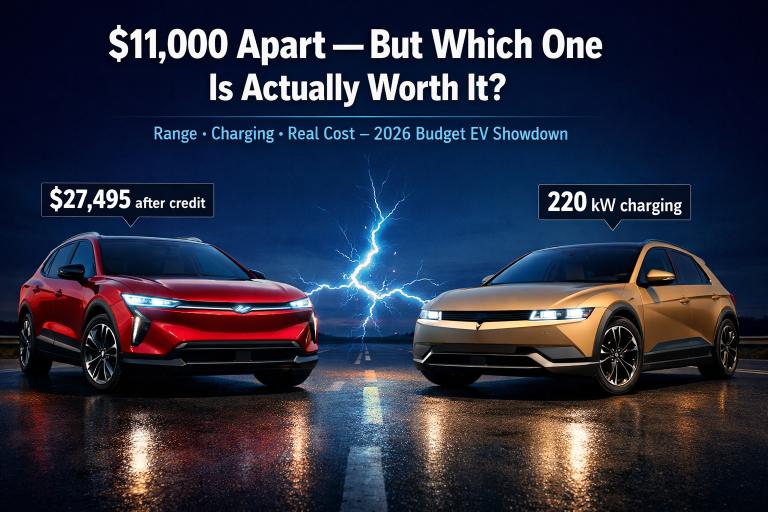
The Chevy Equinox EV and the Hyundai Ioniq 5 answer the same question — which EV should a practical American family buy in 2026 — and they answer it differently enough that recommending one over the other requires knowing two things about you: how often you road trip, and whether you qualify for the $7,500 federal Clean Vehicle Credit. The Equinox EV LT starts at $34,995. For the same 318–319 miles of EPA range, the comparable Ioniq 5 Long Range starts at $46,450 — an $11,455 gap. After the federal credit, the Equinox EV LT comes to $27,495. The Ioniq 5 Long Range comes to $38,950. That $11,455 sticker gap does not change with the credit applied, because both cars qualify. What the Ioniq 5 offers for that premium: 800-volt charging that cuts DC fast-charge time from 30–33 minutes to approximately 18 minutes, a 10-year/100,000-mile powertrain warranty versus Chevy’s 5-year/60,000-mile, and stronger resale value data over 5 years. Whether those advantages justify $11,455 depends on how you drive.

Chevy Equinox EV vs Ioniq 5 — The Short Answer:
For most buyers who charge at home, the Chevy Equinox EV wins — $34,995 vs $46,450 for comparable range, both $7,500-credit eligible, leaving $11,455 in your pocket. The Ioniq 5 wins on charging speed (18 min 10-80% vs 30–33 min), powertrain warranty (10yr/100k vs 5yr/60k), and long-term resale value. The decision comes down to one question: do you road trip regularly enough for 12 fewer minutes at a charger to justify paying $11,455 more? For most buyers, the answer is no. For frequent road trippers or buyers prioritising long-term warranty coverage, the Ioniq 5’s premium is defensible.
The Numbers: What You Actually Pay in 2026
Most comparisons between these cars start at the wrong number. The Equinox EV’s $34,995 base and the Ioniq 5’s $43,450 base suggest an $8,455 gap — but that comparison is not apples-to-apples. The $43,450 Ioniq 5 SE Standard Range delivers only 220 miles of EPA range. The $34,995 Equinox EV LT delivers 319 miles. To match the Equinox EV on range, you need the Ioniq 5 SE Long Range at $46,450. The real gap, on equivalent products, is $11,455.
| Chevy Equinox EV LT | Ioniq 5 SE Standard Range | Ioniq 5 SE Long Range | |
|---|---|---|---|
| Starting MSRP | $34,995 | $43,450 | $46,450 |
| After $7,500 Clean Vehicle Credit | $27,495 | $35,950 | $38,950 |
| EPA Range | 319 miles | 220 miles | 318 miles |
| Battery (usable) | ~82 kWh | 58 kWh | 77.4 kWh |
| Drive | FWD | RWD | RWD |
| 0-60 mph | ~6.2 sec | ~7.4 sec | ~7.4 sec |
| Max DC Fast Charge | 150 kW (400V) | 220 kW (800V) | 238 kW (800V) |
| 10-80% Fast Charge Time | ~30–33 min | ~18 min | ~18 min |
| Bumper-to-Bumper Warranty | 3yr / 36,000 mi | 5yr / 60,000 mi | 5yr / 60,000 mi |
| Powertrain Warranty | 5yr / 60,000 mi | 10yr / 100,000 mi | 10yr / 100,000 mi |
| EV Battery Warranty | 8yr / 100,000 mi | 8yr / 100,000 mi | 8yr / 100,000 mi |
| Tow Rating | 1,000 lbs | — | 2,200 lbs |
Two additional purchase structures are worth flagging. First, buyers whose income exceeds the credit thresholds ($150,000 AGI single, $300,000 joint) can still capture the $7,500 as a lease credit — the commercial vehicle lease credit passes to the leasing entity (which passes it as lower monthly payments) with no buyer income restriction. If you are over the income threshold, leasing both vehicles extracts the same $7,500, and the $11,455 purchase-price gap between equivalent-range trims remains unchanged. Second, the Ioniq 5 SE AWD at approximately $49,450 adds all-wheel drive at 266 miles EPA range — a $14,455 premium over the Equinox EV LT at 319 miles. The range trade-off for AWD on the Ioniq 5 is significantly larger than on the Equinox EV (AWD RS drops range by approximately 65 miles on the Equinox EV, versus 52 miles on the Ioniq 5).
Range Comparison: EPA vs Real-World
The Equinox EV LT’s 319-mile EPA figure and the Ioniq 5 Long Range’s 318-mile EPA figure are effectively identical on paper. Real-world range is where they diverge slightly — and in ways that favour each car depending on conditions.
EPA range estimates are derived under standardised lab conditions. Real-world figures run approximately 15–20% lower under mixed highway and city driving, with cold weather at 20°F reducing range by up to 40% on either vehicle. At 70 mph highway cruising in moderate weather, expect approximately 250–270 miles from the Equinox EV LT and 265–285 miles from the Ioniq 5 Long Range. The Ioniq 5’s slightly smaller 77.4 kWh usable battery (vs ~82 kWh usable in the Equinox EV) is offset by its superior aerodynamic drag coefficient — the Ioniq 5 is more slippery at highway speeds. The net result is similar real-world range from both vehicles in the same conditions. For a full explanation of how EPA figures compare to real-world outcomes across all vehicles, our article on EV range vs real-world range covers the methodology in detail.
In cold weather, neither vehicle has a meaningful advantage — both use heat pump heating on available trims, and LFP battery chemistry is not relevant here (the Equinox EV uses an NMC pack, the Ioniq 5 also uses NMC). Winter range reduction on both vehicles is similar: approximately 30–40% at sustained below-freezing temperatures. Buyers in cold-climate states should treat 220 miles as a realistic cold-weather planning number on both vehicles, rather than the EPA figure. Our article on EV battery performance in extreme cold covers the specific variables.
Verdict on range: At equivalent trim levels, real-world range is effectively tied. The Equinox EV’s advantage is delivering this range at $11,455 lower MSRP.
Charging Speed: The Ioniq 5’s Most Important Advantage
This is where the Ioniq 5 earns its premium — not on range, and not on features, but on the time you spend at a DC fast charger on long road trips. The Ioniq 5 uses an 800-volt electrical architecture, which allows it to accept up to 238 kW of DC charging power. The Chevy Equinox EV uses a 400-volt architecture, limited to 150 kW. At a 350-kW charger (Electrify America’s fastest stations), the Ioniq 5 charges from 10% to 80% in approximately 18 minutes. The Equinox EV takes approximately 30–33 minutes for the same range top-up.
That 12–15 minute difference matters in proportion to how frequently you use DC fast chargers. For buyers who charge primarily at home overnight — the majority of US EV owners, per J.D. Power data — DC fast charge speed is irrelevant to daily life. Home charging on a Level 2 charger (which both vehicles support at 11.5 kW) adds approximately 30–35 miles of range per hour overnight. For most daily commutes, both cars wake up full every morning regardless of charging speed.
For road trippers, the maths is different. Assume two long-distance trips per month, each requiring two DC fast charge stops. At 12 minutes saved per stop, that is 48 minutes per month, or approximately 9–10 hours per year. Whether 9 hours of additional time at chargers per year is worth $11,455 in purchase price is a personal calculation, but the number makes it concrete rather than vague.
One additional note on public charging infrastructure: the Equinox EV, as a GM product, has access to the GM Energy charging network and partnerships with Pilot/Flying J truck stops for Level 2 charging. Both vehicles support the standard J1772/CCS charging port. Neither has access to Tesla’s Supercharger network without an adapter. For a full comparison of public EV charging coverage in the US, our article on EV charging coverage in the US covers the network quality question honestly.
Interior, Features, and Build Quality
The Ioniq 5’s interior is one of the best in its class, from any brand at any price. The flat floor (made possible by Hyundai’s dedicated E-GMP platform), sliding front console, and 14-inch centre display create a genuinely different spatial experience from a converted-platform SUV. The dual 12-inch screens (driver display and infotainment, linked) are responsive and well-integrated. Vehicle-to-Load (V2L) capability — 1.9 kW of usable power from the car’s battery via an adapter — is standard on Long Range trims and allows the Ioniq 5 to power camping equipment, electric bikes, or run a small appliance. The Ioniq 5 feels like a deliberate EV design rather than a gasoline SUV with batteries added.
The Equinox EV’s interior reflects its platform history more openly — it shares architecture with the Blazer EV and uses a more conventional SUV layout. The 17.7-inch infotainment screen is large and well-executed by GM’s Ultifi software platform, which receives over-the-air updates. Google built-in navigation and maps are standard across trims. Interior materials at the LT level are appropriate for the price: hard plastics on lower surfaces, soft-touch on the dashboard cap. The build quality feels consistent and well-assembled, without the premium feel of the Ioniq 5’s dual-screen setup and flat floor.
Standard equipment comparison at base trims:
- Equinox EV LT ($34,995): 17.7-inch infotainment, 11-inch driver display, wireless Apple CarPlay and Android Auto, heated front seats, heated steering wheel, 4G LTE hotspot, automatic emergency braking, lane-keeping assist, adaptive cruise control
- Ioniq 5 SE Long Range ($46,450): 12-inch dual screens, wireless Apple CarPlay and Android Auto, heated front seats, V2L capability (1.9 kW), Highway Driving Assist (lane-centering cruise), automatic emergency braking, remote charging scheduling, 800V charging hardware standard on all trims
At the base trim comparison, both cars are well-equipped. The Ioniq 5 includes V2L and 800V hardware standard; the Equinox EV includes heated seats at a lower price point. Neither has a meaningful features deficit for most buyers.

Reliability and Warranty — A Clear Win for Hyundai
The warranty comparison between these two vehicles is not close, and it is the most underappreciated aspect of this comparison in most reviews.
Hyundai’s warranty on the Ioniq 5: 5 years / 60,000 miles bumper-to-bumper; 10 years / 100,000 miles powertrain; 8 years / 100,000 miles battery (above 70% SOH). The 10-year powertrain warranty is transferred to subsequent owners at 5 years / 60,000 miles — meaningful for resale value, since a used Ioniq 5 within its first 10 years still carries factory powertrain coverage.
Chevy’s warranty on the Equinox EV: 3 years / 36,000 miles bumper-to-bumper; 5 years / 60,000 miles powertrain; 8 years / 100,000 miles battery. The bumper-to-bumper coverage is half the duration of the Ioniq 5’s. The powertrain coverage is half the mileage at half the years.
In practical terms: if your Equinox EV develops a non-battery powertrain fault at 65,000 miles, you are outside warranty. The Ioniq 5 at the same mileage has 35,000 miles of powertrain coverage remaining. This is not a hypothetical — it is the contractual commitment each manufacturer has made about their product’s durability.
On measured reliability, the Equinox EV is too new to have significant longitudinal data — the 2024 model was the first production year, and high-mileage reliability patterns take 3–4 years of owner data to establish. The Ioniq 5 launched in the US in 2021; early-year examples are now approaching 5 years old with documented owner data from J.D. Power’s Vehicle Dependability Study. J.D. Power’s 2024 IQS ranked Hyundai above the industry average on initial quality. GM’s Chevy brand has historically been slightly below industry average on initial quality in recent J.D. Power data, though EV-specific reliability data for the Equinox EV is not yet established. Neither car has a documented systematic failure pattern at this stage.
IIHS safety: the Ioniq 5 has achieved IIHS Top Safety Pick+ in recent testing cycles — the top tier of IIHS ratings, requiring “Good” scores on all major crash tests and “Acceptable” or better headlight ratings. The Equinox EV achieved IIHS Top Safety Pick (without the +) in 2024 testing. Verify current ratings for the 2026 model year at iihs.org — IIHS updates ratings annually and prior-year designations do not carry forward automatically.
Verdict: The Ioniq 5 wins on warranty coverage, measurably and significantly. The Equinox EV’s 3-year bumper-to-bumper and 5-year powertrain warranty are below the category average for EVs in 2026. Buyers who keep their vehicles to 75,000 miles or beyond should weight this difference heavily. Our article on how long EV batteries last covers the specific battery health variables that apply to both vehicles.
5-Year Total Cost of Ownership
The purchase price gap is the most visible number in this comparison. Over five years, several other variables close the gap — but not enough to reverse the Equinox EV’s financial advantage for most buyers.
The assumptions below apply to a typical US buyer: 12,000 miles per year, primarily home charging at $0.15/kWh, with occasional DC fast charging on road trips. Both vehicles qualify for the full $7,500 Clean Vehicle Credit.
| 5-Year Cost Factor | Equinox EV LT | Ioniq 5 SE Long Range | Difference |
|---|---|---|---|
| Purchase price (after $7,500 credit) | $27,495 | $38,950 | Equinox saves $11,455 |
| Electricity (60k miles @ $0.15/kWh, ~3.5 mi/kWh) | ~$2,570/yr ($12,850 total) | ~$2,570/yr ($12,850 total) | Tied |
| Insurance (5-year estimate) | ~$8,500–9,500 | ~$9,500–10,500 | Equinox saves ~$1,000 |
| Maintenance (EV items: tires, filters, brakes) | ~$2,000–2,500 | ~$2,000–2,500 | Tied |
| Estimated resale at 5 years (60k miles) | ~$11,000–13,000 | ~$14,000–16,000 | Ioniq 5 better by ~$2,500–3,000 |
| Net 5-year ownership cost | ~$28,000–31,000 | ~$38,000–42,000 | Equinox saves ~$9,500–11,000 |
The Ioniq 5’s better resale value — approximately $2,500–3,000 more at 5 years — is the primary cost that partially offsets the Equinox EV’s purchase price advantage. The gap does not close the full $11,455 purchase price differential. On the 5-year numbers, the Equinox EV saves approximately $9,500–11,000 for the typical home-charging buyer.
The scenario where the Ioniq 5 closes the gap more significantly: high-mileage drivers (20,000+ miles/year) who rely on DC fast charging regularly. At 20,000 miles annually with frequent DC fast charging, the Ioniq 5’s 800V charging speed reduces time spent at chargers meaningfully, and the 10-year powertrain warranty provides stronger coverage through the higher-wear period. For a full 5-year ownership cost comparison against a third option, our gas vs hybrid vs EV 5-year cost comparison benchmarks both EVs against their petrol and hybrid alternatives.
Who Should Buy Which
Choose the Equinox EV If
- You charge primarily at home and your typical longest single trip is under 200 miles — charging speed is irrelevant to your daily routine
- You qualify for the $7,500 credit and want 319 miles of EPA range for $27,495 — there is no comparable vehicle at this effective price in 2026
- Budget flexibility is limited and the $11,455 gap represents a meaningful portion of your car budget — that money can service a home charger install, emergency fund, or other priorities
- You plan to sell within 3 years — within the 3-year bumper-to-bumper warranty window, the coverage gap with the Ioniq 5 is smaller
- You want a familiar GM ownership experience with nationwide Chevy dealer service access
Choose the Ioniq 5 If
- You regularly take road trips of 300+ miles and will use DC fast charging multiple times per trip — the 18-minute charge stop vs 30–33 minutes is a genuine quality-of-life improvement
- You plan to keep the vehicle for 7+ years — the 10-year/100,000-mile powertrain warranty provides coverage the Equinox EV’s 5-year/60,000-mile cannot match at higher mileage
- V2L capability matters to you — camping, outdoor power, or emergency home backup from the vehicle’s battery is standard on the Ioniq 5 Long Range
- Interior quality and the Ioniq 5’s flat-floor dedicated EV platform design are priorities that justify a premium
- You want stronger resale value at 3–5 years and plan to trade or sell before the 7-year mark
- You tow — the Ioniq 5’s 2,200-lb tow rating vs the Equinox EV’s 1,000 lbs is the difference between towing a small utility trailer and not being able to tow meaningfully at all

One buyer profile that does not belong in this comparison at all: anyone in a state with income-based EV rebates that shift the math further, or buyers looking at the Ioniq 5 N (the high-performance variant at approximately $67,990). The N is a different product from a different segment — 641 hp, 3.4-second 0-60, and a 231-mile EPA range. It competes with the Tesla Model 3 Performance, not the Equinox EV. For broader EV buying guidance, our article covering first-time EV buyer mistakes addresses the most common errors that apply to both of these purchases.
FAQ: Chevy Equinox EV vs Hyundai Ioniq 5
Which is the better value — the Chevy Equinox EV or Hyundai Ioniq 5?
The Chevy Equinox EV is the better value by most financial metrics. At $34,995 for 319 miles of EPA range (or $27,495 after the $7,500 federal credit), it undercuts the Ioniq 5 Long Range — the trim needed to match its range — by $11,455 before or after incentives. Over 5 years, the Equinox EV saves approximately $9,500–11,000 in total ownership cost for the typical home-charging driver, even accounting for the Ioniq 5’s better resale value. The Ioniq 5 is worth the premium for road trippers and buyers who need the 10-year powertrain warranty or towing capability. For most buyers, it is not.
Does the Chevy Equinox EV qualify for the $7,500 federal tax credit?
Yes — the Equinox EV qualifies for the full $7,500 Clean Vehicle Credit as of 2026, subject to buyer income limits ($150,000 AGI single / $300,000 married filing jointly) and the MSRP cap ($80,000 for SUVs). The credit can be applied at point-of-sale as a direct discount since 2024. Buyers whose income exceeds the threshold can still capture the credit through a lease (the commercial vehicle credit has no income limit and is typically passed through as lower payments). The Ioniq 5 also qualifies following Hyundai’s domestic production at Metaplant America in Georgia. Confirm current eligibility at fueleconomy.gov before purchase — credit rules can change with legislation.
Is the Ioniq 5’s charging speed significantly better than the Equinox EV?
Yes — at compatible high-speed chargers. The Ioniq 5’s 800V architecture supports up to 238 kW DC charging, completing a 10-80% charge in approximately 18 minutes. The Equinox EV at 150 kW takes approximately 30–33 minutes for the same top-up. However, the full speed advantage only materialises at 350 kW-capable chargers (Electrify America’s fastest stations and similar). At a more common 150 kW charger, the Ioniq 5 is hardware-limited to the same 150 kW as the Equinox EV, and charge times are comparable. The Ioniq 5’s charging advantage is real and meaningful for frequent road trippers who route through 350 kW stations specifically.
How does the Chevy Equinox EV compare to the Ioniq 5 on reliability?
The Ioniq 5 has a longer documented reliability track record — it launched in the US in 2021, giving it 5 years of owner data, and has appeared in J.D. Power’s Vehicle Dependability Study with above-average Hyundai brand results. The Equinox EV launched in 2024 and has limited longitudinal data at this point. The more concrete reliability metric is warranty coverage: Hyundai’s 10-year/100,000-mile powertrain warranty represents a contractual commitment about long-term drivetrain durability that Chevy’s 5-year/60,000-mile powertrain coverage does not match. For both vehicles, the 8-year/100,000-mile EV battery warranty is identical.
Which has more range — Equinox EV or Ioniq 5?
At equivalent trim levels (Equinox EV LT vs Ioniq 5 SE Long Range), EPA range is effectively tied: 319 miles vs 318 miles. The critical distinction is price — equivalent range costs $34,995 in the Equinox EV and $46,450 in the Ioniq 5. The Ioniq 5 SE Standard Range at $43,450 delivers only 220 miles EPA — significantly less than the Equinox EV LT at $34,995. For buyers comparing sticker prices without accounting for range equivalence, this is the most common and most costly misunderstanding in this comparison.
Should I buy or lease the Equinox EV or Ioniq 5?
Leasing is worth considering for both vehicles, primarily because it bypasses the income threshold on the $7,500 federal credit — if your AGI is above $150,000 single or $300,000 joint, you cannot take the credit on a purchase, but a lease transfers the credit to the leasing company, which typically passes it as lower monthly payments. Beyond the credit question, the Equinox EV depreciates faster than the Ioniq 5 based on early market data, which means leasing the Equinox EV carries less residual-value risk than buying it outright. Our article on whether to buy or lease an EV covers the full decision framework.
Is the Ioniq 5 worth $11,455 more than the Equinox EV?
For most buyers, no. The financial analysis across 5 years of ownership shows the Equinox EV saving approximately $9,500–11,000 in total cost of ownership for a typical home-charging driver. The Ioniq 5 recovers approximately $2,500–3,000 of that through better resale value and saves roughly $1,000 in insurance costs (Equinox EV is cheaper to insure). The remainder of the gap does not close. The Ioniq 5 is worth the premium for three specific buyer profiles: frequent road trippers who will use 350 kW DC chargers regularly (18-minute vs 33-minute stops), buyers who keep vehicles past 60,000 miles and value the 10-year powertrain warranty, and buyers who need 2,200 lbs of tow capacity. Everyone else is paying $11,455 for advantages that do not show up in their daily use. For a broader perspective on EV purchase decisions in the $30,000–50,000 range, see our guide to best EVs under $40,000.
- MSRP: GM US and Hyundai US official configurators, May 2026. Prices before taxes, fees, and dealer markup. Dealer markup has varied by market and vehicle availability — actual transaction prices may differ.
- EPA range and efficiency: fueleconomy.gov — 2026 model year figures for Equinox EV and Ioniq 5 trims. EPA fuel economy ratings represent laboratory test results; real-world mileage varies.
- Federal Clean Vehicle Credit: IRS Publication 5866 and fueleconomy.gov eligibility tool — income thresholds, MSRP caps, and point-of-sale transfer rules as of May 2026. Tax law is subject to change; verify current eligibility before purchase.
- Charging speed data: Manufacturer published maximum charging rates; real-world DC fast charge times from EV review community data (Electrify America test sessions, owner forum reports).
- Warranty terms: GM US and Hyundai US warranty documentation, May 2026.
- IIHS safety: iihs.org Top Safety Pick / Top Safety Pick+ designations — verify 2026 model year ratings directly as IIHS updates annually.
- 5-year TCO estimates: KBB 5-year cost data (depreciation, insurance baselines); Insurance Information Institute EV insurance data; DOE AFDC electricity cost benchmarks. All estimates are approximations for a typical US buyer scenario — individual costs vary significantly.
- J.D. Power Initial Quality Study 2024: Hyundai and GM brand rankings for initial quality and vehicle dependability.