Last Updated: March 2026 — Charger specs, pricing, and compatibility verified for 2026 models
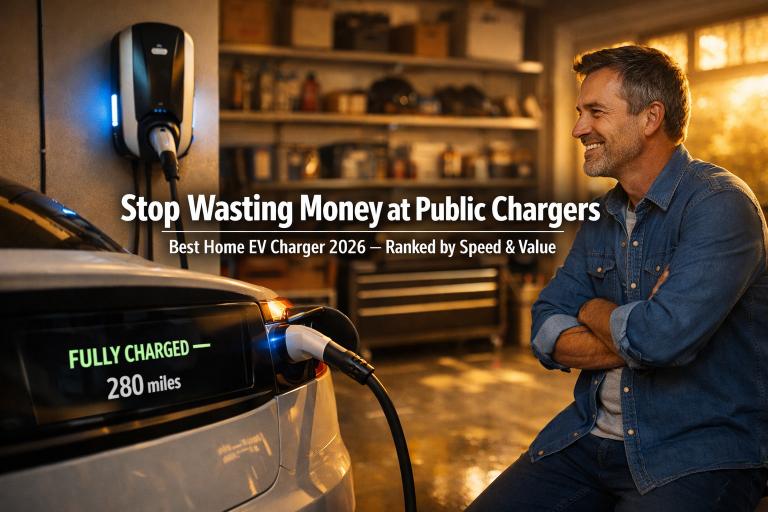
Choosing the best home EV charger in 2026 is one of the most practical decisions any EV owner can make — and most people get it wrong by defaulting to the cheapest option or the brand their dealer recommended. A Level 2 home charger typically delivers 25–30 miles of range per hour of charging, compared to 3–5 miles per hour from a standard 120V wall outlet. Over a year of daily overnight charging, that speed difference translates directly into never worrying about range — and lower cost per mile than public fast charging. This guide ranks the best Level 2 home EV chargers in 2026 by speed, smart features, installation simplicity, and long-term reliability.
Best Home EV Charger 2026 — Quick Summary:
The ChargePoint Home Flex is the best overall Level 2 home charger in 2026 — offering up to 50A / 11.5 kW, full app control, and universal J1772 + NACS compatibility at $699. Best budget pick: Emporia EV Charger Level 2 (~$179–$219). Best smart charger: Wallbox Pulsar Plus (~$649). All three support 7–65 miles of range added per hour depending on amperage and vehicle acceptance rate.
Why Install a Level 2 Home EV Charger in 2026?
Charging Speed vs Standard Wall Outlet
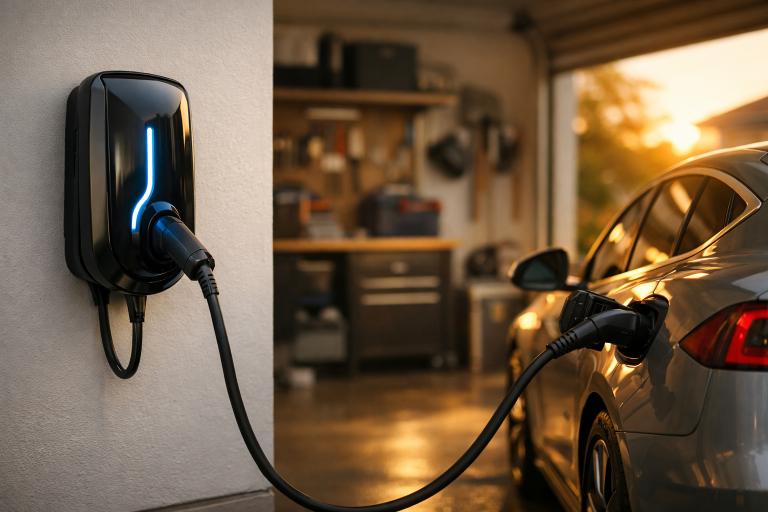
Every EV comes with a Level 1 portable charger that plugs into a standard 120V household outlet. While it technically works, the charging rate of 3–5 miles of range per hour means fully charging a 60–80 kWh battery from empty takes 40–60+ hours. For most EV owners, that means going to bed with a depleted battery and waking up to find it still not fully charged. By contrast, a Level 2 charger running on a 240V / 40A circuit delivers approximately 25–30 miles of range per hour — meaning a 250-mile-range EV charges fully from empty in 8–10 hours overnight. For the average U.S. driver covering 37 miles per day, therefore, a Level 2 charger restores a full day’s driving in approximately 60–90 minutes.
Long-Term Convenience and Cost Savings
Beyond speed, home Level 2 charging is consistently cheaper per kWh than public DC fast charging. Most U.S. residential electricity rates average $0.13–$0.17 per kWh, while public DC fast charging averages $0.28–$0.45 per kWh depending on network and location. As a result, charging 15,000 miles per year at home versus public charging saves approximately $400–$700 annually — enough to offset the charger hardware cost within 1–2 years for most buyers. Furthermore, adding smart scheduling to charge during off-peak utility hours (typically 11 PM–6 AM) extends those savings further in time-of-use rate markets.
How We Ranked the Best Home EV Chargers for 2026
Charging Speed, Amperage, and Power Output
Maximum amperage determines how quickly a charger can deliver power — though the vehicle’s onboard charger is the actual limiting factor. A 48A charger connected to a vehicle with a 7.2 kW onboard charger will still only charge at 7.2 kW. For this reason, the ranking weights adjustable amperage (allowing the charger to grow with future vehicles) over single fixed maximum output. Units rated at 40–50A with adjustable settings score highest for future-proofing. Units with fixed 32A (7.7 kW) output are sufficient for most current EVs but may under-serve future vehicles with 11+ kW onboard chargers.
Smart Features, Reliability, and Installation
In 2026, a Level 2 charger without app connectivity is a missed opportunity. Smart scheduling, energy monitoring, and utility rate integration can save $100–$300 per year in electricity costs with zero additional effort. Reliability data is sourced from aggregated owner reviews across Amazon, Home Depot, and EV owner forums. Installation ease is weighted for homeowners doing a straightforward 240V / 40A circuit installation — models requiring proprietary equipment or complex configuration score lower regardless of their other capabilities.
Best Home EV Chargers for 2026 — Top Picks Ranked
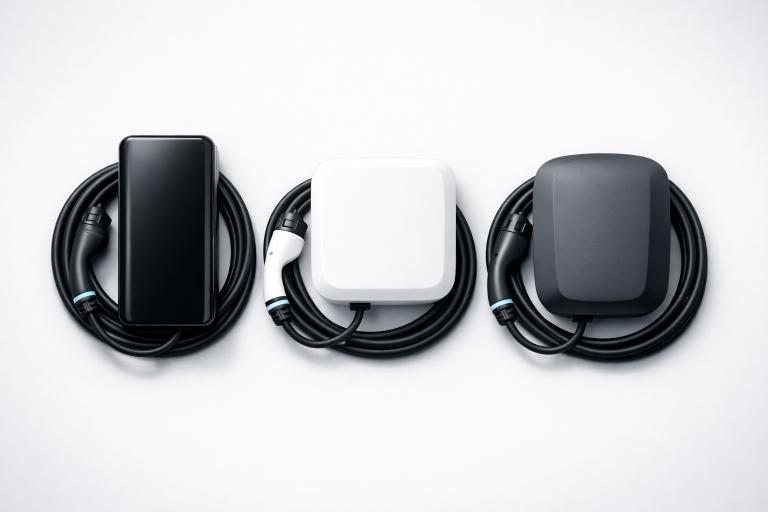
Best Overall Level 2 Home EV Charger — ChargePoint Home Flex
The ChargePoint Home Flex earns the top ranking in 2026 for consistently delivering on every important dimension: speed, compatibility, smart features, and reliability. Adjustable from 16A to 50A (up to 11.5 kW), it supports both J1772 and NACS via adapter — covering every EV sold in the U.S. market. The ChargePoint app provides real-time energy monitoring, scheduled charging, and utility rate integration. It’s UL listed, ENERGY STAR certified, and suitable for outdoor installation. At $699, it’s not the cheapest option, but it’s the one most likely to serve you across multiple EV purchases and household scenarios without needing replacement.
Best Budget Home EV Charger — Emporia EV Charger Level 2
The Emporia EV Charger is the standout budget recommendation in 2026 at $179–$219. It delivers 48A / 11.5 kW maximum output — matching or exceeding more expensive competitors — with full Wi-Fi app connectivity, energy monitoring, and solar charging integration through the Emporia Home Energy Monitor ecosystem. Build quality is solid for the price, and the app experience is consistently rated positively by owners. For buyers who want maximum charging speed at minimum hardware cost and are comfortable with a less recognized brand, the Emporia is the best value in the category by a significant margin.
Best Smart Home EV Charger — Wallbox Pulsar Plus
The Wallbox Pulsar Plus (~$649) leads on smart features: power sharing between two EVs on the same circuit, dynamic load balancing that adjusts charging speed based on total home electrical demand, and one of the most polished app experiences in the category. It’s compact — the smallest Level 2 charger in the comparison at 4.5 inches square — and fully weather-resistant for outdoor installation. The 40A / 9.6 kW output is slightly below the ChargePoint’s 50A ceiling, but for most EVs with onboard chargers rated at 7.2–11.5 kW, the real-world charging speed difference is minimal. The power sharing feature is a genuine differentiator for two-EV households.
| Charger | Max Amperage | Max Output | Smart App | Plug Type | Price | Best For |
|---|---|---|---|---|---|---|
| ChargePoint Home Flex | 50A | 11.5 kW | ✅ Full | J1772 + NACS | $699 | BEST OVERALL |
| Emporia Level 2 | 48A | 11.5 kW | ✅ Full + Solar | J1772 | $179–$219 | BEST BUDGET |
| Wallbox Pulsar Plus | 40A | 9.6 kW | ✅ Power Share | J1772 | $649 | BEST SMART |
| Grizzl-E Classic | 40A | 9.6 kW | ❌ None | J1772 | $229–$259 | Best non-smart charger / durability |
| JuiceBox 48 | 48A | 11.5 kW | ✅ Full | J1772 | $549 | Strong mid-range all-rounder |
| Tesla Wall Connector | 48A | 11.5 kW | ✅ Tesla app | NACS native | $475 | BEST FOR TESLA |
Charging Speed and EV Compatibility Explained
Level 2 Charging Time by EV Battery Size
| EV Model | Battery Size | Onboard Charger | Time to Full (32A / 7.7kW) | Time to Full (48A / 11.5kW) |
|---|---|---|---|---|
| Tesla Model 3 Standard | ~60 kWh | 7.7 kW | ~8 hrs | ~8 hrs SAME — onboard limit |
| Tesla Model Y LR | ~82 kWh | 11.5 kW | ~10.5 hrs | ~7 hrs FASTER |
| Chevy Equinox EV | ~85 kWh | 11.5 kW | ~11 hrs | ~7.5 hrs FASTER |
| Hyundai Ioniq 6 LR | ~77 kWh | 11 kW | ~10 hrs | ~7 hrs FASTER |
| Nissan Leaf 40 kWh | 40 kWh | 6.6 kW | ~6 hrs | ~6 hrs SAME — onboard limit |
Plug Types and EV Compatibility — J1772 and NACS
As of 2026, the U.S. EV charging connector landscape has largely converged on two standards. J1772 remains the universal standard for Level 1 and Level 2 charging — every non-Tesla EV sold in the U.S. accepts J1772. NACS (North American Charging Standard), Tesla’s proprietary connector now adopted as an industry standard by Ford, GM, Rivian, Honda, and others, is increasingly common on new vehicles. For homeowners buying a Level 2 charger in 2026, the practical advice is simple: buy a J1772 charger and keep a NACS adapter for any Tesla in the household — or if exclusively charging a Tesla, the Tesla Wall Connector at $475 offers native NACS without adapters and deep integration with the Tesla app.
Home EV Charger Installation Cost and Electrical Requirements
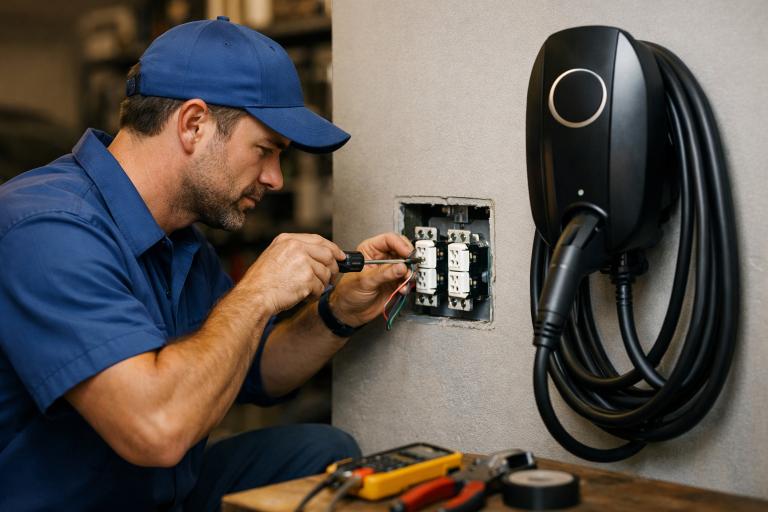
Typical Home EV Charger Installation Cost in 2026
The charger hardware is only part of the cost. Installation by a licensed electrician adds $200–$600 in most U.S. markets for a straightforward installation — running a new 240V / 40–50A dedicated circuit from the electrical panel to the garage wall. However, if the run requires conduit through finished walls or the circuit breaker is located far from the garage, costs can reach $800–$1,200. In addition, if your home’s electrical panel is already near capacity and requires an upgrade to accommodate the new circuit, total costs including panel upgrade can reach $1,500–$3,000 — a scenario that affects approximately 15–20% of older homes based on electrician estimates. Therefore, always get two or three quotes before committing.
Electrical Panel and Circuit Requirements
A 40A Level 2 charger requires a dedicated 50A double-pole circuit breaker (NEC requires breakers rated at 125% of the charger’s continuous load). A 48A charger requires a 60A breaker. The wiring gauge required is typically 6 AWG copper for 50A circuits and 4 AWG for 60A. Most homes built after 2000 with a 200A main panel have sufficient capacity without upgrade. Homes with 100A panels or panels already near full capacity may require a panel upgrade or load management device (which automatically reduces charger output when other high-draw appliances are running). Several smart chargers — including the Wallbox Pulsar Plus and Emporia — include built-in dynamic load management that eliminates the need for panel upgrades in many situations by throttling charger output intelligently.
Smart EV Charger Features That Matter in 2026
App Control and Energy Monitoring
App-connected Level 2 chargers allow scheduling — setting the charger to start at midnight when off-peak electricity rates begin and complete before the morning commute. In time-of-use utility markets (California, New York, Texas, and growing), this scheduling feature alone saves $150–$350 per year on charging costs compared to unscheduled charging. Additionally, energy monitoring tracks monthly charging costs, helping owners understand their actual EV running costs and verify utility billing accuracy. The best apps (ChargePoint, Wallbox, JuiceBox) provide per-session cost data, historical usage tracking, and CO₂ offset estimates. In contrast, basic models without connectivity — like the Grizzl-E Classic — sacrifice these features for simplicity and durability, which is a valid tradeoff for buyers who prefer set-and-forget operation.
Load Balancing and Utility Rate Integration
Dynamic load management is the most underrated smart charger feature in 2026. Essentially, it monitors total home electrical draw in real time and reduces charger output when high-draw appliances (HVAC, oven, dryer) are running simultaneously — preventing circuit overload without requiring a panel upgrade. Both the Wallbox Pulsar Plus and Emporia charger support this via their companion energy monitors. Moreover, utility rate integration — where the charger automatically adjusts charging schedules based on real-time spot prices from the utility — is available on ChargePoint and JuiceBox in supported markets and represents the leading edge of smart EV charging in 2026. Consequently, for buyers in deregulated electricity markets, this feature can meaningfully reduce annual charging costs.
How to Choose the Right Home EV Charger for Your Situation
🔌 Best Charger for Daily Commuters
- Pick: Emporia Level 2 (~$199)
- 48A / 11.5 kW — fully replenishes 250-mile EV overnight
- Smart scheduling for off-peak rate savings
- Solar integration if you have home panels
- Best value for straightforward daily charging needs
- Suitable for single EV households on standard circuits
⚡ Best Charger for Future-Proofing / Two EVs
- Pick: ChargePoint Home Flex or Wallbox Pulsar Plus
- Adjustable 16–50A for any future vehicle’s onboard charger
- Wallbox: power sharing for two EVs on one circuit
- ChargePoint: largest U.S. network app ecosystem
- Both outdoor-rated for flexible installation
- Best for households planning to add a second EV within 3 years
Best Home EV Charger for Long-Term Reliability
The Grizzl-E Classic ($229–$259) is the recommendation for buyers who prioritize mechanical simplicity and durability over smart features. Unlike app-connected units, it has no Wi-Fi, no firmware updates to fail, and no connectivity dependencies — it simply charges at 40A whenever plugged in. Built in Canada to industrial standards, it carries strong warranty support and consistently earns the highest reliability ratings among non-smart chargers. As a result, it’s particularly well-suited for buyers in remote locations with unreliable internet, two-EV households where only one charger needs smart features, or simply those who want a proven durable unit with minimal maintenance overhead.
$250–$500 → Grizzl-E Classic (durable, no-frills) or JuiceBox 48 (smart, mid-range)
$500–$700 → Wallbox Pulsar Plus (best smart features, power sharing)
Best overall → ChargePoint Home Flex (most versatile, top-rated app)
Tesla owners → Tesla Wall Connector (native NACS, deep Tesla integration)
FAQ — Home EV Chargers in 2026
What is the best home EV charger in 2026?
The ChargePoint Home Flex is the best overall home EV charger in 2026 — offering adjustable 16–50A output (up to 11.5 kW), universal J1772 + NACS compatibility, full app control with smart scheduling and energy monitoring, and UL/ENERGY STAR certification at $699. For budget buyers, the Emporia Level 2 at $179–$219 delivers equivalent 48A output and full smart features at a fraction of the price. Tesla owners should consider the Tesla Wall Connector ($475) for native NACS integration and Tesla app compatibility.
How fast does a Level 2 charger charge an EV?
A Level 2 charger adds approximately 25–30 miles of range per hour at 40A / 9.6 kW — the most common residential output. At the maximum 48–50A / 11.5 kW, some EVs charge faster: a Tesla Model Y Long Range (11.5 kW onboard charger) charges from 10% to 100% in approximately 7 hours at full 48A output. The practical limit is your EV’s onboard charger rating — a vehicle with a 7.7 kW onboard charger won’t charge faster than 7.7 kW regardless of the charger’s maximum amperage.
How much does a home EV charger cost to install in 2026?
Total installed cost for a Level 2 home EV charger in 2026 ranges from approximately $400–$1,300 for most homeowners — combining hardware ($179–$699) and licensed electrician installation ($200–$600 for standard installations). Panel upgrades add $800–$2,000 if required. The federal Alternative Fuel Vehicle Refueling Property Credit (Form 8911) provides up to 30% of installation costs as a tax credit (up to $1,000 for residential installations). Many state and utility programs offer additional rebates of $200–$500, meaningfully reducing the net out-of-pocket cost.
Are home EV chargers compatible with all electric cars?
Any Level 2 charger with a J1772 connector is compatible with every non-Tesla EV sold in the U.S. — including all Hyundai, GM, Ford, Volkswagen, BMW, and Rivian models. Tesla vehicles use the NACS connector natively but include a J1772 adapter in the box, making them compatible with all J1772 chargers. Ford, GM, Rivian, Honda, and Acura have adopted NACS on 2024+ models, making them compatible with Tesla Wall Connectors directly. When buying a Level 2 charger in 2026, J1772 remains the safe universal choice — covering all current and most near-future EVs in the U.S. market.