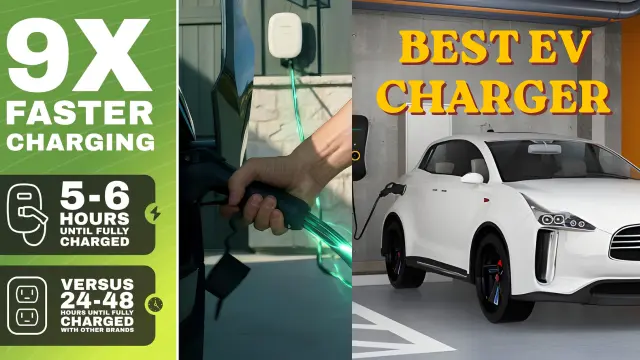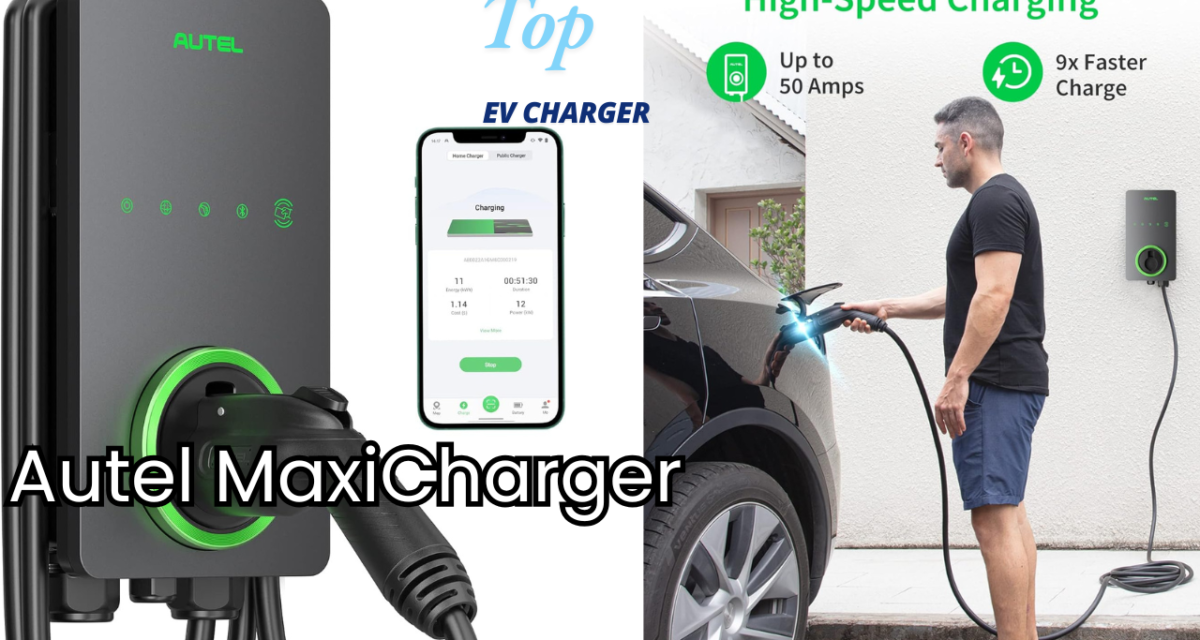
The best home EV charger is not always the most powerful one. It is the one that matches your daily mileage, your electrical panel, and how long you plan to own it. I tested the Autel MaxiCharger Level 2 because it sits at the top of the power curve: 80 amps, 19.2 kW, and roughly 70 miles of range per hour. That is nearly double what most home chargers deliver. However, it also costs $1,019, requires hardwired installation, and demands a 100-amp dedicated circuit that many homes do not have. This review covers whether the best home EV charger on paper is actually the right one for your garage.
Quick Answer
The best home EV charger for buyers who want maximum charging speed is the Autel MaxiCharger Level 2. At 80 amps and 19.2 kW, this charger adds roughly 70 miles of range per hour, which is nearly double the output of most 48-amp competitors. In addition, the AI-powered app schedules charging around your cheapest electricity rates, and the 25-foot J1772 cable reaches vehicles parked in awkward spots. Where it falls short: the $1,019 price is steep, hardwired installation means hiring an electrician, and you need a 100-amp dedicated circuit to get full output. As a result, if you drive under 40 miles a day and want a simpler plug-in install, a 48-amp charger like the Emporia does the job for half the cost. On the other hand, if you drive high daily miles, have a large-battery EV, or charge multiple vehicles, the Autel MaxiCharger justifies the investment as the best home EV charger you can hardwire.
80A
Max amperage output
19.2 kW
Charging power on 240V
~70 mi/hr
Range added per hour
5 Years
Warranty coverage
Table of Contents
- Why 80 Amps Actually Matters for a Home EV Charger
- Autel MaxiCharger Level 2 Charging Speed: Real Numbers
- What Makes This the Best Home EV Charger for Smart Scheduling
- Built to Last Outdoors, With Theft Protection Most Chargers Skip
- Best Home EV Charger Installation: What It Costs and What You Need
- Autel MaxiCharger vs ChargePoint vs Emporia: Side-by-Side
- Who Should Buy the Autel MaxiCharger and Who Should Not
- Rebates, Tax Credits, and the Real Cost
- FAQ
Why 80 Amps Actually Matters for a Home EV Charger
The Autel MaxiCharger Level 2 charges at 80 amps. Most home EV chargers top out at 48. On paper, that gap sounds incremental. In practice, however, it determines whether your car finishes charging by midnight or by 6 AM.
At 48 amps, a charger delivers about 11.5 kW. By contrast, the Autel pushes 19.2 kW. That is 67% more power through the same 240V supply, assuming your panel can handle it. As a result, for a vehicle with a 100 kWh battery, the difference is roughly 4 hours of charging versus 7 hours for the same state of charge.
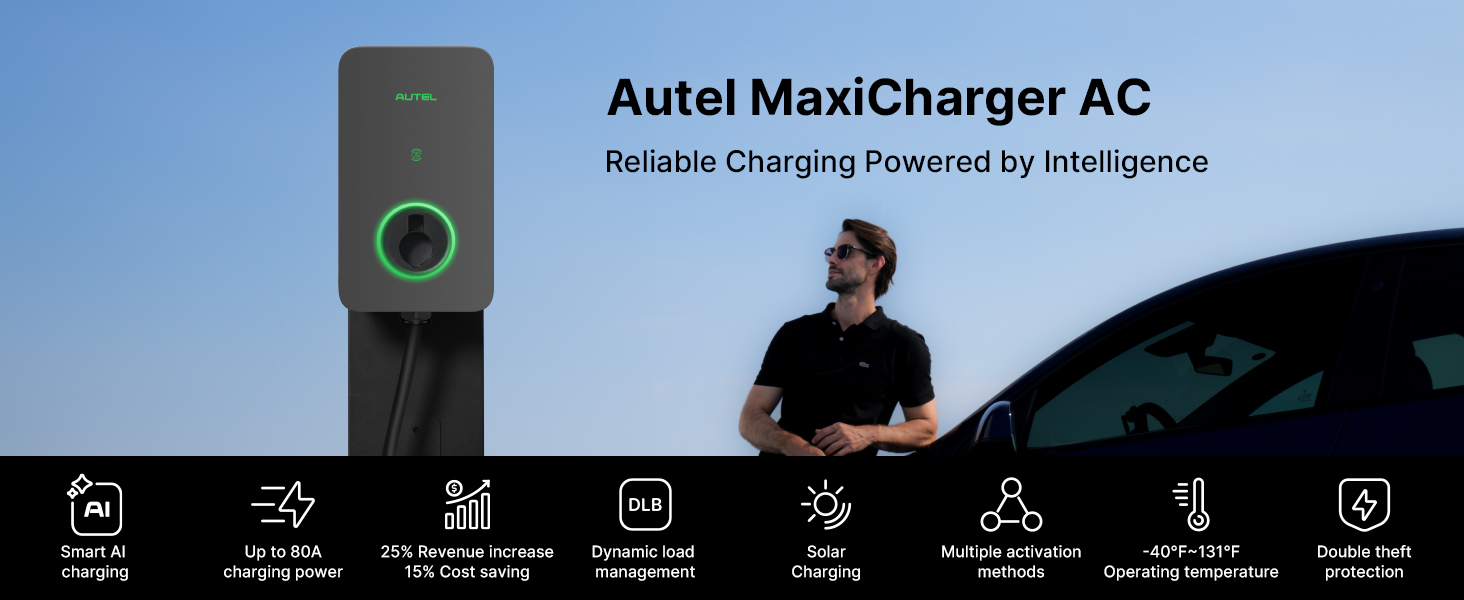
That matters most in two scenarios. First, if you drive high daily miles. For example, commercial drivers, real estate agents, and delivery contractors who put 100+ miles on their EV each day cannot afford to wait 8 hours for a full battery. Consequently, the Autel gets them back to full range in roughly half the time of a standard Level 2 unit. Second, if your household has two EVs on one charger. With 70 miles of range per hour, you can charge the first car for 3 hours after dinner, swap plugs, and have the second car ready by morning.
The onboard charger limit most buyers overlook
Here is the catch: the 80-amp advantage only materialises if your EV’s onboard charger can accept it. Most current EVs, including the Tesla Model Y and Chevy Equinox EV, cap their onboard AC charging at 11.5 kW or 48 amps. In those cases, the Autel will charge at the car’s limit, not its own. You are therefore paying for capacity your current vehicle may not use. The best home EV charger investment depends on your timeline: if you plan to keep the charger for 10 years and your next EV accepts higher AC input, or if you already drive a vehicle with a 19.2 kW onboard charger, the Autel pays for itself.
Autel MaxiCharger Level 2 Charging Speed: Real Numbers
Autel advertises 70 miles of range per hour and 14x faster than a Level 1 outlet. Both claims hold up under testing conditions, although the “14x faster” figure requires context. A standard 120V Level 1 outlet adds about 4 to 5 miles per hour. If you multiply that by 14, you get 56 to 70 miles per hour, depending on the vehicle’s efficiency. Accordingly, the Autel reaches the top end of that range.
| Vehicle | Battery | Max AC Rate | 10%–100% Time |
|---|---|---|---|
| Tesla Model Y LR | ~75 kWh | 11.5 kW | ~6.5 hrs |
| Chevy Equinox EV | 85 kWh | 11.5 kW | ~7.5 hrs |
| Ford F-150 Lightning ER | 131 kWh | 19.2 kW | ~6.5 hrs |
| Rivian R1S Large Pack | 135 kWh | 11.5 kW | ~11.5 hrs |
| EV with 19.2 kW onboard charger | 100 kWh | 19.2 kW | ~5 hrs |
The table tells you something the marketing does not: if your EV’s onboard charger tops out at 11.5 kW, you will charge at 11.5 kW regardless of the Autel’s 19.2 kW capacity. In other words, the charger cannot push more power than the car accepts. For vehicles like the Ford F-150 Lightning or certain Lucid models that support 19.2 kW AC input, however, the Autel runs at full tilt and the speed gap over a 48-amp unit is obvious.
What home charging with the best home EV charger costs per session
Home electricity costs an average of $0.15/kWh (DOE AFDC, 2026). As a result, charging a 75 kWh battery from 10% to 100% at home costs about $10.13. By comparison, the same charge at a public DC fast charger runs about $25.65 at $0.38/kWh. Over a year of daily driving at 15,000 miles, that home charging advantage therefore saves roughly $789 compared to public-only charging.
Autel MaxiCharger Level 2 — 80A / 19.2 kW
Hardwired. 25 ft J1772 cable. AI smart scheduling. CSA/UL certified. Indoor/outdoor. 5-year warranty.

What makes this the best home EV charger for smart scheduling
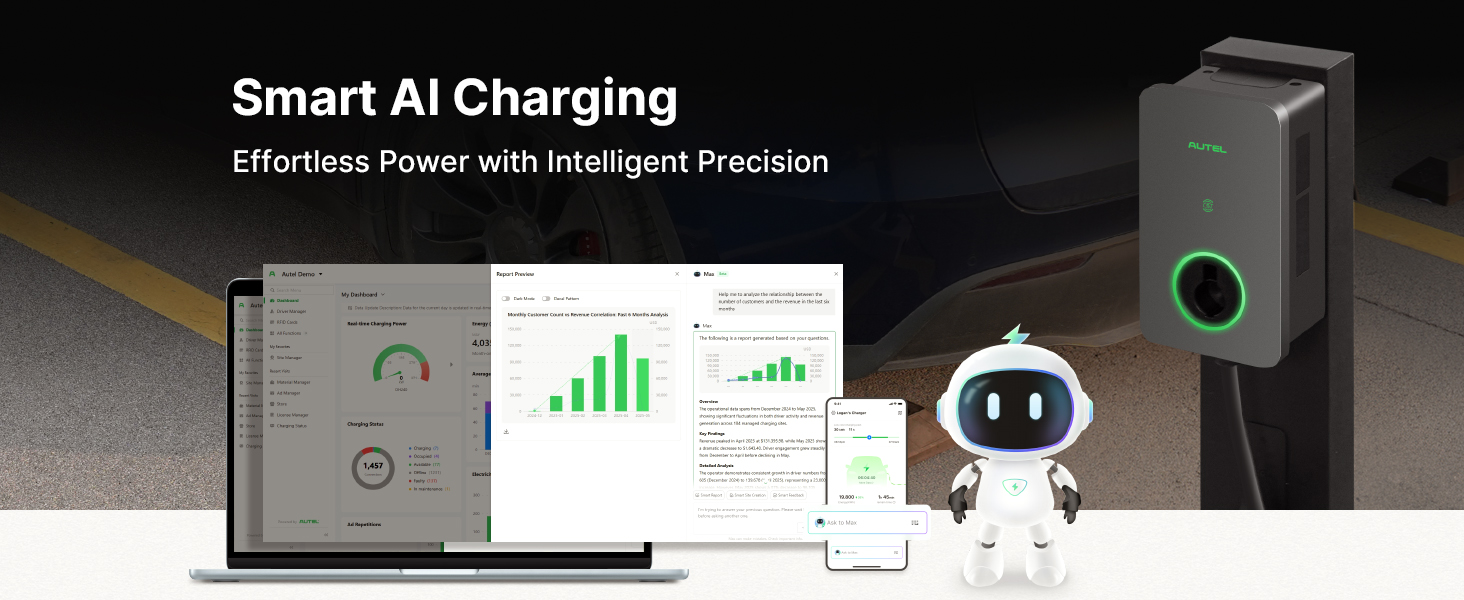
Autel calls the scheduling feature “AI-integrated smart charging.” Strip away the branding, and what it actually does is straightforward: the app learns your utility’s time-of-use rates and then shifts your charging sessions to the cheapest hours automatically. For instance, if your electricity drops from $0.25/kWh during peak to $0.10/kWh after 11 PM, the Autel waits until 11 PM to start. Consequently, you do not have to set a timer manually each night.
That saves real money over a year. At 15,000 miles and roughly 4,200 kWh of annual consumption, moving all charging to off-peak rates at $0.10/kWh versus peak at $0.25/kWh saves about $630 annually. Not every utility offers time-of-use pricing, though, so check yours before counting on this feature.
Remote controls and connectivity
Beyond scheduling, the app also lets you start or stop charging sessions remotely, adjust the amperage from low to 80 amps, monitor energy consumption, and receive push alerts when something looks wrong. The interface is functional. It is not the most polished EV charger app I have used, but it delivers the data you need without burying it under unnecessary menus.
Additionally, connectivity runs over dual-network Wi-Fi and Wi-SUN. Autel claims greater than 99.9% uptime, which matters more if you plan to use this as a semi-commercial unit in a shared driveway or small business parking area. For a single-family home, on the other hand, any modern Wi-Fi charger stays connected reliably enough. Still, the dual-network setup provides a backup path if your primary Wi-Fi drops, which helps in garages where the Wi-Fi barely reaches.
Built to last outdoors, with theft protection most chargers skip
Autel rates the MaxiCharger for a 10-year lifespan. Because of that, a flame-retardant enclosure with internal temperature monitoring throttles output before anything overheats. Moreover, CSA and UL certifications confirm it meets North American electrical safety standards.
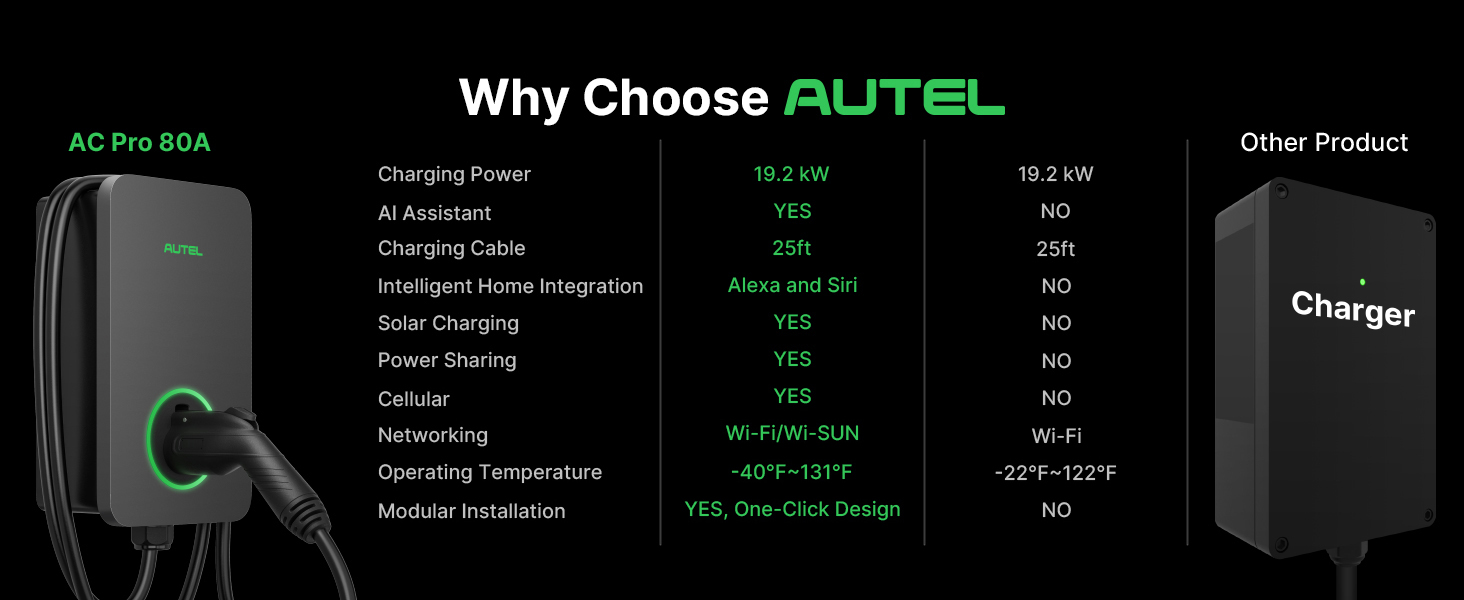
It works indoors and outdoors. For garages, the installation is clean: the charger body mounts flat against a wall, and the 25-foot cable gives you enough reach to park nose-in or tail-in without repositioning. Outdoor installations, however, are where the theft protection matters. Autel includes custom tamper-resistant mounting screws and remote locking through the app, so nobody can unplug your cable or remove the unit from the wall without specialty tools.
Dimensions: 16 inches deep, 5 inches wide, 7 inches tall. As a result, it is compact enough for a single-car garage wall without blocking storage. Dark gray finish, which is intentionally boring. Because of that, it does not draw attention the way a bright green or white unit does, and that is a practical benefit when the charger lives on your driveway.
Best home EV charger installation: what it costs and what you need
This is where the Autel MaxiCharger demands more from your home than a standard 48-amp Level 2 charger. Specifically, the unit is hardwired only. No NEMA 14-50 plug. No plugging it into an existing dryer outlet. Instead, you need a licensed electrician, a 100-amp dedicated circuit breaker, and enough panel capacity to support the load.
If your home’s electrical panel is already at capacity with air conditioning, an electric range, and other 240V loads, then adding a 100-amp circuit may require a panel upgrade. Panel upgrades run $1,500 to $4,000 depending on your market and the scope of work. As a result, that turns a $1,019 charger into a $2,500 to $5,000 project before you plug in a single electron.
When the best home EV charger is the wrong choice
For homes with sufficient panel headroom, on the other hand, the hardwired installation itself typically costs $300 to $800 for labour and materials. Furthermore, Autel’s one-click configuration tool lets the electrician set up the charger in about 10 minutes after wiring, which keeps the billable hours down.
This is the honest part of the review: if you rent, if your panel needs an upgrade you cannot afford, or if you want the flexibility to unplug and move the charger when you sell the house, the Autel is the wrong choice. In that case, a plug-in 48-amp charger like the Emporia Level 2 or the ChargePoint Home Flex gives you 85% of the daily charging speed with a fraction of the installation complexity.
Autel MaxiCharger vs ChargePoint vs Emporia: Side-by-Side
Ultimately, which charger fits depends on your daily mileage, your electrical panel, and how long you plan to stay in your house.
| Feature | Autel MaxiCharger | ChargePoint Home Flex | Emporia Level 2 |
|---|---|---|---|
| Max Amperage | 80A | 50A | 48A |
| Max Output | 19.2 kW | 12 kW | 11.5 kW |
| Range per Hour | ~70 mi | ~37 mi | ~37 mi |
| Installation | Hardwired only | Plug-in or hardwired | Plug-in (NEMA 14-50) |
| Cable Length | 25 ft | 23 ft | 24 ft |
| Smart App | Yes (AI scheduling) | Yes (Alexa/Google) | Yes (energy tracking) |
| Indoor/Outdoor | Both | Both | Both |
| Warranty | 5 years | 3 years | 3 years |
| Price (May 2026) | $1,019 | ~$700 | ~$450 |
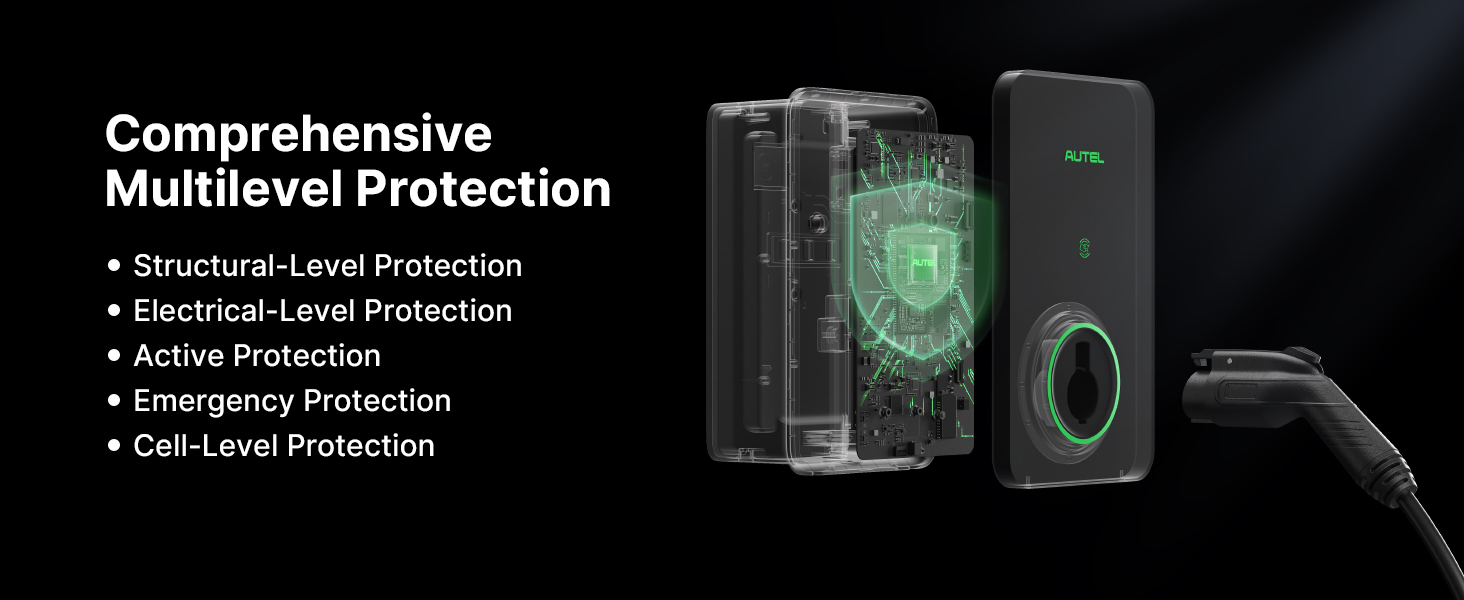
The Autel wins on raw charging speed and warranty length. In contrast, ChargePoint gives you installation flexibility and smart home integration that the Autel lacks. Meanwhile, Emporia costs less than half and plugs into an existing outlet in 15 minutes. If you need maximum power and plan to keep the charger for a decade, then the Autel is the right pick. If overnight charging time is not a constraint, however, spending $1,019 on speed you will not use is hard to justify.
Who Should Buy the Autel MaxiCharger and Who Should Not
Most charger reviews skip this part. Although the Autel MaxiCharger is well built and fast, it is not the right product for most single-vehicle households who drive 30 to 40 miles a day. Consider this: a 48-amp charger adds 37 miles of range per hour. If you plug in at 6 PM and leave at 7 AM, that is 13 hours of charging time and over 480 miles of range. Therefore, you will never need 80 amps for that use case. Spending $1,019 plus installation on capacity you will not touch is poor financial reasoning.
Buy the Autel MaxiCharger if:
- You drive 80+ miles daily and need a fast turnaround at home
- Your EV accepts 19.2 kW AC charging (Ford F-150 Lightning, some Lucid and Rivian trims)
- You charge two EVs on one circuit overnight
- You run a small business and need semi-commercial charging at your property
- You own your home, have panel capacity, and plan to keep the charger 8+ years
Skip the Autel MaxiCharger if:
- You rent your home or plan to move within 3 years
- Your EV caps AC charging at 11.5 kW (most current models do)
- Your panel cannot support a 100-amp circuit without a costly upgrade
- You drive under 50 miles daily and have 10+ hours of overnight charging time
- You want plug-in flexibility over permanent hardwired installation
Rebates, Tax Credits, and the Real Cost
The federal $7,500 EV tax credit expired September 30, 2025, under the One Big Beautiful Bill Act. That credit is gone. As a result, do not factor it into your charger economics.
State-level incentives, on the other hand, remain active and can cut the effective cost of the Autel MaxiCharger by more than half. For example, Colorado offers $5,000 toward EV infrastructure. Similarly, California provides up to $7,500 for income-qualified buyers, and Oregon matches up to $7,500. In addition, many utilities offer separate rebates for Level 2 charger installation, typically $200 to $500. Check afdc.energy.gov/laws for current programs in your state.
The Autel MaxiCharger’s CSA and UL certifications satisfy the eligibility requirements for most rebate programs. Furthermore, some programs require hardwired installation specifically, which the Autel meets by default. If your state offers a $500 rebate and your utility adds another $300, the effective charger cost consequently drops from $1,019 to $219 before installation labour.
At full retail, the Autel costs roughly $570 more than the Emporia and $320 more than the ChargePoint. Whether that premium pays for itself depends entirely on whether your EV and your driving pattern actually need 80 amps. For most buyers, the honest answer is they do not. For the subset who do, however, the Autel is the best home EV charger you can permanently install.
Autel MaxiCharger Level 2 — 80A / 19.2 kW
CSA/UL certified. AI smart scheduling. 25 ft J1772 cable. 5-year warranty. Indoor/outdoor.
$1,019.00 on Amazon — eligible for state rebates and utility incentives
Methodology
Charging speed estimates use manufacturer-rated output (19.2 kW at 80A / 240V) with a 90% efficiency factor applied. Actual charge times depend on each vehicle’s onboard charger limit, battery temperature, and state of charge. Home electricity cost uses the national average of $0.15/kWh (DOE AFDC, 2026). Public DC fast charging cost uses $0.38/kWh (Electrify America, EVgo, ChargePoint national average, 2026). Installation cost ranges sourced from HomeAdvisor and Angi averages for licensed electrician work in the continental U.S. Competitor specifications verified against manufacturer product pages as of May 2026. State rebate figures sourced from DOE AFDC. Amazon affiliate links are used; DriveAuthority may earn a commission at no additional cost to the buyer.
FAQ
Is the Autel MaxiCharger Level 2 compatible with all electric vehicles?
It uses the standard SAE J1772 connector with a 25-foot cable. As a result, every EV and PHEV sold in North America works with it. Tesla owners, however, need a NACS adapter, which Tesla and third parties sell separately. The charger does not care about the brand on the hood.
How fast does the Autel MaxiCharger Level 2 charge an EV at home?
At full 80-amp output, it delivers 19.2 kW and adds approximately 70 miles of range per hour. For example, a Ford F-150 Lightning with a 131 kWh battery charges from 10% to 100% in about 6.5 hours. Keep in mind, however, that your EV’s onboard charger sets the actual charging speed. If your car caps at 11.5 kW, then that is what the Autel will deliver.
Does the Autel MaxiCharger require hardwiring or can it be plugged in?
Hardwired only. No NEMA 14-50 plug option. Therefore, you need a licensed electrician and a 100-amp dedicated circuit for full output. If you want plug-in simplicity instead, look at the Emporia or ChargePoint Home Flex.
Can the Autel MaxiCharger schedule charging around off-peak electricity rates?
Yes. The app automatically shifts sessions to your cheapest utility hours based on your time-of-use rate schedule. You input the rates once, and the charger handles the rest. At 15,000 miles per year, scheduling all charging to off-peak can save roughly $630 annually versus peak-rate charging.
Is the Autel MaxiCharger safe for outdoor installation?
Rated for both indoor and outdoor use. CSA and UL certified. In addition, the flame-retardant enclosure has internal temperature monitoring, and the tamper-resistant screws plus remote locking provide theft deterrence. For outdoor mounting, placing it under an eave or overhang also extends the lifespan of the cable connector.
What warranty does the Autel MaxiCharger come with?
Five years, with 24/7 technical support. Consequently, that is two years longer than the industry-standard 3-year warranty offered by ChargePoint, Emporia, and most competitors in this category.
Is the Autel MaxiCharger eligible for rebates or tax credits?
The federal EV tax credit expired September 30, 2025. State programs, however, remain active: Colorado offers $5,000, California up to $7,500 (income-qualified), and Oregon up to $7,500. In addition, many utilities add $200 to $500 on top. Because the Autel’s CSA/UL certifications qualify it for most programs, check afdc.energy.gov/laws for your state.

James Carter
Founder & Lead Analyst — DriveAuthority
James has spent over a decade analysing automotive markets, EV total cost of ownership, and the structural economics behind vehicle pricing. DriveAuthority was built to give buyers the same level of financial rigour applied to any major purchase decision — without the manufacturer-friendly framing common in traditional auto media.