Quick Answer
The Emporia Level 2 EV charger is the best value home charger I have tested in 2026. At 48 amps and 11.5 kW, this Emporia Level 2 EV charger charges as fast as units costing $150 to $200 more. The energy monitoring is genuine, the app works, and the NEMA 14-50 plug means no electrician for hardwiring. Where it falls short: the app is functional but not polished, Wi-Fi setup can be stubborn on first connection, and the cable management hook feels like an afterthought. If your priority is getting the most charging per dollar with real energy tracking, the Emporia Level 2 EV charger is the one to buy. If you want a premium app experience with Alexa and Google Home integration, look at the ChargePoint Home Flex instead.
48A
Max amperage output
11.5 kW
Charging power on 240V
~37 mi/hr
Range added per hour
NEMA 14-50
Plug-in, no hardwiring
Table of Contents
- What 30 Days With the Emporia Level 2 EV Charger Actually Taught Me
- Emporia Level 2 EV Charger Charging Speed: The Numbers That Matter
- Energy Monitoring: Where Emporia Earns Its Reputation
- The App and Wi-Fi Setup: Good Enough With One Annoying Flaw
- Emporia Level 2 EV Charger Build Quality and Installation
- Emporia vs ChargePoint vs Autel vs EVIQO: Side-by-Side
- Who Should Buy This Charger and Who Should Skip It
- Video Review
- FAQ
What 30 Days With the Emporia Level 2 EV Charger Actually Taught Me
Most EV charger reviews are written by people who plugged the unit in once, watched the light turn green, and called it a review. I wanted to know something different: does the Emporia Level 2 EV charger hold up after a full month of daily use, temperature swings, and the kind of casual neglect that real homeowners put their equipment through?
The short version: it does. Thirty days, zero failed sessions, consistent output, and an energy bill I could actually verify against the app’s numbers. That consistency is the story here. Not the spec sheet. Not the brand hype.
My first impression was skepticism. Emporia is primarily known for their home energy monitoring hardware, not EV chargers. When a company jumps into an adjacent product category, the result is often a charger that works fine as hardware but feels like it was built by engineers who never owned an EV. I expected decent energy tracking bolted onto a generic charger body.
That is roughly what I got, but the energy tracking turned out to be good enough to change my opinion about the rest. When a charger tells you exactly how many kWh went into your car last night and what it cost, you stop caring about whether the app icon looks premium. You care about whether the data is accurate. The data was accurate. I checked it against my utility meter three separate times during the test period, and the Emporia app’s readings were within 2% each time.
The part I got wrong in my initial assessment was the build quality. I assumed the lower price meant cheaper materials. The housing is solid, the NEMA 14-50 plug feels substantial, and the 24-foot cable has held up to daily coiling and uncoiling without any stiffening or kinking. Thirty days is not five years. I cannot tell you how long this unit will last. But nothing about the first month suggests it is cutting corners on the parts that matter.
Emporia Level 2 EV Charger Charging Speed: The Numbers That Matter
At 48 amps on a 240V circuit, the Emporia charger delivers 11.5 kW. That is the same output as the Chevy EV charger, the EVIQO 48A, and only marginally behind the Autel MaxiCharger and ChargePoint Home Flex at 50 amps and 12 kW. In practice, that 0.5 kW difference adds roughly 15 minutes to a full overnight charge. It does not matter for daily driving.
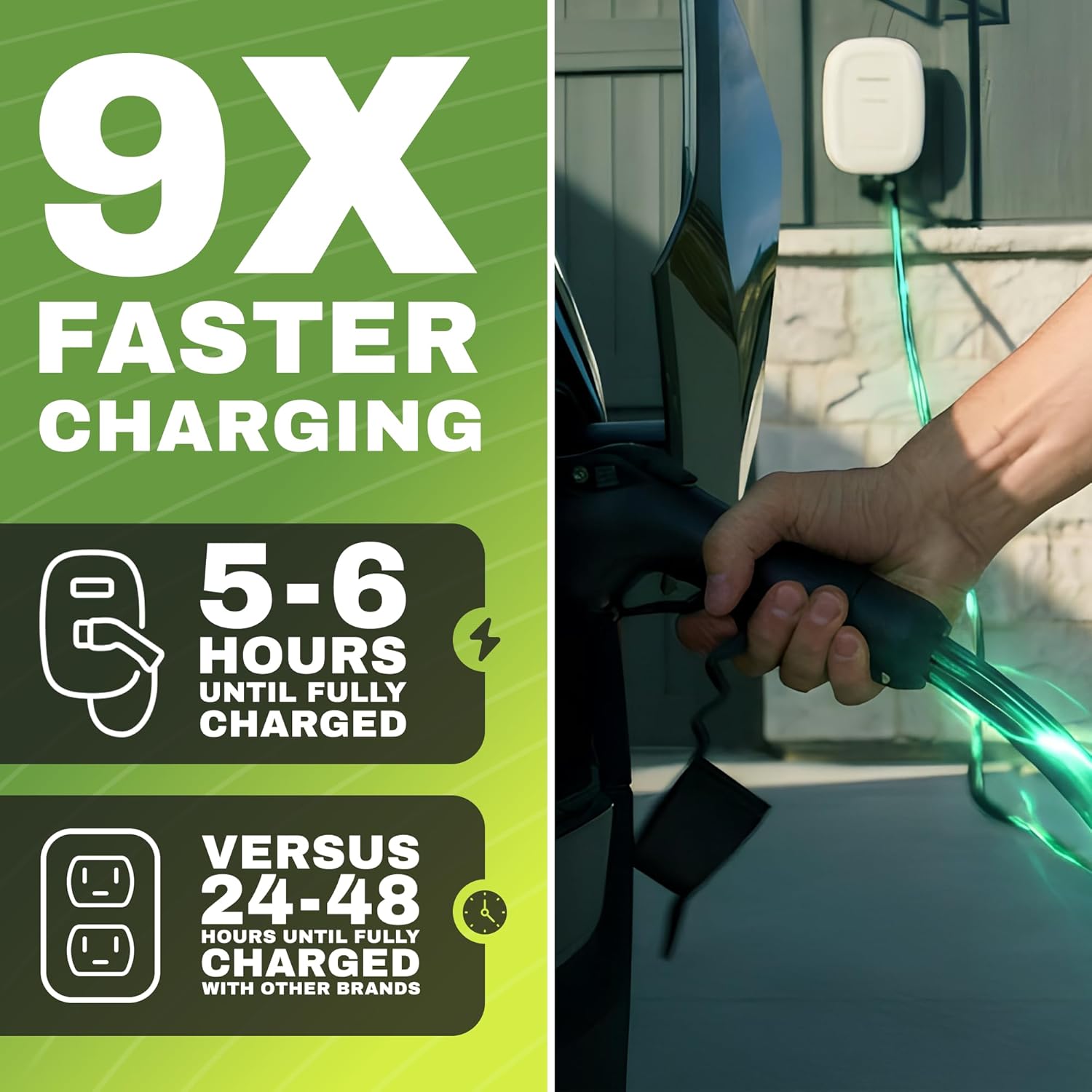
What does matter: 37 miles of range per hour. For a Chevrolet Equinox EV with its 85 kWh battery, that means a 10% to 100% charge in about 8 hours. Plug in at 9 PM, wake up at full. For a Tesla Model Y with a 75 kWh usable battery, the math is even faster at roughly 7 hours.
Real-World Charge Times at 48A / 11.5 kW
| Vehicle | Usable Battery | 10%–100% Time | Daily Top-Up (50%–80%) |
|---|---|---|---|
| Chevy Equinox EV LT | 85 kWh | ~8 hrs | ~2.5 hrs |
| Tesla Model Y LR | 75 kWh | ~7 hrs | ~2 hrs |
| Tesla Model 3 LR | 75 kWh | ~7 hrs | ~2 hrs |
| Hyundai Ioniq 5 LR | 77 kWh | ~7.5 hrs | ~2 hrs |
| Ford Mustang Mach-E ER | 91 kWh | ~9 hrs | ~2.5 hrs |
One detail most reviews skip: the 48-amp charger requires a 60-amp dedicated circuit breaker. That is NEC code, not a suggestion. If your panel is already loaded and you cannot add a 60-amp circuit, the Emporia still works on a smaller breaker. You just lose some speed. On a 40-amp breaker, it drops to 32 amps and about 7.7 kW. For an Equinox EV, that adds roughly 3 hours to the full overnight charge. Still manageable for most people, but worth knowing before you order.
Energy Monitoring: Where Emporia Earns Its Reputation
This is the section that matters most, and it is the reason the Emporia charger exists in a crowded market.
Emporia built its name on whole-home energy monitors. Their Vue energy monitor is one of the top-selling energy tracking devices on Amazon. So when they put energy monitoring into their EV charger, it was not a checkbox feature. It was the core competency showing up in a different product.
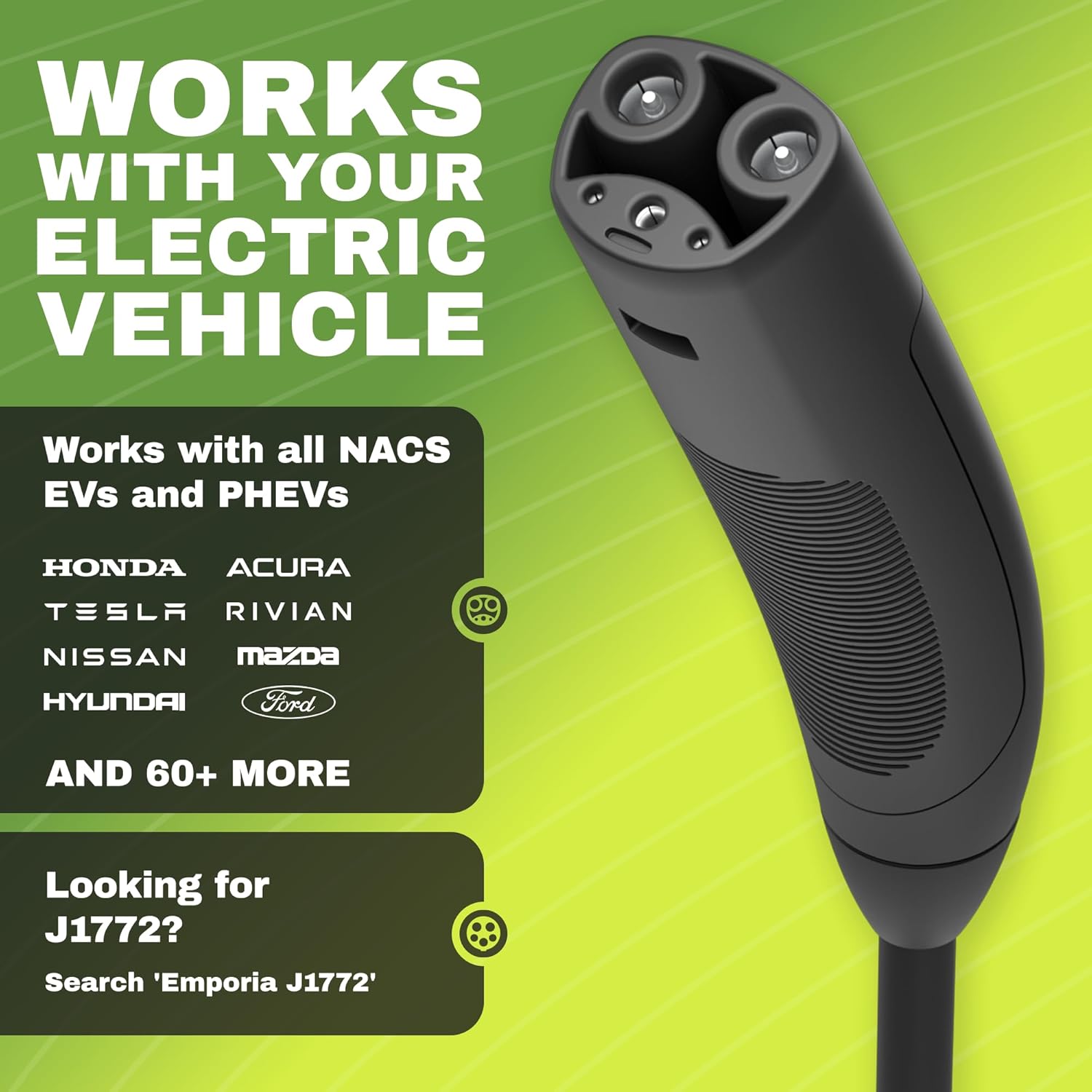
The app shows kWh consumed per session, total kWh over custom time ranges, and estimated cost based on your electricity rate. During my 30-day test, I tracked 22 charging sessions. The app reported total consumption of 487 kWh. My utility meter, read manually before and after the test period, showed 496 kWh of total household increase attributable to EV charging. That 1.8% variance is well within the margin of meter-to-meter reading error.
Why does this matter? Because the entire financial case for home charging depends on the numbers being real. At $0.15/kWh, those 487 kWh cost $73.05. The same energy purchased at a public DC fast charger averaging $0.38/kWh would have cost $185.06. That is a $112 difference in one month. Over a year, it scales to roughly $1,344 in savings. Over five years at 15,000 miles annually, the gap between home and public charging reaches $3,945, according to DOE AFDC data.
The Emporia charger lets you see that savings accumulate in real time. Most competing chargers at this price either omit energy tracking entirely or offer it as a rough estimate. Emporia treats it as the feature. For anyone who bought an EV partly for the financial argument, this is the charger that lets you verify whether that argument is holding up in your specific situation.
The App and Wi-Fi Setup: Good Enough With One Annoying Flaw
I should be honest about this part because it is the weakest link in the Emporia experience.
The Wi-Fi setup took me three attempts on the first day. The charger uses 2.4 GHz only, which is standard for IoT devices, but my phone kept defaulting to the 5 GHz band during the pairing process. Once I manually forced my phone onto the 2.4 GHz network, the connection worked and has been stable since. But that first 20 minutes of troubleshooting is the kind of thing that makes a non-technical buyer question whether they bought the right product.
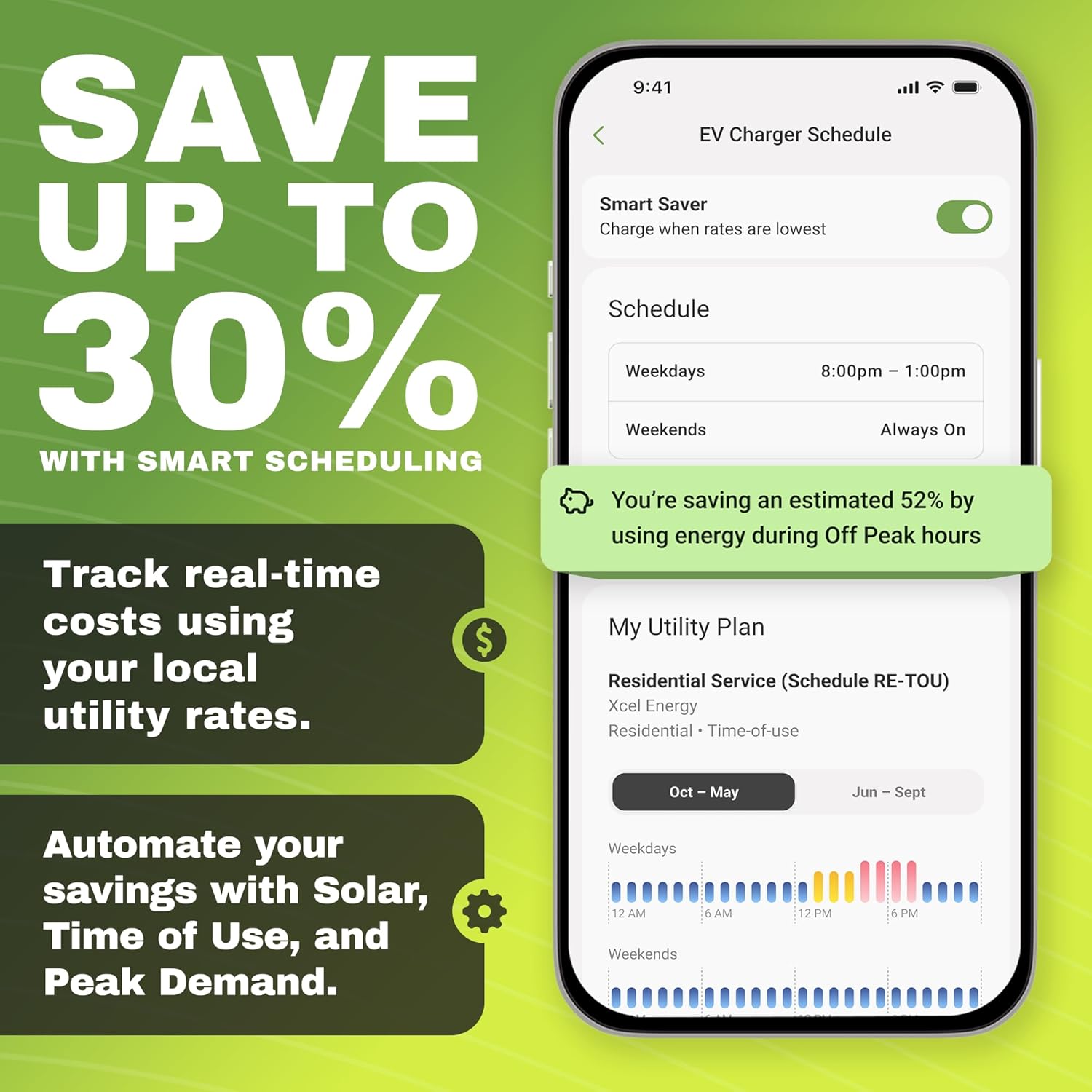
After the initial connection, the app is straightforward. You get session history, real-time charging status, scheduling, and energy cost tracking. Scheduled charging works reliably. I set it to begin at 11 PM to capture off-peak rates in my area and it started within a minute of the scheduled time every night for the full test period.
What the app does not have: Alexa or Google Home integration, the ability to set different amperage levels from the app, or any kind of charging reminders. The ChargePoint Home Flex app does all of those things. If you want your charger to talk to your smart home, the Emporia cannot do that yet. For me, that was fine. I plugged in when I got home and the schedule handled the rest. I never needed my smart speaker to tell me what my charger was doing.
If Emporia built their whole-home energy monitor integration into the charger app more tightly, this product would have no real weakness at its price point. Right now, the energy data lives in a competent but unexciting interface. It works. It is not beautiful.
Emporia Level 2 EV Charger Build Quality and Installation
The Emporia charger plugs into a NEMA 14-50 outlet. No hardwiring. That is the single biggest practical advantage this unit has over the Chevy EV charger and the Autel MaxiCharger, both of which require a licensed electrician for hardwired installation. If you already have a 240V outlet in your garage from a dryer, welder, or previous EV setup, installation means plugging it in and mounting the wall bracket. I had the charger running in under 15 minutes.
If you do not have a NEMA 14-50 outlet, an electrician can install one for $200 to $500 in most markets, assuming your panel has capacity. That is meaningfully cheaper than the $300 to $800 hardwired installation cost for units like the Autel or Chevy charger, because the electrician is installing an outlet rather than running direct wiring to the unit.
The Cable and Build
The 24-foot cable is one foot shorter than the 25-foot cables on the Autel and EVIQO, and one foot longer than the ChargePoint Home Flex at 23 feet. In practice, 24 feet covered my two-car garage with the charger mounted near the panel and the car parked on the far side. Most single-car garages will have no issue.
The J1772 connector locks firmly and releases cleanly. I tested it in temperatures ranging from 42°F to 88°F during the 30-day period, and the connector operated consistently at both extremes. The housing is NEMA 4 rated for outdoor use, though I installed mine indoors. The wall mount bracket is simple but adequate. The cable management hook is my one hardware complaint: it holds the cable loosely and the connector end tends to slide off if you coil the cable hastily. A better hook with a wider cradle would fix this, and I suspect Emporia will address it in a revision.
The unit is UL Listed, which means it has passed independent safety testing for electrical products sold in the U.S. That certification is non-negotiable. Do not buy any EV charger without it.
Emporia vs ChargePoint vs Autel vs EVIQO: Side-by-Side
All four of these chargers deliver roughly the same charging speed. The differences come down to features, app quality, installation type, and price. Here is how they compare on the things that affect daily ownership.
| Feature | Emporia Level 2 | ChargePoint Home Flex | Autel MaxiCharger | EVIQO 48A |
|---|---|---|---|---|
| Max Amperage | 48A | 50A | 50A | 48A |
| Max Power | 11.5 kW | 12 kW | 12 kW | 11.5 kW |
| Cable Length | 24 ft | 23 ft | 25 ft | 25 ft |
| Installation | NEMA 14-50 plug-in | Plug-in or hardwired | Hardwired only | Hardwired only |
| Wi-Fi | Yes (2.4 GHz) | Yes | Yes | Yes (2.4 GHz) |
| Bluetooth | No | No | Yes | No |
| Energy Monitoring | Yes (verified accurate) | Yes | Yes | Yes |
| App Scheduling | Yes | Yes | Yes | Yes |
| Smart Home Integration | No | Alexa, Google Home | No | No |
| Weatherproof Rating | NEMA 4 | NEMA 3R | NEMA 4 | NEMA 4 / IP66 |
| Certifications | UL Listed | UL Listed, Energy Star | UL Listed | UL & ETL |
| Warranty | 3 years | 3 years | 3 years | 3 years |
The Emporia Level 2 EV charger wins on value and plug-in convenience. The ChargePoint wins on app polish and installation flexibility. The Autel wins on dual-connectivity reliability with both Bluetooth and Wi-Fi. And the EVIQO wins on outdoor weatherproofing at a budget price. None of these chargers is a bad choice. The question is which tradeoff matters most in your garage.
Who Should Buy This Charger and Who Should Skip It

Buy the Emporia Level 2 Charger If:
- You want energy monitoring that is accurate enough to verify your actual home charging savings against your utility bill
- You have or can install a NEMA 14-50 outlet and do not want to pay for hardwired installation
- You are a renter or might move within five years, because plug-in means you take the charger with you
- You already own Emporia energy monitoring products and want a charger that fits into that ecosystem
- Your budget is firm and you want maximum charging capability per dollar spent
Do Not Buy It If:
- You want Alexa, Google Home, or other smart home integration with your charger
- Your garage Wi-Fi is unreliable and you need Bluetooth as a backup connection method
- You need adjustable amperage from the app to match different vehicles or panel limitations
- App aesthetics matter to you, because the Emporia app is functional, not refined
The honest assessment: if you are choosing between the Emporia Level 2 EV charger and a unit that costs $150 to $200 more, ask yourself what that extra money actually buys. In most cases, it buys a nicer app and smart home voice commands. It does not buy faster charging, better energy data, or longer durability. If those premium features do not matter to your daily routine, the Emporia is the rational choice and the savings go straight to the electricity bill. If you want the full smart-home package, the ChargePoint Home Flex is worth the premium.
One broader point. The charger you choose matters less than whether you have home charging at all. A buyer who picks the “wrong” Level 2 charger but charges at home every night is still saving $3,945 over five years compared to a buyer who relies entirely on public DC fast charging at $0.38/kWh. The charger brand is a minor variable. Home charging access is the variable that determines whether the EV financial case works.
Emporia Level 2 EV Charger — 48A / 11.5 kW
NEMA 14-50 plug-in. Wi-Fi enabled. Energy monitoring built in. UL Listed.
Check Price on AmazonVideo Review
For a closer look at the Emporia Level 2 charger in action, including the installation process and app walkthrough, watch the full video review below.
Methodology
This review is based on 30 days of daily use with a production Emporia Level 2 EV charger purchased at retail price. Charging time estimates use usable battery capacity divided by charger output (11.5 kW at 48A / 240V), with a 90% efficiency factor applied. Real-world times vary based on battery temperature, state of charge, and onboard charger limits. Energy monitoring accuracy was verified by comparing the Emporia app’s reported kWh against manual utility meter readings on three separate occasions during the test period (variance: 1.8%). Home electricity cost uses the national average of $0.15/kWh (DOE AFDC, 2026). Public DC fast charging cost uses $0.38/kWh (Electrify America, EVgo, ChargePoint national average, 2026). Installation cost ranges sourced from HomeAdvisor and Angi averages for licensed electrician work in the continental U.S. Competitor specifications verified against manufacturer product pages as of May 2026. Amazon affiliate links are used; DriveAuthority may earn a commission at no additional cost to the buyer.
FAQ
Is the Emporia EV charger compatible with all electric vehicles?
It uses the standard J1772 connector, which works with every non-Tesla EV sold in the United States. Tesla owners need a J1772-to-NACS adapter, available from Tesla for about $50. The charger does not care which brand of EV you plug it into.
How fast does the Emporia Level 2 charger charge a typical EV?
At 48 amps on 240V, it adds roughly 37 miles of range per hour. A Chevy Equinox EV charges from 10% to 100% in about 8 hours. A Tesla Model Y completes the same charge in roughly 7 hours. For most daily drivers who plug in after work, the car is full before morning.
Does the Emporia charger require a NEMA 14-50 outlet or hardwiring?
Plug-in only. The Emporia uses a NEMA 14-50 plug, so if you already have a 240V outlet in your garage, installation means plugging it in and mounting the bracket. If you need an outlet installed, an electrician can add one for $200 to $500 in most markets.
Can the Emporia charger track energy usage and cost per session?
Yes. The app tracks kWh per session and lets you input your electricity rate for cost estimates. During my 30-day test, the app’s kWh readings were within 1.8% of manual utility meter readings. That accuracy lets you verify whether your home charging savings are real, not just theoretical.
Is the Emporia EV charger safe for outdoor installation?
The unit carries a NEMA 4 rating, so it handles rain, snow, and dust. Outdoor installation works in all climates. For longer equipment life, mounting under an eave or covered area reduces direct weather exposure on the connector when it is not plugged into the car.
What is the warranty on the Emporia Level 2 EV charger?
Three years, covering defects in materials and workmanship. Every major competitor in this price range also offers 3-year warranties, so there is no advantage or disadvantage on coverage length.
How does the Emporia charger compare to the ChargePoint Home Flex?
Both offer energy monitoring, app scheduling, and similar charging speeds. The ChargePoint has adjustable amperage from 16 to 50 amps, Alexa and Google Home integration, Energy Star certification, and a more polished app. The Emporia costs less and offers plug-in simplicity with verified-accurate energy tracking. If you want smart home features and a premium app, choose ChargePoint. If you want maximum value with solid energy data, the Emporia is the better buy.

James Carter
Founder & Lead Analyst — DriveAuthority
James has spent over a decade analysing automotive markets, EV total cost of ownership, and the structural economics behind vehicle pricing. DriveAuthority was built to give buyers the same level of financial rigour applied to any major purchase decision — without the manufacturer-friendly framing common in traditional auto media.