Last Updated: March 2026
Nobody tells you the full number before you sign. You see the sticker price, maybe the monthly payment estimate — and then the real cost of owning an electric car per month arrives in pieces: the first electricity bill, the insurance renewal, the tire quote at 28,000 miles. Most EV buyers calculate this too late. That’s the problem this article is designed to fix.
What You’ll Learn in This Breakdown
What follows is a complete 2026 monthly cost breakdown covering every category that actually matters: your loan or lease payment, home and public charging costs, insurance premiums versus a comparable gas car, maintenance savings and the hidden costs that offset them, and a step-by-step personal cost builder you can complete in five minutes. All figures reflect U.S. national averages as of Q1 2026 and will vary by location, vehicle, and driving profile. I’ve spent a decade covering EV ownership economics — and the honest picture is more nuanced than most EV advocates admit, and less alarming than most sceptics claim.
Cost of Owning an Electric Car Per Month — Quick Answer:
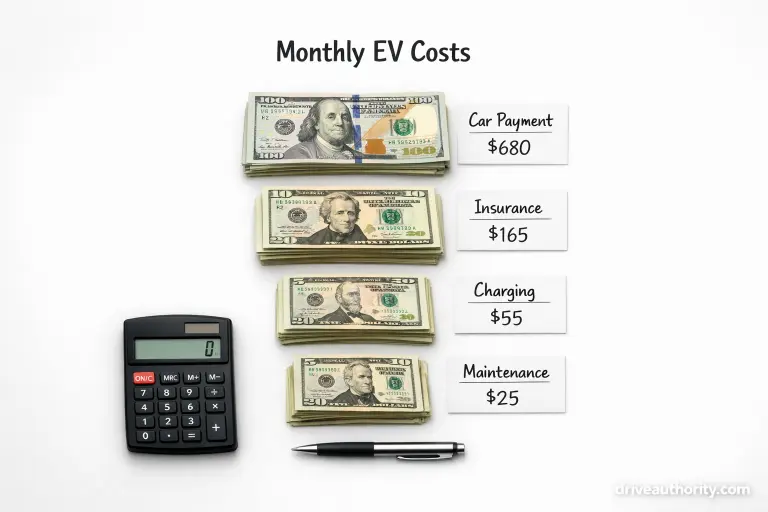
For a financed mid-range EV in 2026, total monthly ownership cost ranges from approximately $680 to $950 all-in — covering a loan payment of $450–$680, home charging of $40–$70, insurance of $130–$180, and a maintenance reserve of $35–$50. By contrast, a comparable financed gas vehicle runs $700–$950/month when fuel is included. EVs typically save $80–$160/month on fuel and maintenance combined — however higher vehicle prices and insurance premiums partially offset those savings. Owners who pay cash spend approximately $200–$320/month on charging, insurance, and maintenance only.
What Does It Actually Cost? The Quick Monthly Summary
Here’s the number I give every reader who asks me directly: budget $700–$900 per month all-in for a financed mid-range EV in 2026. That covers your payment, charging, insurance, and maintenance reserve. It’s not dramatically different from a financed gas vehicle — however the internal breakdown is very different, which is why so many buyers feel surprised after the fact.
The biggest single variable is how you’re acquiring the vehicle. A financed Tesla Model Y or Hyundai Ioniq 5 carries a monthly payment of $550–$700 before incentives — that’s 65–75% of your total monthly cost right there. Lease that same car and your payment drops by $80–$150/month. Pay cash, and your monthly costs collapse to approximately $200–$320, covering only charging, insurance, and maintenance. By contrast, a comparable gas vehicle costs $700–$950/month all-in when fuel is included, based on AAA’s 2025 annual vehicle ownership report. The gap between EV and gas is narrower than the sticker price suggests — because fuel savings are real, even if they don’t eliminate the payment difference.
Monthly Payment: Buy, Finance, or Lease?
Your payment is the heaviest line item in your monthly EV budget — typically 60–75% of the total all-in figure if you’re financing. Getting this right before you walk into a dealership is the decision that everything else depends on. Here’s what each path looks like with real 2026 numbers.
Financing an EV: What to Expect in 2026
According to Edmunds Q1 2026 transaction data, average monthly finance payments break down by segment as follows: entry-level EVs (Chevy Equinox EV, Nissan Leaf) at approximately $380–$480/month; mid-range EVs (Hyundai Ioniq 5, Tesla Model Y, Ford Mustang Mach-E) at approximately $520–$680/month; and premium EVs (BMW i4, Mercedes EQS) at $900–$1,400/month. These figures assume a 60-month loan at current average auto loan rates of approximately 6.5–7.5% APR for buyers with good credit — because rates in 2026 remain elevated compared to the 2020–2022 EV buying window.
The $7,500 IRA federal tax credit is the most important payment lever available in 2026 — specifically because it now applies at point-of-sale at eligible dealers, directly reducing your financed amount without waiting for a tax return. That credit reduces the effective financed price by $7,500, saving approximately $115–$130/month on a 60-month loan. However, not every vehicle qualifies — income caps, MSRP limits, and battery sourcing rules all affect eligibility. Check the current qualifying model list at the DOE’s AFDC credit eligibility tool before assuming the discount applies to your specific situation.
Leasing vs. Buying: Monthly Cost Reality
Leasing an EV typically costs $80–$150/month less than financing the same vehicle — because you’re paying for projected depreciation over the term, not the full vehicle value. In 2026, EV lease deals have improved as residual values have stabilised and manufacturer incentives have returned. A Chevy Equinox EV leases for approximately $299–$379/month; a Tesla Model Y for approximately $379–$449/month; a Hyundai Ioniq 6 for approximately $329–$399/month, based on current manufacturer offers.
That said, leasing has a structural trap that I watch buyers walk into constantly: the mileage cap. Most EV leases cap you at 10,000–12,000 miles per year. Exceed that and you pay $0.15–$0.25 per excess mile at return — which erases the monthly payment advantage fast for higher-mileage drivers. Leasing makes most financial sense for buyers who drive under 12,000 miles annually, upgrade every 3 years, and value the ability to move to the next generation without a trade-in negotiation. By contrast, buying makes more sense if you plan to own for 6+ years and want to build equity rather than make perpetual payments. For a deeper breakdown of the buy-versus-lease math by model, our guide to the best EVs under $40K covers the total monthly cost picture per vehicle.
| Segment | Example Model | Cash Price (approx.) | Financed /mo | Leased /mo | After $7,500 Credit (Finance) |
|---|---|---|---|---|---|
| Entry EV | Chevy Equinox EV LT | ~$35,000 | $430–$480 | $299–$349 LOWEST | ~$315–$360 |
| Mid-Range EV | Hyundai Ioniq 5 SE | ~$42,000 | $550–$620 | $369–$419 | ~$430–$485 |
| Mid-Range EV | Tesla Model Y RWD | ~$44,990 | $580–$660 | $389–$449 | ~$460–$540 |
| Premium EV | BMW i4 eDrive35 | ~$57,000 | $780–$890 | $549–$649 HIGH INS. | No IRA credit (MSRP >$55K cap) |
Monthly Electricity Cost: What You’ll Pay to Charge
This is the cost most buyers either dramatically overestimate or completely underestimate. Home charging is genuinely cheap — typically $35–$70/month for average U.S. drivers. However, that number can more than triple if you rely heavily on public DC fast charging. The gap between these two scenarios is the single most important factor in your real-world EV running cost.
Home Charging: How to Calculate Your Monthly Bill
The formula is simple: (monthly miles ÷ vehicle efficiency in mi/kWh) × local electricity rate per kWh. At the U.S. national average residential electricity rate of 16.9 cents/kWh (EIA, January 2026), a driver covering 1,200 miles per month in a vehicle averaging 3.5 mi/kWh pays approximately $58/month to charge at home. That’s roughly one-quarter of what the same driver would spend on gasoline at $3.50/gallon in a 30 mpg equivalent.
The strongest savings lever is off-peak Time-of-Use (TOU) charging. Most utilities offer overnight rates of 8–12 cents/kWh between 9pm and 6am — which reduces the same driver’s monthly charging cost to approximately $28–$42. As a result, enrolling in your utility’s EV TOU rate is the single highest-return action available to a new EV owner. Specifically, California, Texas, and the Midwest have the most competitive off-peak rates. Our home EV charging setup guide covers Level 1 versus Level 2 installation and how to enrol in your utility’s EV rate program.
Public Charging Costs: DC Fast Charge vs. Home Rate Gap
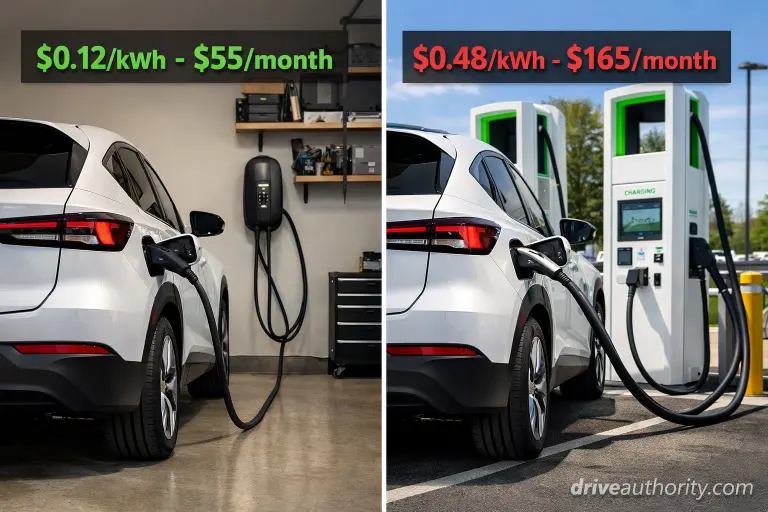
Public DC fast charging is significantly more expensive than home charging — and this catches mixed-use drivers off guard every time. Tesla Supercharger pricing runs approximately $0.30–$0.48/kWh depending on location and time. Electrify America charges approximately $0.43–$0.48/kWh for non-members. EVgo and ChargePoint typically land in the $0.35–$0.45/kWh range on a pay-as-you-go basis.
For a driver adding 200 miles per month via DC fast charge — a realistic mixed-use pattern — that adds approximately $25–$40 to the monthly charging bill above the home base. Therefore, a home-plus-occasional-fast-charge driver should budget approximately $75–$105/month total. Heavy public-charging users — apartment dwellers without dedicated home access — can realistically face $120–$185/month in charging costs alone. That number eliminates much of the fuel-saving advantage that makes EVs financially compelling. Our public EV charging cost guide covers current network pricing across Electrify America, Tesla, EVgo, and ChargePoint in detail.
| Usage Profile | Monthly Miles | Charging Method | Est. Monthly Cost | Gas Equivalent (30 mpg / $3.50) |
|---|---|---|---|---|
| Low Mileage | 700–800 mi | Home only (16.9¢/kWh) | ~$34–$39 LOWEST | ~$82–$93 |
| Average Driver | 1,000–1,250 mi | Home + occasional fast | ~$60–$90 | ~$117–$146 |
| High Mileage | 1,500–1,800 mi | Home + regular fast | ~$95–$135 | ~$175–$210 |
| No Home Charging | 1,000–1,250 mi | Public DC fast only | ~$130–$185 HIGH | ~$117–$146 |
EV Insurance Costs Per Month: The Real 2026 Picture
Every EV cost article I’ve read underweights insurance. That’s a mistake — because in 2026, EV premiums average $25–$45/month above equivalent gas car rates, and over five years that represents $1,500–$2,700 in real added cost. You should price this in before you buy, not after your first renewal arrives.
Why EV Insurance Costs More Than Gas Cars
Three structural factors drive higher EV premiums. First, vehicle replacement value: EVs cost more to replace, which raises comprehensive coverage baselines. Second, repair complexity: battery proximity, high-voltage system protocols, and sensor-dense body panels all increase labour time and parts cost above ICE-equivalent repairs. Third, battery damage uncertainty: insurers factor in battery assessment and potential replacement costs after collision events — even when the pack isn’t visibly damaged.
According to Insurify’s 2025 EV insurance cost report, the average annual EV premium in the U.S. sits at approximately $1,860–$2,280 — versus approximately $1,450–$1,750 for a comparable ICE vehicle. That translates to roughly $155–$190/month for EVs versus $121–$146/month for gas cars. However, premiums vary sharply by model: a Tesla Model S carries dramatically higher premiums than a Chevy Equinox EV. For a full model-by-model breakdown, our EV insurance vs gas car cost guide covers real annual figures across 12 popular models.
How to Reduce Your Monthly EV Insurance Cost
The most effective reduction strategy available in 2026 is telematics — usage-based insurance programs from Progressive (Snapshot), State Farm (Drive Safe & Save), and Nationwide (SmartRide) that reward low-risk driving with discounts of 10–25%. That alone can close a significant portion of the EV insurance premium gap against gas cars. Bundling home and auto insurance typically saves an additional $15–$25/month — a quick win that most new EV buyers forget to action at purchase time.
Specifically, the EV models with the lowest insurance tiers in 2026 are the Chevy Equinox EV, Ford Mustang Mach-E, and Hyundai Ioniq 6 — all benefiting from lower replacement costs and better parts availability than premium EV alternatives. By contrast, Tesla Model S and Porsche Taycan sit in the highest premium tier. Choosing a lower-tier EV can save $30–$60/month on insurance relative to a premium alternative at a similar transaction price. For first-time buyers watching every dollar, our guide to first-time EV buyer mistakes flags the insurance trap as one of the most common financial surprises.
Monthly Maintenance Costs: Where EVs Save and Where They Don’t
Maintenance is the EV ownership argument I agree with most — and the one most articles overstate. The savings versus a gas car are genuine and meaningful. However, they don’t eliminate all costs, and two EV-specific expenses catch owners off guard with enough regularity that they deserve their own section.
What EVs Don’t Need — and What You Save
EVs eliminate oil changes, spark plug replacements, timing belt service, transmission fluid, and exhaust system maintenance entirely. These items cost gas vehicle owners approximately $600–$900 per year in combined service intervals, per AAA’s 2025 Your Driving Costs study. Regenerative braking compounds the saving: because EVs use motor deceleration rather than friction brakes as the primary stopping mechanism, brake pad wear is dramatically slower. Most EV owners report needing brake pad service every 80,000–120,000 miles — versus every 25,000–40,000 miles for ICE vehicles.
As a result, EV annual maintenance costs approximately $400–$600 per year versus $900–$1,300 per year for a comparable gas car, based on AAA’s data. That’s a genuine saving of approximately $40–$75/month — real money over a 5-year ownership period. For a broader look at which EVs carry the lowest long-term maintenance burden, our cheapest cars to maintain guide covers EV and hybrid maintenance costs side by side.

EV-Specific Costs Owners Don’t Expect
Three costs reliably surprise first-time EV owners. The first is tires: EVs weigh 300–600 lbs more than equivalent gas cars, and instant torque delivery accelerates tread wear. Expect tire replacement every 25,000–35,000 miles on most mid-range EVs — significantly faster than a comparable gas car. Amortised across ownership, that adds approximately $15–$25/month to true running costs.
The second is the 12V auxiliary battery — the conventional battery that powers your car’s electronics independently of the main pack. It typically needs replacement every 4–6 years at a cost of $200–$400. Admittedly, that’s not a frequent expense — however it’s entirely overlooked in most EV cost calculators. The third cost is standard items that don’t change: cabin air filters ($20–$40 every 15,000–20,000 miles), wiper blades, and washer fluid are identical in schedule and cost to ICE vehicles. What that means for your budget is an honest maintenance reserve of $35–$50/month once tyre amortisation is factored in — lower than the $75–$110/month ICE equivalent, but not zero.
| Maintenance Item | EV (Monthly Est.) | Gas Car (Monthly Est.) | EV Advantage |
|---|---|---|---|
| Oil & engine fluids | $0 ELIMINATED | $20–$30 | +$20–$30/mo |
| Brake service | ~$4–$7 (amortised) | ~$12–$18 | +$8–$11/mo |
| Tire replacement | ~$15–$25 FASTER WEAR | ~$10–$18 | –$5–$7/mo |
| 12V battery / filters / wipers | ~$6–$10 | ~$5–$10 | Roughly equal |
| Annual total estimate | $400–$600/yr LOWER | $900–$1,300/yr | ~$40–$75/mo saved |
Your Total Monthly Cost: How to Build Your Own Number
This is the mistake I’ve watched hundreds of buyers make: they read a national average monthly EV cost and assume it applies to their situation. It doesn’t. Your state’s electricity rate, your credit score, your mileage, and your insurance ZIP code all move the number meaningfully. The five-step builder below takes under five minutes and gives you a figure that’s actually yours.
Step 1 — Monthly payment. Use the table in §2 as your starting estimate, then adjust for your credit score (higher rates for sub-700 FICO) and down payment amount. If leasing, use manufacturer current offers directly. If buying outright, enter $0 — and skip to Step 2.
Step 2 — Charging cost. Take your typical monthly miles, divide by your vehicle’s efficiency (mi/kWh from the EPA window sticker), and multiply by your local electricity rate per kWh. Add $25–$40 if you expect to DC fast-charge occasionally. Check your utility’s website for TOU rates — they can reduce this figure by 35–45% with zero hardware investment. The DOE’s AFDC fuel cost calculator runs this formula with your ZIP code and vehicle automatically.
Step 3 — Insurance. Get a real quote specific to the EV model you’re considering — don’t use a generic average. EV premiums vary by 40–60% across models and ZIP codes. As a placeholder only, use $155/month for a mid-range EV in a suburban area.
Step 4 — Maintenance reserve. Budget $35–$50/month. This covers tires at accelerated wear frequency, cabin filters, wipers, and the eventual 12V battery. It’s lower than the $75–$110/month ICE equivalent — however it’s not zero, and leaving it out of your calculation will produce a number that doesn’t match your bank statement.
Step 5 — Total and compare. Add all four figures. Then calculate your current gas car’s all-in monthly cost: payment + fuel + insurance + maintenance. The gap between those two totals is your actual EV decision data — not a marketing projection. For the most affordable EV options ranked by total monthly cost, our best electric cars for the money guide covers current models across all segments.
FAQ: Cost of Owning an Electric Car Per Month
How much does it cost per month to own an electric car in 2026?
For a financed mid-range EV — like the Hyundai Ioniq 5 or Tesla Model Y — expect a total monthly cost of approximately $680–$950 all-in, covering payment, charging, insurance, and maintenance. Entry-level EVs like the Chevy Equinox EV come in at approximately $550–$700/month financed. Owners who pay cash face only approximately $200–$320/month in ongoing costs. However, all figures vary significantly by state electricity rate, insurance ZIP code, and mileage — which is why building your own worksheet number (see §6) is more useful than any national average.
Is it cheaper to own an EV or a gas car per month?
On a monthly basis, financed EVs are often comparable to or slightly above equivalent gas vehicles — because EVs carry higher sticker prices and therefore higher loan payments. That said, EVs typically save $40–$70/month on fuel and $40–$75/month on maintenance versus a comparable gas car. As a result, over a full 5-year ownership period, a mid-range EV typically costs $3,000–$7,000 less in total than an equivalent gas vehicle — even if the monthly bills look similar. The savings accrue over time rather than month one. Our EV vs gas car 5-year cost comparison runs the complete arithmetic.
How much does it cost to charge an EV at home per month?
At the U.S. national average electricity rate of 16.9 cents/kWh (EIA, January 2026), most drivers covering 1,000–1,250 miles per month pay approximately $45–$65/month to home-charge their EV. Use the formula: (monthly miles ÷ vehicle efficiency in mi/kWh) × your local rate. Enrolling in your utility’s Time-of-Use off-peak rate — typically 9–12 cents/kWh between 9pm and 6am — reduces that figure to approximately $28–$42/month. The DOE AFDC fuel cost calculator runs your exact scenario by ZIP code and vehicle in seconds.
What hidden costs do EV owners most often overlook?
The three most consistently missed costs are: higher insurance premiums ($25–$45/month above gas-car equivalents for the same coverage level); accelerated tire wear due to EV weight and torque characteristics, adding approximately $15–$25/month when amortised across ownership; and the 12V auxiliary battery replacement every 4–6 years at $200–$400 — a cost entirely absent from most EV total-cost calculators. Together, these add $40–$80/month to real ownership costs that most published EV budget tools omit. Admittedly, they’re outweighed by oil and brake savings over time — but they belong in your calculation from day one. Our first-time EV buyer mistakes guide covers all the financial surprises worth knowing before you sign.
The cost of owning an electric car per month is more honest than it’s usually presented — and the real number depends almost entirely on how you’re buying, where you live, and whether you have home charging access. For most financed buyers, the monthly bills look similar to a comparable gas vehicle. The financial advantage arrives over time, through fuel and maintenance savings that compound across a 5-year ownership period. Build your worksheet number in §6. Compare it to your current car’s real monthly spend. If the math works for your situation — it usually does for home-charging buyers with a 5-year horizon — the decision becomes straightforward.