Last Verified: March 2026
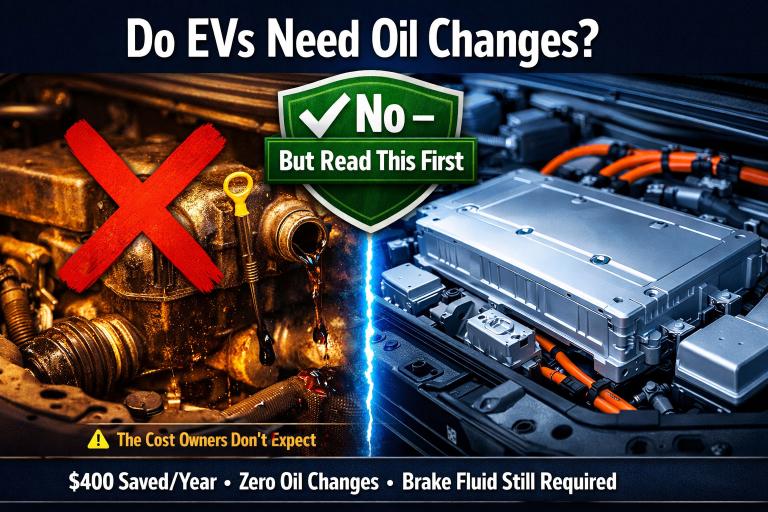
Do EVs need oil changes? No — and that’s the one maintenance fact most people already know. The problem is that “no oil changes” has somehow turned into “EVs need zero maintenance,” which is simply not true. EVs do need servicing. Some of those service items are cheaper than a gas car’s equivalents. Others — specifically tires and brake fluid — surprise owners who weren’t told the full picture before they bought. This guide covers everything: what EVs skip, what they still require, what it costs annually, and where the real savings versus a gas car actually land in 2026.
Why This Matters More Than You’d Think
I’ve reviewed dozens of EV ownership cost articles, and the one thing they consistently get wrong is the maintenance section. Because they lead with “no oil changes” and stop there. That’s not analysis — that’s a headline. The full picture is more nuanced and, for some buyers, more expensive than expected. This guide gives you the complete itemized breakdown, because that’s what you need to make a confident ownership decision.
Do EVs Need Oil Changes? — Direct Answer:
No. Electric vehicles have no internal combustion engine, so they require no engine oil, oil filter, spark plugs, or timing belt. However, EVs do require regular servicing: brake fluid (every 2 years), cabin air filter (every 15,000–25,000 miles), tire rotation (every 5,000–7,500 miles), and 12V auxiliary battery replacement. Based on AAA data, average annual EV maintenance costs run approximately $900 vs. $1,300 for a comparable gas car — a real saving, but not zero.
The Direct Answer: Do Electric Cars Need Oil Changes?
No — electric cars do not need oil changes. That answer is simple, and it’s correct. However, the reason behind it matters for understanding your full service picture, so it’s worth understanding rather than just accepting.
Why EVs Don’t Need Engine Oil
Internal combustion engines require oil because they have hundreds of moving metal parts — pistons, crankshafts, camshafts, cylinder walls — that generate enormous heat and friction. Engine oil lubricates those surfaces and prevents destruction. Electric motors have a fundamentally different architecture. They use a rotor spinning inside a magnetic stator, with sealed bearings that are lubricated for the lifetime of the vehicle in most designs. There’s nothing to change. As a result, not only oil changes but also oil filters, spark plugs, timing belts, fuel injectors, and exhaust systems are eliminated entirely. That’s where the real maintenance saving begins — and it’s substantial.
What EVs Do Use Instead: Fluids That Still Require Attention
Specifically, three fluids still matter in an EV, and owners who ignore them learn about it the hard way. Brake fluid is hygroscopic — it absorbs moisture from the atmosphere over time, which lowers its boiling point and degrades braking performance. EVs require brake fluid replacement on a 2-year schedule regardless of how little the physical brakes have been used. Regenerative braking reduces pad wear dramatically, but it does not slow moisture uptake in the fluid. Battery coolant manages thermal performance in the battery pack — most OEMs specify a coolant service interval between 5 and 10 years, though this varies by brand. Gear or differential fluid applies to some AWD EVs with dedicated rear drive units — Tesla Model 3 AWD, for example, specifies a differential fluid check at 150,000 miles.
← Scroll to see full table on mobile
| Fluid Type | Gas Car Required? | EV Required? | Typical Interval |
|---|---|---|---|
| Engine Oil | ✅ Yes — essential | ❌ No — no engine | Every 5,000–10,000 mi |
| Brake Fluid | ✅ Yes | ✅ Yes OFTEN MISSED | Every 2 years |
| Battery Coolant | ✅ Yes (engine coolant) | ✅ Yes (battery thermal) | 5–10 years · OEM-specific |
| Transmission Fluid | ✅ Yes (auto/CVT) | ⚠️ Some AWD EVs only | Model-specific (e.g., 150K mi) |
| Fuel / AdBlue | ✅ Yes | ❌ No — no fuel system | N/A |
| Windshield Washer | ✅ Yes | ✅ Yes — identical | As needed |
Full EV Maintenance Schedule: What You Actually Need to Service
Here’s the maintenance reality most EV content skips over. EVs have a shorter service list than gas cars — but that list is not blank. Specifically, the items that remain are easy to overlook precisely because EVs are marketed as low-maintenance. The 12V auxiliary battery is the one that catches owners by surprise most often.
Annual and Mileage-Based EV Service Items
Cabin air filter — Most EVs use the same cabin air filter as a gas car. Because EVs lack an engine compartment generating heat and particulates, some owners assume the cabin filter is irrelevant. It isn’t. Pollen, dust, and particulates still enter the HVAC system. Replacement interval is typically every 15,000–25,000 miles, and the cost is $15–$30 DIY versus $60–$90 at a dealer. Tire rotation — because EVs are significantly heavier than equivalent gas cars (due to battery pack weight), and because instant torque delivery accelerates rear tire wear on RWD and AWD models, rotation intervals on EVs are shorter than on comparable gas vehicles. Most EV manufacturers recommend rotation every 5,000–7,500 miles rather than the standard 7,500–10,000 miles. That’s an additional rotation per year for most drivers, at approximately $25–$50 per rotation.
Brake fluid — Already flagged, but worth repeating because it’s the most commonly skipped EV service item. Every 2 years, regardless of brake pad condition, regardless of mileage. Dealer cost typically $80–$150 depending on market and model. Wiper blades — identical to any vehicle, approximately $20–$40 to replace yourself. No change from gas car parity. 12V auxiliary battery — this is the one that surprises people. Even though the main traction battery powers the drivetrain, all EVs use a separate 12V battery to run accessories, door locks, displays, and HVAC electronics. Replacement interval is typically 3–7 years. Cost ranges from $80–$250 depending on the vehicle. A failed 12V battery can leave you unable to start or exit the vehicle — it’s therefore a service item worth tracking proactively.
Battery Health Checks and Thermal System Service
Battery State of Health (SOH) monitoring tells you what percentage of the original battery capacity remains. Most EVs display this in the vehicle app or through OBD diagnostic tools. I recommend checking SOH annually after year three — that’s when gradual degradation becomes measurable in real-world range. Specifically, if your EV shows below 80% SOH before the battery warranty period ends (typically 8 years / 100,000 miles under federal minimum requirements), you have a warranty claim. Don’t wait for the battery to fail — monitor it. Battery thermal coolant service varies significantly by manufacturer. Tesla, for example, does not publish a standard coolant interval and addresses it through service bulletins. Hyundai and Kia specify coolant checks at 6-year intervals. Because of that variance, always consult your OEM service documentation rather than applying a generalized interval.
What Never Needs Servicing on an EV
This is where the savings accumulate. Eliminated entirely versus a gas car: engine oil and filter, spark plugs, timing belt or chain, fuel filter, fuel injectors, oxygen sensors, catalytic converter, exhaust system, and multi-speed transmission fluid in most single-speed EVs. Brake pads are not eliminated — but they last significantly longer because regenerative braking handles most deceleration. In practice, EV brake pads typically last 70,000–100,000+ miles versus 30,000–70,000 miles on gas cars. That’s one or two fewer brake jobs over five years of ownership.
← Scroll to see full table on mobile
| Service Item | Interval | Est. Cost | Gas Car Equivalent | EV Saving |
|---|---|---|---|---|
| Engine oil + filter | N/A — eliminated | $0 SAVED | $60–$150 × 2/year | ~$150–$300/yr |
| Tire rotation | Every 5,000–7,500 mi | $25–$50/visit | $25–$50/visit | $0 (same or higher) |
| Brake fluid | Every 2 years | $80–$150 DON’T SKIP | $80–$150 | $0 (same) |
| Cabin air filter | Every 15K–25K mi | $15–$30 DIY | $15–$30 DIY | $0 (same) |
| Brake pads | 70K–100K+ mi | $150–$350/axle | 30K–70K mi | ~$200–$500 saved |
| 12V auxiliary battery | Every 3–7 years | $80–$250 OFTEN MISSED | $80–$200 | ~$0 (similar) |
| Battery coolant | 5–10 years (OEM-specific) | $150–$350 | $100–$200 (engine coolant) | Slight increase |
| Spark plugs | N/A — eliminated | $0 SAVED | $80–$200 every 60K mi | ~$80–$200 |
| Timing belt/chain | N/A — eliminated | $0 SAVED | $500–$1,500 lifetime | ~$500–$1,500 |
EV vs. Gas Car Maintenance Costs: The Real Annual Numbers
Every article on this topic says “EVs save you money on maintenance.” I don’t disagree — but the honest question is how much, where, and whether the saving is large enough to factor into a purchase decision. Because the gap is real, but it’s not as wide as the marketing suggests.
Average Annual EV Maintenance Cost in 2026
According to AAA’s Your Driving Costs report, the average annual maintenance and repair cost for an EV in 2024 was approximately $900. The comparable figure for a gas-powered vehicle was approximately $1,300 per year. That’s a real $400 annual saving — meaningful over five years, but not the dramatic gap that “no oil changes” implies in isolation. What’s more, that average hides significant variance. A compact EV like the Chevrolet Bolt or Nissan Leaf on 16-inch tires will trend toward $700–$850 per year. A premium EV with wide performance tires and a complex AWD drivetrain can trend toward $1,100–$1,400 — matching or exceeding a mid-size gas car’s annual service bill.
EV vs. Gas Car: 5-Year Maintenance Cost Comparison
Over five years, the cumulative saving for an average EV buyer versus an average gas car buyer is approximately $1,500–$2,500, based on U.S. Department of Energy AFDC data and AAA figures. Specifically, the saving is largest in three categories: oil service elimination ($600–$1,200 over five years), brake service reduction ($300–$700), and spark plug and timing service elimination ($400–$1,000 over vehicle life). The saving is smaller — or absent — in tire replacement, which is often more frequent and more expensive on EVs due to vehicle weight and tire specifications. That’s the part of the EV maintenance cost story most buyers don’t hear clearly enough before buying.
← Scroll to see full table on mobile
| Category | EV Annual Avg. | Gas Car Annual Avg. | Annual Saving |
|---|---|---|---|
| Scheduled service | ~$200–$350 | ~$450–$700 | ~$250–$350 |
| Tire replacement | ~$250–$500/yr avg. | ~$200–$400/yr avg. | −$50 to −$100 |
| Brake service | ~$30–$60/yr avg. | ~$100–$200/yr avg. | ~$70–$140 |
| Fluids (all) | ~$80–$130/yr avg. | ~$100–$160/yr avg. | ~$20–$50 |
| 12V / electrical | ~$30–$50/yr avg. | ~$30–$60/yr avg. | ~$0–$10 |
| Total annual estimate | ~$900 | ~$1,300 | ~$400/yr saving |
Tires and Brakes: The Two EV Costs Owners Don’t Expect
This is the section that separates honest EV maintenance content from the wave of “EVs cost nothing to maintain” articles saturating this topic. Tires and brake fluid are the two areas where real EV ownership costs surprise people — for opposite reasons. One is higher than expected. The other is lower — but still requires attention.
Why EVs Wear Tires Faster — and What It Costs
There are two reasons EV tires wear faster than equivalent gas car tires. First, instant torque delivery. Because electric motors deliver their maximum torque immediately from rest, acceleration events place significantly higher lateral and longitudinal stress on tires — specifically on rear and AWD configurations. Second, battery weight. The average EV weighs 20–30% more than an equivalent gas car due to the battery pack. That additional load compresses tires harder into the road surface on every rotation, accelerating wear. As a result, rotation intervals are shorter (every 5,000–7,500 miles rather than 7,500–10,000), and replacement intervals are shorter — typically 20,000–40,000 miles for EV-specific tires versus 40,000–60,000 miles for standard all-season tires on gas cars. Admittedly, tire cost is the single area where EV ownership can exceed gas car ownership on an annual basis, particularly for performance-oriented models on 20-inch or larger wheel packages.
Brake Pad Longevity: The Good News and the Hidden Cost
Here’s where EVs genuinely impress. Regenerative braking handles the majority of deceleration events in normal driving — the physical brake pads are engaged far less frequently than on a gas car. In practice, EV brake pads typically last 70,000–100,000 miles versus 30,000–70,000 miles on comparable gas vehicles. That’s one or two fewer brake jobs per ownership cycle. However — and this is the part that catches owners off-guard — brake fluid still degrades on a calendar schedule regardless of pad wear. Specifically, brake fluid is hygroscopic: it absorbs moisture from the air over time, reducing its boiling point and compromising braking performance under hard use. The replacement interval is every 2 years regardless of how little you’ve used the physical brakes. Because most EV owners associate their excellent brake pads with “good brakes,” they skip the fluid. That’s a mistake I see consistently.
EV Maintenance by Brand: Are Some Cheaper to Service Than Others?
The short answer is yes — and the gap between the cheapest and most expensive EVs to service can exceed $300 per year. That’s a real number worth knowing before you finalize a purchase. Brand matters here, not because of reliability differences alone, but because of tire specifications, service network access, and drivetrain architecture.
Lowest Maintenance Cost EVs in 2026
Based on Consumer Reports reliability data and RepairPal model-specific benchmarks, the models with consistently the lowest annual maintenance costs are the Tesla Model 3 Standard Range, Chevrolet Bolt EV, and Hyundai Ioniq 6. What they share is a simple single-motor RWD or FWD drivetrain, no AWD differential fluid service requirement, standard tire sizes (17–18 inch), and in Tesla’s case, a strong OTA update capability that resolves many minor issues without a physical dealer visit. As a result, owners of these models report annual maintenance bills in the $600–$850 range at normal mileage. That’s genuinely low and constitutes a real total-cost-of-ownership advantage over the segment average.
Higher-Cost EV Service Situations to Know Before You Buy
By contrast, performance and premium EVs carry a meaningful service cost premium. Wider, lower-profile tires on 20–21-inch wheels wear faster and cost significantly more to replace — a full set of 21-inch performance EV tires can cost $1,200–$2,000, versus $600–$900 for a standard 18-inch EV tire set. AWD models with rear drive units also require periodic fluid checks at high mileage. Beyond vehicle specification, service network access matters. Tesla’s proprietary service model means independent shops can’t access all diagnostic data without approved tools — a limitation that restricts your service options and, in low-dealer-density markets, increases wait times and travel cost. Newer EV brands with limited independent shop coverage also carry a parts lead-time risk that established brands don’t. If you’re buying a less common EV brand, confirm parts availability in your specific market before committing.
Budget-Friendly EVs to Service
- Chevrolet Bolt EV / EUV
- Hyundai Ioniq 6 RWD
- Tesla Model 3 Standard RWD
- Nissan Leaf (base trims)
Est. ~$650–$900/yr · Standard tires · Simple drivetrain · Wide service coverage
Average-Cost EVs to Service
- Ford Mustang Mach-E
- Hyundai Ioniq 5 AWD
- Volkswagen ID.4
- Tesla Model Y AWD
Est. ~$900–$1,150/yr · AWD adds drivetrain service · Larger tire sizes
Higher-Cost EVs to Service
- Tesla Model S / Model X
- Rivian R1T / R1S
- Lucid Air
- BMW iX / Mercedes EQS
Est. ~$1,200–$1,800/yr · Performance tires · Premium parts cost · AWD drivetrain service
DIY vs. Dealer EV Maintenance: What Owners Can Do Themselves
The good news is that several EV maintenance tasks are straightforward, owner-accessible, and significantly cheaper to do yourself. The important caveat: high-voltage EV systems (400V–800V on most modern EVs) are not DIY territory under any circumstances. That line is clear, and this section respects it. Everything below it, however, is fair game for a careful owner.
EV Maintenance You Can Do at Home
Cabin air filter replacement is the highest-value DIY task on any EV. Dealer cost for this service typically runs $60–$90 including labor. The filter itself costs $15–$30 online, and replacement takes 10–15 minutes on most models with a basic screwdriver. Over five years at the recommended replacement interval, that saves approximately $150–$300. Wiper blade replacement is identical to any vehicle — no EV-specific procedure, standard $20–$40 replacement blades work across all models. Tire pressure monitoring and top-up is particularly important for EVs because range efficiency decreases measurably with under-inflated tires. Check monthly and maintain the OEM-specified pressure — this is also the simplest way to extend tire life. Windshield washer fluid is no different from a gas car — any standard concentrate or premixed fluid works.
What Requires a Dealer or Certified EV Specialist
Brake fluid replacement requires a proper hydraulic bleed procedure to remove all moisture-absorbed fluid and ensure no air enters the brake lines. This is not complex, but it’s also not appropriate for most owners without specific hydraulic experience and equipment. 12V auxiliary battery replacement is DIY-accessible on some models — the Chevrolet Bolt’s 12V battery, for example, is straightforward. On others, particularly those where the 12V is integrated near high-voltage components, professional replacement is the safer choice. Always check your specific model’s service documentation before attempting this. Battery thermal coolant service requires proper EV-specific coolant and a pressurized flush procedure — dealer or certified EV specialist only. And any work adjacent to the high-voltage traction battery, inverter, or motor — regardless of how accessible it appears — must be handled by a certified EV technician. These systems operate at voltages that are immediately fatal on contact. That’s not a disclaimer, it’s a hard rule.
🔧 Safe to DIY at Home
- Cabin air filter replacement ($15–$30 DIY vs. $60–$90 dealer)
- Wiper blade replacement — identical to gas car
- Tire pressure check and inflation
- Windshield washer fluid top-up
- Exterior wash and paint care
- 12V battery (on models where it’s accessible)
🚫 Requires Dealer or EV Specialist
- Brake fluid replacement — requires hydraulic bleed
- Battery thermal coolant flush
- Tire rotation (alignment check required with each)
- Battery State of Health diagnostics (OEM tool required)
- Any high-voltage adjacent work — never DIY
- OTA update failures or charging system faults
FAQ: Do EVs Need Oil Changes?
Do electric cars need oil changes?
No. Electric vehicles have no internal combustion engine, so they require no engine oil, oil filter, spark plugs, or timing belt. The electric motor uses sealed bearings that are lubricated for the lifetime of the vehicle. However, EVs still require brake fluid replacement (every 2 years), cabin air filter changes, tire rotations, and 12V auxiliary battery replacement — therefore, maintenance costs are lower than a gas car, but they are not zero.
How much does it cost to maintain an EV per year?
Based on AAA’s 2024 vehicle cost data, the average annual EV maintenance cost is approximately $900 versus approximately $1,300 for a comparable gas-powered vehicle — a saving of roughly $400 per year. That average varies by model: compact EVs with standard tires trend toward $650–$850 annually, while performance or premium EVs with larger tire packages can exceed $1,200 per year. Over five years, the typical EV maintenance saving versus a gas car is approximately $1,500–$2,500.
What maintenance does an electric car actually need?
The key EV service items are: tire rotation (every 5,000–7,500 miles), brake fluid replacement (every 2 years regardless of pad wear), cabin air filter (every 15,000–25,000 miles), 12V auxiliary battery replacement (every 3–7 years), and battery thermal coolant service (every 5–10 years, OEM-specific). Specifically, brake fluid and the 12V battery are the two items most commonly skipped by EV owners who assume “low maintenance” means “no maintenance.”
Do EV brakes last longer than gas car brakes?
Yes — significantly. Regenerative braking handles the majority of deceleration in normal EV driving, which reduces physical brake pad wear dramatically. EV brake pads typically last 70,000–100,000+ miles versus 30,000–70,000 miles on equivalent gas cars. However, brake fluid still requires replacement on a 2-year calendar schedule regardless of pad condition, because it absorbs moisture over time. The pads last longer; the fluid schedule does not change. That distinction is the most important nuance in EV brake maintenance.
The Bottom Line on EV Maintenance in 2026
EVs are genuinely cheaper to maintain than gas cars. That’s a real, data-supported conclusion — not a marketing claim. The $400 annual saving and approximately $2,000 five-year advantage are consistent across multiple independent data sources. What’s more, the elimination of oil changes, timing belts, and spark plugs removes some of the highest-stress maintenance events from your ownership experience entirely. That said, the honest picture includes tire costs, brake fluid discipline, and the 12V battery as real ownership responsibilities. Know those items, schedule them proactively, and the EV maintenance advantage is exactly what it’s advertised to be.