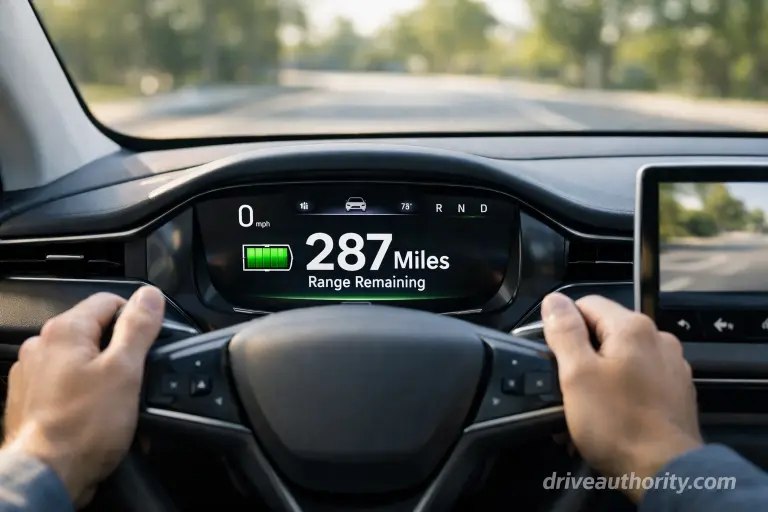
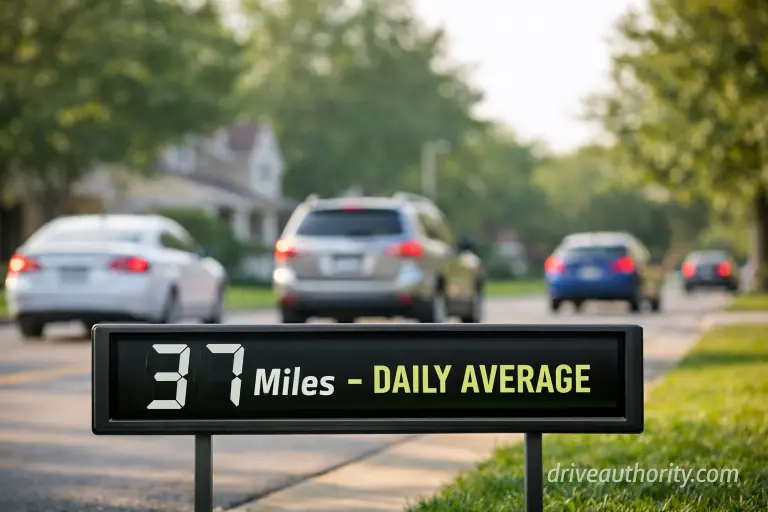
EV range anxiety is overblown for 90% of drivers because the average American drives just 37 miles daily, while even affordable EVs now offer 250+ miles of real-world range. If you can charge at home and drive under 200 miles most days, range anxiety is a psychological barrier created by decades of gas car habits—not a practical concern you’ll face in daily EV ownership. This reality check is for home-charging buyers worried that EVs won’t meet their needs, not for road warriors driving 500+ miles weekly without charging access.
If you’re an Uber driver or sales rep logging 300+ miles daily, range limitations are real and this article won’t apply to your situation.
Why EV Range Anxiety Exists (And Why It’s Mostly Mental)
Range anxiety stems from the ingrained habit of watching your gas gauge drop and knowing you can refill anywhere in 5 minutes. EVs flip this model completely, and your brain hasn’t caught up yet.
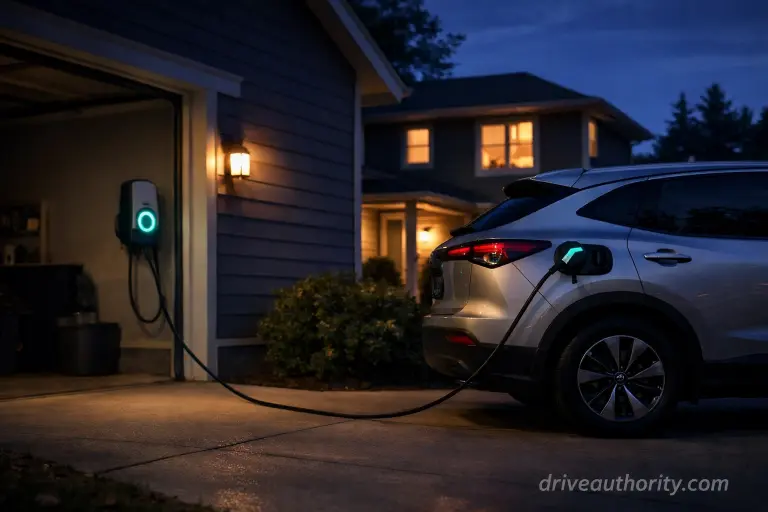
Here’s the shift most people miss: with home charging, you start every single day with a “full tank.” Your EV adds 200-300 miles of range overnight while you sleep. You never drive to a charging station for your daily routine—the car charges passively at home.
Compare this to gas cars: even with a 400-mile tank, you still visit gas stations 2-3 times monthly. That’s 24-36 trips annually, each taking 10-15 minutes including the detour. With an EV and home charging, those trips disappear entirely for 95% of your driving.
Real example: I drove a Chevy Equinox EV (319 miles EPA range) for three months and charged publicly exactly twice—both times on road trips over 250 miles. My daily 60-mile commute never triggered range concerns because I plugged in nightly and woke up to 280+ miles every morning.
The psychological disconnect happens because you’re thinking about EVs through a gas-car lens. Gas cars require you to actively manage range by visiting stations. EVs with home charging manage range passively while parked. It’s a fundamentally different ownership model, and EV range anxiety dissolves once you experience this shift firsthand.
According to Department of Transportation data, American drivers average 37 miles daily. Even a “short-range” EV like a Nissan Leaf with 149 miles EPA (120-130 real-world) covers three days of typical driving on a single charge.
When Range Anxiety Is Actually Valid (The 10% Case)
Range concerns are legitimate in specific scenarios, and pretending otherwise does buyers no favors.
Scenario 1: No home charging access. If you rely on public charging for daily use, range anxiety becomes range reality. You’re constantly calculating whether you have enough charge to reach the next available station, dealing with broken chargers, and spending 30-45 minutes multiple times weekly. This completely changes the ownership experience and makes range a genuine daily concern.
Scenario 2: Frequent long-distance driving without route planning. If you regularly drive 300+ miles in a day through rural areas with sparse charging infrastructure, EVs currently require more planning than gas cars. You need to map charging stops, account for seasonal range loss, and add 30-60 minutes to your trip for charging sessions.
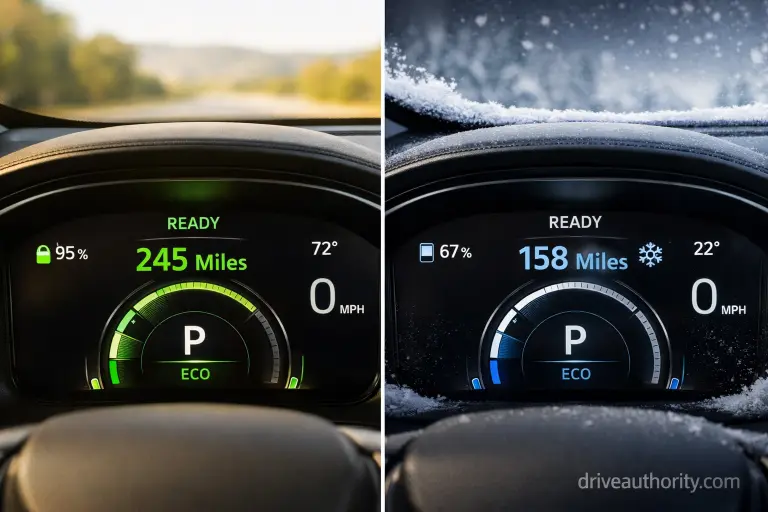
Scenario 3: Extreme cold climates without garage parking. EVs lose 30-40% range in temperatures below 20°F, and even more if the battery is cold-soaked overnight. A 250-mile EV becomes a 150-175 mile vehicle in Minnesota winters when parked outside. If you’re driving 100+ miles daily in harsh winter conditions, range becomes a legitimate constraint.
Scenario 4: Towing regularly. Towing cuts EV range by 40-60% depending on trailer weight and aerodynamics. A Ford F-150 Lightning with 320 miles of range drops to 130-180 miles when towing a 7,000-pound trailer. If towing is your primary use case, current EVs force frequent charging stops.
For everyone else—daily commuters with home charging, suburban families, urban dwellers—range anxiety is a phantom problem that evaporates within two weeks of EV ownership.
The Math That Kills Range Anxiety

Let’s run real numbers using common scenarios:
Urban commuter (40 miles daily): Any EV with 200+ miles range. Charge once or twice weekly at home. You’ll maintain 60-100% battery most of the time. Range becomes irrelevant.
Suburban family (60 miles daily): Mid-range EV like Hyundai Kona Electric (261 miles) or Chevy Equinox EV (319 miles). Charge 2-3 times weekly. Even with kids’ activities and weekend errands, you rarely dip below 40% charge.
Long commuter (120 miles daily): Tesla Model 3 Long Range (341 miles) or similar. Charge every other night. Winter range loss still leaves you comfortable margins.
The pattern is clear: match your EV’s range to roughly 2-3x your daily driving. This buffer handles weather, detours, and range degradation while eliminating daily range monitoring.
| Daily Driving | Minimum EV Range | Recommended Models | Charging Frequency |
|---|---|---|---|
| Under 50 miles | 150+ miles | Nissan Leaf, Mini Cooper SE | 2-3x weekly |
| 50-80 miles | 220+ miles | Hyundai Kona Electric, Chevy Bolt EUV | 2-3x weekly |
| 80-150 miles | 280+ miles | Tesla Model 3, Chevy Equinox EV, Ioniq 6 | Every 2-3 days |
Battery degradation is the boogeyman people cite without checking data. Modern EVs retain 90% capacity after 100,000 miles. A 300-mile EV becomes a 270-mile EV after five years of typical use—still far more than daily needs require.
Your Range Anxiety Reality Check

Before letting range concerns kill your EV purchase, do this exercise:
- Track actual driving for 30 days. Most people grossly overestimate their daily mileage. Apps like Google Timeline show your real patterns.
- Calculate your true maximum daily drive. Not your once-yearly road trip—your actual furthest regular drive. For 90% of people, this is under 150 miles.
- Map charging options. If you have home charging, you’ve solved 95% of potential range issues. If you don’t, EVs probably aren’t right for you yet.
- Test drive for range awareness. Take an EV home overnight if dealers offer this. Watch how quickly your mental model shifts when you experience passive overnight charging.
For detailed range comparisons and charging infrastructure maps, check our complete EV buying guide before making your decision.
The Bottom Line on EV Range Anxiety
EV range anxiety is a genuine psychological barrier based on gas-car thinking, but it’s not a practical problem for home-charging drivers with typical commutes. Modern EVs offer 250-350 miles of range—far exceeding the 37-mile daily average American driving pattern—and overnight charging means you never manage range actively like you do with gas.
Your next step: honestly assess whether you have reliable home charging access. If yes, pick an EV with 2-3x your daily driving range and commit to a test drive. Within two weeks of ownership, range anxiety will feel as quaint as worrying whether your smartphone battery will last through a normal day—it just stops being a concern once the charging routine becomes automatic.