Public EV charging costs $0.43-$0.68 per kWh in 2026, meaning a typical charge costs $32-$51 compared to $9-$12 at home. New EV owners consistently underestimate this 3-5x price difference, turning what should be a money-saving decision into an expensive mistake if you can’t charge at home. This reality check is for buyers considering an EV without reliable home charging access—not for those with garages or dedicated parking spots.
If you already have home charging installed, this won’t apply to your situation. You’re golden.
Why Public EV Charging Cost Shocks First-Time Owners
The advertised promise of EVs saving money assumes you’re charging at home. Nobody tells you that public charging can cost more per mile than premium gasoline.
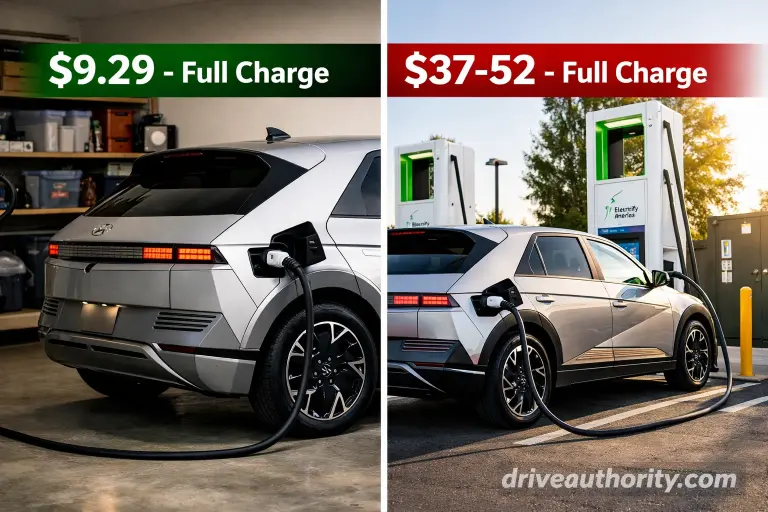
Here’s the math that catches people off guard: a Hyundai Ioniq 5 with a 77.4 kWh battery costs $9.29 to charge from empty at home (at $0.12/kWh). That same charge at an Electrify America station costs $33-$52 depending on your pricing plan and location. At $0.48/kWh (typical non-membership rate), you’re paying $37 for 260 miles of range.
Compare that to a gas-powered Tucson getting 26 mpg. At $3.50/gallon, driving 260 miles costs $35 in fuel. You’re spending nearly identical amounts, but the gas car fills in 5 minutes while you’re waiting 35-45 minutes at a charger.
The public EV charging cost disparity gets worse with Tesla Superchargers, which now range from $0.25-$0.60/kWh depending on location and time of day. Peak pricing in urban areas like California can hit $0.58-$0.68/kWh. A Model 3 with a 75 kWh battery costs $19-$51 for a full charge depending on when and where you plug in.
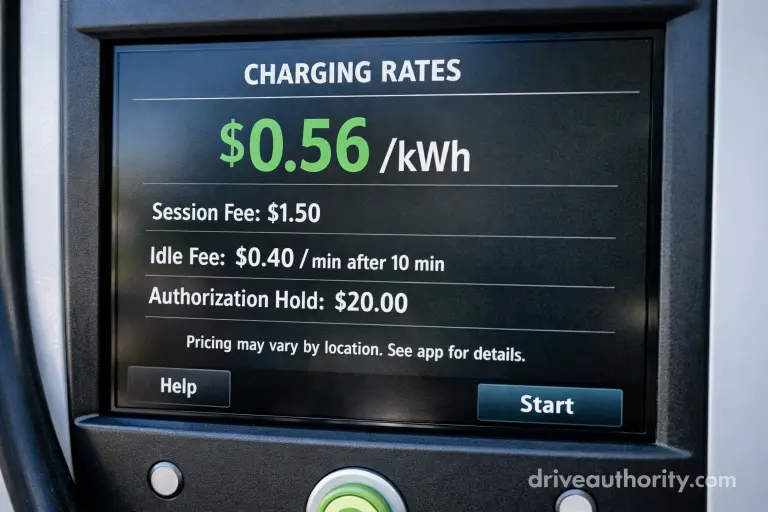
Real-world example: my colleague bought a Volkswagen ID.4 assuming he’d charge at work. His employer installed ChargePoint stations but charges $0.52/kWh with no time limits. He’s spending $160-$180 monthly on charging versus the $55 he’d pay at home. Over five years, that’s an extra $6,300 in transportation costs he didn’t budget for.
The Hidden Variables That Spike Charging Costs
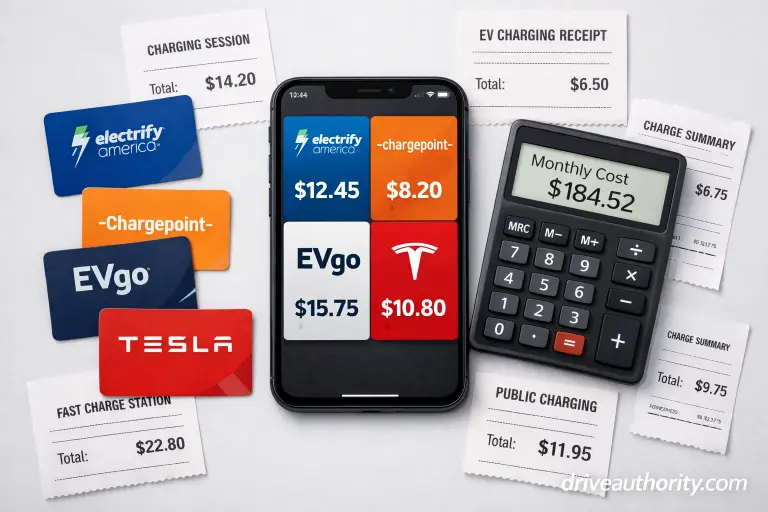
Public charging networks use dynamic pricing that changes based on factors most new owners don’t anticipate. Understanding these variables is critical before committing to an EV without home charging.
Time-of-day pricing hits hardest. Electrify America charges 30-40% more during peak hours (typically 4-9 PM). If you’re charging after work like most people, you’re automatically paying premium rates. That $0.43/kWh rate advertised becomes $0.56-$0.61/kWh when you actually need it.
Idle fees compound the expense. Most networks charge $0.40-$1.00 per minute after your car finishes charging. If you don’t return within 5-10 minutes, you’re paying an extra $4-$10 in penalties. Tesla Superchargers in busy areas charge $1.00/minute when the station is 50%+ full.
Membership confusion creates unexpected costs. Electrify America offers a “Pass+” subscription at $4/month for lower per-kWh rates. Sounds reasonable until you realize it only saves money if you’re charging more than twice weekly. Most casual users end up paying the subscription fee while still using expensive pay-as-you-go rates occasionally.
Location pricing varies wildly. The same Electrify America network charges $0.36/kWh in Texas, $0.48/kWh in Florida, and $0.63/kWh in California. If you move or road trip frequently, your charging budget becomes unpredictable.
Furthermore, charging speed impacts cost. Many networks charge more for 350 kW “ultra-fast” stations even if your car maxes out at 150 kW. You’re paying a premium for speed you can’t actually use.
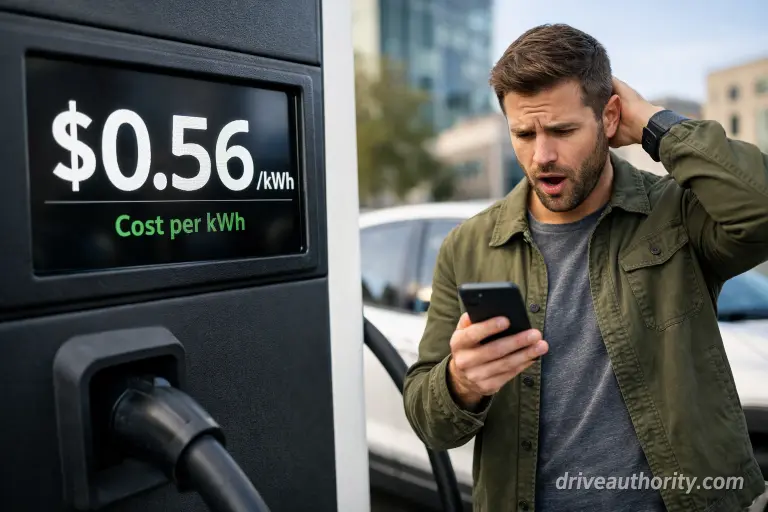
According to recent Department of Energy analysis, public DC fast charging averaged $0.56/kWh nationally in late 2024, with costs trending upward as networks invest in infrastructure upgrades and profitability.
When Public Charging Makes Financial Sense (Rarely)
Public charging only pencils out financially in very specific scenarios—and most new EV owners don’t fit them.
Scenario 1: Ultra-low home electricity rates. If you live in an area with $0.06-$0.08/kWh home rates (parts of the Pacific Northwest), public charging at $0.43-$0.48/kWh still hurts but the gap is smaller. You’re paying 5-6x more instead of 3-4x more.
Scenario 2: Truly occasional use. If you charge publicly once or twice monthly for road trips while doing 95% of charging at home, the premium is tolerable. You’re spending an extra $20-$30 monthly versus gas, which is acceptable for most budgets.
Scenario 3: Free workplace charging. Some employers offer free charging as a perk. This completely changes the economics. Verify this benefit is truly free (not billed back to employees) and available long-term before buying an EV based on this assumption.
The harsh reality: if you’re relying on public charging for 50%+ of your needs, you’re spending $140-$200 monthly on electricity versus $55-$70 at home. That $90-$130 monthly penalty ($1,080-$1,560 annually) erases most EV savings over gas cars.
For apartment dwellers or those without dedicated parking, this creates an impossible situation. You bought an EV to save money and help the environment, but the infrastructure reality punishes you financially for trying.
Calculate Your Real Public EV Charging Cost Before Buying
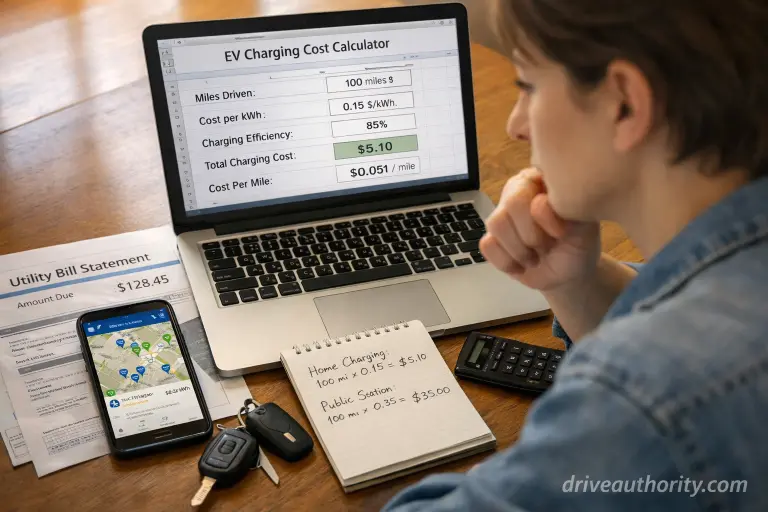
Before committing to an EV without home charging, run these numbers honestly:
- Track your actual driving: Use 30 days of current mileage to estimate monthly kWh needs (divide miles by 3.5)
- Map local charging stations: Use PlugShare to find nearby stations and their real pricing (not advertised rates)
- Calculate realistic monthly costs: (monthly kWh needed) × (average local public charging rate)
- Compare to current fuel costs: Is the EV actually cheaper, or are you paying a premium for environmental benefits?
A Chevy Equinox EV driven 1,000 miles monthly needs roughly 285 kWh. At $0.48/kWh public charging, that’s $137/month. A comparable gas SUV at 28 mpg uses 36 gallons monthly, costing $126 at $3.50/gallon. You’re spending more to go electric while enduring longer refueling times.
For detailed cost comparisons and charging network maps, check our complete EV ownership cost guide before making your purchase decision.
The Bottom Line on Public Charging Costs
Public EV charging cost in 2026 runs 3-5x higher than home charging, surprising new owners who assumed EVs automatically save money. At $0.43-$0.68/kWh, you’re often spending as much or more than gas while dealing with longer charging times and infrastructure headaches.
Your decision is simple: if you can install home charging, EVs make excellent financial sense. If you’re dependent on public charging for daily use, you’re better off with a plug-in hybrid or efficient gas car until your housing situation changes. Don’t let anyone convince you otherwise—the math doesn’t lie, and your wallet will remind you every month.