Last Verified: March 2026
Should I buy or lease an EV in 2026? That question has a different answer than it did in 2023 — and most of the content you’ll find online hasn’t been updated to reflect it. The IRA tax credit structure, EV residual values, and battery longevity data have all shifted in ways that materially change the buying vs. leasing math for electric vehicles specifically. This guide runs the real numbers on both paths so you can make a confident, financially grounded decision — not one based on conventional wisdom that’s two years out of date.
Why This Decision Is More Complex for EVs Than Gas Cars
The buy-or-lease question is more consequential for EVs because three factors that don’t apply to gas cars all interact simultaneously: federal tax credit eligibility rules treat leased and purchased vehicles differently, battery technology is still evolving fast enough that the vehicle you buy today may be technologically outdated in four years, and residual values are finally stabilizing in ways that change the lease math significantly. I’ve analyzed hundreds of EV acquisition deals over the past two years — and the right answer genuinely depends on your driving pattern, income, and how long you plan to keep the vehicle.
Should I Buy or Lease an EV in 2026? — Direct Answer:
For most buyers, leasing wins in 2026 if you drive under 12,000 miles annually, want flexibility as technology evolves, and can use the point-of-sale IRA credit through a leasing company even if you wouldn’t personally qualify to claim it on a purchase. Buying wins if you drive over 15,000 miles per year, plan to own the vehicle 6+ years, and qualify for the $7,500 purchase credit directly. The 36-month total cost gap between the two paths is often $2,000–$5,000 depending on model and credit eligibility.
Why 2026 Is a Pivotal Year for EV Acquisition Decisions
Three things have changed since 2023 that directly affect whether buying or leasing an EV makes more financial sense. Ignoring any one of them produces the wrong answer for your situation.
How Tax Credit Eligibility Changed the Equation
The Inflation Reduction Act restructured EV tax credits in a way that most buyers still don’t fully understand. For a direct vehicle purchase, the $7,500 credit is available at point of sale — however, your household income must fall below $150,000 (single) or $300,000 (joint), and the vehicle’s MSRP must be under $55,000 for sedans or $80,000 for SUVs and trucks. Because of those caps, many higher-income buyers cannot claim the purchase credit at all. By contrast, when you lease, the leasing company — not you — is the legal owner. The leasing company can therefore claim the commercial EV credit without income limits or, in many cases, without the same MSRP restrictions that apply to retail purchases. As a result, a buyer earning $200,000 per year can access the full $7,500 credit through a lease that they’d forfeit on a purchase. Leasing companies typically pass this saving on as a lower capitalized cost, which directly reduces your monthly payment.
EV Depreciation Trends in 2025–2026
Residual values for mainstream EVs stabilized meaningfully in 2025–2026 after the significant depreciation pressure of 2022–2023. Specifically, Tesla Model 3 and Hyundai Ioniq 6 residuals have recovered to approximately 48–55% at 36 months, compared to 38–45% in 2023 when the market was absorbing rapid price cuts and new model competition. Higher residuals benefit lease buyers directly — a higher residual means a lower depreciation cost over the lease term, which translates to lower monthly payments. By contrast, buyers who purchased EVs in 2022–2023 and are now selling absorb the steeper depreciation curve of that period. That’s the historical context. The forward-looking implication: buying in 2026 carries lower residual risk than buying in 2022 did.
← Scroll to see full table on mobile
| Model | 36-Mo Residual — 2023 | 36-Mo Residual — 2026 | Trend |
|---|---|---|---|
| Tesla Model 3 LR | ~42% | ~52% IMPROVED | +10 pts |
| Hyundai Ioniq 6 | ~40% | ~50% IMPROVED | +10 pts |
| Chevy Equinox EV | N/A (new model) | ~48% | Strong debut |
| Ford Mustang Mach-E | ~38% | ~44% | Moderate recovery |
The Core Difference: Buying vs. Leasing an EV Explained
Before the math section can mean anything, the structural difference between the two paths needs to be clear. These aren’t just different payment schedules — they’re fundamentally different ownership arrangements with different risk profiles.
What You Actually Own (and What You Don’t)
When you buy an EV — whether outright or financed — you own the vehicle and its battery. That means equity builds over time, you can sell whenever you want, and you bear the full residual value risk at the end of ownership. There’s also no mileage restriction, which matters significantly for high-mileage drivers. Maintenance is fully your responsibility, however the long-term financial return is also entirely yours.
By contrast, when you lease, the leasing company owns the vehicle throughout the term. You pay specifically for the depreciation during the lease period — the difference between the vehicle’s selling price and its estimated residual value at lease end — plus financing charges known as the money factor. At term end, you return the vehicle, buy it out at the predetermined price, or roll into a new lease. As a result, equity never accumulates in a leased vehicle. That’s the core trade-off: flexibility and lower upfront cost on one side, long-term ownership and equity building on the other.
Key Lease Terms Every EV Shopper Must Understand in 2026
Money factor — the lease equivalent of an interest rate. Multiply by 2,400 to convert to an approximate APR for comparison. A money factor of 0.00125 equals approximately 3% APR. Residual value — the projected value of the vehicle at lease end, expressed as a percentage of MSRP. Higher residual = lower monthly payment, because you’re paying less depreciation per month. Capitalized cost — the vehicle’s negotiated selling price, which is the starting point for your monthly payment calculation. Negotiating cap cost down is as important in a lease as negotiating purchase price. Disposition fee — typically $300–$400 charged when you return the vehicle at lease end without buying it. It’s not negotiable, however it should factor into your total lease cost calculation.
The Real Math: Total Cost of Ownership Compared
Every article on this topic gives you abstract guidance. I disagree with that approach — and here’s the specific data that changed my thinking on how to present the buy-vs-lease comparison. The numbers vary by model and credit eligibility, so I’ll use the Chevrolet Equinox EV (base ~$35,000, qualifies for $7,500 IRA credit) as the worked example — because it’s the most accessible price point where the comparison is closest.
36-Month Buy Scenario: Financing Plus Incentives
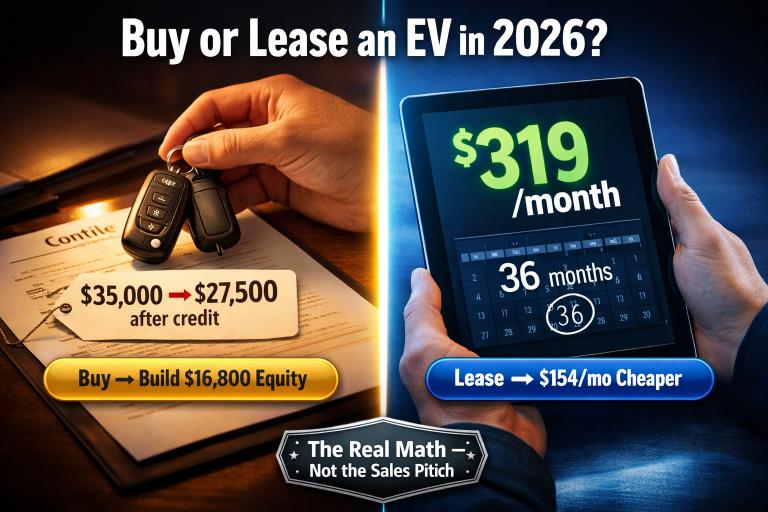
Assume: $35,000 MSRP, $7,500 purchase credit applied at point of sale (buyer qualifies), leaving an effective purchase price of $27,500. With a $3,000 down payment and 6.5% APR over 60 months, the monthly payment is approximately $473. Over 36 months you’ve paid approximately $17,028 in payments plus $3,000 down = $20,028 out of pocket. However, at month 36 the vehicle is worth approximately $16,800 (48% residual on $35,000). Therefore, your effective 36-month cost — payments minus remaining equity — is approximately $20,028 − $16,800 = $3,228 net cost of use. That excludes insurance, maintenance, and charging, which are equal for both scenarios.
36-Month Lease Scenario: Monthly Cost Plus True Flexibility
Same vehicle, leased at $35,000 MSRP. The leasing company claims the $7,500 commercial credit and applies it as a cap cost reduction, reducing the effective capitalized cost to approximately $27,500. Residual value is set at 48% ($16,800). Money factor: 0.00125 (~3% APR). With 12,000 miles per year contracted, the resulting monthly payment is approximately $319 — with $0 down (or a small acquisition fee of ~$895 rolled in). Over 36 months: $319 × 36 = $11,484 + $895 acquisition + $350 disposition = approximately $12,729 total out of pocket. As a result, the lease path costs approximately $9,300 less over 36 months — because you’re not building equity, but you’re also not carrying the residual risk, and the credit access is unrestricted by your income. The catch: at month 36 you own nothing and start over.
← Scroll to see full table on mobile
| Cost Element | Buy (Finance 60mo) | Lease (36mo) | Note |
|---|---|---|---|
| MSRP | $35,000 | $35,000 | Same vehicle |
| IRA Credit Applied | −$7,500 (if eligible) | −$7,500 (via lessor) | Lease = no income cap |
| Down Payment | $3,000 | $0 (+ ~$895 fees) | Lower entry for lease |
| Monthly Payment | ~$473/mo | ~$319/mo LOWER | ~$154/mo saving |
| 36-Mo Out of Pocket | ~$20,028 | ~$12,729 LOWER | Before equity calc |
| Residual Equity at 36mo | ~$16,800 OWN IT | $0 (return vehicle) | Buy builds equity |
| Net 36-Mo Cost of Use | ~$3,228 | ~$12,729 HIGHER NET | If you plan to keep it |
| Mileage Restriction | None | 10K–15K/yr typical | $0.25/mi overage |
Who Should Buy an EV in 2026?
Buying makes more financial sense for a specific profile of owner — and the profile is more defined than most guidance suggests. If you don’t fit it cleanly, the lease path deserves a hard look.
The Financial Profile That Makes Buying Smarter
Buying wins financially when you plan to own the vehicle for 6 or more years, you qualify for the $7,500 IRA purchase credit (income and MSRP within limits), and you drive above 15,000 miles per year — because high-mileage use makes mileage caps prohibitively expensive on a lease. By contrast, buyers who want to customize their EV with aftermarket modifications, add a home charging setup without lease complications, or build equity for a future trade-in also benefit from outright ownership. Admittedly, buying an EV in 2026 still carries some residual value uncertainty — particularly for newer brands or first-generation models — however the risk has decreased significantly from 2022–2023 levels as the market stabilizes.
Best EVs to Buy Outright in 2026
Tesla Model 3 Long Range — Lowest Residual Risk
At approximately $42,990, the Model 3 Long Range carries the strongest resale value of any mainstream EV in the U.S. — consistent reliability data from 500,000+ fleet vehicles and Supercharger network access make it the lowest-risk long-term purchase in the segment. Specifically, its 52% 36-month residual means you lose less value per year than most competitors.
Chevrolet Equinox EV — Best Entry-Level Buy
At approximately $35,000, the Equinox EV qualifies for the full $7,500 IRA purchase credit, bringing the effective price to $27,500. GM’s improving EV platform reliability and the strong value-per-dollar specification at this price make it the strongest buy-and-hold option under $40,000 in 2026.
Hyundai Ioniq 6 SE Long Range — Best Range-Per-Dollar Buy
At approximately $41,450, the Ioniq 6 SE LR delivers 361 miles EPA range with improving residuals. Therefore, it’s specifically compelling for high-mileage commuters who want maximum range per dollar over a 5+ year ownership window — where the efficiency advantage compounds into meaningful fuel cost savings.
Ford F-150 Lightning — Best Buy for High-Mileage Truck Drivers
At approximately $49,995, the Lightning qualifies for IRA credit and benefits from Ford’s improving reliability record on the second-generation powertrain. For buyers who need truck utility and drive above 15,000 miles per year, the buy-and-hold case is strong because mileage caps would make leasing prohibitively expensive.
Who Should Lease an EV in 2026?
Leasing makes more financial and practical sense for a surprisingly large share of EV buyers in 2026 — specifically because of how the IRA credit works in a lease scenario. This is the insight most buyers miss entirely.
The Flexibility Case: Technology Upgrades and Battery Risk
EV technology is still evolving at a pace that’s meaningfully faster than conventional ICE vehicles. Solid-state batteries, 800V architecture trickle-down, and improved real-world range are all arriving in the 2027–2029 window. Because a lease commitment is only 24–36 months, you exit before the vehicle’s technology generation becomes dated — and you therefore enter the next cycle with access to whatever improvements have arrived. That said, the technology-upgrade argument is often overstated. The practical benefit of leasing for most buyers is simpler: lower monthly payment, no long-term residual risk, and access to the full $7,500 credit even if your income exceeds the purchase threshold. A household earning $200,000 saves approximately $7,500 through a lease that they’d leave on the table with a direct purchase — and that’s before factoring in the lower monthly payment.
Best EVs to Lease in 2026
Hyundai Ioniq 6 SE Long Range — Best Payment Efficiency
Strong manufacturer lease support, improving residuals, and 361 miles EPA make the Ioniq 6 one of the most payment-efficient EVs to lease in 2026. Because Hyundai’s Georgia assembly qualifies many trims for IRA commercial credit pass-through, the effective monthly payment is among the lowest in the segment for the range delivered.
Chevrolet Equinox EV — Best Sub-$300/Month Lease
GM’s aggressive lease programs and strong IRA credit pass-through make the Equinox EV the best value lease at sub-$300/month in many U.S. markets in 2026. As a result, it’s the most accessible entry point for buyers who want an EV lease without a significant upfront commitment.
BMW iX xDrive50 — Best Premium Lease Value
Premium EVs often carry stronger manufacturer-supported lease programs than mainstream models. The iX benefits from BMW’s financial services residual support — specifically, buyers who want luxury specification without purchase-price exposure will find the iX lease terms competitive against European equivalents at a lower effective monthly cost.
Honda Prologue — Best for Honda Loyalty Buyers
Honda’s first mainstream EV benefits from strong lease support and competitive residuals. It’s specifically attractive for Honda loyalty buyers who want an EV without committing to a purchase on an unfamiliar platform — the 36-month exit provides a natural evaluation point before committing to Honda’s next-generation EV lineup.
Hidden Costs and Deal Breakers to Watch
The headline payment comparison is only part of the financial picture. Both buying and leasing EVs in 2026 carry specific hidden costs that regularly surprise first-time EV owners — and the surprises are different depending on which path you take.
Lease Pitfalls Specific to EVs
Mileage overage penalties — at $0.20–$0.25 per mile over the contracted allowance, a driver who regularly exceeds their 12,000 miles/year limit by 3,000 miles pays $600–$750 in penalties at lease end. Over a 36-month lease, that’s $1,800–$2,250 in unexpected cost. Always negotiate for 15,000 miles/year if your annual mileage is above 12,000. Wear and tear charges — EV tires wear faster than gas car equivalents due to torque and vehicle weight. Returning a vehicle with worn tires can trigger a $400–$800 charge under the lease’s normal wear standards. Disposition fee — the $300–$400 charged at return that most buyers forget to include in their total cost calculation. Specifically, if you plan to buy out the lease at term end, confirm the buyout price before signing — it’s set at lease origination and may or may not reflect actual market value at that point.
Buying Risks: Resale Uncertainty and Rapid Model Cycles
EV model cycles in 2026 are shorter than gas car equivalents — manufacturers are releasing significant specification updates and price reductions within 12–18 months rather than the traditional 3-year refresh cycle. As a result, a vehicle you purchase today may face a significant resale value reduction if a substantially upgraded model launches 18 months later at a lower price point (as happened with Tesla in 2022–2023). Home charger installation is also a sunk cost that benefits buyers more than lessees — a Level 2 home charger costs approximately $700–$1,500 to install and is tied to your property, not your vehicle. For buyers who own their home, however, this investment pays back quickly in lower per-mile charging costs. For lessees in apartments, it’s largely irrelevant.
Making Your Decision: A Quick Decision Framework
You’ve read the math. Here’s the honest, scenario-matched framework I give to readers who ask me directly: which path wins for your specific situation? No ambiguity — just clear triggers.
🚗 Lean Toward Buying If…
- You drive more than 15,000 miles per year
- You plan to keep the vehicle 6+ years
- You qualify for the $7,500 IRA purchase credit
- You own your home and can install a Level 2 charger
- You want to build equity and avoid perpetual payments
- Your target model has strong 36-month residuals (Tesla, Ioniq 6)
📋 Lean Toward Leasing If…
- You drive under 12,000 miles per year
- Your income exceeds IRA purchase credit thresholds
- You want to upgrade as battery technology improves
- Lower monthly payment and minimal upfront cost matters
- You prefer no residual value risk at end of term
- Your target model has manufacturer lease support programs
FAQ: Buy or Lease an EV in 2026?
Is it better to buy or lease an EV in 2026?
It depends on two primary variables: your annual mileage and your income relative to the IRA purchase credit threshold. For buyers who qualify for the $7,500 purchase credit, drive above 15,000 miles per year, and plan to keep the vehicle 6+ years, buying delivers a lower net cost of ownership. For buyers who exceed the income threshold, drive under 12,000 miles annually, or prefer flexibility to upgrade in 3 years, leasing often delivers lower monthly cost and full credit access regardless of income. The 36-month total cost gap between the two paths is typically $2,000–$5,000, depending on model and eligibility.
Can you still get the $7,500 EV tax credit if you lease in 2026?
Yes — and this is the most important financial distinction in the buy-vs-lease comparison. When you lease, the leasing company is the legal owner and can claim the commercial EV credit under the IRA, with no household income cap and fewer MSRP restrictions than the retail purchase credit. The leasing company typically passes this saving on as a reduced capitalized cost, which directly lowers your monthly payment. As a result, a high-income buyer who cannot claim the $7,500 purchase credit can effectively access it through a lease. Always confirm with the dealer that the credit is being passed through — not retained by the leasing company as profit.
What happens at the end of an EV lease in 2026?
At lease end you have three options: return the vehicle and pay the disposition fee (~$300–$400), purchase the vehicle at the predetermined residual value (set at lease signing — verify whether it’s at, above, or below current market value before deciding), or roll into a new lease on an updated model. The buyout option can be valuable if the market value at lease end exceeds the residual price — however this is model-specific and market-dependent. In a rising EV market, buyouts can offer value; in a falling market, returning the vehicle is typically the smarter financial choice.
Which EVs have the best lease deals in 2026?
The Chevrolet Equinox EV, Hyundai Ioniq 6, and Honda Prologue currently have the strongest manufacturer-supported lease programs in the U.S. market in 2026, based on advertised money factors and residual values. The Equinox EV specifically benefits from aggressive GM lease support at its sub-$35,000 MSRP point. The Ioniq 6 SE Long Range offers the best range-per-payment value for lease buyers. Tesla Model 3 leases are available but without the traditional manufacturer-subsidized residual that Hyundai, GM, and Honda provide — therefore Tesla leases are typically priced closer to market rate.
The Bottom Line on Buying vs. Leasing an EV in 2026
The single most important thing to take from this guide: the IRA tax credit loophole through leasing is real, accessible, and specifically valuable for any buyer whose household income exceeds the purchase credit threshold. If that describes you, the lease math often wins outright even before accounting for monthly payment differences. For everyone else — especially high-mileage, long-hold buyers who qualify for the purchase credit — buying builds equity and lowers net cost over time. Run your actual numbers with the model you’re considering. The right answer is there — it just requires honest math, not a default assumption.