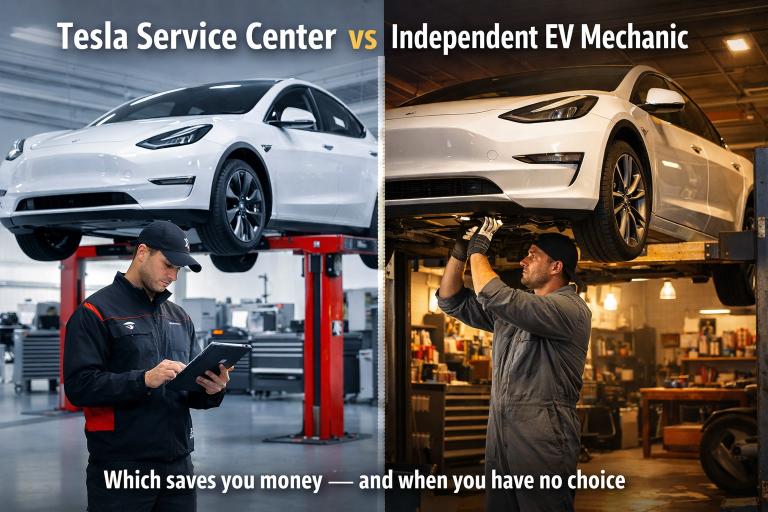
The Tesla service center vs independent EV mechanic decision is one of the most financially important choices you’ll make as a Tesla owner. Most people approach it without the right information. Once your factory warranty expires, the question goes beyond price. It’s about what each option can actually do for your specific repair, how long you’ll wait, and whether the wrong choice risks your remaining coverage.
What This Tesla Service Center vs Independent Mechanic Comparison Covers
I’ve tracked Tesla service costs and repair data for years. The number I hear most from frustrated owners isn’t the bill itself. It’s the 3-week appointment wait that pushed them toward independent shops in the first place. This article compares both options across five criteria: labor rates, real repair costs, scheduling, parts access, and warranty implications. It also identifies which repairs independent shops cannot complete on a Tesla — the part most comparisons skip entirely.
Tesla Service Center vs Independent EV Mechanic — Quick Answer:
Independent EV mechanics are typically 20–40% cheaper for out-of-warranty mechanical repairs — brake service, suspension, 12V battery, tires, and HVAC components. However, Tesla Service Centers remain necessary for high-voltage battery work, Autopilot hardware, software-gated diagnostics, and any warranty-eligible repair. Neither option is universally better. The right choice depends entirely on repair type, your warranty status, and whether a qualified independent shop operates near you.
Tesla Service Center vs Independent EV Mechanic: The Numbers at a Glance
Quick Verdict: Tesla Service Center or Independent Mechanic?
Choosing the wrong option for the wrong repair type is how owners waste money or void coverage. It can also end with an incomplete fix that still requires a Tesla visit — meaning you pay twice.
When Tesla Service Center Is the Right Call
Use a Tesla Service Center when your vehicle is within the factory warranty and the repair is warranty-eligible. That service is effectively zero-cost to you. Any repair involving the high-voltage battery pack, Autopilot hardware, software-gated diagnostics, or Tesla-certified structural body repair requires Tesla access. There is no workaround for these categories at independent shops. The software access boundary is a hard technical limit, not a preference.
When an Independent EV Mechanic Makes Financial Sense
By contrast, once your Tesla is out of warranty, independent shops become financially competitive. Brake service, suspension, tires, 12V battery, and HVAC repairs can all be handled independently — typically cheaper and faster. The labor rate gap of $50–$75 per hour compounds quickly on a multi-hour job. That said, finding a genuinely Tesla-experienced independent mechanic matters. Not every EV shop has the tooling or training for Tesla-specific components.
🔵 Use Tesla Service Center When…
- Vehicle is within factory warranty on eligible repairs
- High-voltage battery diagnostic, replacement, or module service
- Autopilot / FSD hardware recalibration after collision
- Software-gated repair requiring Tesla diagnostic authorization
- Tesla-certified structural body repair required
- Mobile service is available for your repair (cheapest option)
🟢 Use Independent EV Mechanic When…
- Tesla is out of warranty and repair is mechanical, not software-gated
- Brakes, suspension, tires, 12V battery, HVAC — wear item category
- Faster turnaround needed than local Tesla Center can offer
- Cost gap is significant and repair is on the “can fix” list
- Body cosmetic work, PDR, bumper repair, accessories
- A vetted, Tesla-experienced shop operates in your area
Tesla Service Center vs Independent EV Mechanic: What You Actually Pay
Here’s what most service articles won’t tell you: Tesla Service Center labor rates rank among the highest in the EV sector. The parts markup compounds that cost further on longer jobs. However, the gap isn’t uniform across repair types. Knowing which repairs produce the biggest independent savings is the real financial leverage here.
Tesla Service Center Labor Rates and Common Repair Costs
Tesla Service Center labor rates run approximately $175–$225 per hour, based on aggregated data from Tesla Motors Club and Tesla’s service documentation. Urban markets like California and New York skew higher. Midwest and Southern markets land at the lower end. Tesla’s Mobile Service handles a subset of repairs at lower total cost — it eliminates shop overhead entirely. Mobile covers 12V battery replacement, minor software issues, door handle actuators, and certain sensor replacements, typically at $50–$150 less than in-center pricing.
Common Tesla Service Center repair examples: 12V battery replacement runs approximately $200–$350 in-center. Front brake service runs approximately $350–$500. Suspension component replacement runs approximately $600–$1,200 depending on model and part. Door handle actuator runs approximately $300–$500. Parts markup at Tesla Service Centers runs approximately 20–35% above independent shop OEM sourcing, per Tesla Motors Club owner comparisons. That markup, combined with the higher labor rate, drives significant cost gaps on multi-hour jobs.
Independent EV Mechanic Labor Rates and Cost Reality
Independent EV-specialist shops charge approximately $110–$160 per hour for Tesla work, based on NAPA AutoCare and RepairPal regional benchmarks. That’s a $40–$80 per hour gap versus Tesla Service Center rates. On a three-hour brake job, that gap alone represents $120–$240 in labor savings. The same 12V battery replacement costing $200–$350 at Tesla runs approximately $150–$250 at a qualified independent shop. Brake service at independent shops typically runs $250–$380 for the same front axle job.
The catch is parts sourcing. Independent shops order Tesla OEM parts through third-party distributors. However, lead times may be longer than through Tesla’s own supply chain. As a result, cost savings occasionally come with an added day or two for parts to arrive. Software-dependent repairs cannot be completed at any independent shop regardless of price. That limitation only affects a specific repair category — however it’s the one most owners don’t check before booking.
Repair Cost Table: Tesla Service Center vs Independent Shop Side by Side
| Repair Type | Tesla Service Center Cost | Independent EV Shop Cost | Est. Savings |
|---|---|---|---|
| 12V Battery Replacement | $200–$350 | $150–$250 CHEAPER | ~$50–$100 |
| Front Brake Service (pads + rotors) | $350–$500 | $250–$380 CHEAPER | ~$100–$120 |
| Suspension Component (front control arm) | $700–$1,200 | $450–$850 CHEAPER | ~$200–$400 |
| Door Handle Actuator | $300–$500 | $220–$380 CHEAPER | ~$80–$120 |
| HVAC Repair (cabin air, blower) | $400–$700 | $280–$520 CHEAPER | ~$100–$200 |
| High-Voltage Battery Service | $5,000–$20,000+ | Not available TESLA ONLY | — |
| Autopilot Hardware Recalibration | Varies — often warranty | Not available TESLA ONLY | — |
Tesla Service Center vs Independent EV Mechanic: Wait Times and Scheduling
I get this complaint constantly. The repair itself is manageable — but a 2–3 week wait for an appointment is the real ownership pain point. Tesla’s service capacity has improved in major metro areas in 2026. However, it still lags behind fleet growth from 2021–2024. That gap affects your ownership experience — and sometimes makes the independent shop option worth a look even when the cost difference is modest.
Tesla Service Center vs Independent Shop: Appointment Availability in 2026
High-density markets — Los Angeles, San Francisco, New York, Austin — typically show 1–3 week lead times for non-urgent repairs. That’s based on Tesla Motors Club and r/TeslaMotors scheduling data from Q1 2026. Suburban markets often show 5–10 day availability. Rural markets with a single regional service center can face 3–4 week lead times for non-mobile repairs.
Tesla’s Mobile Service program meaningfully reduces wait times for eligible repairs. Mobile appointments often book within 3–7 days. That’s because mobile techs don’t compete for service bay capacity. Tesla no longer provides loaner vehicles as standard policy at most U.S. service centers. However, Uber credit or rental reimbursement may apply for multi-day warranty repairs. Verify current loaner policy at your local service center, as it varies by market.
Independent EV Shop Scheduling and Turnaround Time
Independent EV-specialist shops typically offer appointments within 3–7 business days for non-urgent mechanical work. That’s meaningfully faster than most Tesla Service Centers for comparable jobs. Turnaround on brake, suspension, and 12V battery repairs is generally same-day or next-day. Therefore, if you need your vehicle back quickly, the independent option frequently wins on scheduling — even before cost enters the equation.
The honest limitation is geographic. Tesla-qualified independent EV shops concentrate in metro and EV-dense markets. Rural and suburban owners may find the nearest qualified independent shop is farther away than their Tesla Service Center. As a result, the scheduling advantage depends heavily on where you live. Parts procurement can also add 1–2 days if a Tesla-specific component isn’t locally stocked — a delay Tesla’s own supply chain typically avoids.
Tesla vs Independent Shop: What Each Can Actually Fix
This is the section most comparison articles get wrong — or skip entirely. Tesla’s proprietary software architecture creates a hard ceiling on what independent shops can access, regardless of their EV experience or tooling investment. Understanding that boundary before you book is what separates an informed owner from one who pays twice for the same repair.
Repairs Independent EV Shops Handle Well
Independent shops excel at mechanical and wear-item repairs — the jobs most out-of-warranty Tesla owners actually need. These are all accessible without Tesla’s proprietary software tools: brakes, suspension, wheel bearings, tires, windshields, 12V batteries, HVAC, and cabin air filters. Body and cosmetic work is equally accessible. Paintless dent repair, bumper replacement, and paint correction are often cheaper at independent shops than at Tesla’s certified body network. Third-party accessory installation and non-OEM upgrades are also well within independent shop capability.
What makes these safe to have done independently is straightforward: none of them require Tesla’s diagnostic software to authorize or complete. As a result, having these repairs done at a qualified independent shop carries no legal warranty risk under the Magnuson-Moss Warranty Act.
What Only a Tesla Service Center Can Access or Repair
The high-voltage battery pack is the most consequential hard limit. Replacement, module-level diagnostics, and cell balancing all require Tesla’s proprietary Battery Management System tools. Independent shops cannot access this equipment as of 2026. Autopilot and FSD hardware recalibration after a collision requires Tesla diagnostic software. That software authorizes and verifies the calibration — independent shops cannot replicate it. Any repair requiring Tesla’s OTA software to unlock a component or reset a system falls into the same category. Structural repairs also require Tesla certification. Not because independent shops lack skill — but because Tesla’s repair specs require access to its proprietary certification portal.
The practical implication is significant. Attempting a software-gated repair at an independent shop doesn’t just risk an incomplete result. It can produce a software lockout that requires a Tesla Service Center visit to resolve — meaning you pay twice. Any repair touching the high-voltage system, Autopilot hardware, or OTA-dependent components belongs at Tesla, regardless of price.
Full Access Reference: Independent EV Mechanic vs Tesla Service Center
The table below covers the 11 most common Tesla repair categories. Use it to confirm which option applies before booking. For software-gated items, no independent EV mechanic provides a viable alternative — regardless of claimed capability.
| Repair Category | Independent Shop | Tesla Service Center | Notes |
|---|---|---|---|
| Brakes / Rotors / Pads | ✅ YES | ✅ Yes | Independent typically cheaper by $100–$120 |
| Suspension Components | ✅ YES | ✅ Yes | Independent saves $200–$400 on typical jobs |
| 12V Battery Replacement | ✅ YES | ✅ Yes (also Mobile) | Mobile service often cheapest option for this |
| Tires / Wheel Alignment | ✅ YES | ✅ Yes | Any qualified tire shop can handle this |
| HVAC / Cabin Air | ✅ YES | ✅ Yes | Independent typically 25–35% cheaper |
| Windshield Replacement | ✅ YES | ✅ Yes | OEM glass required for camera recalibration |
| Body / Cosmetic Repair | ✅ YES | ⚠️ Certified shops only | Structural repairs need Tesla certification |
| High-Voltage Battery Service | ❌ NO | ✅ Required | Proprietary BMS tooling — Tesla only |
| Autopilot / FSD Recalibration | ❌ NO | ✅ Required | Software authorization required post-collision |
| OTA Software-Gated Diagnostics | ❌ NO | ✅ Required | Tesla diagnostic access cannot be replicated independently |
| Structural Collision Repair | ⚠️ Non-structural only | ✅ Certified network | Tesla body repair certification required for structural work |
The Software Lockout Risk: Why Choosing the Wrong Shop Costs You Twice
Warranty Implications: Tesla Service Center vs Independent EV Mechanic
This is the mistake I watch Tesla owners make constantly — and it costs them real money. Fear of voiding the warranty pushes owners toward Tesla Service Center pricing for repairs an independent shop could legally handle for far less. That fear is partly warranted, but mostly misunderstood.
Does Using an Independent Mechanic Void Your Tesla Warranty?
Generally, no — and U.S. federal law is the reason. The Magnuson-Moss Warranty Act prohibits manufacturers from voiding a warranty solely because the owner used an independent service provider for unrelated repairs. Specifically, having your brakes or suspension serviced at an independent shop cannot legally void your Tesla’s drivetrain or battery warranty. The FTC’s consumer guidance on auto warranties covers this protection in plain language.
However, the risk is real in one scenario. If an independent shop performs a repair directly related to a subsequent warranty claim — and does it incorrectly — Tesla can deny that claim. The grounds: improper prior service caused the failure. That’s a legitimate manufacturer defense, not a blanket warranty void. As a result, use independent service confidently for out-of-warranty wear items. Avoid independent shops for anything touching high-voltage systems or software while coverage remains active.
In-Warranty vs. Out-of-Warranty: How the Tesla Service Decision Changes
While your Tesla is under its factory warranty — 4 years / 50,000 miles for the basic vehicle — use Tesla Service Centers for covered repairs. Those repairs cost you nothing. The battery and drive unit carry a separate 8-year / 100,000–150,000 mile warranty. For those components, Tesla is always the right call while coverage is active.
The independent shop option becomes financially relevant once the basic warranty expires. That’s when the Tesla service center vs independent EV mechanic cost gap works in your favor. Tesla’s Extended Service Agreement (ESA), where applicable, generally requires repairs at Tesla Service Centers to maintain coverage. Verify current ESA terms at Tesla.com before making any service decision that affects your agreement.
Tesla Service Center vs Independent EV Mechanic: Which Should You Choose?
The cost table and access list give you the data. However, data without a decision framework just adds to the cognitive load. Therefore, use this guide to map your situation to the right choice. You leave with a clear action — not a list of factors to weigh alone.
Go to a Tesla Service Center When…
Your vehicle is within the factory warranty and the repair is warranty-eligible — in which case it costs you nothing. Any repair involving the high-voltage battery, drive unit, Autopilot hardware, or OTA software-gated components requires Tesla access regardless of cost. Specifically, collision-related structural repairs or Autopilot recalibration require a Tesla-certified shop. Only Tesla can produce a complete, software-verified repair for those jobs. Tesla’s Mobile Service is worth checking first for eligible repairs — it’s the cheapest Tesla option and often books faster than in-center visits.
Choose an Independent EV Mechanic When…
Your Tesla is out of warranty and the repair falls into the mechanical category — brakes, suspension, 12V battery, HVAC, tires, windshield, or cosmetic body work. In that scenario, an independent shop will typically save you 20–40% on labor alone, and often more when parts markup is factored in. By contrast, if your local Tesla Service Center has a 2–3 week wait, an independent shop is worth considering. That’s true even when the price difference is modest — faster turnaround has real value. That said, vet the shop before booking — specifically, confirm they have documented Tesla experience and the EV-specific tooling your repair requires.
James’s Honest Take on the Decision
FAQ: Tesla Service Center vs Independent EV Mechanic
Is it cheaper to service a Tesla at an independent mechanic?
Yes — for eligible out-of-warranty repairs. Independent EV-specialist shops charge approximately $110–$160 per hour versus Tesla Service Center rates of $175–$225 per hour. On a three-hour job, that gap represents $120–$240 in labor savings before parts differences. However, the savings only apply to mechanical repairs — brakes, suspension, 12V battery, HVAC, and similar categories. Software-gated repairs, high-voltage battery work, and Autopilot hardware cannot be completed at independent shops regardless of price.
Will using an independent mechanic void my Tesla warranty?
Generally, no. The Magnuson-Moss Warranty Act prohibits Tesla from voiding your warranty solely because you used an independent service provider for repairs unrelated to a warranty claim. Specifically, having brakes or suspension serviced independently cannot legally void your battery or drivetrain warranty. However, one risk is real: if an independent shop performs a repair improperly and that repair directly relates to a warranty claim, Tesla can deny it. As a result, use independent service confidently for wear items. However, avoid independent shops for software-adjacent or safety-critical repairs while any warranty remains active.
What can an independent EV mechanic actually fix on a Tesla?
Independent shops handle the full mechanical and wear-item category well. That includes brakes, suspension, tires, wheel alignment, 12V battery, HVAC, windshields, and cabin air filters. Body and cosmetic repairs including paintless dent repair, bumper work, and paint correction are also within independent shop capability. By contrast, high-voltage battery service, Autopilot hardware recalibration, OTA software-gated diagnostics, and Tesla-certified structural collision repair require Tesla Service Center access. The dividing line is simple: if the repair requires Tesla’s proprietary diagnostic software to authorize or complete, only Tesla can do it.
Why are Tesla Service Center wait times so long?
Tesla’s service capacity has consistently lagged behind fleet expansion. The high-volume Model 3 and Model Y production years from 2020–2023 significantly outpaced service center growth. As a result, service centers in California, Texas, and New York handle far more vehicles per bay than legacy automaker benchmarks. Tesla’s Mobile Service program has partially addressed this by offloading eligible repairs from physical service centers — however it doesn’t cover the full repair scope. In 2026, appointment lead times of 1–3 weeks for non-mobile in-center repairs remain common in high-density urban markets, based on owner-reported scheduling data.
The Bottom Line: Repair Category Determines the Right Choice
The Tesla service center vs independent EV mechanic decision is not a brand loyalty question — it’s a repair category question. For out-of-warranty mechanical work, the independent shop option is cheaper, often faster, and legally protected under federal warranty law. For software-gated repairs, high-voltage battery service, and anything requiring Tesla’s proprietary diagnostic tools, there is no alternative to Tesla Service Center access. Know your repair category before you choose your shop — that single piece of clarity is worth more than any labor rate comparison.