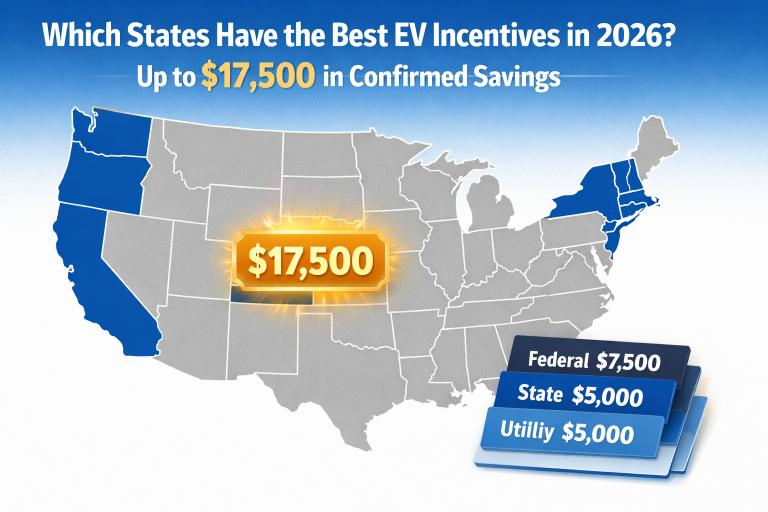
The federal $7,500 EV tax credit expired September 30, 2025. If you’re searching for “which states have the best EV incentives,” the answer changed overnight. State programs are no longer supplementary — they’re the primary source of EV purchase savings in 2026. The gap between the best-incentive state (Colorado: up to $12,250 combined) and the worst (Texas, Florida: $0 state) is now wider than ever because there’s no federal credit to level the field. This guide covers every active state program, the new OBBBA federal deduction, and how to stack them for maximum savings.
Best States for EV Incentives in 2026: Colorado leads with VXC $9,000 (income-qualified) + IMVC $750–$3,250 state credit + OBBBA deduction = up to $12,250+ in combined savings. California follows with Clean Cars 4 All up to $12,000 (low-income, vehicle scrap required). New Jersey offers $4,000 rebate + sales tax exemption. Illinois provides $4,000 rebate. Federal: no purchase credit — only the OBBBA $10K/yr loan interest deduction for U.S.-assembled vehicles.
What Changed: The $7,500 Federal Credit Is Gone
The IRA Clean Vehicle Credit — the one that provided up to $7,500 at the dealership — was repealed by the One Big Beautiful Bill Act (signed July 4, 2025). The credit remained available for vehicles purchased on or before September 30, 2025. After that date: no point-of-sale transfer, no MSRP caps, no battery sourcing rules — because the credit itself no longer exists. The Section 25E used EV credit ($4,000) also expired on the same date. The Commercial Clean Vehicle Credit (Section 45W) was similarly eliminated.
Colorado responded immediately: Governor Polis announced increased VXC rebates on October 2, 2025, specifically to offset the federal loss. VXC jumped from $6,000 to $9,000 for new EVs (effective November 3, 2025). Several other states expanded or maintained programs. The result: state incentives are now the main event, not a supplement to federal credits.
The OBBBA Federal Deduction — What Replaced the Credit
The replacement isn’t a credit — it’s a tax deduction. A $7,500 credit reduced taxes by $7,500. A $10,000 deduction reduces taxable income by $10,000, saving you $10,000 multiplied by your marginal tax rate. At 22%: ~$2,200/year. The vehicle must be new, U.S.-assembled (VIN starts 1, 4, or 5), purchased for personal use (no leases), and financed with a loan. Income phase-out begins at $100K single / $200K joint. No MSRP cap. Active through tax year 2028. Full details in our OBBBA deduction guide.
Top 5 States for EV Incentives in 2026
#1 Colorado — Up to $12,250 Combined (Income-Qualified)
Colorado is the #1 state for EV savings in 2026 — and it expanded specifically because the federal credit died. The Vehicle Exchange Colorado (VXC) program provides $9,000 for new EVs and $6,000 for used EVs at point of sale. Requirements: income at or below 80% AMI, trade-in of a qualifying older vehicle (12+ years old or fails emissions), and purchase from a participating dealer. The Colorado IMVC state tax credit adds $750 base (2026), plus $2,500 if MSRP is under $35,000 — totaling up to $3,250. Combined with OBBBA (~$2,200/yr at 22% bracket): the maximum first-year stack reaches approximately $12,250+ for income-qualified buyers with a sub-$35K EV.
#2 California — Up to $12,000 (Low-Income, Scrap Required)
California’s Clean Cars 4 All provides up to $12,000 for low-income buyers who scrap an older vehicle. This is the highest single state incentive in the country. The standard CVRP offers $2,000–$4,500 depending on income tier (phases out above $135K single). Combined with OBBBA: up to ~$14,200 in first year for qualifying low-income buyers. Program budget can exhaust mid-year — check cleanvehiclerebate.org before purchase.
#3 New Jersey — $4,000 Rebate + Sales Tax Exemption
Charge Up New Jersey provides up to $4,000 rebate for new EVs under $55,000 MSRP. EVs are also exempt from NJ’s 6.625% sales tax (~$2,650 on a $40K EV). No income cap on either benefit. Combined: up to ~$6,650 in state savings plus OBBBA. The simplest, most accessible incentive structure of any top state.
#4 Illinois — $4,000 Rebate (No Income Cap)
The Illinois EPA EV Rebate provides $4,000 for new EVs through June 30, 2026 (then drops to $2,000). No income cap. Post-purchase rebate — apply within 90 days. The best Midwest incentive by a wide margin.
#5 Massachusetts — Up to $3,500 via MOR-EV
MOR-EV provides $3,500 for BEVs, $1,500 for PHEVs. Income-qualified adders available. Budget can exhaust mid-year. Combined with OBBBA: up to ~$5,700 first year.
Full State-by-State EV Incentive Breakdown — 2026
| State | Program | Max Amount | Type | Income Cap? | Key Requirement |
|---|---|---|---|---|---|
| Colorado TOP | VXC + IMVC | $9,000 + $750–$3,250 | POS rebate + tax credit | VXC: 80% AMI / IMVC: None | VXC requires trade-in of older vehicle |
| California | Clean Cars 4 All / CVRP | Up to $12,000 / $4,500 | Grant / Rebate | Yes (tiered) | CC4A requires vehicle scrap; CVRP income-based |
| New Jersey | Charge Up NJ + Sales Tax | $4,000 + ~$2,650 tax | POS rebate + exemption | None | MSRP under $55K for rebate |
| Illinois | IL EPA EV Rebate | $4,000 | Post-purchase rebate | None | $4K until June 2026; then $2K |
| Massachusetts | MOR-EV | $3,500 | Post-purchase rebate | $150K single | Budget can exhaust mid-year |
| Oregon | DEQ EV Rebate | $2,500–$5,000 | Post-purchase | $80K (standard) | Low-income tier: $5,000 |
| New York | Drive Clean Rebate | $2,000 | POS rebate | None | MSRP under $42K |
| Connecticut | CHEAPR | $2,250–$4,250 | POS (participating dealers) | Tiered | Enhanced tier for income-qualified |
| Washington | Sales Tax Exemption | ~$2,500–$4,500 | POS exemption | None | Check current legislative status |
| Minnesota | Drive Electric MN | $2,500 | Rebate | $75K single | Piloting $3,500 low-income tier |
| Texas NONE | None | $0 | — | — | OBBBA deduction only |
| Florida NONE | None | $0 | — | — | OBBBA deduction only |
Used EV Incentives by State in 2026
The federal $4,000 used EV credit (Section 25E) also expired September 30, 2025. Used EV buyers now depend entirely on state programs. Colorado leads: VXC provides $6,000 for used EVs (income-qualified, trade-in required). California’s CVAP offers up to $5,000. Oregon’s DEQ covers used EVs at $2,500–$5,000. New York’s Drive Clean applies $1,000 for used. In states without programs (Texas, Florida), there is zero incentive for used EV purchases — not even a federal deduction (OBBBA covers new vehicles only).
Utility Rebates — The Layer Most Buyers Miss
Utility rebates are independent of both federal and state programs. Xcel Energy (Colorado) offers EV purchase rebates and home charger subsidies. PG&E (California) provides up to $1,000 for charger installation. ConEd (New York) offers charging bill credits. The 30C federal charger credit (30%, up to $1,000) remains active through June 30, 2026 — install before the deadline. Time-of-use rate plans save $300–$600/year on charging costs by shifting to off-peak hours. Call your utility before purchase — this step alone can save $1,000–$5,000 that most buyers leave on the table.
How to Stack for Maximum Savings in 2026
Best Case: Income-Qualified Colorado Buyer (Sub-$35K EV)
VXC rebate: $9,000 + IMVC credit: $3,250 ($750 + $2,500 adder) + OBBBA interest deduction (Year 1, 22% bracket): ~$1,078 + 30C charger credit: $1,000 = up to ~$14,328 in first-year savings. Requires: income below 80% AMI, qualifying trade-in, U.S.-assembled EV under $35K MSRP, eligible census tract for 30C.
Typical Case: Middle-Income Buyer, Strong State Program
New Jersey $4,000 rebate + sales tax exemption ~$2,650 + OBBBA ~$1,078/yr = ~$7,728 first year. No income cap on either NJ benefit.
Worst Case: No State Incentive (TX, FL, AL)
OBBBA deduction only: ~$1,078/year (22% bracket on ~$4,900 interest) + 30C charger $1,000 (if eligible) = ~$2,078 first year. The gap between Colorado and Texas is now ~$12,000 on the same vehicle.
States With No EV Incentives
Texas, Florida, Alabama, Georgia, Indiana, Kansas, Kentucky, Mississippi, Missouri, Nebraska, Oklahoma, Tennessee, and Wyoming offer zero state-level EV purchase incentives. Georgia eliminated its $5,000 credit in 2015. Several of these states impose annual EV registration fees ($100–$200) that effectively function as anti-incentives. Buyers in these states are limited to the OBBBA loan deduction and utility programs (typically $250–$500). Cross-state registration to claim another state’s incentive is illegal — programs require proof of residency.
FAQ: State EV Incentives 2026
Is the $7,500 federal EV tax credit still available in 2026?
No. The $7,500 Clean Vehicle Credit (Section 30D) expired September 30, 2025. The $4,000 used EV credit (Section 25E) also expired. What replaced it: the OBBBA auto loan interest deduction — up to $10,000/year in deductible interest for new, U.S.-assembled vehicles through 2028. This is a deduction (reduces taxable income), not a credit.
Which state gives the most money back for buying an EV in 2026?
Colorado leads with up to $12,250+ combined: VXC $9,000 (income-qualified, trade-in required) + IMVC $3,250 (if MSRP under $35K) + OBBBA deduction. California’s Clean Cars 4 All reaches $12,000 for low-income buyers scrapping an older vehicle. New Jersey offers $4,000 + sales tax exemption (~$6,650 total) with no income cap.
Can I stack state and federal EV incentives?
Yes — state programs and the OBBBA federal deduction are independent and fully stackable. They’re administered by separate agencies. However, the OBBBA is a deduction (not a credit) and requires a financed purchase of a U.S.-assembled vehicle. State programs have their own separate eligibility rules.
Are there incentives for used EVs in 2026?
The federal $4,000 used EV credit expired. State programs remain: Colorado VXC $6,000 (income-qualified), California CVAP $5,000, Oregon DEQ $2,500–$5,000, New York $1,000. The OBBBA federal deduction does NOT cover used vehicles. States without used EV programs offer zero used EV incentives.
What about the home charger tax credit?
The 30C Alternative Fuel Refueling Property Credit provides 30% (up to $1,000) for home charger purchase and installation. It expires June 30, 2026 and requires an eligible census tract. Install before the deadline. Stacks with utility charger rebates.
Which states have no EV incentives at all?
Texas, Florida, Alabama, Georgia, Indiana, Kansas, Kentucky, Mississippi, Missouri, Nebraska, Oklahoma, Tennessee, and Wyoming offer no state-level EV purchase incentives. Buyers in these states are limited to the OBBBA loan deduction and small utility rebates ($250–$500 typical).
This article is for informational purposes only. Tax rules change. Consult a qualified tax professional before purchasing. All information current as of April 2026.
- Colorado Energy Office (VXC) — $9,000 new / $6,000 used EV rebate (Nov 2025+)
- Governor Polis Announcement — VXC increase in response to federal credit expiration
- Emich VW IMVC Guide — IMVC $750 base + $2,500 adder (2026 rates)
- IRS OBBBA Guidance — Loan interest deduction rules
- California CVRP — Rebate amounts and income tiers
- NCSL EV Incentive Database — State-by-state program tracker
- DOE AFDC — Federal and state incentive lookup tool