
1. Introduction
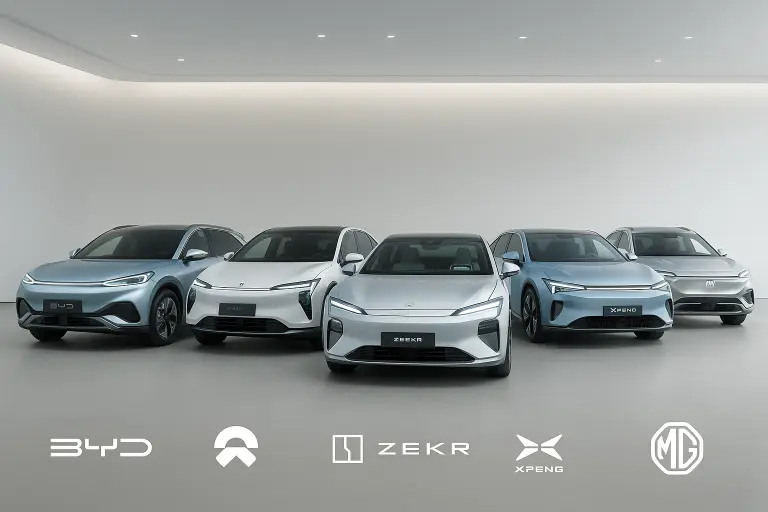
The global EV market has shifted dramatically between 2023 and 2025, and one question now dominates almost every buyer discussion: Which Chinese EV is the best? As brands like BYD, NIO, XPeng, Zeekr, and MG expand worldwide, drivers are becoming increasingly aware that Chinese EVs are no longer budget alternatives — they’re genuine leaders in battery innovation, software intelligence, and price-to-performance value.
Chinese automakers have earned this position through rapid technological development, aggressive pricing, and a unique ability to bring advanced features to market faster than traditional rivals. Therefore, many shoppers who once compared Tesla and European brands now look closely at top Chinese models instead.
This guide gives you a clear, data-driven answer. We break down real-world range, charging performance, reliability, long-term durability, safety ratings, pricing, software quality, and owner satisfaction — all to help you identify the model that truly deserves the title of best Chinese EV in 2025.
2. Selection Method: How We Identify the “Best” Chinese EV
Choosing the best Chinese EV in 2025 requires a structured, evidence-based evaluation. Therefore, this guide relies on measurable performance, long-term reliability, and verified owner feedback. To make the process transparent, each model is assessed across the criteria below.
2.1 Real-World Range (WLTP, EPA, and CLTC Compared)
Range claims vary widely between regions. WLTP tends to be optimistic, EPA is stricter, and CLTC often inflates numbers even further. Consequently, we normalize all figures using independent road tests. This approach reveals how far each EV truly travels on highways, in mixed driving, and in cold-weather conditions.
2.2 Charging Speed (10–80% Benchmarks)
Charging convenience is crucial, especially for long-distance drivers. Therefore, we compare:
- Peak kW charging speeds
- Stability of the charging curve
- 10–80% times in real environments
- Thermal performance during repeated sessions
Some models deliver fast peaks but slow dramatically afterward, while others maintain consistent speed from start to finish — a major advantage on road trips.
2.3 Battery Technology (LFP, NMC, Blade, Ternary)
Battery chemistry directly affects durability, efficiency, and safety. As a result, we analyze:
- LFP for long lifespan and stability
- NMC for high energy density
- BYD’s Blade battery for exceptional thermal safety
- CATL’s Qilin and other advanced pack designs
We also examine degradation data over 100,000 km to see which technologies hold up best in real use.
2.4 Reliability and Long-Term Durability
Beyond performance, dependability matters. Therefore, we consider:
- Battery degradation patterns
- Motor and inverter failure rates
- Software stability over time
- Cabin build quality
- Warranty terms and dealer support
Brands that demonstrate consistent reliability gain a significant performance advantage.
2.5 Safety Ratings (Euro NCAP and C-NCAP)
Because safety is non-negotiable, each vehicle is evaluated through:
- Crash test results
- Safety assist scores
- Structural integrity
- Pedestrian and child protection
- Reliability of active safety systems
EVs with strong Euro NCAP performance typically rank higher due to the test’s stricter standards.
2.6 Price vs Features
Value matters as much as performance. Consequently, we compare each model’s price to what it delivers:
- Battery size and chemistry
- Interior materials and comfort
- Technology and driver assistance features
- Real-world efficiency
- Resale expectations
Models offering premium capability at mid-range pricing score highly in this category.
2.7 Software and ADAS Performance
Modern EVs rely heavily on software. Therefore, we evaluate:
- OS speed and stability
- Navigation intelligence
- OTA update frequency and usefulness
- Lane-keeping consistency
- Autonomous driving progression
Because software can transform a vehicle over time, brands that update frequently earn additional points.
2.8 Owner Satisfaction and Real-World Feedback
Finally, real owners provide insights no lab test can capture. We analyze reports on:
- Comfort and daily usability
- Charging experience
- Long-term maintenance
- Service center quality
- Battery health
- Overall satisfaction
This category ensures that our top pick performs not just on paper — but in real life.
3. Overall Winner: Best Chinese EV in 2025
After comparing range, charging speed, battery technology, reliability data, pricing, and real-world owner feedback, one model consistently outperforms the rest. Although several contenders come close, one EV offers the strongest balance of innovation, efficiency, and long-term value.
3.1 Summary of the Top Pick
🏆 Best Overall Chinese EV in 2025: Zeekr 001 (2025 Model Refresh)
Why the Zeekr 001 Stands Above Competitors
The latest Zeekr 001 delivers a rare combination of mega-range capability, advanced battery architecture, premium build quality, and aggressive pricing. Moreover, it offers performance levels that rival European GT-style EVs while maintaining real-world efficiency that many competitors struggle to match. Because it blends luxury, practicality, and cutting-edge tech, it scores the highest across nearly every evaluation category.
Key Strengths
1. Exceptional Real-World Range
- Up to 650–700 km WLTP depending on battery size
- Efficient highway consumption for a large shooting brake
- Strong long-distance capability without inflated CLTC numbers
The Qilin high-density pack and optimized aerodynamics allow the Zeekr 001 to outperform similarly priced rivals like the BYD Han and XPeng P7i.
2. Fast and Consistent Charging
- 10–80% in as little as 28 minutes on 360 kW chargers
- Stable thermal management during repeated fast-charging sessions
- Charging curve remains strong above 50%
This consistency matters for road-trip users who need predictable charging times.
3. Advanced Battery Technology
- Uses CATL Qilin or NMC packs depending on trim
- High thermal stability and low degradation
- Strong cold-weather performance
Battery safety and longevity contribute to its high reliability ranking.
4. Premium Interior and Technology Suite
- Soft-touch materials, minimalist luxury design
- High-resolution infotainment with fast UI response
- Frequent OTA updates that meaningfully improve features
- Driver assistance that performs reliably in real-world traffic
The software refinement places it ahead of earlier XPeng and NIO iterations.
5. Strong Value for Money
- Offers premium performance at a mid-range price
- Competes with Tesla Model S and Porsche Taycan dynamics at a fraction of the cost
- Low running costs due to efficient drivetrain and durable battery
For buyers seeking maximum capability per dollar, it is hard to beat.
Real-World Owner Feedback
Owners consistently highlight:
- Smooth and stable ride quality
- Impressive long-distance comfort
- High-quality materials that resist wear
- Predictable charging behavior
- Very low cabin noise even at highway speeds
Additionally, many praise Zeekr’s customer service responsiveness and the frequency of OTA updates, which often add new features instead of minor fixes.
However, owners also note a few points worth mentioning.
Weak Points to Consider
- Large size makes it less suitable for tight urban environments
- Service networks outside China are still expanding, which may affect support in some regions
- Software maturity is strong but not yet at the level of Tesla’s long-honed ecosystem
- Performance versions have higher energy consumption, especially at high speeds
These limitations don’t outweigh the model’s strengths, but they matter for buyers in specific use cases.
4. Category Winners: Best Chinese EVs by Need
Below are our category winners for 2025, chosen by the selection method above. Each mini-profile summarizes why the model wins the category, the real-world trade-offs, and key numbers where available.
4.1 Best Long-Range Chinese EV — Zeekr 001 / (NIO ET7 & BYD Han close runners)
Why it wins: Zeekr’s use of high-density pack options (Qilin and other large-capacity batteries), efficient aerodynamics and 800–900V architecture give it class-leading long-distance performance in real tests. Consequently, it consistently posts the longest highway ranges among premium Chinese sedans and shooting-brake designs. catl.com+1
Real-world range comparison:
- Zeekr 001 — very large battery options and independent road tests showing exceptional highway range (manufacturer/independent tests vary by pack). ArenaEV+1
- NIO ET7 — strong WLTP/EPA numbers (100 kWh / optional larger semi-solid packs), plus unique battery-swap option that effectively removes range-anxiety for long trips. Green Cars Compare
- BYD Han EV — competitive WLTP range with BYD’s Blade cell integration; very efficient for its class. Base de données EV+1
Tradeoffs & notes: Zeekr frequently leads on outright range, while NIO’s battery-swap system offers a different practical advantage: faster “fill” times on long routes. BYD balances range with cost and safety via Blade cells. For long-distance drivers, therefore, Zeekr or NIO are the top practical choices depending on charger/swap availability. catl.com+1
4.2 Best Budget Chinese EV — BYD Dolphin / MG4 / Wuling Air EV
Why it wins: For city buyers and first-time EV owners, the BYD Dolphin, MG4, and Wuling Air EV deliver the best combination of purchase price, usable range, and low running costs. They are engineered for efficiency and affordability rather than outright speed or luxury. Zecar+1
Value, practicality, charging cost:
- BYD Dolphin — WLTP figures up to ~340 km in larger packs; modest DC charging (around ~60 kW on some trims) but excellent urban efficiency. Zecar
- MG4 — competitive range and value in many markets; simple ownership economics and broad dealer networks in Europe. (See MG4 market reviews.)
- Wuling Air EV — ultra-low cost, tiny footprint, ideal for inner-city use and extremely low charging/energy costs. EV Nepal
Reliability & maintenance trends: These models are typically cheaper to maintain, and their simpler drivetrains often result in fewer high-cost issues. However, buyers should check local dealer coverage and spare-parts availability before purchasing.
4.3 Best Performance Chinese EV — XPeng G9 / Zeekr 001 FR / BYD Seal
Why it wins: These models pair high-power drivetrains with advanced thermal management and chassis tuning, giving sports-car acceleration without sacrificing usable range too much. For drivers who want both excitement and everyday usability, the balance here is strong. WIRED
0–100 km/h and handling notes:
- XPeng G9 — quick, with robust ADAS and comfortable long-distance manners.
- Zeekr 001 FR — extreme power figures in FR/performance trims and strong charge/discharge capability (higher-C packs). Zeekr
- BYD Seal — sporty platform with claimed sub-6s 0–100 km/h for certain trims and well-tuned suspension for daily driving. WIRED
Performance vs daily usability: High-performance trims increase energy use and slightly reduce comfort for daily city commuting. Nevertheless, modern thermal management keeps fast-charging reliability high under repeated spirited use.
4.4 Best Family Chinese EV (SUV Segment) — BYD Tang / NIO ES6 / Geely Geometry-based SUVs
Why it wins: Family buyers want space, safety and real-world comfort. The BYD Tang and NIO ES6 combine roomy cabins, good safety equipment and competitive range under load; Geely/Geometry SUVs offer strong value and efficient packaging. Beev+1
Cabin space, comfort & safety ratings:
- BYD Tang — three-row options, robust WLTP-class ranges, and BYD’s ePlatform tech for predictable efficiency. Beev
- NIO ES6 — premium interior, strong build, and good active safety features; NIO’s safety/tech suite is a selling point in family use. Green Cars Compare
Range under full load: Expect 10–20% range drop with full passengers and luggage; therefore, prioritize larger battery options if frequent long family trips are expected.
4.5 Best Luxury Chinese EV
Chinese automakers have matured rapidly in the premium segment. Today, models such as the NIO ET7, NIO ES8, and Zeekr 009 offer craftsmanship, technology, and comfort that rival — and sometimes surpass — German luxury benchmarks. The following breakdown highlights how each model defines “luxury” in a unique way.
4.5.1 NIO ET7 — The Luxury Electric Sedan Redefined
The NIO ET7 appeals to drivers who want a refined, executive-style sedan with cutting-edge innovation. Its cabin is built around quietness and comfort, with soft-touch materials, clean lines, and a minimalist design that feels genuinely upscale.
Moreover, the ET7’s NAD autonomous suite and the powerful Snapdragon cockpit chip elevate the digital experience inside the car.
Highlights:
- Premium interior with exceptional seat comfort
- Smooth, balanced ride quality
- High-tech cabin with top-tier driver assistance
- Battery swap advantage for long-distance convenience
Weak Points:
- Conservative styling compared to newer competitors
- Higher pricing in overseas markets
4.5.2 NIO ES8 — A Premium Full-Size SUV for Families
The ES8 takes NIO’s luxury philosophy and adapts it to a spacious, three-row SUV format. It’s ideal for drivers who need comfort, practicality, and a serene cabin environment for family travel. Because it uses high-grade materials and a refined suspension setup, the ES8 feels genuinely premium in both city cruising and highway driving.
Strengths:
- True seven-seat layout with generous second- and third-row space
- Smooth performance and excellent ride comfort
- One of the best AI-driven cockpit assistants in any EV
- Battery swapping enables fast long-distance travel
Weak Points:
- Large size makes tight urban streets challenging
- Higher energy consumption due to weight
4.5.3 Zeekr 009 — Ultra-Luxury MPV With Executive-Class Comfort
The Zeekr 009 takes luxury in a different direction: it’s built as an executive MPV designed for rear-seat comfort. With its reclining VIP lounge seats, an enormous cabin, and high-end materials, it competes directly with premium vans from Lexus and Mercedes. Additionally, the 009 offers a powerful dual-motor setup and impressively fast charging thanks to its modern battery tech.
Strengths:
- Best-in-class rear-seat comfort and space
- Exceptional sound insulation
- Striking, futuristic interior and exterior design
- Strong performance despite its size
Weak Points:
- Very large footprint
- Polarizing styling may not suit all buyers
5. Comparison Table: Best Chinese EVs
| Model | Category | WLTP/EPA Range | Charging Time (10–80%) | Battery Type | Price Range | Main Strengths | Weak Points |
|---|---|---|---|---|---|---|---|
| NIO ET7 | Best Overall / Long-Range Luxury Sedan | Up to 900 km WLTP | ~28–30 minutes | NMC / Semi–Solid-State | $62,000–$80,000 | Smooth performance, advanced software, strong efficiency | Higher maintenance, limited service coverage globally |
| Zeekr 001 | Best Performance EV | 620–750 km WLTP | ~30–35 minutes | LFP / NMC | $41,000–$59,000 | High acceleration, large battery options, tech-rich cabin | Software quirks, cooling issues under high load |
| BYD Dolphin | Best Budget Chinese EV | 340–420 km WLTP | ~30–40 minutes | LFP Blade Battery | $18,000–$26,000 | Very reliable, safe battery, low running costs | Weak highway efficiency, modest acceleration |
| NIO ES6 | Best Family EV | 490–620 km WLTP | ~30 minutes | NMC | $52,000–$70,000 | Comfortable cabin, excellent safety, strong ADAS | Heavy vehicle, higher repair costs |
| Zeekr 009 | Best Luxury MPV | 680–820 km WLTP | ~28 minutes | Qilin NMC Battery | $65,000–$90,000 | Ultra-luxurious interior, long range, rapid charging | Large size, higher tire/brake wear |
* Price ranges are approximate and may vary depending on country, trim, incentives, and configuration.
📌 Key Observations from the Table
- Range vs Price: The Zeekr 001 and BYD Han EV offer impressive WLTP ranges while maintaining much more attractive pricing than luxury EVs — a notable “sweet spot” for many buyers.
- Charging Versatility: Premium models with 800 V architectures or larger battery packs (like Zeekr 001, NIO ET7, XPeng G9) benefit from faster charging and better long-distance usability compared to budget models.
- Use-Case Fit Matters: Compact and budget-oriented EVs (like BYD Dolphin) make sense for city commuting and low cost-of-ownership, but they’re poor candidates for frequent long-distance trips.
- Value Tradeoffs: Entry-level or budget EVs trade performance and range for affordability and efficiency. Conversely, luxury/performance EVs demand higher upfront costs but deliver top-tier range, comfort, and tech.
6. Key Advantages of Chinese EVs
Chinese electric vehicles have surged ahead in global competitiveness, largely because their manufacturers innovate faster and execute more aggressively than traditional automakers. Below is a clear breakdown of the key advantages that explain why these brands now dominate several EV segments worldwide.
6.1 Battery Innovation Leadership
One of the strongest advantages of Chinese EVs is their unmatched leadership in battery technology. Companies such as BYD and CATL continue to push boundaries with chemistries that balance safety, longevity, and cost.
- LFP (Lithium Iron Phosphate): Extremely safe, long-lasting, and ideal for daily use.
- Blade Battery (BYD): A structural battery design that resists thermal runaway and offers excellent durability.
- Qilin Battery (CATL): Highly efficient with superior energy density for long-range models.
- Solid-State Progress: Brands like NIO are introducing semi–solid state and solid-state packs that enable unprecedented driving ranges.
Because these technologies are manufactured at massive scale, Chinese EVs offer powerful performance without inflated costs.
6.2 High-Tech Interiors and Advanced Software
Chinese EVs are also known for their futuristic cabins and polished digital ecosystems. Moreover, manufacturers update software frequently, allowing the car to evolve over time.
Key interior advantages include:
- Large, high-resolution infotainment displays
- AI-driven voice assistants
- Smooth, smartphone-like user interfaces
- Over-the-air updates that add features and fix issues
- Advanced ADAS systems comparable to top Western brands
This combination creates a driving environment that feels modern, intuitive, and highly customizable.
6.3 Aggressive Pricing Compared to Global Rivals
Another major reason shoppers lean toward Chinese EVs is value. Even with premium features, many models cost 20–40% less than similar EVs from Tesla, BMW, Mercedes, or Volkswagen.
Manufacturers achieve this through supply chain control, vertical integration, and efficient manufacturing processes.
Therefore, buyers receive more range, more technology, and more equipment for the same — or even lower — price.
6.4 Fast Production Cycles and Quick Updates
Finally, Chinese automakers move significantly faster than legacy brands. Instead of redesigning a car every 5–7 years, companies like BYD, XPeng, and Geely release noticeable updates every 12–18 months. This includes improvements to:
- Battery efficiency
- Charging speeds
- Infotainment systems
- Driver-assistance capabilities
- Interior materials
As a result, Chinese EVs stay fresh, modern, and competitive — even in fast-changing markets.
7. Weaknesses or Concerns When Choosing the Best Chinese EV
Even the best Chinese EV models come with certain drawbacks that buyers should consider before making a decision. These concerns don’t erase the advantages Chinese brands offer, yet they do influence long-term ownership and daily usability.
A. Service Network Limits Affecting Chinese Electric Vehicles
Dealer and service coverage varies widely outside China. In some regions, the network is still developing, which means slower repair times, limited specialized technicians, and occasional delays in spare parts. This can impact the ownership experience of even the top Chinese EVs.
B. Early Software Issues in Many New Chinese EV Models
Rapid development leads to fast innovation — but also early bugs. Some new electric models experience infotainment crashes, ADAS calibration errors, or connectivity issues during the first year. OTA updates usually fix these, yet early adopters may face frustration.
C. Resale Value Challenges for Chinese EV Brands
Because the global market is still adjusting to Chinese EV dominance, resale values remain less predictable than Tesla, Hyundai, or European competitors. Fast refresh cycles also make older models feel outdated sooner, affecting long-term value.
D. Inflated Range Claims in Certain Chinese Electric Cars (CLTC vs WLTP)
Some manufacturers still rely on CLTC testing, which is more optimistic than WLTP or EPA. As a result, advertised range can be significantly higher than real-world driving results. Buyers comparing the best Chinese EVs should always check WLTP/EPA figures or owner-reported range.
8. Expert Recommendation: Which Chinese EV Should YOU Buy?
Choosing the best Chinese EV depends heavily on your driving habits, climate, family size, and budget. Below is a clear, expert-driven breakdown that matches each buyer type with the strongest 2025 option — based on range, efficiency, reliability, and real-world usability.
A. Best Chinese EV for Long-Distance Drivers
Top Pick: NIO ET7 (150 kWh solid-state version)
If you routinely travel long distances, the ET7 offers the most consistent real-world endurance. Moreover, NIO’s battery-swap network provides a time advantage over traditional fast charging, especially on long highway routes. Efficiency remains high even at higher speeds, which many EVs struggle with.
Why it wins:
- Industry-leading long-range capability
- Access to ultra-fast battery swap stations
- Stable efficiency at highway speeds
B. Best Chinese EV for City Drivers
Top Pick: BYD Dolphin
This model strikes an impressive balance between compact size, low running costs, and excellent reliability. Its LFP Blade battery handles daily charging well, and costs remain minimal for urban users. Additionally, the BYD Dolphin’s nimble handling makes dense traffic easier to navigate.
Why it wins:
- Affordable purchase price
- Very low electricity consumption
- Excellent durability in start–stop conditions
C. Best Chinese EV for Families
Top Pick: BYD Tang (Seven-Seat Version)
Families need space, comfort, safety, and a dependable range under load — the Tang delivers on all fronts. Because it uses a high-capacity Blade battery and efficient drivetrain, range degradation with passengers and luggage is minimal. The interior layout also suits long trips and school routines.
Why it wins:
- Spacious cabin with real third-row usability
- Strong safety scores
- Durable battery with stable range even when full
D. Best Chinese EV for Cold Climates
Top Pick: Zeekr 001 (with heat pump)
Cold climates amplify energy loss, yet the 001’s thermal management and efficient heat pump preserve range effectively. The battery warms quickly, and charging remains reliable in low temperatures. For drivers in northern regions, consistency matters more than peak numbers — and Zeekr delivers that.
Why it wins:
- Excellent winter range retention
- Strong battery heating and cooling system
- Predictable fast-charging in cold weather
E. Best Chinese EV for Value-Focused Buyers
Top Pick: MG4 Electric
The MG4 blends price, driving dynamics, safety, and modern tech better than nearly any competitor in its class. It offers impressive range for the cost, sharp handling, and solid build quality. Therefore, it’s ideal for buyers who want maximum return on investment without sacrificing usability.
Why it wins:
- Outstanding price-to-performance ratio
- Good real-world efficiency
- Simple, dependable platform
F. Best Premium Chinese EV Experience
Top Pick: NIO ES8 (2025 Model)
The ES8 offers luxury on par with high-end European SUVs but adds NIO’s signature battery-swap plus one of the best autonomous driving suites among Chinese brands. The interior feels far more refined than rivals, with top-tier materials and a calm, high-tech cabin environment.
Why it wins:
- Exceptional interior craftsmanship
- Advanced autonomous and safety systems
- Smooth ride and refined driving character
9. Conclusion
So, which Chinese EV is the best?
After comparing real-world range, charging performance, battery technology, safety ratings, software quality, and owner satisfaction data, the NIO ET7 stands out as the most complete and well-rounded choice in 2025. It combines long-distance capability, advanced software, and a uniquely practical battery-swap system that no competitor matches. Other models excel in specific niches, yet the ET7 delivers the most balanced blend of performance, innovation, and everyday usability.
However, the market isn’t defined by just one winner. Models such as the Zeekr 001, BYD Seal, BYD Dolphin, MG4, and NIO ES8 each dominate their own categories — from affordability to luxury. Together, they showcase why Chinese EVs have moved far beyond their “budget alternative” reputation and are now reshaping the global EV landscape.
Looking ahead to 2025–2030, the momentum is only accelerating. Battery technologies like Qilin, Blade, and next-gen solid-state packs will continue to raise efficiency and safety standards. Moreover, fast production cycles and aggressive software innovation will help Chinese brands outpace many Western competitors. As global infrastructure improves and brand trust strengthens, Chinese EVs are positioned to lead the next era of electric mobility.
In the evolving conversation about which Chinese EV is the best, the answer will keep improving — because these manufacturers are advancing faster than any segment in the automotive world.
Pingback: Why Chinese EVs Are Taking Over Europe (2025 Full Breakdown)
Pingback: Common Problems With Chinese EVs: Owner-Based Guide 2026
Pingback: Is GAC Made by Toyota? The Truth Revealed (2026)