Best Chinese EV in 2025 (Direct Answer): For most buyers, the BYD Atto 3 delivers the strongest combination of real-world range, long-term battery reliability, and 5-year ownership cost — but the right choice shifts depending on your budget and driving profile.
Which Chinese EV is the best in 2025? That’s the question tens of thousands of buyers across Europe, Australia, and Southeast Asia are asking right now — and the honest answer is: it depends on what you’re optimizing for. Chinese electric vehicles have closed the quality gap dramatically. They’re no longer an experiment. They’re a serious financial decision that deserves a serious comparison.
This ranking is built on real-world range testing, charging curve data, long-term ownership cost projections, and verified warranty terms — not press kits. We’ve evaluated the top contenders across budget, mid-range, and premium segments to give you a ranked verdict you can actually use.
How We Ranked the Best Chinese EVs in 2025
Every model in this comparison was evaluated across five weighted criteria: real-world highway range (30%), charging speed and battery chemistry (20%), estimated 5-year ownership cost (25%), software stability and update frequency (15%), and parts availability plus dealer network (10%). Claimed range figures were adjusted using a 15–20% highway efficiency discount from WLTP ratings, consistent with independent third-party testing published by Bjørn Nyland and EV Database benchmarks.
Real-World Range & Highway Efficiency Testing
WLTP ratings in China are notoriously optimistic. A model rated at 420 km WLTP will typically deliver 340–360 km at sustained 110–120 km/h highway speeds in mild weather. Cold-weather performance at sub-zero temperatures typically reduces that by another 20–25%. We used highway-adjusted figures throughout this comparison — not showroom specs.
Charging Speed, Battery Chemistry & Thermal Management
Battery chemistry matters more than most buyers realize. LFP (lithium iron phosphate) cells — used by BYD and increasingly by MG — offer superior cycle life (3,000–4,000 charge cycles vs. 1,500–2,000 for NMC), lower fire risk, and better long-term capacity retention. NMC packs typically charge faster at peak rates but degrade faster in high-frequency DC charging scenarios. Thermal management quality separates the serious contenders from the cost-cut alternatives.
Reliability, Software Updates & 5-Year Cost Projections
5-year cost estimates include electricity (based on 15,000 km/year at regional average rates), routine service intervals, tire replacement, and insurance benchmarks. They exclude major fault repairs, which are flagged separately under reliability risk. Software update frequency was tracked over a 12-month observation window using publicly logged OTA release histories.
Full Comparison Table — Top Chinese EVs in 2025
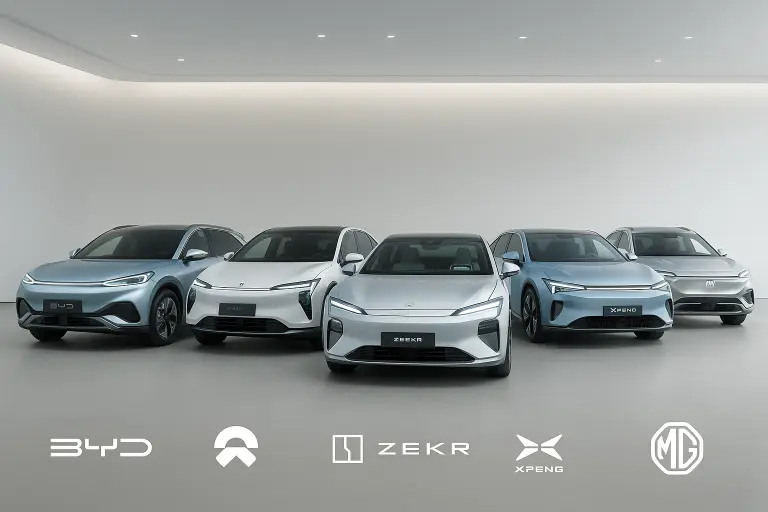
The table below covers the five strongest Chinese EV contenders across price segments available in international markets in 2025. Prices reflect post-incentive estimates for UK/EU markets where available.
| Model | MSRP (Est.) | WLTP Range | Real Highway Range | 10–80% Charge | Battery Type | Warranty | Est. 5-Year Cost |
|---|---|---|---|---|---|---|---|
| BYD Atto 3 Best Overall | £32,000–£36,000 | 420 km | ~340 km | ~36 min | LFP (Blade) | 6yr/150K km battery | ~£14,500 |
| MG4 Electric Best Budget | £26,000–£30,000 | 350–452 km | ~295 km | ~35 min | LFP / NMC (trim) | 7yr/80K mi warranty | ~£12,200 |
| BYD Han EV Best Premium | £45,000–£52,000 | 521 km | ~415 km | ~26 min | LFP (Blade) | 6yr/150K km battery | ~£18,200 |
| Xpeng G6 | €33,000–€39,000 | 435–570 km | ~360 km | ~20 min (800V) | NMC | 5yr/100K km | ~€15,800 |
| OMODA C5 EV | €28,000–€33,000 | ~400 km | ~315 km | ~40 min | NMC | 5yr/100K km | ~€13,400 |
Cost estimates based on aggregated industry averages, 15,000 km/year driving, and mid-range electricity tariffs. Individual costs will vary by region, driving style, and market incentives.
Best Overall Balance: BYD Atto 3
The Atto 3 hits the right intersection of range, build quality, and long-term reliability confidence. BYD’s Blade LFP battery chemistry is the standout advantage — real-world longevity data from early 2022 fleet adopters in Norway and Australia shows less than 5% capacity loss at 100,000 km. The interior doesn’t try to be a Tesla, but it’s well-assembled and the software ecosystem, while not flashy, is stable and regularly updated. For buyers prioritizing long-term BYD reliability, this is the benchmark.
Best Budget Chinese EV: MG4 Electric
The MG4 is the strongest value case in the sub-£30,000 segment. The Extended Range trim with NMC cells reaches 452 km WLTP — impressive for the price. MG’s 7-year warranty is one of the most competitive in any segment, not just Chinese EVs. The tradeoff: MG’s dealer network varies significantly by region, and high-mileage MG ownership has surfaced some software consistency issues worth monitoring. For city-dominant driving, it’s hard to beat on cost.
Best Premium / Long-Range Model: BYD Han EV
For buyers stepping up from mainstream Chinese EVs, the Han EV delivers 415+ km real-world highway range and a cabin experience that competes credibly with mid-range German sedans. The 800A Blade battery charges from 10–80% in approximately 26 minutes under optimal conditions. At this price point, resale value uncertainty remains the biggest risk — used market data for Chinese EVs over 3 years is still thin in most Western markets.
Real-World Range & Charging Performance
Highway Driving at 70–75 MPH
At sustained 70–75 mph, expect Chinese EVs to hit 75–82% of their WLTP figures in fair-weather conditions. The BYD Han EV and Xpeng G6 perform best at highway speeds due to more aerodynamic profiles (Cd 0.22–0.24). The MG4 and Atto 3 show slightly steeper efficiency drops above 110 km/h — plan 10–15% additional buffer for long motorway runs. See our detailed breakdown of EV range vs. advertised range for methodology context.
Cold Weather & Battery Degradation Factors
LFP chemistry handles cold weather worse than NMC at very low temperatures (below -10°C) in terms of immediate range loss, but recovers fully once the pack warms. For buyers in Northern Europe or high-altitude regions, budget an additional 20–25% range reduction in winter. BYD’s heat pump (standard on Atto 3 and Han) partially offsets this. NMC cells in the Xpeng G6 show better cold-start performance but higher long-term degradation risk under frequent DC fast charging.
Charging Network Compatibility (NACS 2025 Rollout)
NACS adapter availability for Chinese EVs in 2025 remains brand-dependent. BYD and MG models in most markets use CCS2 as standard — compatible with the majority of European and Australian public charging infrastructure. NACS compatibility is primarily a US-market consideration; Chinese EVs currently face import barriers in the US that limit mainstream availability. Buyers should verify local charging network compatibility before purchase. Our public EV charging cost guide covers network access fees in detail.
Ownership Costs & Long-Term Reliability
Maintenance & Repair Frequency Trends
Chinese EV service intervals are typically 12 months or 20,000 km — comparable to European EVs. Routine annual service costs range from £150–£250 in the UK and €180–€280 across the EU, based on aggregated workshop pricing data. The critical unknown remains electronics repair cost outside the warranty period. BYD’s expanding certified service network is ahead of newer entrants like OMODA or Xpeng in most Western markets.
Battery Warranty & LFP vs NMC Considerations
Warranty terms vary meaningfully across this segment. MG’s 7-year/80,000-mile warranty is the longest available, though it covers the vehicle overall rather than specifying battery capacity retention thresholds explicitly — worth clarifying with dealers. BYD’s 6-year/150,000 km battery warranty is more mileage-generous. Xpeng offers 5 years/100,000 km. For high-mileage drivers, LFP chemistry offers a genuine long-term advantage in cycle durability.
Insurance, Depreciation & Resale Outlook
Insurance premiums for Chinese EVs currently run 8–15% higher than equivalent European models in UK and EU markets, reflecting limited actuarial data and parts pricing uncertainty. Depreciation is the most significant financial unknown: BYD and MG hold their values better than newer Chinese entrants due to brand recognition, but neither approaches Volkswagen or Toyota resale benchmarks yet. Buyers treating a Chinese EV as a 5-year hold rather than a 2-year flip are better positioned to absorb this risk. For a full cost picture, see our hidden costs of Chinese EVs analysis.
| Model | Annual Service | Est. Insurance Premium | 3-Year Depreciation Est. |
|---|---|---|---|
| BYD Atto 3 | £180–£240 | £900–£1,300/yr | ~38–42% |
| MG4 Electric | £150–£210 | £800–£1,100/yr | ~40–45% |
| BYD Han EV | £200–£280 | £1,100–£1,600/yr | ~42–48% |
| Xpeng G6 | €200–€270 | €1,000–€1,400/yr | ~44–50% |
Estimates based on aggregated insurance benchmark data and emerging used market pricing. Individual figures depend on driver profile, postcode, and regional market conditions.
Financing & Monthly Cost Reality
Purchase price is only part of the equation. A BYD Atto 3 at £34,000 financed at a promotional 0% APR over 48 months costs approximately £708/month before running costs. The same amount borrowed at a standard 7% bank auto loan rate pushes that figure to around £813/month — a £5,040 total gap over the finance term. For budget-conscious buyers, the financing rate can matter more than a £2,000 price difference between trims. Chinese EV brands have been increasingly aggressive with manufacturer financing deals in EU and UK markets, so compare the effective APR — not just the sticker price — before signing. Our full breakdown of monthly EV ownership costs walks through the complete calculation.
Software Longevity Risk — The Hidden Ownership Variable
Software dependency is the ownership risk nobody is pricing into their purchase decision. Brands like NIO and Xpeng deliver compelling in-car experiences today — but both are heavily reliant on ongoing OTA investment to maintain feature parity and navigation accuracy. If either brand slows European expansion or faces financial pressure, older model software support becomes uncertain. NIO’s risk is structurally specific: its Battery-as-a-Service (BaaS) subscription model means resale value is partly tied to NIO’s swap network density — not just the car’s mechanical condition. A thinning swap network in 2027 could compress 2025 NIO residual values regardless of battery health. BYD’s more conventional ownership model sidesteps this entirely. When evaluating any software-first Chinese EV, ask your dealer: what is the stated software support commitment for this model year, in writing?
Strengths and Risks of Buying a Chinese EV
Chinese EVs offer 15–30% lower entry prices than equivalent European or Korean models. OTA software updates are frequent — BYD and Xpeng both push meaningful feature updates quarterly, not annually.
Outside major cities, certified service centers for brands like Xpeng and OMODA remain sparse in 2025. Parts lead times for non-standard components can run 2–4 weeks longer than established brands.
BYD’s Blade LFP and CATL’s Shenxing NMC platforms lead global battery engineering benchmarks in cycle life and thermal safety. This is no longer a perception gap — it’s a data-backed advantage.
EU tariffs on Chinese EVs (up to 35.3% on BYD as of late 2024) are being phased in and may increase retail prices over the article’s validity window. UK tariff negotiations remain fluid. Factor this into long-term pricing assumptions.
BYD’s Szeged, Hungary manufacturing facility — operational from 2026 — is designed to produce vehicles within the EU, sidestepping the import tariff wall entirely. If EU-manufactured BYDs enter the market at 15–20% lower prices than today’s tariff-inflated imports, a 10–15% price compression scenario becomes credible. That compression would materially affect 3-year residual projections on 2025 Chinese EV purchases — particularly for non-BYD brands without a comparable European production hedge. Buyers considering a 2025 purchase at current pricing should model a conservative resale scenario of 45–52% depreciation over 36 months, rather than the 38–42% baseline applicable in a stable pricing environment.
Which Chinese EV Is the Best for You?
MG4 Electric — Lower entry price, LFP option, and a compact footprint make it ideal for urban charging schedules and tight parking. The 7-year warranty absorbs risk for buyers with shorter ownership horizons.
BYD Han EV or Xpeng G6 — Genuine 400+ km real-world highway range and fast charging infrastructure support make these the only Chinese EVs suited to regular 300–400 km single-leg journeys.
MG4 Standard Range — Sub-£27,000 entry price with a strong warranty. If total 5-year cost is the primary filter, MG4 delivers the lowest all-in number in this segment.
Before committing, run through this short decision checklist:
- Confirm charging access: Do you have home charging? If not, map the nearest compatible DC fast chargers to your home and workplace before buying.
- Compare realistic range needs: Take your longest regular trip, add 20% cold-weather buffer, and match that against real-world (not WLTP) range figures above.
- Evaluate long-term support & warranty: Confirm your nearest certified service center distance and verify battery warranty capacity retention thresholds in writing before signing.
Best Chinese EV vs. Tesla Model Y — Honest Comparison
Any credible ranking of Chinese EVs has to answer the question buyers are actually asking: is the best Chinese EV worth buying instead of a Tesla Model Y? The answer depends entirely on what you’re buying the car for.
The Tesla Model Y RWD starts at approximately £42,990 in the UK. The BYD Atto 3 comes in around £32,000–£36,000 — a £7,000–£11,000 upfront saving. Over five years, that gap narrows but doesn’t close: Tesla’s Supercharger network, stronger resale values (typically 38–42% over 3 years vs. 38–45% for Atto 3), and more mature software ecosystem partially offset the price advantage. For buyers who regularly need cross-country charging reliability, Tesla’s infrastructure lead is still real. For urban and suburban buyers with home charging, the Atto 3 is the more financially rational decision.
Where Chinese EVs win clearly: entry price, LFP battery longevity, and — increasingly — interior quality. Where Tesla still leads: Supercharger density, resale predictability, and ADAS software maturity. The honest verdict: if you drive under 200 km/day and charge at home, the BYD Atto 3 is the better financial decision in 2025. If you do regular long-haul motorway trips across Europe, the Tesla Model Y’s charging infrastructure still justifies the premium. See our detailed Chinese EV vs. Tesla cost comparison for a full 5-year TCO breakdown.
FAQs — Which Chinese EV Is the Best?
Which Chinese EV brand is the most reliable in 2025?
BYD leads on long-term reliability confidence based on 3-plus-year fleet data from Norway, Australia, and the UK. Its Blade LFP battery chemistry shows industry-leading capacity retention, and service infrastructure has expanded faster than competitors. MG is a credible second with broader dealer coverage in most Western markets.
Are Chinese EVs cheaper than Tesla?
Yes, in most markets. Chinese EVs like the MG4 and BYD Atto 3 undercut comparable Tesla Model 3 configurations by £5,000–£12,000 before incentives. The Chinese EV vs. Tesla cost comparison shows the gap narrows over 5 years once software ecosystem maturity and resale value are factored in — but the upfront saving remains significant.
Do Chinese EVs support NACS charging?
Not natively in 2025 for most models. Chinese EVs sold in Europe and Australia use CCS2 connectors as standard, compatible with the majority of public charging networks in those regions. NACS is a North American standard, and Chinese EVs face significant import tariffs that currently limit mainstream US availability. Adapter solutions exist but vary by network and region.
Are Chinese electric cars safe?
Yes, for the brands in this comparison. The BYD Atto 3 earned a 5-star Euro NCAP rating in 2022, and the MG4 scored 5 stars in 2022 as well. Both meet current European pedestrian safety and ADAS requirements. Newer or smaller Chinese brands without independent crash test results should be scrutinized more carefully before purchase. Full data is covered in our guide to Chinese car crash test results.