The global shift toward electric mobility has accelerated at an unprecedented pace — and one question keeps rising as Chinese brands dominate this new era: Are Chinese EVs high quality, or are they simply affordable alternatives riding the EV wave? It’s a fair concern, especially as Chinese electric cars appear everywhere from Europe to Southeast Asia, often offering features and prices that disrupt traditional automakers.
As more drivers consider making the switch, the debate gets louder: Do Chinese EVs truly match global standards for build quality, safety, technology, and long-term reliability — or is the low price too good to be true?
This article offers a clear, evidence-based breakdown of how Chinese electric vehicles actually perform in the areas that matter most. We’ll explore their engineering foundations, battery leadership, real-world safety results, ownership durability, and the software innovations that increasingly define EV quality. By the end, you’ll have a well-grounded understanding of whether Chinese EVs live up to their rapidly growing reputation.
2. What Defines High Quality in a Chinese EV?
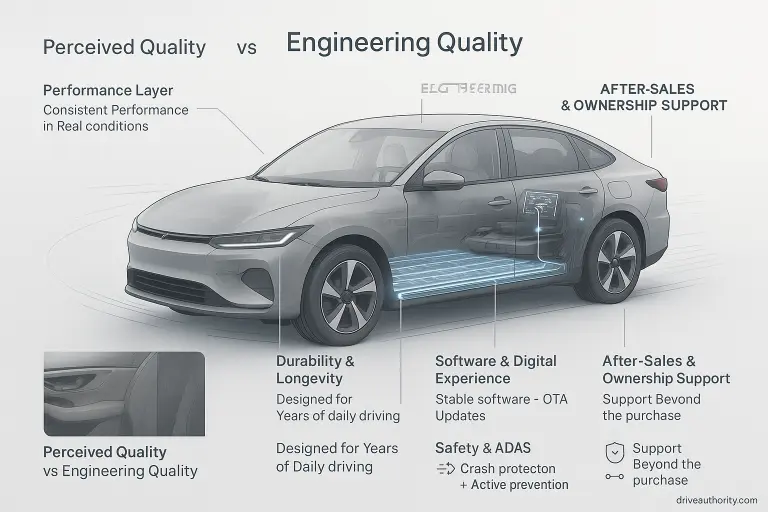
Before answering the core question — are Chinese EVs high quality? — it’s essential to understand what “quality” truly means in the electric era. The standards are no longer the same ones used to judge gasoline cars. Today, the vehicles that win aren’t just well-assembled; they excel in engineering fundamentals that shape long-term safety, reliability, and daily usability.
At its core, a high-quality electric vehicle is defined by six fundamental pillars:
2.1 Performance: How the EV Feels on the Road
A quality Chinese EV delivers smooth acceleration, precise handling, and stable braking — not just in ideal conditions but in heat, cold, and heavy traffic. Thermal management now matters as much as horsepower.
2.2 Battery Technology: The Heart of EV Quality
This is where Chinese brands often lead globally. High-quality batteries are defined by:
- strong energy density
- ultra-stable chemistry
- slow degradation
- safe temperature control
- fast yet secure charging
Since the battery is the single most expensive component in an EV, it is also the clearest indicator of true engineering quality.
2.3 Durability: How the EV Ages Over Time
A well-engineered EV maintains consistent performance after years of use. Durability depends on cooling systems, power electronics, chassis design, and long-term electronic stability — areas where cheap early EVs once struggled.
2.4 Safety: Crash Protection + Smart Driving Systems
Modern safety extends beyond crash structure. High-quality Chinese EVs combine:
- strong Euro NCAP crash performance
- reliable airbags and structural rigidity
- competent ADAS systems that actually prevent accidents
Safety is one of the fastest-rising quality metrics for Chinese brands.
2.5 Software & User Experience: The New Quality Battleground
In the EV world, software quality often matters more than traditional “luxury features.” A high-quality electric vehicle has:
- intuitive UI/UX
- stable operating systems
- smooth navigation and charging management
- frequent over-the-air improvements
You’re no longer buying a machine — you’re buying an evolving digital platform.
2.6 After-Sales Support: The Ownership Multiplier
Even the best EV needs solid backup:
parts availability, warranty strength, repair networks, and service transparency. This is an area where some Chinese EVs shine in their home market but still face challenges abroad.
Perceived Quality vs. Engineering Quality — A Critical Difference
Traditional car buyers often judge quality by:
- soft-touch dashboards
- leather textures
- door-closing sounds
- panel gap alignment
This is perceived quality — how the car feels at first glance.
But true EV excellence lies in engineering quality:
- battery cooling systems
- inverter efficiency
- structural rigidity
- software stability
- sensor reliability
A vehicle can look premium yet fail early if its engineering fundamentals are weak. Conversely, a Chinese EV with modest interior materials can outperform Western rivals if its battery, software, and thermal systems are superior.
Why This Distinction Matters in the EV Era
Electric vehicles flipped the old rulebook. In the past, “fit and finish” often decided whether a car felt high-end. Today, battery performance, thermal stability, ADAS accuracy, and software innovation matter far more than stitch patterns or chrome trims.
This is exactly why Chinese EVs have risen so rapidly. They invested heavily in the engineering layers that define modern automotive quality — and it shows in real-world performance, safety scores, and durability data.
3. The Evolution of Chinese EV Quality: From Cheap Beginnings to World-Class Engineering
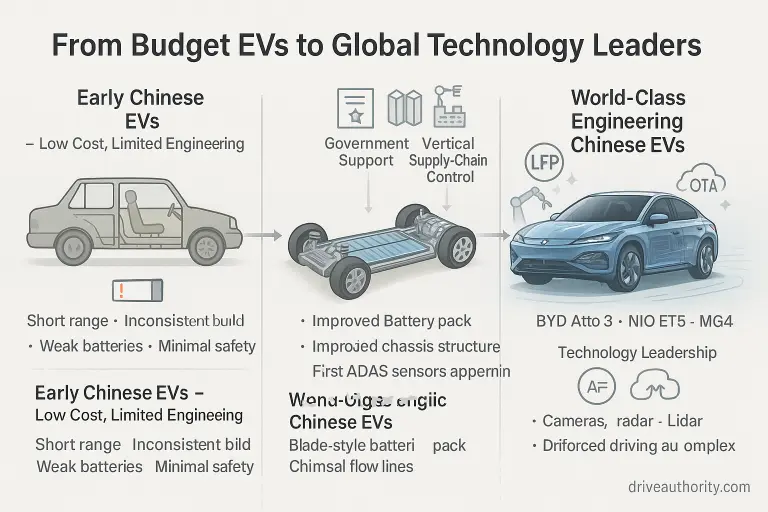
To understand why Chinese EVs are now considered high quality, we need to look at how dramatically the industry has evolved. What began as a market filled with low-cost, low-tech electric cars has transformed into a global powerhouse producing some of the most advanced EVs on the road.
3.1 How Early Chinese Electric Cars Struggled With Quality
In the early 2010s, many Chinese EVs suffered from:
- short driving ranges
- inconsistent build quality
- weak batteries
- limited safety features
- minimal software integration
These cars were inexpensive, but they lacked engineering maturity. As a result, global buyers viewed them as cheap alternatives rather than high-quality Chinese EVs.
3.2 The Turning Point: Government Support and Massive Scale
China’s rise in EV quality was not accidental. Three major forces accelerated the shift:
1. Strong government policy:
Generous subsidies, EV mandates, and city-level incentives pushed manufacturers to innovate aggressively.
2. Unmatched production scale:
No country produces more batteries, semiconductors, or EV components than China. High volume = lower costs + higher consistency.
3. Vertical supply-chain control:
Chinese brands own or control critical supply lines — from lithium refining to battery pack assembly. This eliminated expensive middlemen and enabled better engineering quality at lower prices.
This combination created the perfect environment for rapid improvement.
3.3 Breakthrough Models That Redefined Chinese EV Quality
Within a few years, several flagship models began shifting global perception:
- BYD Atto 3:
Known for its Blade Battery safety, smooth performance, and strong Euro NCAP safety rating. - NIO ET5:
A tech-forward sedan with sophisticated software, battery-swap capability, premium interior execution, and advanced ADAS. - MG4 Electric:
Built on a dedicated EV platform with precise handling, strong efficiency, and impressive value — widely praised in Europe.
These vehicles demonstrated that the quality of Chinese electric cars had reached — and in some areas surpassed — global competitors in safety, battery engineering, and software sophistication.
3.4 How China Became a Leader in High-Quality EV Technology
Because Chinese automakers invested early in:
- LFP and advanced battery chemistry
- autonomous driving research
- over-the-air software ecosystems
- robotics-driven manufacturing
…they moved rapidly from “budget EV makers” to world-class producers of high-quality Chinese EVs trusted in dozens of global markets.
4. Build Quality of Chinese EVs: How High-Quality Chinese Electric Cars Compare to Tesla, Hyundai, and European Brands

Build quality is one of the most debated aspects when people ask, “Are Chinese EVs high quality?” To answer it clearly, we need to break down every element — from exterior finishing to manufacturing precision — and compare Chinese electric cars directly with global leaders like Tesla, Hyundai, Volkswagen, and premium European marques.
4.1 Exterior Build Quality of Chinese EVs: Panel Gaps, Materials, and Paint Finish
In the early days, exterior quality was the biggest weakness for Chinese automakers. Today, the story is very different.
Where Chinese EVs excel now:
- Improved panel alignment that now rivals Tesla and often surpasses older U.S. factory builds.
- Consistent paint quality thanks to modern, automated paint shops across factories owned by BYD, SAIC, Geely, and Changan.
- Better corrosion resistance due to international export standards.
Still improving:
Some mid-tier Chinese brands occasionally show:
- lighter sheet metal
- thinner paint layers compared to European brands known for durability
Leaders in exterior build quality:
- NIO
- BYD (especially newer models like Seal, Song L, and Atto 3)
- Zeekr
These brands now stand side-by-side with Hyundai and Volkswagen in terms of exterior refinement.
4.2 Interior Quality of Chinese Electric Cars: Ergonomics, Materials, and Fit & Finish
Interiors have become a major selling point for high-quality Chinese EVs, often outperforming global rivals in design and comfort.
Strengths:
- Soft-touch materials even in mid-priced models
- Clean, modern layouts with strong ergonomics
- High-resolution screens and responsive UI
- Better cabin insulation than many Teslas
How they compare:
- Tesla: Minimalist but often criticized for harsh plastics and inconsistent fit.
→ Many Chinese EVs now exceed Tesla in interior quality. - Hyundai/Kia: Still strong in material quality and layout consistency.
→ Chinese brands match them closely and sometimes surpass them in technology integration. - European brands: Remain leaders in premium detailing.
→ Chinese EVs are catching up fast, especially with NIO and Zeekr.
Brands with top-tier interiors:
- NIO
- Zeekr
- BYD
- Aion
Mid-market brands like MG and Chery still vary, but the overall trend is sharply upward.
4.3 Manufacturing Precision: Robotics, Gigacastings, and Battery Integration in Chinese EVs
China’s factories are among the most automated in the world, and this directly boosts Chinese EV quality.
Three major manufacturing strengths:
1. Robotics-driven assembly
Factories owned by BYD, Geely, and SAIC feature high levels of automation — similar to or higher than Tesla’s Shanghai plant.
2. Advanced battery integration
Since Chinese companies (CATL, BYD) dominate global battery supply:
- pack-to-frame integration is more precise
- thermal systems are more reliable
- longevity is higher
3. Emerging gigacasting technologies
Several Chinese brands have adopted or are rapidly adopting gigacasting similar to Tesla’s approach, improving rigidity and reducing manufacturing variation.
Who leads manufacturing precision?
- BYD → Industry benchmark for vertical integration
- Tesla Shanghai → Sets global standards, but competes directly with China’s best
- Geely/Zeekr → Extremely advanced in chassis engineering and robotics
- NIO → High-end precision with luxury-level tolerances
Brands still improving:
- Changan
- Chery
- JAC
These lag slightly in consistency but continue to improve yearly.
4.4 Which Chinese EV Brands Offer the Best Build Quality Today?
Top-tier build quality (rival premium European brands):
- NIO
- Zeekr
- BYD (high-end and mid-range models)
Mid-tier build quality (competitive with Hyundai, VW, Kia):
- MG
- Aion
- Haval
- Geely (non-premium lines)
Developing tier (improving but not yet consistent):
- Chery
- Dongfeng
- JAC
The overall takeaway is clear: Chinese electric cars are no longer the cheap, low-quality vehicles they once were. Many now exceed global rivals in build precision, interior execution, and manufacturing sophistication.
5. Battery Technology in Chinese EVs: The Strongest Proof of High Quality
If there is one area where the question “Are Chinese EVs high quality?” receives a definitive yes, it’s battery technology. China is not just competitive — it leads the world. Brands like BYD, CATL, CALB, and Gotion dominate global production, chemistry innovation, and real-world performance, giving Chinese electric cars a structural advantage that other automakers struggle to match.
5.1 Why BYD and CATL Lead Global Battery Quality
Two companies define the modern EV battery landscape:
- CATL, the world’s largest EV battery supplier
- BYD, the only automaker that designs, builds, and installs its own batteries at massive scale
Together, they power vehicles from Tesla to BMW — and this alone underscores the engineering quality behind Chinese EV batteries.
Their dominance comes from:
- deeper control of raw materials
- unmatched manufacturing scale
- more mature LFP chemistry
- faster research-to-production cycles
- vertically integrated EV platforms
In other words, China owns the full battery ecosystem — from mining to cell production to pack integration.
5.2 LFP Batteries: The Backbone of High-Quality Chinese EVs
Lithium Iron Phosphate (LFP) has become the signature chemistry of Chinese EV quality. While Western brands still depend heavily on NMC batteries, Chinese manufacturers perfected LFP years ago.
Key advantages of LFP in Chinese EVs:
- Exceptional safety (thermally stable, very low fire risk)
- Longer lifespan with 2,000–3,000+ full charging cycles
- Minimal degradation even after years of use
- Cheaper and cleaner to produce
- Better durability in hot climates
This is why taxis, ride-hailing fleets, and delivery vans in China routinely exceed 300,000–500,000 km with original batteries.
5.3 BYD’s Blade Battery: A Milestone in Chinese EV Quality
The Blade Battery is China’s most famous battery innovation — and one of the auto industry’s biggest breakthroughs in decades.
What makes the Blade Battery special:
- Ultra-safe design that resists puncture, crushing, and thermal runaway
- Higher energy density than traditional LFP cells
- Slim, structural format enabling lighter, stronger EV platforms
- Remarkably low heat generation during fast charging
- Proven durability in high-mileage taxis and fleet vehicles
BYD uses the Blade Battery across many models, including the Atto 3, Seal, and Dolphin, giving them world-class safety and reliability scores.
5.4 Real-World Degradation: Chinese EV Batteries Age More Slowly
One of the strongest indicators of Chinese EV quality is battery health over time.
Fleet data shows:
- CATL and BYD LFP packs often lose only 5–8% capacity after 150,000 km
- Some high-mileage taxis see 10% degradation after 200,000 km
- Western NMC-based EVs often average 12–20% degradation over similar distances
LFP’s chemistry, combined with advanced thermal systems, simply ages better.
5.5 Trade-Offs: LFP vs. NMC Batteries Used in Western EVs
LFP (common in Chinese EVs) and NMC (common in Western EVs) each offer benefits — the difference comes down to priorities.
LFP (Chinese EV advantage):
- Pros: Safer, cheaper, longer lifespan, slower degradation, more stable
- Cons: Slightly heavier, slightly lower energy density
NMC (Western EV focus):
- Pros: Higher energy density, longer range in premium models
- Cons: More expensive, shorter lifespan, more fire risk, faster degradation
This is why European and American brands increasingly source LFP cells from CATL and BYD for their entry and mid-range EVs.
5.6 Why Battery Technology Is the Core of Chinese EV Quality
Chinese EV makers outperform in quality largely because they dominate the component that matters most:
- batteries influence price
- batteries control safety
- batteries define long-term reliability
- batteries shape performance in heat and cold
- batteries determine resale value
When you combine advanced chemistry, tight integration, and massive R&D investment, the result is clear:
Battery technology is the strongest evidence that Chinese EVs are truly high quality.
6. Safety Ratings: Are Chinese EVs Truly Safe? (Are Chinese EVs High Quality in Crash Protection?)
The debate around “Are Chinese EVs high quality?” inevitably lands on one core issue: safety. And today, the data paints a far more nuanced picture than the old stereotypes suggest.
Chinese EVs in Euro NCAP: A Reality Check
When exported, many Chinese electric vehicles consistently perform at the top of Europe’s most demanding crash-testing system. Brands such as BYD, NIO, MG, and XPeng have earned five-star Euro NCAP ratings, often scoring on par with — and sometimes above — established players like Tesla, Volkswagen, Hyundai, and Volvo.
These results challenge the lingering belief that Chinese vehicles cut corners in structural engineering. In fact, several models show impressive performance in:
- Adult occupant protection
- Child occupant protection
- Vulnerable road user safety
- ADAS performance (AEB, lane support, collision avoidance)
The takeaway? Export-targeted models generally meet or exceed global safety expectations.
Domestic vs. Export Versions: Why They Differ
A critical nuance is understanding that not all Chinese EVs are built for the same regulatory environments. Export variants — especially those destined for Europe, Australia, and the Middle East — often include:
- Reinforced structures
- More advanced ADAS suites
- Higher-grade airbags
- Improved battery protection systems
Meanwhile, domestic-market versions may carry lighter equipment to reduce cost, since local regulations don’t always require the same level of ADAS sophistication or structural reinforcement.
This dual-spec strategy can explain conflicting online reviews: a five-star European MG4 differs meaningfully from the cheaper version sold in rural China.
Misconceptions About Chinese Safety Standards
Three myths persist — and deserve to be unpacked:
- Myth: “Chinese cars are unsafe because they’re cheap.”
Today’s leading models are not cheap knockoffs. BYD, NIO, and Geely engineer EVs specifically to exceed global regulatory benchmarks. - Myth: “China doesn’t care about crash safety.”
China has steadily upgraded its national NCAP equivalent — C-NCAP — aligning it closer to Euro NCAP. New rules in 2024 introduce harsher side-impact and ADAS tests, closing historical gaps. - Myth: “Electric cars from China cut corners on battery safety.”
Ironically, Chinese LFP and Blade batteries often outperform Western NMC packs in thermal-runaway resistance. Structural battery packs from BYD and CATL show extremely stable behavior in puncture and crush tests.
The Bottom Line on Safety Quality
Viewed through the lens of “Are Chinese EVs high quality?”, safety is one of the most compelling areas where the answer increasingly leans toward yes — especially for export-certified models.
The combination of rigorous Euro NCAP performance, rapid regulatory alignment, and globally leading battery safety gives Chinese EVs a serious competitive edge.
The real caution is not about Chinese EVs being unsafe; it’s about knowing which spec you’re buying.
7. Software & Technology: The Silent Quality Revolution (Are Chinese EVs High Quality in Software & Tech?)
If you really want to understand “Are Chinese EVs high quality?”, you have to look beyond steel, batteries, and crash scores. The quiet revolution — the one reshaping consumer perception fastest — is happening in software, UI design, and digital intelligence. And here, Chinese automakers have moved from fast followers to genuine category leaders.
A New Benchmark in UI/UX Sophistication
Brands like NIO, XPeng, Zeekr, and Aion are redefining what “premium digital experience” means inside an EV. Their advantage comes from an ecosystem where hardware and software teams work together from day one, rather than bolting features onto legacy platforms.
What stands out?
- Fluid, intuitive interfaces with responsive animations
- Voice assistants that actually understand natural speech
- Deep personalization, from seat presets to cabin scent profiles
- Multi-screen layouts designed around the driver, not retrofitted
In many cases, these systems feel more refined and coherent than those in Tesla, Hyundai, or most European brands. Legacy automakers often struggle to match this polish because they’re still transitioning from mechanical-first to software-first cultures.
ADAS Performance: Matching Tesla, Surpassing Most Others
Tesla still leads in real-world autonomy scaling, but the gap is narrowing. Chinese EVs now feature:
- High-resolution LiDAR systems (XPeng, NIO)
- City-level autonomous pilot modes that handle dense traffic
- Adaptive learning algorithms tuned for real-world edge cases
- Cross-domain computing with in-house chips from Huawei and NVIDIA partnerships
In structured environments — highways, parking, low-speed congestion — many Chinese systems outperform European and Korean ADAS suites in smoothness, decision-making, and driver confidence.
The trend suggests a shift: while Tesla had the early edge in autonomy, Chinese brands are pushing a more sensor-rich and reliability-focused philosophy that appeals to safety-conscious buyers.
Over-the-Air Updates & Ecosystem Integration
One of the strongest indicators of high quality in the EV era is how fast a car improves after you buy it. Chinese EVs excel here:
- Frequent OTA updates (monthly or even biweekly)
- Full-stack upgrades covering ADAS, charging, UI, HVAC logic, and efficiency
- Smart home and smartphone integration, often deeper than Western ecosystems
- App-based energy management, allowing users to schedule charging, preheat, or even sell power
This agile-update culture mirrors consumer electronics more than the traditional auto industry. It’s one of the clearest reasons Chinese EVs now feel “alive” and continuously improving.
The Modern Quality Question
In a world where software defines half the driving experience, the question “Are Chinese EVs high quality?” takes on new meaning. The answer becomes harder to ignore: they’ve quietly built some of the most advanced digital systems on the market, often eclipsing long-established brands.
The real strategic question now is whether Western manufacturers can transition fast enough to compete with this pace of software-driven innovation.
8. Long-Term Reliability: What Do Real-World Owners Say About Chinese EV Quality?
When buyers ask “Are Chinese EVs high quality in the long term?”, they’re really asking whether these cars hold up after years of daily use — not just whether they impress in a showroom. Reliability is becoming the new battleground, and real-world data from owners, fleets, and high-mileage taxis in China provides a clearer picture than marketing claims.
Warranty Coverage: Clear Confidence Signals
Chinese automakers often offer stronger warranties than their Western rivals — an early indicator that they trust their engineering:
- BYD: 6 years / 150,000 km vehicle warranty + 8 years / 200,000 km battery warranty
- NIO: Lifetime warranty for the first owner (selected components)
- MG / SAIC: 7-year warranty in many export markets
- Geely / Zeekr: Competitive battery + drivetrain guarantees
Compared to Tesla’s more limited coverage and several European brands offering only 3–5 years, this warranty architecture communicates a strategic message: these companies expect their vehicles to last.
Real-World Weak Points: Where Reliability Still Varies
While the overall picture is improving fast, long-term owner reports highlight a few consistent patterns:
- Thermal management quirks in extreme cold, especially on budget LFP-based models
- Sensitive electronics, particularly infotainment hardware on early MG and XPeng generations
- Service availability gaps in new export markets (spare parts delays, limited repair hubs)
- Interior wear on entry-level models where cost savings show over time
These issues don’t define the entire segment, but they show that Chinese EV quality isn’t uniform. Premium brands (NIO, Zeekr, Li Auto) generally show far fewer long-term complaints than budget imports.
High-Mileage Fleet Data: The Strongest Evidence of Quality
The most convincing durability insights come from Chinese taxi and ride-hailing fleets, where vehicles quickly accumulate 150,000–300,000 km. Here’s what stands out:
- BYD e6 and Qin Pro EV models routinely cross 500,000 km with minimal battery degradation (often under 10%).
- LFP battery performance is consistently stable even under harsh charge/discharge cycles.
- Power electronics and motors show exceptionally low failure rates.
- Cabin components hold up better than expected in high-use environments.
This fleet-level resilience is one of the primary reasons China captured the global EV market so quickly: the technology works, and it lasts.
So, Are Chinese EVs High Quality in Long-Term Reliability?
The short answer: many of them are — particularly those built on modern platforms with LFP batteries, mature thermal systems, and strong after-sales networks. Reliability varies by brand and segment, but the narrative of “cheap but fragile” no longer reflects the evidence.
The strategic challenge ahead is less about engineering and more about global service infrastructure, which will determine how Western buyers perceive long-term value.
9. After-Sales Service & Global Support: Is This the Hidden Weak Point in Chinese EV Quality?
Even when people ask “Are Chinese EVs high quality?”, the conversation eventually circles back to a practical reality: quality isn’t only what happens on the road — it’s also what happens when something goes wrong. And this is where after-sales service becomes a defining part of the ownership experience.
Chinese brands score impressively on engineering, battery tech, and value. But global support remains uneven, creating gaps that potential buyers need to evaluate with clear eyes.
Dominant at Home, Patchy Abroad
In China, after-sales service for electric vehicles is mature, dense, and well-integrated:
- Nationwide repair networks
- Fast parts delivery
- Large inventories of technicians trained specifically on EV systems
- Established resale markets with predictable price curves
However, once these brands expand internationally, the ecosystem thins out dramatically.
Outside China, buyers often face:
- Limited dealer presence
- Small service networks still under construction
- Longer wait times for diagnostics and repairs
- Inconsistent communication standards between regions
This doesn’t mean the cars are low quality — but support infrastructure hasn’t yet caught up with the speed of global expansion.
Parts Availability: The Most Common Global Concern
For many new markets, the bottleneck isn’t technical complexity — it’s logistics.
Owners report:
- Multi-week waits for replacement body panels
- Delays for electronics modules sourced directly from China
- Difficulty finding shops certified to repair battery packs
In contrast, brands with strong local manufacturing (BYD, MG/SAIC, Geely/Volvo group) often perform better because they already have regional warehouses and faster supply chains.
Repair Networks: Growing Fast but Still Incomplete
Tesla’s early struggles in service coverage created a blueprint that Chinese companies are now repeating. To meet rising demand, manufacturers are rapidly expanding:
- BYD is building large service centers across Europe and Southeast Asia
- MG already operates one of the fastest-growing networks in the UK
- NIO offers mobile service vans + swap stations in select countries
- Zeekr is partnering with established dealer groups
But even with aggressive expansion, coverage still lags behind established giants like Toyota, Hyundai, or Volkswagen.
Resale Value: A Work in Progress
Resale value has become a barometer of perceived quality — and this is where Chinese EVs still face resistance, especially in Western markets.
Factors pushing prices down:
- Unfamiliar brand names
- Limited historical reliability data
- Smaller buying pools for used Chinese EVs
- Fast-moving model cycles that age older versions quickly
However, in markets where Chinese brands are now mainstream (China, Thailand, Brazil, Israel), resale trends are stabilizing, especially for BYD and MG.
Realistic Expectations for International Buyers
If someone is considering a Chinese EV outside China, here’s the pragmatic view:
You can expect:
- Excellent battery life
- High feature density for the price
- Competitive warranty terms
- Strong engineering and day-to-day reliability
You should be prepared for:
- Limited service centers (depending on the country)
- Delays in parts shipping
- Less predictable resale value
- Fewer technicians trained specifically on advanced EV platforms
In other words, the vehicles themselves often match or exceed global standards — but the ownership ecosystem is still catching up, and this can influence perceived quality as much as hardware engineering.
10. Price–Quality Ratio: Why Chinese EVs Offer Exceptional Value for Money
One of the strongest reasons people revisit the question “Are Chinese EVs high quality?” is the almost unbelievable price–quality ratio. Chinese manufacturers have managed to deliver electric vehicles that rival — and often outperform — Western competitors while costing significantly less. This isn’t because they cut corners. It’s because the entire manufacturing ecosystem is designed for efficiency and scale.
Scale + Vertical Integration: The Secret Behind the Value
Chinese EV makers operate within the world’s most concentrated EV supply chain. This ecosystem gives them three structural advantages:
1. Gigascale production reduces costs per unit
China produces more EVs than the rest of the world combined. This allows automakers to:
- Purchase raw materials at lower cost
- Optimize factory output
- Standardize platforms across multiple models
The result? Lower manufacturing cost without sacrificing quality.
2. Vertical integration eliminates middlemen
Companies like BYD build nearly everything in-house:
- Batteries
- Semiconductors
- Motors
- Power electronics
- Software
This reduces price volatility, ensures tight quality control, and creates cost savings Western brands can’t match.
3. Localized supply chains shorten development cycles
While traditional automakers rely on global suppliers, Chinese brands have:
- Domestic battery giants
- Local chip manufacturers
- Nearby robotics and automation partners
This speeds up innovation and reduces logistics costs.
“More Quality per Dollar”: What This Actually Means
The premium-per-dollar ratio becomes obvious when comparing features.
Most Chinese EVs offer:
- Larger batteries for the same price
- Better interior tech (screens, software, ADAS)
- Higher safety equipment as standard
- More efficient motors
- Better thermal management
- Faster charging speeds in mid-range models
For the cost of a basic Western EV, buyers often get a fully loaded Chinese EV with advanced features like:
- 360° cameras
- Lidar-based driver assistance
- Heated/ventilated seats
- Premium infotainment systems
- Over-the-air update ecosystems
Value isn’t just price — it’s what you get for that price. And Chinese EVs consistently deliver more.
Breaking the Psychological Barrier: Affordable Doesn’t Mean Low Quality
For decades, consumers associated “Made in China” with low-cost and low-quality goods. EVs are forcing a hard reset of that perception.
Three shifts are driving this:
- Benchmark performance — Models like the BYD Seal, Zeekr 001, and XPeng G6 outperform many Western rivals.
- Battery leadership — CATL and BYD supply top-tier batteries even to Tesla, BMW, and Mercedes.
- Safety results — Many Chinese EVs now score 5 stars in Euro NCAP, matching or surpassing legacy brands.
In the EV era, software precision, battery engineering, and manufacturing innovation matter more than outdated ideas about fit-and-finish or brand prestige. And in these domains, Chinese companies are setting global standards, not following them.
11. Should You Buy a Chinese EV? A Clear, Balanced Verdict on Chinese EV Quality
By this point, many readers asking “Are Chinese EVs high quality?” have a clearer picture of how these vehicles genuinely perform. But the real decision comes down to one practical question: Should you buy one? The answer depends on your priorities, your market, and your tolerance for certain trade-offs.
Below is a balanced, buyer-focused verdict that cuts through hype — and skepticism — to help you make an informed choice.
When Chinese EVs Are a Smart, High-Value Choice
A Chinese EV becomes an excellent decision when your priorities align with the strengths these brands consistently deliver:
1. You want maximum features for the price
Chinese EVs routinely offer:
- Larger batteries
- Longer equipment lists
- Advanced driver-assistance systems
- Premium interiors
- Higher-tech infotainment
all at a price that undercuts Western and Korean competitors by thousands.
2. You value battery lifespan and safety
CATL and BYD lead the world in LFP and Blade battery technology.
If you want:
- Low degradation
- Safe chemistry
- High cycle lifespan
Chinese EVs are the global benchmark.
3. You prioritize cutting-edge software and in-car tech
Brands like NIO, XPeng, Zeekr, and BYD deliver:
- Fast, intuitive UI
- OTA updates
- Smart driving assistance
- Seamless ecosystem integration
If tech matters to you, Chinese EVs excel.
4. You drive primarily in urban or suburban environments
Chinese EVs are optimized for:
- Energy efficiency
- Smooth acceleration
- Quiet comfort
- City-friendly ADAS
This makes them ideal as daily commuters or family vehicles.
When You Should Be Cautious or Think Twice
Chinese EVs are not perfect — and understanding their weaknesses is essential before buying.
1. You live in a region with limited service network coverage
Outside China, support can be thin:
- Fewer technicians
- Slower parts delivery
- Inconsistent dealership maturity
If after-sales reliability matters deeply to you, evaluate local support first.
2. You care about resale value
In many markets (especially Europe and the US), Chinese EVs face:
- Unfamiliar brands
- Rapid model refresh cycles
- Limited used-EV demand
Resale values can be unpredictable compared to Toyota, Hyundai, or Tesla.
3. You frequently take long road trips
Although many Chinese EVs have good range, charging infrastructure, not the car itself, may be the limiting factor in certain regions.
4. You prefer a brand with decades of global trust
Chinese brands are rising fast, but legacy automakers still hold an emotional and historical edge for some buyers.
Summary: Key Strengths and Weaknesses of Chinese EVs
Strengths
- World-leading battery technology
- Excellent feature-to-price ratio
- Rapid software innovation
- Strong safety ratings (for export models)
- High daily-use comfort and efficiency
- Fast development cycles and modern design
Weaknesses
- Uneven global after-sales support
- Slower parts availability in some regions
- Uncertain long-term resale values
- Limited global brand recognition
- Fewer long-term reliability studies outside China
Final Verdict: Should You Buy a Chinese EV?
If your primary decision factors are value, technology, battery quality, and features, Chinese EVs are among the strongest options on the global market. For many drivers, they deliver more quality per dollar than almost any competing brand.
However, if you live in a region where service networks are immature, or if resale value and long-term brand prestige matter greatly to you, then cautious evaluation is wise.
In short: the engineering and technology are world-class — the ecosystem is still catching up.
12. Conclusion: Are Chinese EVs High Quality? A Clear, Final Answer
So, are Chinese EVs high quality? Based on the evidence — engineering progress, battery leadership, safety results, software innovation, and real-world usage — the answer is yes, increasingly and undeniably so. The days when Chinese cars were viewed as low-cost, low-quality alternatives are over. Today, many Chinese EVs match or exceed global competitors in the metrics that matter most in the electric era: battery longevity, safety engineering, efficiency, and intelligent software.
But it’s also true that quality is more than what you see on the spec sheet. It’s the entire ownership experience — and here, the picture is still evolving. While the vehicles themselves demonstrate world-class capabilities, after-sales networks, parts availability, and resale value remain inconsistent across international markets. The technology is ready; the global infrastructure is still catching up.
A Future Where Chinese EVs Become Global Benchmarks
As Chinese brands expand deeper into Europe, the Middle East, Africa, Southeast Asia, and Latin America, the landscape is shifting fast. Every year:
- Service networks get stronger
- Local manufacturing footprints expand
- Charging partnerships multiply
- Perception barriers fade through real-world experience
Given China’s dominance in battery supply chains, vertical manufacturing, and software-centric design, Chinese EVs are positioned to become the standard setters, not just competitors.
Over the next decade, expect:
- More premium Chinese EVs rivaling German luxury brands
- More mid-range models outperforming Korean and American rivals
- Continued breakthroughs in battery chemistry and thermal management
- Faster innovation cycles driven by massive domestic competition
The trajectory points in one direction: upward.
What This Quality Shift Means for the Global Auto Industry
The rise of high-quality Chinese EVs represents one of the biggest disruptions since the birth of the modern automobile. It forces traditional automakers to accelerate:
- Battery development
- Software ecosystems
- Pricing and value strategies
- Manufacturing efficiency
- Over-the-air update capabilities
- ADAS advancements
In short, Chinese EVs are reshaping global expectations of what an electric car should offer — and at what price. Consumers benefit from this pressure, gaining access to better technology, longer-lasting batteries, safer platforms, and more affordable choices.
Final Reflection
Chinese EVs are no longer the “budget option.” They are a sign of where the industry is heading: toward smarter, safer, more efficient electric vehicles that deliver exceptional value. The quality is real, the progress is accelerating, and the world is beginning to recognize it.
And as global infrastructure matures, the question “Are Chinese EVs high quality?” will likely fade — replaced by a new one:
Can the rest of the world keep up?
FAQ: Clear Answers to Common Questions About Chinese EV Quality
1. Are Chinese electric cars reliable long-term?
Yes — especially models using LFP or Blade battery technology from BYD and CATL. These chemistries degrade slowly and perform well under heavy daily use. Real-world taxi fleets in China routinely exceed 200,000–400,000 km with minimal battery loss. However, long-term reliability outside China can vary depending on service network maturity in each country.
2. Why are Chinese EVs cheaper?
Chinese EVs cost less because of massive production scale, vertically integrated supply chains, and domestic access to battery materials. Companies like BYD build batteries, semiconductors, and motors in-house, which reduces costs without reducing engineering quality. Lower prices reflect manufacturing efficiency — not inferior components.
3. Which Chinese EV brand has the best quality?
Different brands excel in different areas:
- BYD — best overall reliability, world-class batteries, strong safety
- NIO — premium software, user experience, and service ecosystem
- XPeng — advanced ADAS technology and smart driving features
- Zeekr — excellent build quality and performance tuning
- MG (SAIC) — strong value and consistent global support
The “best” depends on whether you prioritize battery life, tech, premium feel, or after-sales support.
4. Are Chinese EVs safe according to global standards?
Yes. Many leading models — such as the BYD Atto 3, MG4, NIO ET5, and XPeng G9 — have earned 5-star Euro NCAP ratings. Export versions often include enhanced structural reinforcements and upgraded ADAS systems. The misconception that Chinese cars lack safety is outdated and no longer reflects current engineering practices.
5. How do Chinese EVs compare to Tesla?
Tesla still leads in global charging infrastructure and long-range efficiency. But Chinese EVs often outperform Tesla in:
- Interior quality
- Build precision
- Standard safety features
- Infotainment and user experience
- Price-to-performance ratio
In the mid-range and budget segments, Chinese EVs generally offer better value. In premium segments, brands like NIO and Zeekr rival Tesla in software and comfort while offering competitive pricing.