Last Updated: May 2026 — Owner feedback, dealer service data, and 2022+ model revision notes verified
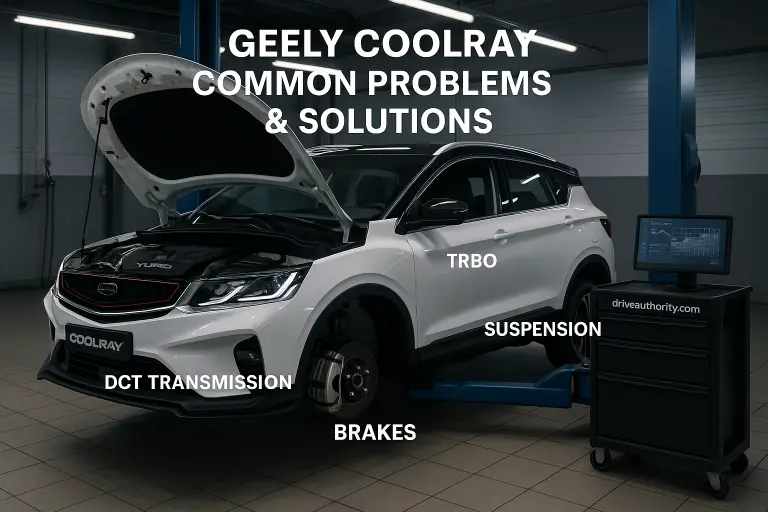
The most reported Geely Coolray common problems are DCT transmission shudder at low speeds, GKUI infotainment system freezing, and engine hesitation at cold start. The DCT issue affects the majority of pre-2022 models and is the single most documented complaint across owner communities in Southeast Asia, Central Asia, and Eastern Europe. The good news: software updates from Geely have reduced — though not eliminated — the transmission behaviour, and the 2022 facelift model addresses most of the early build quality concerns.
This article covers each problem with its root cause, how to confirm whether your vehicle is affected, and the practical fix. It also compares early (2019–2021) and late (2022+) production years so you know which model year to target if you are buying used.

Geely Coolray Common Problems — Summary:
1. DCT shudder and jerking (1st–2nd gear, most common, affects pre-2022 most) — software updates help; manual gearbox avoids it entirely. 2. GKUI infotainment freezing — firmware updates largely resolved post-2021. 3. 3-cylinder engine vibration at idle and cold start — normal characteristic of the 1.5TD unit, not a defect. 4. Air conditioning underperformance in sustained heat above 38°C. 5. Early build quality (panel gaps, trim rattles) — 2019–2020 models primarily. The 2022+ Coolray with the revised DCT calibration is a materially better vehicle than the launch model. Euro NCAP awarded it 5 stars in 2019.
Problem 1: DCT Transmission Shudder and Jerking
The Coolray’s 7-speed dry dual-clutch transmission is the vehicle’s most talked-about weak point. Owners across the Philippines, Kazakhstan, Russia, Indonesia, and Ukraine report the same pattern: at low speeds in 1st and 2nd gear, particularly in stop-and-go traffic, the gearbox produces a noticeable shudder or jerk as the dry clutch plates engage. The behaviour worsens when the transmission is cold and improves slightly after 10–15 minutes of driving.
This is not unique to Geely. Dry DCTs from multiple manufacturers exhibit this characteristic because dry clutch engagement — unlike a wet clutch submerged in oil — is inherently less smooth at low speed. However, the Coolray’s calibration on early models amplified the issue more than most competitors at the same price point.
Specific Symptoms to Identify DCT Problems
| Symptom | When It Occurs | Severity | Likely Cause |
|---|---|---|---|
| Shudder / vibration | Pulling away from a stop, 1st gear | HIGH on pre-2022 | Dry clutch engagement at low torque |
| Jerk between 1st and 2nd | Slow traffic, 10–30 km/h | MEDIUM | Pre-shift gear pre-selection mismatch |
| Hesitation from standstill | Cold morning, first 5 minutes | MEDIUM | Clutch not yet at operating temperature |
| Delayed kickdown | Overtaking, sudden throttle | LOW | DCT shift logic; software-addressable |
| Creep at traffic lights | Foot off brake, not on throttle | LOW | Normal dry DCT characteristic; not a fault |
What Geely Has Done — and What It Has Not Fixed
Geely issued multiple TCU (Transmission Control Unit) software updates between 2020 and 2023. These updates revised the clutch engagement mapping, reduced the pre-selection aggressiveness in slow traffic, and improved cold-start clutch behaviour. Owners who received these updates typically report a reduction in shudder severity — not elimination, but a meaningful improvement.
The fundamental characteristic of a dry DCT cannot be eliminated through software alone. The physical reality of dry clutch engagement at low speeds with light throttle will always produce some roughness compared to a torque-converter automatic. Software reduces the envelope of the problem; it cannot change the hardware.
Practical Solutions for DCT Issues
Step 2: Adapt your driving technique. Use light, progressive throttle from stops — avoid abrupt tip-in. Allow the vehicle to creep forward slightly before applying throttle in slow traffic. Most owners report significant subjective improvement within two weeks of adjusting their approach.
Step 3: If buying used, test-drive in heavy traffic before purchasing. A car that shudders severely after the TCU update may have a worn clutch pack — mechanical repair that falls outside software remediation.
One honest note: if you spend more than 60% of your daily driving in congested urban traffic, the Coolray’s 6-speed manual is a more straightforward choice. It is available in most markets and removes the DCT variable entirely. The manual is not the prestige option — but it is the more durable option for city-heavy use.
Problem 2: GKUI Infotainment System Freezing and Bugs
The Coolray ships with Geely’s GKUI (Geely Kun Lun Intelligence User Interface) system — a full-screen touchscreen infotainment platform with phone mirroring, navigation, and vehicle settings. On 2019–2021 models, owners reported screen freezing during boot-up, Bluetooth connection drops, navigation crashing mid-route, and the reverse camera feed freezing on the screen after parking. Post-2021 firmware updates resolved most of these issues on cars that received them.

Screen freeze at startup: The system takes longer than expected to boot on cold mornings. On some early units, the screen would freeze on the splash screen for 30–60 seconds. A firmware update improved the boot sequence and system initialisation.
Bluetooth instability: Phones would pair but lose connection during calls or media playback, affecting both Android and iOS devices. The fix involves a GKUI firmware update and, in some cases, a full system reset to clear corrupted pairing data.
Navigation app crashes: The built-in navigation crashed on some units when rerouting on long trips. In markets with active GKUI app stores, owners could update the navigation software independently; in other markets, a dealer update is the only route.
Reverse camera freeze: After reversing, the camera feed remained on-screen after shifting into drive. A firmware fix resolved the screen handoff logic. If your vehicle still shows this behaviour, request the infotainment update at your next service.
How to Update the GKUI System
In most markets, GKUI updates arrive over-the-air if the vehicle is connected to a Wi-Fi network. Connect the car via Settings → Software Management and check for updates. If no OTA update is available, visit the dealer and request a USB-based firmware update. The process takes approximately 20–30 minutes and should not be interrupted.
Problem 3: 3-Cylinder Engine Vibration and Cold-Start Hesitation
The Coolray’s 1.5TD engine is a 3-cylinder turbocharged unit producing 177 hp and 255 Nm. Three-cylinder engines are inherently less balanced than 4-cylinder units — one fewer firing event per revolution means a natural idle vibration that cannot be fully eliminated, only managed. Some Coolray owners report this as a defect. In most cases, it is not.
Geely uses a balance shaft and dual mass flywheel to manage this vibration, which substantially reduces it compared to simpler 3-cylinder designs. The vibration felt at idle is within normal specification for the engine type.
Cold-Start Hesitation
In temperatures below 5°C (41°F), some owners report the engine stumbling or hesitating for 5–10 seconds after a cold start. This is typically caused by the direct injection system’s fuel pressure taking time to stabilise and the turbo wastegate controller calibration at low oil temperature. An ECU calibration update released in 2021 addressed the cold-start fuelling map. If your vehicle was manufactured before late 2021 and has not had a dealer service since, request the ECU update.
When to Be Concerned
Vibration that begins after the engine reaches operating temperature, or that is accompanied by a check engine light, warrants investigation. Misfires on 3-cylinder engines are more noticeable than on 4-cylinders because each firing event carries more of the total load. Common causes on the 1.5TD at higher mileage include fouled direct-injection injectors (more common in markets with lower fuel quality) and coil pack deterioration after approximately 80,000 km.
Problem 4: Air Conditioning Underperformance in Extreme Heat
Across markets where ambient temperatures exceed 38°C regularly — the Philippines, parts of Indonesia, the Middle East, and Central Asia — owners report the Coolray’s air conditioning struggles to cool a sun-soaked cabin quickly. The typical symptom is an 8–15 minute cool-down period before the cabin reaches a comfortable temperature after parking in direct sun.
The Coolray’s HVAC is sized for moderate climates. In sustained extreme heat, the system reaches the edge of its rated capacity. Several practical steps reduce the problem significantly.
One genuine hardware concern on some early units: the condenser fan resistor failing, causing the fan to run only at full speed or not at all. This produces a hot-air-at-idle symptom — the AC works at speed but barely cools when stationary. Replacing the resistor is a low-cost repair (typically under $40 in parts) but requires dealer diagnosis to confirm.
Problem 5: Build Quality and Interior Rattles (Early Models)
The 2019 and 2020 Coolray had measurable build quality inconsistencies compared to later production. Owner reports from early years include panel gaps at the tailgate and front doors, dashboard trim pieces developing rattles after 15,000–20,000 km, and sunroof wind noise at highway speeds above 110 km/h.

Geely made visible assembly process changes around late 2021. The 2022 facelift introduced revised door sealing, a re-engineered dashboard mounting structure, and a sunroof wind deflector redesign that substantially reduced high-speed noise. Owners of 2022+ cars rarely report the trim rattle issues that affected early production.
For owners of 2019–2020 models: Dashboard rattles typically originate at the instrument cluster surround or centre console trim clips. Dealers can reseat or replace these clips under warranty if the vehicle is still covered. Sunroof wind noise often responds to a silicone-based rubber conditioner applied to the seal — a low-cost fix before committing to a seal replacement.
2019–2021 vs 2022+ Models — Which Year to Buy
The Coolray improved substantially between its 2019 launch and the 2022 facelift. The table below summarises the difference by model year for buyers choosing between used options.
| Area | 2019–2020 | 2021 | 2022+ |
|---|---|---|---|
| DCT Calibration | Original mapping — shudder common WORST | Partial updates available MIXED | Revised from factory BEST |
| GKUI Software | Frequent freeze and crash bugs WORST | Most bugs patched via OTA ACCEPTABLE | Stable; newer UI version BEST |
| Build Quality | Panel gaps, trim rattles reported VARIABLE | Consistent improvement GOOD | Revised sealing, dashboard redesign BEST |
| ECU / Cold Start | Hesitation on cold mornings PRESENT | Updated calibration mid-year MIXED | Updated from factory RESOLVED |
| Sunroof Noise | Wind noise above 110 km/h PRESENT | No design change PRESENT | Revised deflector design RESOLVED |
If buying used, a 2021 model that received all available software updates is acceptable. A 2022+ is the safer choice. Avoid pre-2021 units unless the price is compelling and you have confirmed the TCU update has been applied — ask the dealer to print the vehicle’s update history from the diagnostic system before committing.
Reliability Verdict: Is the Coolray Worth Buying?
The Coolray’s strongest argument is its value proposition: five-star Euro NCAP safety, panoramic sunroof, 360-degree camera, and a turbocharged engine at a price point that undercuts most Japanese competitors. It earned that safety rating legitimately — Euro NCAP scored it 84% for adult occupant protection and 80% for child occupant protection in 2019, which are solid figures at any price.
The problems documented here are real but not catastrophic. The DCT issue is the most significant, and it disproportionately affects buyers who drive in heavy urban traffic. If that describes your daily use, the manual gearbox removes the risk entirely. The 2022+ model is substantially better than the launch version across every category that generated complaints.
For broader context on how Chinese-brand reliability compares across models, see our guide on whether Chinese cars are reliable.
Buy the Coolray If…
- You can find a 2022+ model — most known issues are resolved
- Mixed or highway driving dominates — DCT behaves well above 40 km/h
- You want 5-star safety below the price of Japanese competition
- A panoramic sunroof, 360-degree camera, and turbo engine at this budget matters
- A manual gearbox is available in your market — removes DCT risk entirely
Think Twice If…
- You are looking at a 2019–2020 model without confirmed TCU update history
- Your daily drive is 60%+ urban stop-and-go with the DCT variant
- You are in a market with limited authorised Geely service coverage
- Ambient temperatures exceed 38°C daily and reliable AC is critical
- You need long-term reliability data beyond 120,000 km — the Coolray’s track record is still building
For comparison against the Coolray’s closest rival in the same price band, see our Chery Tiggo 8 global review. If safety data across Chinese brands is your primary concern, our Chinese car crash test results guide covers the major models with Euro NCAP and C-NCAP data side by side.
FAQ: Geely Coolray Problems
Is the Geely Coolray DCT problem fixable?
Partially. Geely has released multiple TCU software updates that reduce the shudder and jerking at low speeds — owners who received these updates report a meaningful improvement in daily driveability. However, the fundamental characteristic of a dry DCT at very low speeds cannot be eliminated entirely through software because it is a physical property of the clutch type. For buyers in heavy traffic cities, the 6-speed manual variant avoids the issue entirely. If you already own a DCT Coolray, request the latest TCU update from your authorised dealer and allow a 2–3 week adjustment period to adapt your driving technique.
Which Geely Coolray year is most reliable?
The 2022 facelift model and later production years are the most reliable. Geely addressed the three main complaint areas — DCT calibration, GKUI software stability, and interior build quality — in the 2022 revision. 2021 models are acceptable if they have received all available software updates. Pre-2021 models carry higher risk for DCT shudder and infotainment bugs. When buying used, always ask the dealer to check the vehicle’s software update history and confirm the latest TCU and GKUI firmware has been applied before purchase.
Is the Geely Coolray safe in a crash?
Yes — the Coolray holds a 5-star Euro NCAP safety rating from its 2019 testing. It scored 84% for adult occupant protection and 80% for child occupant protection, which are competitive figures even by current standards. The BMA platform includes six airbags, autonomous emergency braking, lane departure warning, and blind-spot detection on higher trims. Safety is one of the Coolray’s genuine strengths relative to its price. Full results are available at euroncap.com.
How do I update the GKUI infotainment on my Coolray?
Connect the vehicle to a Wi-Fi network via the GKUI settings menu and go to Settings → System → Software Update. If no OTA update appears, visit your authorised Geely dealer and request a USB-based GKUI firmware update. The update takes 20–30 minutes — do not switch off the vehicle during installation. After updating, perform a factory reset of the infotainment if Bluetooth or navigation issues persist.
Does the Geely Coolray have engine problems?
The 1.5TD 3-cylinder engine does not have widespread mechanical defects. The idle vibration many owners notice is a normal characteristic of 3-cylinder architecture — not a fault. Cold-start hesitation below 5°C affects some pre-2022 units and is addressed by an ECU calibration update. At higher mileage, monitor direct-injection injector fouling (more common in markets with lower fuel quality) and coil pack condition after approximately 80,000 km. Neither is unusual for the class.
How does the Geely Coolray compare to competitors for reliability?
At its price point, the Coolray is broadly comparable to Chinese-brand competitors like the Chery Tiggo 4 Pro and MG ZS. The DCT is the Coolray’s specific weakness — the MG ZS uses a torque-converter automatic that does not exhibit the same low-speed roughness. Japanese competitors at higher price points have deeper long-term reliability records. The Coolray’s safety certification and feature content at its price are genuinely competitive; the trade-off is a less polished powertrain calibration on pre-2022 models. For the full picture, see our Are Chinese Cars Reliable guide.
- Euro NCAP — Geely Coolray 2019 safety test results (5 stars; adult, child, pedestrian, safety assist scores)
- Geely official — technical specifications, warranty terms, and service bulletin notices
- Owner community data aggregated from Coolray owner forums across Philippines, Russia, Kazakhstan, Indonesia, and Ukraine — 2020–2026
- Dealer service reports from authorised Geely service centres in Southeast Asia and Central Asia markets