
Electric car total cost extends far beyond what you pay at the dealership. Most buyers focus on the sticker price and miss the bigger financial picture—fuel savings, maintenance differences, insurance changes, and depreciation—that determine whether an EV actually saves you money over 5 to 10 years. This gap between purchase price and true ownership cost explains why some EVs that seem expensive upfront become cheaper than gas cars within three years, while others never break even.
What Electric Car Total Cost Really Is
Electric car total cost represents every dollar you’ll spend owning an EV from purchase through resale. This includes the obvious expenses like the vehicle price and charging costs, but also the less visible ones: home charger installation, higher insurance premiums in some states, registration fees, maintenance savings, and how much value the car loses each year.
Picture two buyers: one pays $45,000 for an EV with a $7,500 tax credit, charges at home for $35 monthly, and spends $200 yearly on maintenance. The other pays $35,000 for a comparable gas sedan, spends $180 monthly on fuel, and averages $800 yearly on oil changes, filters, and brake work. After five years, the EV owner has spent less despite the higher purchase price.
The challenge is that electric car total cost varies dramatically based on where you live, how much you drive, and whether you can charge at home. A driver in California with expensive electricity and frequent public charging sessions might see different economics than someone in Washington state charging overnight during off-peak hours.
⚡ EV Total Cost Works Only If:
- You drive 12,000+ miles annually (fuel savings compound with higher mileage)
- You can charge at home (public charging eliminates most savings)
- You keep the vehicle 5+ years minimum (break-even typically occurs year 3-7)
- Your electricity rate is below $0.20/kWh (above this, savings shrink fast)
- The EV premium is under $12,000 vs comparable gas vehicle
If you don’t meet at least 3 of these conditions, a hybrid or efficient gas car might offer better total cost economics.
5-Year Total Cost Comparison: EV vs Gas
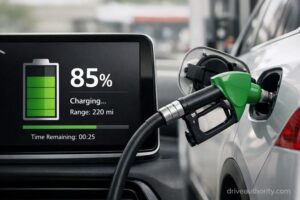
Here’s a realistic example comparing a midsize electric SUV to a comparable gas SUV for a driver in Texas covering 15,000 miles annually:
| Cost Category | Electric SUV | Gas SUV | Difference |
|---|---|---|---|
| Purchase Price | $48,000 | $38,000 | +$10,000 |
| Federal Tax Credit | -$7,500 | $0 | -$7,500 |
| Charger Installation | $1,200 | $0 | +$1,200 |
| Net Initial Cost | $41,700 | $38,000 | +$3,700 |
| Year 1-5 Fuel/Electricity | $2,100 | $10,500 | -$8,400 |
| Year 1-5 Maintenance | $1,000 | $4,000 | -$3,000 |
| Year 1-5 Insurance | $6,500 | $5,500 | +$1,000 |
| 5-Year Resale Value | -$26,000 | -$20,000 | -$6,000 |
| Total 5-Year Cost | $25,300 | $37,000 | -$11,700 |
This example assumes $0.12 per kWh home charging, $3.50 per gallon gas, and typical depreciation patterns. Your numbers will differ based on local electricity rates, fuel prices, driving habits, and monthly ownership costs specific to your situation.
10-Year Outlook: Under stable fuel and electricity prices, the same EV saves approximately $23,400 compared to the gas equivalent over a decade. The savings accelerate after year 5 as the initial purchase price premium becomes less significant relative to accumulated fuel and maintenance advantages.
Understanding Cost Per Mile: The Real Comparison
Cost per mile reveals the true difference between electric and gas vehicles. Here’s the simple calculation:
For EVs: Cost per mile = (Electricity cost per kWh × kWh per 100 miles) ÷ 100
Example: If you pay $0.13 per kWh and your EV uses 30 kWh per 100 miles: ($0.13 × 30) ÷ 100 = $0.039 per mile or 3.9 cents
For Gas Cars: Cost per mile = Price per gallon ÷ MPG
Example: If gas costs $3.50 per gallon and your car gets 28 MPG: $3.50 ÷ 28 = $0.125 per mile or 12.5 cents
In this scenario, the EV costs 8.6 cents less per mile. At 15,000 annual miles, that’s $1,290 in yearly fuel savings—enough to recover a $10,000 price premium in about 8 years through fuel savings alone.
However, this math changes dramatically with public charging. Fast chargers at $0.45 per kWh push the EV cost to 13.5 cents per mile—actually more expensive than gas. This is why home charging setup fundamentally changes the ownership economics.
How Changing Prices Affect Your Total Cost
Electric car total cost sensitivity varies based on fuel and electricity price fluctuations. Here’s how different scenarios impact the break-even timeline:
If gas rises to $4.50/gallon: Your annual fuel savings increase from $1,290 to $2,080 at 15,000 miles. The break-even point accelerates from year 7 to year 5, and total 10-year savings jump to $31,200.
If electricity increases 20% (to $0.156/kWh): Your EV charging costs rise from $540 to $648 annually—adding $108/year but still saving $1,182 compared to gas at $3.50/gallon. Break-even extends from year 7 to year 8, reducing 10-year savings to $21,000.
If both rise proportionally: The EV advantage remains stable since both fuel types increase. However, if electricity rises faster than gas (common in some states), the economic case weakens significantly.
The key insight: electric car total cost advantages grow when gas prices rise faster than electricity rates, which has been the historical trend in most US regions over the past decade.
Why Most People Misunderstand Electric Car Total Cost
The confusion starts with treating EVs like traditional cars. People assume lower maintenance automatically means lower total cost, or that avoiding gas stations guarantees savings. Neither is always true. An EV that costs $15,000 more than a gas equivalent needs significant fuel and maintenance savings to justify that premium—and if you drive fewer than 10,000 miles annually, you might never recover the difference.
Another common mistake is ignoring depreciation. Some EVs lose 40% of their value in three years while comparable gas cars lose 30%. That extra 10% depreciation can erase years of fuel savings when you eventually sell or trade in. Battery technology advances quickly, and today’s EV might feel outdated sooner than a conventional vehicle.
Many calculators also oversimplify electricity costs by using state averages. Your actual rate matters more than the state average. Someone paying $0.42 per kWh in peak hours versus $0.09 per kWh overnight faces completely different charging economics, even in the same city.
Real-World Case Study: Texas Driver at 15,000 Annual Miles
Meet Sarah, a Dallas resident who compared a $48,000 electric SUV to a $38,000 gas equivalent. She drives 15,000 miles yearly, mostly commuting and errands.
Initial costs: After the $7,500 federal tax credit and $1,200 for home charger installation, her EV’s effective price was $41,700 versus $38,000 for the gas SUV—a $3,700 difference.
Energy costs: Sarah’s electricity rate is $0.12 per kWh, and her EV uses 30 kWh per 100 miles. Her annual charging cost: ($0.12 × 30 × 150) = $540. The gas SUV averaging 28 MPG at $3.50 per gallon would cost: (15,000 ÷ 28 × $3.50) = $1,875 annually. Yearly fuel savings: $1,335.
Maintenance: Over five years, Sarah spent $1,000 on tire rotations, cabin air filters, and one brake fluid change. The gas SUV owner spent $4,000 on oil changes, transmission service, spark plugs, air filters, and brake pads. 5-year maintenance savings: $3,000.
Insurance and depreciation: Sarah’s EV insurance cost $200 more annually ($1,000 over five years). Her EV depreciated to $22,000 (54% loss) while the gas SUV held $18,000 value (53% loss)—nearly identical in this case.
Break-even point: Year 3. By year five, Sarah saved $11,700 in total ownership costs despite the higher purchase price.
The critical factors: home charging access, moderate-to-high mileage, and keeping the vehicle long enough to recoup the initial premium.
Secondary Factors (Not the Main Cause)
Insurance variations can add $200 to $600 annually for EVs compared to gas equivalents, though this gap is narrowing as insurers gain more claims data. Higher repair costs for specialized EV components drive some of this difference.
Charging infrastructure matters for total cost if you rely on public charging. Fast-charging stations can cost $0.40 to $0.60 per kWh compared to $0.12 to $0.15 at home, dramatically changing your fuel cost advantage over gasoline. Understanding public charging costs helps avoid budget surprises.
Regional incentives beyond federal tax credits—like state rebates, utility discounts, HOV lane access, or reduced registration fees—can shift the financial equation by thousands of dollars but vary widely by location.
How to Tell If This Affects You
You’ll benefit most from understanding electric car total cost if you’re comparing specific EV and gas models before purchase. The analysis matters less if you’ve already decided on an EV for environmental reasons regardless of cost.
Consider total cost calculations essential if you:
- Drive more than 12,000 miles yearly, where fuel savings compound significantly
- Have access to home charging with electricity rates below $0.20 per kWh
- Plan to keep the vehicle at least five years to recoup higher purchase prices
- Live in a state with substantial EV incentives beyond the federal tax credit
- Are comparing an EV costing $8,000+ more than a similar gas vehicle
Skip the detailed analysis if you drive fewer than 8,000 miles annually—your fuel savings probably won’t justify the upfront premium. Also skip it if you can’t install home charging and depend on public stations; your electricity costs might approach or exceed gasoline costs per mile. New EV buyers should also review common first-time mistakes before committing.
Practical, Safe Next Steps
Gather your actual numbers rather than using national averages. Check your most recent electricity bill for your per-kWh rate, including any time-of-use pricing. Calculate your current annual fuel spending based on actual mileage and local gas prices. Pull your car insurance quotes for both the EV you’re considering and a comparable gas vehicle.
Use a total cost calculator with 5-year and 10-year projections. Several automotive sites and manufacturers offer TCO calculators that let you input purchase price, incentives, mileage, electricity rates, and fuel prices. Run both timeframes—some EVs break even in year 3 but others take 7 or 8 years. Your ownership timeline determines whether the math works.
Factor in home charging installation realistically. A basic Level 2 charger costs $300 to $600, but installation ranges from $500 to $2,000 depending on your electrical panel capacity and garage wiring. This one-time cost affects your total ownership expense but gets less important the longer you keep the vehicle. If you’re renting or lack garage access, add public charging costs instead.
Account for depreciation using recent resale data, not manufacturer estimates. Check actual sale prices for 3-year-old and 5-year-old versions of the EV you’re considering. Some models hold value well; others drop faster than gas equivalents. Subtract projected resale value from your total costs to see your net expense over ownership.
Compare equivalent vehicles honestly. Don’t compare a compact EV to a midsize gas SUV. Match size, features, and performance level. An EV that costs $12,000 more than a gas car with the same capabilities needs serious fuel savings to justify the gap—often requiring 15,000+ annual miles and cheap home electricity. Review best EVs under $40,000 for realistic budget options.
For Canadian buyers, factor in provincial rebates (like BC’s up to $4,000 or Quebec’s up to $7,000) and generally lower electricity rates than most US states. These can significantly improve EV total cost economics compared to American buyers in high-electricity-cost states.
When to Consider Expert Help
If your calculation shows the EV and gas option within $3,000 total cost over five years, the decision gets more subjective. At that point, consult a financial advisor familiar with auto expenses or speak with EV owners in your area who drive similar distances. They can provide insight into real-world charging costs and maintenance surprises that calculators miss. A dealership finance manager can also model different ownership lengths and help you understand how lease versus purchase affects your total cost equation.
Frequently Asked Questions About Electric Car Total Cost
Is an electric car cheaper in the long term?
For most drivers covering 12,000+ miles annually with home charging access, EVs become cheaper than gas equivalents within 3 to 6 years despite higher purchase prices. According to Department of Energy analysis, the typical EV owner driving 15,000 miles yearly saves $800 to $1,000 annually on fuel and maintenance combined. The break-even point depends on your electricity rates, fuel prices, driving distance, and the price premium of the EV. Drivers with expensive electricity or low annual mileage may never recover the upfront cost difference.
How long does it take for an EV to break even?
Break-even typically occurs between year 3 and year 7 of ownership. Higher annual mileage and lower electricity costs accelerate the break-even point. An EV costing $10,000 more than a comparable gas car with $1,500 annual fuel savings reaches break-even around year 7, assuming similar depreciation and maintenance costs.
Do electric cars depreciate faster than gas cars?
Depreciation varies significantly by model and market conditions. Some EVs depreciate faster due to rapidly improving battery technology making older models less attractive. However, recent data shows many mainstream EVs now depreciate at rates similar to gas equivalents—around 50-55% value loss over five years. Tesla and some luxury EVs tend to hold value better than budget models.
Is public charging more expensive than gasoline?
Often, yes. Public fast charging at $0.40 to $0.60 per kWh can cost 10 to 15 cents per mile—comparable to or more expensive than gasoline at current prices. DC fast charging should be considered a convenience option rather than your primary charging method. Home charging at $0.10 to $0.15 per kWh costs 3 to 5 cents per mile, making it significantly cheaper than gas.
What happens to total cost if I can’t charge at home?
Without home charging, your electric car total cost increases dramatically. Relying on public charging at average rates of $0.35 to $0.45 per kWh eliminates most fuel savings compared to gas. Some drivers in this situation find that hybrids or plug-in hybrids offer better total cost economics. Consider your charging situation carefully before committing to a full EV.
Final Takeaway
Understanding electric car total cost means looking beyond monthly payments and sticker prices to calculate the full financial picture over years of ownership. For many buyers, EVs cost less overall despite higher purchase prices, but the math only works with home charging, moderate-to-high annual mileage, and a 5+ year ownership timeline. Run the numbers with your actual electricity rates, driving habits, and available incentives before deciding—what saves money for one driver might cost more for another, even with the same vehicle. Compare your options using realistic scenarios and avoid common EV purchasing mistakes to make the most informed decision.
Explore More EV Cost Guides
Understanding total ownership costs is just the beginning. These related guides help you navigate the complete EV ownership experience:
Cost Planning:
- Cost of Owning an Electric Car Monthly – Break down your monthly EV expenses
- Public EV Charging Cost – What you’ll actually pay away from home
- Home EV Charging Setup Guide – Installation costs and equipment choices
Buying Decisions:
- Best EV Under $40,000 in 2026 – Affordable options with strong value
- First Time EV Buyer Mistakes – Avoid costly purchasing errors
- EV vs Hybrid vs Plug-in Hybrid – Which powertrain fits your needs
Additional Resources:
- Best Electric Cars for the Money – Top value picks across all budgets
- How Long Do EV Batteries Last – Long-term reliability insights