📋 Quick Navigation
- Quick Answer – 5-Year Cost Summary
- Introduction – EV vs Gas Car Cost in 2026
- 5-Year Comparison Summary (Bullet Overview)
- Electric Car Total Cost of Ownership Explained
- Free Personal 5-Year Cost Calculator
- Upfront Purchase Price
- Fuel vs Charging Costs Over 5 Years
- Maintenance & Repair Costs
- Insurance Costs
- Depreciation & Resale Value
- Total 5-Year Cost of Ownership
- When an EV Makes More Financial Sense
- When a Gas Car May Still Be Cheaper
- Additional Factors Beyond Cost
- FAQs
- Data Sources & Methodology
- Final Verdict
⚡ Quick Answer — Electric Car vs Gas Car: 5-Year Cost at a Glance
*Important condition: The EV saves $1,650 only when you qualify for the $7,500 federal tax credit and have home charging access. Without either, the gas car is typically $5,000–$9,000 cheaper over 5 years. Use the free calculator below to model your specific situation.
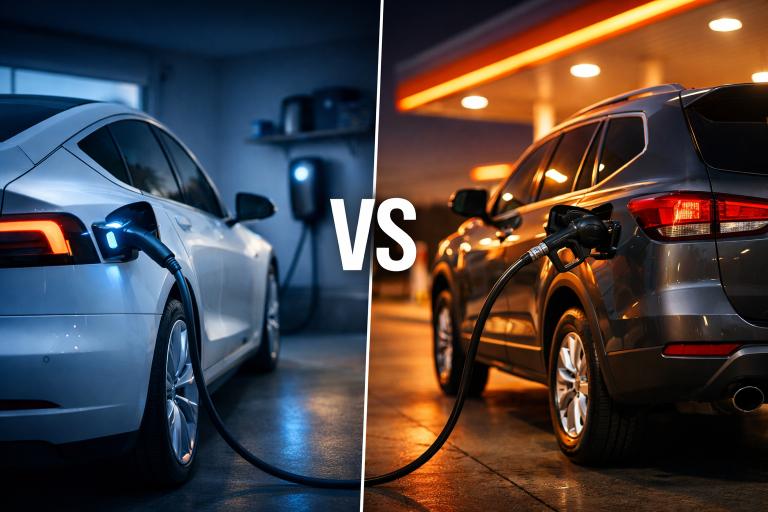
Electric Car vs Gas Car Cost (2026): Which Is Really Cheaper Over 5 Years?
Over 5 years, an electric car costs approximately $78,495 versus $80,145 for a comparable gas car — a difference of about $1,650 in favor of the EV for the average buyer with home charging. But that narrow margin hides enormous variation: the real long-term cost difference between electric and gasoline vehicle ownership can swing by $10,000 or more depending on your mileage, charging access, and incentive eligibility.
This electric car vs gas car cost guide covers every category of 5-year ownership expense: upfront purchase price, federal tax credits, fuel vs charging cost per mile, EV maintenance savings, insurance premiums, and depreciation. We include both the scenarios where EVs win and the scenarios where they don't — because the honest answer is that neither powertrain is universally cheaper in 2026.
Three market forces make this comparison especially important right now: gasoline prices remain volatile above $3.50/gallon, the federal EV tax credit now has stricter battery-sourcing requirements that disqualify many models, and battery price stabilization has brought more EVs under $35,000 after incentives than at any point in history.
2026 incentive update: The federal New Clean Vehicle Credit (up to $7,500) now has stricter battery component and mineral sourcing requirements. Only ~40–50% of new EV models qualify for the full credit in 2026. Verify your vehicle's eligibility at IRS.gov before purchasing.
For a comparison of specific models, see our guide to the best electric cars for the money in 2026. Ready to run the numbers for your situation? Jump to the free cost calculator, or read through the full breakdown below.
Electric Car vs Gas Car Cost — 5-Year Comparison Summary
- EV 5-Year Total Cost: $78,495 (home charging + full $7,500 federal credit)
- Gas Car 5-Year Total Cost: $80,145
- EV Fuel Cost Per Mile: $0.045 (home charging) / $0.12 (public fast charging)
- Gas Fuel Cost Per Mile: $0.118 (30 MPG at $3.55/gallon)
- EV Maintenance Savings: ~$3,800 over 5 years — no oil changes, reduced brake wear
- EV Insurance Cost: ~$2,200 more over 5 years — gas car wins this category
- Main EV Financial Risk: Higher depreciation ($5,000–$9,000 more than gas over 5 years)
- EV wins when: 12,000+ mi/yr, home charging, and federal credit qualifies
- Gas wins when: Low mileage, no home charging, or no incentive eligibility
Electric Car Total Cost of Ownership vs Gasoline Vehicle — What's Really Included
When comparing the electric car total cost of ownership to a gasoline vehicle, most buyers make the mistake of looking only at the sticker price or monthly payment. The real cost difference between an EV and a gas car only becomes clear when you account for every expense across the full 5-year ownership period — purchase price, incentives, fuel, maintenance, insurance, and depreciation.
The 5-year car ownership cost comparison in this guide covers all six categories. Each has a clear winner, and the final result depends on which categories dominate your specific situation. EV buyers win on fuel, maintenance, and net purchase price (after incentives). Gas car buyers win on depreciation and insurance. The total outcome is determined by which side of that ledger is heavier for your driving profile.
For the average U.S. commuter, the EV vs gasoline long-term cost difference is nearly identical — just $1,650 over five years. But that national average conceals two very different outcomes: high-mileage home-charging drivers who save $11,000+ on their electric car total cost of ownership, and low-mileage public-charging-only drivers who pay $7,000+ more for the EV. Identifying which profile matches your situation is the most important step before you buy.
For a full monthly breakdown of what EV ownership actually costs day-to-day, see our monthly cost of owning an electric car guide, which covers loan payments, charging bills, insurance, and maintenance in one place. And if you're weighing specific models, our guide to buying a Chinese EV in 2026 covers an increasingly important segment of the budget EV market.
Free 5-Year Cost Calculator — Electric Car vs Gas Car
Adjust your annual mileage, local fuel and electricity prices, and charging access below to calculate the 5-year cost difference between an electric car and a gas car for your specific situation. All values update in real time.
⚡ Your Personal 5-Year Ownership Cost Estimator
Model: EV MSRP $44,000 / Gas MSRP $38,500, EV efficiency 3.5 mi/kWh, EV maintenance $1,700 / Gas $5,500, EV insurance $11,400 / Gas $9,200, EV depreciation $25,520 / Gas $18,095. Full methodology. ⚠️ Tax credit note: The federal EV credit is non-refundable — it reduces your tax liability dollar-for-dollar but cannot exceed what you owe in federal taxes. This calculator assumes full usable tax liability. Buyers with lower annual tax liability may receive a partial or no benefit. Verify your eligibility at IRS.gov ↗.
Download a printable version of this full comparison — all tables, scenario analysis, and the buyer decision matrix in one shareable document. No signup required.
Upfront Purchase Price – EV vs Gas Car MSRP in 2026
Average EV Price vs Average Gas Car Price
The EV price premium is shrinking fast, but it hasn't disappeared. In 2026, the average new EV transaction price sits around $43,500, while the average new gas car comes in near $37,200. That's roughly a $6,300 gap — down from nearly $15,000 in 2022. According to Kelley Blue Book transaction data, compact and midsize segments have seen the sharpest price convergence.
| Segment | Avg. EV MSRP | Avg. Gas Car MSRP | EV Premium |
|---|---|---|---|
| Compact Car | $30,500 | $26,000 | +$4,500 |
| Midsize Sedan | $38,000 | $34,500 | +$3,500 |
| Compact SUV | $44,000 | $38,500 | +$5,500 |
| Midsize SUV | $58,000 | $49,000 | +$9,000 |
| Pickup Truck | $68,500 | $54,000 | +$14,500 |
Estimated 2026 average transaction prices. Individual model prices vary significantly.
Incentives, Tax Credits, and State Rebates (2026 Updates)
The federal New Clean Vehicle Credit remains at up to $7,500 for new EVs and up to $4,000 for used EVs, but income caps and vehicle MSRP limits apply. Stricter battery-sourcing rules introduced in 2024 mean only ~40–50% of new EV models qualify for the full credit in 2026. Check current qualifying models at IRS.gov.
On top of federal incentives, states like California, Colorado, and New York offer additional rebates of $1,000–$4,000. When stacked, total incentives can reach $9,000–$11,500 in high-incentive states — effectively eliminating the EV price premium in compact and midsize segments for qualifying buyers.
Net Price Example (Compact SUV): A $44,000 EV minus $7,500 federal credit minus $2,500 state rebate = effective price of $34,000 — cheaper than the comparable $38,500 gas SUV before you've driven a single mile.
Financing Costs and Interest Rate Impact
At 7.2–8.5% APR (2026 average for well-qualified buyers), the higher EV sticker price means higher monthly payments before incentives. A $7,000 price difference at 7.5% APR over 60 months adds roughly $140/month to your payment. Remember: tax credits reduce your April tax liability, not your loan principal — factor this into your financing plan carefully.
For the best-value EV options in the budget segment, see our affordable electric cars for 2026 guide.
EV Charging Cost vs Gas Cost — Per Mile and Over 5 Years
Average Gasoline Cost Per Mile
According to U.S. Energy Information Administration (EIA) weekly retail gasoline data, the national average price in early 2026 is approximately $3.55/gallon. At 30 MPG — the average for a new compact SUV — the gasoline cost per mile is $0.118. California drivers pay roughly $0.155/mile; Texas drivers around $0.095/mile. Gasoline's regional and seasonal volatility is a structural risk that home EV charging avoids entirely.
Home Charging Cost Per kWh
The EIA's Electric Power Monthly puts the national average residential rate at $0.158/kWh in 2026. An efficient EV at 3.5 miles per kWh costs approximately $0.045/mile to charge at home — about 62% cheaper than gasoline. On time-of-use overnight rates, this drops to $0.028–$0.035/mile in many states. The fueleconomy.gov cost calculator lets you compare by your specific ZIP code.
Public Fast Charging vs Gas Price Volatility
Public DC fast charging erodes the cost advantage significantly. At ~$0.42/kWh at major networks in 2026, EV cost per mile rises to $0.12/mile — nearly identical to gasoline. Drivers who rely primarily on public fast charging will see minimal fuel savings. The EV charging cost advantage is overwhelmingly concentrated in home and workplace charging scenarios. See our public EV charging cost breakdown for current network-by-network rates.
Annual Mileage Scenarios (10k, 15k, 20k miles)
| Annual Mileage | EV – Home Charging (5 yr) | EV – Mixed Charging (5 yr) | Gas Car (5 yr) | EV Savings (Home) |
|---|---|---|---|---|
| 10,000 mi/yr | $2,250 | $3,750 | $5,900 | $3,650 |
| 15,000 mi/yr | $3,375 | $5,625 | $8,850 | $5,475 |
| 20,000 mi/yr | $4,500 | $7,500 | $11,800 | $7,300 |
| Based on: EV home $0.045/mi (3.5 mi/kWh at $0.158/kWh), EV mixed $0.075/mi, Gas $0.118/mi (30 MPG at $3.55/gallon). Assumes 3.5 mi/kWh EV efficiency and 30 MPG gas SUV across all scenarios. Source: EIA energy prices Q1 2026. | ||||
5-Year Fuel/Charging Cost Comparison — 15,000 mi/yr driver
To calculate your home charging equipment cost and real per-mile rate, see our home EV charging setup guide.
EV Maintenance Cost vs Gas Car — The Full 5-Year Picture
Fewer Moving Parts in EVs
A conventional gasoline engine contains roughly 2,000 moving parts. An EV drivetrain has fewer than 20. This mechanical simplicity is the core reason electric car maintenance costs run 30–40% lower over a 5-year period. Consumer Reports' annual reliability data and AAA's driving cost studies consistently show EV owners paying significantly less for routine upkeep. There are no spark plugs, timing belts, exhaust systems, or transmission fluid to service.
Oil Changes, Transmission, and Exhaust System Costs
A typical gas car requires 5–7 oil changes per year at $60–$100 each — up to $700/year or $3,500 over five years in oil changes alone. Add transmission service ($150–$300 every 30,000 miles), coolant flushes, and exhaust work, and routine gas car maintenance accumulates to $4,500–$6,500 over five years. These are known, recurring costs with no electric vehicle equivalent.
Brake Wear and Regenerative Braking Benefits
EV regenerative braking captures kinetic energy to recharge the battery rather than burning it off as heat through brake pads. This dramatically reduces brake wear. Many EV owners report original brake pads lasting 100,000+ miles, compared to 40,000–60,000 miles on gas cars. This alone saves $400–$800 in brake service over five years.
Unexpected EV Repair Costs (Battery, Electronics)
EVs are not maintenance-free. High-voltage battery replacements remain expensive — typically $8,000–$18,000 out of warranty. Most batteries carry 8-year/100,000-mile warranties. ADAS sensor repairs after even minor accidents can cost significantly more than equivalent gas car bodywork. These tail-risk costs are real but manageable for most in-warranty owners.
| Maintenance Item | Electric Car (5 yrs) | Gas Car (5 yrs) |
|---|---|---|
| Oil Changes | $0 | $1,800–$3,000 |
| Transmission Service | $0 | $300–$600 |
| Brake Service | $150–$300 | $600–$1,200 |
| Tires (EVs run heavier) | $900–$1,400 | $700–$1,100 |
| Air Filters / Spark Plugs | $0 | $200–$400 |
| Coolant / Fluid Flushes | $100–$200 | $300–$600 |
| Exhaust / Emissions | $0 | $0–$800 |
| Software / Diagnostics | $0–$400 | $100–$300 |
| Total Estimate | $1,150–$2,300 | $4,000–$8,000 |
Estimates for compact/midsize SUV. Excludes unexpected major repairs and out-of-warranty battery replacement.
Insurance Costs – Are EVs More Expensive to Insure?
Repair Complexity and Parts Pricing
EVs cost more to insure — and this gap widened in 2025–2026. The average annual premium for an EV is approximately $2,280/year versus $1,840/year for a comparable gas car — about $440/year more, or $2,200 over five years. The primary driver: EV structural repairs involving battery proximity zones, high-voltage cabling, and specialized tooling cost 25–40% more than equivalent gas car repairs. Insurance is the one cost category where the gas car maintains a consistent, clear advantage.
Safety Ratings and ADAS Impact
EVs consistently earn top safety ratings due to their rigid battery floor structures — a discount trigger with some insurers. However, the cost of repairing ADAS sensors after even minor collisions partially offsets this. Some carriers now offer EV-specific policies for vehicles with strong OTA safety update histories, which may reduce this premium for certain models.
Regional Insurance Variations
| Vehicle Type | Avg Annual Premium | 5-Year Total |
|---|---|---|
| Electric Car (Compact SUV) | $2,280 | $11,400 |
| Gas Car (Compact SUV) | $1,840 | $9,200 |
| Difference | +$440/yr | Gas saves +$2,200 |
National averages. Tesla and luxury EVs can run $300–$800/yr higher. See our full EV insurance cost comparison.
EV Depreciation Rate vs Gas Car — The Biggest Hidden Cost
EV Battery Degradation and Market Perception
Depreciation is the most under-discussed — and most financially significant — factor in the electric car vs gas car long-term cost comparison. On average, a non-luxury EV retains roughly 44–50% of its value after 5 years, compared to 50–56% for comparable gas vehicles. For budget EVs, this represents a $7,000–$10,000 additional depreciation cost that completely erases fuel and maintenance savings for low-mileage drivers.
Gas Vehicle Residual Value Trends
According to Edmunds depreciation research, gasoline trucks and SUVs continue to hold their value well in 2026. The robust used gas car market — supported by buyers hesitant about charging infrastructure — keeps residual values strong. A midsize gas SUV can reasonably retain 50–55% of its value after five years, edging out most EV equivalents on depreciation alone.
Impact of Rapid EV Technology Evolution
EV technology advances faster than any other automotive segment. A 2026 EV with 280 miles of range may feel outdated by 2030 when 400-mile budget models become mainstream. This "technology obsolescence discount" weighs on EV resale values in ways that gas cars — mature, stable technology — simply don't face. Buyers who plan to sell in 3–4 years should factor this carefully into their cost calculation.
| Vehicle / Segment | New Price | 5-Yr Residual % | Est. Resale Value | Depreciation (5 yr) |
|---|---|---|---|---|
| EV Compact SUV (Budget) | $44,000 | 42% | $18,480 | $25,520 |
| EV Compact SUV (Premium) | $58,000 | 52% | $30,160 | $27,840 |
| Gas Compact SUV | $38,500 | 53% | $20,405 | $18,095 ← Gas wins |
| Gas Midsize SUV | $49,000 | 55% | $26,950 | $22,050 |
Estimates vary significantly by brand, trim, and market conditions. Source: Edmunds True Cost to Own methodology.
Key insight: Budget EVs can depreciate $7,000–$10,000 more than comparable gas cars over five years. This single hidden cost often fully offsets fuel and maintenance savings for average or low-mileage drivers — it's the most important number most EV buyers overlook.
Total 5-Year Cost of Ownership — Electric Car vs Gas Car
Here's the complete electric car vs gas car cost comparison across all categories for the most common buyer profile: compact SUV, 15,000 miles/year, home charging access, full $7,500 federal tax credit qualifies.
| Cost Category | Electric Car | Gas Car | Difference |
|---|---|---|---|
| Purchase Price (MSRP) | $44,000 | $38,500 | EV +$5,500 |
| Federal Tax Credit | −$7,500 | $0 | EV −$7,500 ✅ |
| Net Purchase Price | $36,500 | $38,500 | EV −$2,000 ✅ |
| Fuel / Charging (5 yrs) | $3,375 | $8,850 | EV −$5,475 ✅ |
| Maintenance (5 yrs) | $1,700 | $5,500 | EV −$3,800 ✅ |
| Insurance (5 yrs) | $11,400 | $9,200 | Gas −$2,200 ✅ |
| Depreciation (5 yrs) | $25,520 | $18,095 | Gas −$7,425 ✅ |
| Total 5-Year Cost | $78,495 | $80,145 | EV saves ~$1,650 |
Compact SUV, 15,000 mi/yr, home charging, full federal credit qualifies. Excludes financing interest costs. Full methodology.
5-Year Total Cost — Side-by-Side
The $1,650 margin is narrow — it swings dramatically based on your driving profile and charging access.
Scenario Analysis — How Your Situation Changes the Long-Term Cost
| Driver Profile | EV 5-Yr Total | Gas 5-Yr Total | Winner |
|---|---|---|---|
| Low mileage (8,000 mi/yr), public charging only, no credit | $84,100 | $74,800 | ⛽ Gas saves $9,300 |
| Average commuter (15,000 mi/yr), home charging, full credit | $78,495 | $80,145 | ⚡ EV saves $1,650 |
| Average commuter, no home charging, no credit | $87,200 | $80,145 | ⛽ Gas saves $7,055 |
| High mileage (25,000 mi/yr), home charging, full credit | $81,200 | $92,500 | ⚡ EV saves $11,300 |
The takeaway: home charging access and federal credit eligibility are the two variables that determine whether an EV is cheaper or more expensive than a gas car over 5 years. Drive more miles, and the EV advantage grows. Drive fewer without home charging, and the gas car wins decisively. Use the free calculator above or our EV total cost of ownership guide to model your personal numbers.
When an Electric Car Makes More Financial Sense
High Annual Mileage Drivers
Drive 18,000–25,000 miles per year with home charging, and the math tilts decisively toward EVs. Every additional mile amplifies the per-mile cost advantage of electricity over gasoline. Fleet operators and high-mileage commuters often recover the EV price premium in fuel and maintenance savings alone within 2–3 years, making the electric car the clear winner on total 5-year cost of ownership.
Access to Low-Cost Home Charging
Home charging is the EV's financial foundation. Charging overnight on a time-of-use rate that drops to $0.07–$0.10/kWh brings your effective fuel cost to $0.02–$0.03/mile — a 75–80% discount versus gasoline. The fueleconomy.gov EV comparison tool lets you enter your ZIP code electricity rate to calculate real savings for specific models.
Urban Drivers With Fuel Price Volatility
California, New York, Hawaii, and other high-fuel-cost states offer disproportionately large EV savings. At $4.50+/gallon, the per-mile home charging advantage exceeds $0.10/mile — generating $1,500+ in annual fuel savings at average mileage. Urban EV drivers also benefit from HOV lane access and reduced congestion pricing in several major cities. See our best EVs for long daily commutes for top-rated models.
When a Gas Car May Still Be the Cheaper Option
Low Mileage or Occasional Drivers
Under 8,000–10,000 miles per year, you won't accumulate enough fuel and maintenance savings to offset the EV's higher depreciation and insurance costs within a 5-year window. For low-mileage drivers, a reliable gas car or a plug-in hybrid represents better financial value. The EV vs Hybrid vs Plug-in Hybrid comparison explores this middle ground.
No Access to Home Charging
Apartment dwellers, renters, and drivers without dedicated parking face a fundamental EV disadvantage. Relying on public fast charging at $0.42/kWh costs the same per mile as gasoline — eliminating the EV's primary financial advantage. In this scenario, the gas car's lower sticker price, better depreciation, and lower insurance costs make it the rational financial choice over 5 years.
Rural Areas With Limited Charging Infrastructure
In rural areas, DC fast chargers may be 50–100+ miles apart. Range anxiety becomes a real operational constraint. A gas car or plug-in hybrid offers flexibility that a pure EV cannot match. Check charging network coverage before committing — our best EV charging companies for 2026 guide has current coverage maps by region.
⚡ Buy an EV if you…
- Drive 12,000+ miles per year
- Have home or workplace charging
- Qualify for federal/state incentives
- Live in an urban or suburban area
- Plan to own 5+ years
- Want lowest per-mile running costs
⛽ Buy a Gas Car if you…
- Drive under 10,000 miles per year
- Have no home charging option
- Live in a rural area with few chargers
- Need maximum long-trip flexibility
- Don't qualify for EV credits
- Plan to sell within 2–3 years
Additional Factors Beyond the 5-Year Cost Comparison
Environmental Impact and Emissions Regulations
EVs produce zero tailpipe emissions and — accounting for grid electricity — generate 50–70% fewer lifecycle CO₂ emissions than comparable gas cars in the U.S. Tightening emissions regulations in Europe and multiple U.S. states will restrict new gasoline vehicle sales within the decade, with long-term implications for gas car resale values not yet reflected in current depreciation forecasts.
Driving Experience and Torque Delivery
EVs deliver instant, linear torque — a fundamentally different and, for most drivers, superior daily driving experience. Smooth, quiet, immediate acceleration reduces commute fatigue and is a genuine quality-of-life differentiator that doesn't appear in any cost table.
Technology and OTA Updates
Over-the-air software updates allow EVs to improve range, efficiency, and features after purchase — something no gas car offers. This post-purchase asset improvement partially offsets the technology obsolescence risk discussed in the depreciation section.
Long-Term Fuel Price and Policy Risk
Gasoline prices are unpredictable. EV owners hedge against fuel spikes and potential future carbon pricing. Historically, electricity prices have been less volatile than gasoline across economic cycles — an important consideration for long-term financial planning. For the bigger picture on where the EV market is heading, read our analysis of why EVs are reshaping the global car industry.
FAQs — Electric Car vs Gas Car Cost (2026)
Is an electric car cheaper than a gas car over 5 years?
For the average buyer who qualifies for incentives and charges at home, an EV costs approximately $78,495 over 5 years versus $80,145 for a comparable gas car — saving about $1,650. Without home charging or the $7,500 federal credit, the gas car is typically $5,000–$9,000 cheaper over the same period. The outcome depends almost entirely on your mileage, charging access, and credit eligibility.
What is the real cost per mile of an electric car?
With home charging at the national average of $0.158/kWh, an efficient EV costs approximately $0.045 per mile. Public DC fast charging at $0.42/kWh raises this to about $0.12 per mile — nearly identical to a 30-MPG gas car at $3.55/gallon. The EV per-mile cost advantage exists only with home or low-cost workplace charging. Use the free calculator above to estimate your rate.
Are EV maintenance costs really lower than gas cars?
Yes, significantly. EVs typically spend $1,150–$2,300 on routine maintenance over 5 years versus $4,000–$8,000 for a gas car — savings of $2,000–$5,000. No oil changes, no transmission service, no exhaust work, and dramatically reduced brake wear thanks to regenerative braking. The caveat: out-of-warranty battery and ADAS repairs can be expensive.
How much do you save on fuel with an electric car?
At 15,000 miles per year with home charging, expect to save approximately $5,000–$5,500 in fuel costs over five years versus a 30-MPG gas car at $3.55/gallon. High-mileage drivers in high-fuel-cost states can save $7,000–$10,000 or more. Public-charging-only drivers save near zero. The free calculator above estimates your personal fuel savings.
Do electric cars depreciate faster than gas cars?
Budget and mid-range EVs have historically depreciated faster — often $5,000–$9,000 more than comparable gas vehicles over five years. Rapid EV technology evolution creates a "technology obsolescence discount" that stable, mature gas car technology doesn't face. This is the largest hidden cost in EV ownership. Premium EVs from Tesla and BMW hold value better. This is also why the choice of specific model matters enormously.
Is home charging always cheaper than gasoline?
Almost always yes. Even at $0.30/kWh (most expensive U.S. markets), home EV charging costs roughly $0.086/mile — still cheaper than the national gas average of $0.118/mile. On overnight time-of-use rates, home charging drops below $0.035/mile — about 70% cheaper than gasoline. The fueleconomy.gov tool calculates your specific savings by ZIP code.
Which is better financially in 2026 — electric car vs gas car cost?
For average commuters with home charging who qualify for the $7,500 federal EV credit, the electric car is marginally cheaper over 5 years and offers substantially lower per-mile running costs. For low-mileage drivers or those without home charging access, the gas car remains the more cost-effective option in 2026. Run the free calculator above for your specific numbers before deciding.
Data Sources & Methodology
Fuel prices: National average gasoline price from U.S. Energy Information Administration (EIA) weekly retail gasoline data, Q1 2026 average ($3.55/gallon).
Electricity prices: National average residential electricity rate from EIA Electric Power Monthly, January 2026 report ($0.158/kWh). Public fast charging rates represent major network averages.
EV efficiency: 3.5 miles per kWh — representative of current compact and midsize EV SUVs per fueleconomy.gov ratings for 2024–2026 model years.
Vehicle prices: MSRP estimates based on 2026 transaction price averages from Kelley Blue Book and Edmunds market reports. Baseline: EV compact SUV $44,000 / Gas compact SUV $38,500.
Maintenance costs: Estimates based on AAA's "Your Driving Costs" annual study methodology and published dealer service schedules for representative 2024–2026 models.
Insurance costs: National average annual premium estimates based on published industry reports. Individual rates vary by driver profile, location, and insurer.
Depreciation: 5-year residual value estimates based on Edmunds True Cost to Own methodology and current used EV market pricing trends.
Tax credits: Per IRS New Clean Vehicle Credit guidance. Assumes vehicle and buyer meet all qualification requirements for the full $7,500 credit.
Disclaimer: All figures are estimates based on national averages. Actual costs vary significantly based on driving habits, location, specific model, insurance profile, and market conditions. This comparison is for informational purposes and does not constitute financial advice.
Final Verdict — Electric Car vs Gas Car Cost: Which Wins in 2026? 2026 Updated
After a complete 5-year cost comparison across purchase price, incentives, fuel vs charging, maintenance, insurance, and depreciation — the answer is that neither powertrain is a universal winner. The total cost difference between electric and gasoline car ownership can swing $10,000 or more depending on your individual circumstances.
The EV wins when you drive 12,000+ miles per year, have home charging access, qualify for the $7,500 federal credit, and plan to own for 5+ years. In this scenario, an EV saves $3,000–$11,000 over five years while delivering dramatically lower per-mile fuel costs and a better daily driving experience.
The gas car wins when you drive fewer than 10,000 miles annually, live without home charging access, don't qualify for EV credits, or plan a short ownership period. In this scenario, the gas car's lower sticker price, better depreciation, and lower insurance costs represent a genuine financial advantage of $5,000–$10,000 over five years.
2026 Bottom Line: The electric car vs gas car 5-year cost gap has narrowed dramatically. For most average commuters with home charging, the EV is now the financially rational choice — not just the environmentally conscious one. The margin is small today, but the EV hedges against future fuel price increases and offers substantially lower day-to-day running costs. For everyone else, the gas car remains the safer financial bet until charging infrastructure catches up with their situation.
Before making your final decision, explore: EV vs Hybrid vs Plug-in Hybrid — if you're not ready to go fully electric, a PHEV may offer the best balance for your situation. For the most cost-effective EVs available today, our best EVs under $40,000 in 2026 guide covers top options after incentives. And to understand the full ownership picture, our monthly cost of owning an electric car guide breaks down the numbers by payment.
Ready to Run Your Personal Numbers?
Use our free tools to calculate your exact 5-year cost and find the right EV for your situation.