EV range vs real range — the gap is typically 15–25% below the advertised EPA figure under normal driving conditions, and can reach 30–40% in cold weather or at sustained highway speeds above 70 mph. A vehicle rated at 300 miles EPA range realistically delivers 220–255 miles in mixed real-world use. Understanding this gap before you buy determines whether an EV fits your actual life — or leaves you anxious at 40% battery.
Highway at 75 mph (temperate): ~20–22% loss
Cold weather at 14°F: up to 41% loss (AAA cold-weather testing)
Safe planning rule: EPA × 0.80 for highway-dominant driving
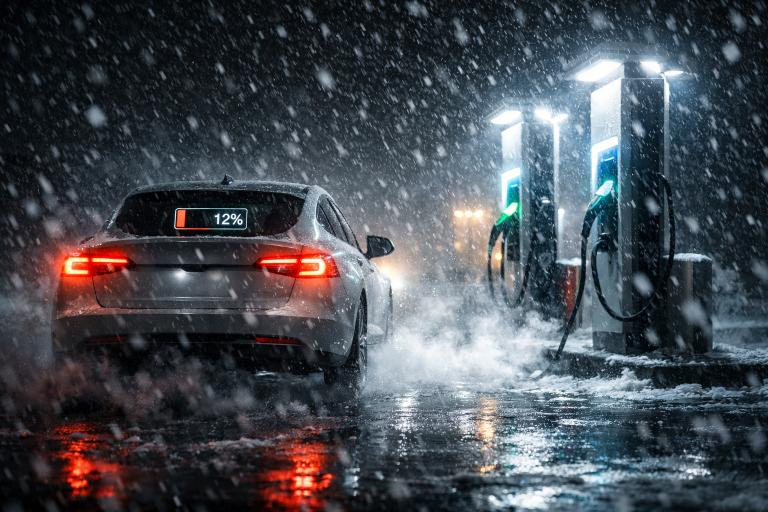
Cold weather causes the largest real-world range reduction — up to 41% in published AAA testing — followed by sustained highway speeds above 75 mph at 20–30%. Urban driving in mild climates produces the smallest gap, often under 15%.
| Driving Condition | Apply This Multiplier | Example: 300mi EPA |
|---|---|---|
| Mixed urban/suburban, mild climate | × 0.85–0.92 | 255–276 mi |
| Highway 65–75 mph, temperate | × 0.80–0.85 | 240–255 mi |
| Highway 75–80 mph, temperate | × 0.72–0.80 | 216–240 mi |
| Cold climate, below 32°F, highway | × 0.60–0.70 | 180–210 mi |
Most drivers experience an 18–25% gap under normal highway conditions. Use the table above as your baseline before purchase — not the window sticker.
Automakers are not lying when they publish range figures. They are reporting results from standardized laboratory tests designed for consistency, not accuracy. The EV range vs real range problem isn’t a marketing scandal — it’s a physics and testing methodology gap that every buyer needs to understand before signing a purchase agreement. This guide breaks down why the numbers diverge, which factors cause the biggest losses, and how to calculate a realistic range estimate for your specific driving pattern.
EV Range vs Real Range — What’s the Difference?
How EPA & WLTP Testing Cycles Work in 2026
The EPA’s range testing uses a standardized drive cycle conducted in a climate-controlled laboratory at 75°F (24°C). The test combines city and highway segments at moderate speeds, with no cabin heating or air conditioning load applied to the battery. The resulting figure is then adjusted downward by a correction factor — typically around 30% for highway and 22% for city — before being published as the official EPA rating.
European vehicles use the WLTP cycle, which tends to produce figures 10–20% higher than EPA equivalents for the same vehicle. If you’re comparing a European EV’s WLTP rating to a U.S. model’s EPA rating, you are not comparing the same thing. Always verify which standard applies before drawing conclusions.
Why Laboratory Results Differ From Daily Driving
Real-world driving introduces variables the test cycle deliberately excludes: wind resistance at higher speeds, elevation changes, stop-and-go traffic patterns, cabin climate control drawing directly from the battery, and battery thermal management systems activating in cold or hot conditions. Each variable compounds the others. A 75°F tailwind laboratory run and a 28°F headwind highway commute are not the same test — but they often produce the same published number.
The Impact of Speed, Temperature & Terrain
Aerodynamic drag increases with the square of speed. Driving at 80 mph doesn’t use slightly more energy than 65 mph — it uses dramatically more. Combined with elevation gain and cold battery temperatures, these factors routinely push real-world range 25–35% below the EPA label on highway-dominant routes.
- Range loss estimates based on aggregated real-world testing data from Edmunds EV Testing Program and AAA Electric Vehicle Range Testing
- Cold weather range figures informed by AAA’s published battery performance studies
- All figures represent estimated ranges — actual results vary by driving pattern, vehicle condition, and climate
- This analysis covers 2024–2026 model year EVs sold in the U.S. market
The Biggest Factors That Reduce Real-World EV Range
Source: Estimated ranges based on AAA EV testing data and aggregated real-world owner reports. Individual results vary.
At a glance: Cold weather at 14°F causes the largest single range reduction — up to 41% in published AAA testing. Sustained highway driving at 75–80 mph follows at 20–30%. HVAC load and long-term battery degradation add further but more manageable losses.
Cold Weather & Battery Thermal Management
Lithium-ion batteries operate most efficiently between 60°F and 85°F. Below 32°F, internal resistance increases and the battery management system restricts both discharge rate and usable capacity. In cold-weather testing published by AAA, EVs without heat pump systems showed range reductions of up to 41% at 14°F (-10°C) compared to temperate conditions — making extreme cold the single largest real-world range factor by a significant margin. Models equipped with heat pump HVAC — increasingly standard in 2026 vehicles — handle cold significantly better, typically limiting losses to 20–28% in the same conditions.
Battery preconditioning — warming the battery before departure while still plugged in — partially mitigates cold weather losses and is now standard in most 2025–2026 EVs. Use it. It can recover 5–10% of range on cold mornings at no additional energy cost to your driving range.
Highway Speeds, Aerodynamics & Rolling Resistance
The EPA test cycle averages approximately 48 mph across its combined segments. Most U.S. highway driving occurs at 65–80 mph. At 75 mph, aerodynamic drag is roughly 33% higher than at 65 mph — and energy consumption scales accordingly. This single factor explains why long-distance highway drivers consistently report ranges 20–30% below the EPA label, even in ideal weather. Crosswind exposure and roof rack loading amplify this further.
HVAC Usage, Software Limits & Battery Degradation
Cabin heating in cold weather draws directly from the drive battery — unlike gas vehicles where heat is a byproduct of engine combustion. On a cold morning commute with the heater running, expect 12–20% additional range reduction on top of cold battery losses. Air conditioning in summer is less severe — typically 12–17% — because battery temperatures are more favorable. Over time, battery degradation adds another layer: most EVs lose 8–15% of usable capacity over five years of normal use, according to long-term ownership data from battery analytics platforms.
EV Range vs Real Range — Cost Implications for Owners
| EV Segment | EPA Range | Realistic Highway Range | Gap |
|---|---|---|---|
| Compact EV (e.g., Bolt EV) | 259 mi | 195–215 mi | ~20–25% |
| Mid-size sedan (e.g., Model 3 RWD) | 341 mi | 265–295 mi | ~15–22% |
| Mid-size SUV (e.g., Model Y LR) | 330 mi | 255–280 mi | ~18–23% |
| Full-size truck (e.g., F-150 Lightning) | 320 mi | 210–250 mi | ~22–34% |
| Long-range premium (e.g., Model S) | 405 mi | 330–365 mi | ~10–18% |
Highway range estimates based on aggregated third-party testing at 70–75 mph in temperate conditions. Results vary by speed, load, and climate.
More Frequent Charging & Time Costs
A 20% range gap doesn’t just mean stopping sooner on a road trip — it changes your weekly charging rhythm. A driver expecting 300 miles of range and getting 235 needs to charge roughly 22% more frequently over a year. At public fast-charging rates, that adds real cost. For home charging, the cost increase is minor. For drivers relying primarily on public DC fast charging, the difference can amount to $200–$400 annually depending on local rates. See our breakdown of public EV charging costs for a full rate comparison by network. For a complete picture of what EV ownership costs month to month, our electric car total cost of ownership guide covers every variable including charging frequency impact.
Range Anxiety & Resale Value Impact
Range anxiety isn’t irrational — it’s a rational response to the gap between advertised and actual numbers. EVs with smaller real-world range gaps consistently earn higher owner satisfaction scores and hold resale value better than models where the gap is wide and poorly communicated. When evaluating resale, the advertised range matters less than the reputation for delivering on it.
How to Estimate Realistic EV Range Before You Buy
Adjusting EPA Numbers for Your Driving Style
No formula is perfect, but these adjustments give you a defensible working estimate before purchase:
EPA Range × 0.80–0.85 = Realistic estimate
Cold climate, highway (below 32°F):
EPA Range × 0.60–0.70 = Realistic estimate
Mixed urban/suburban, mild climate:
EPA Range × 0.85–0.92 = Realistic estimate
The planning rule most buyers use: EPA range × 0.80 = realistic highway range. If that number comfortably covers your daily round-trip with a 20% buffer remaining, the vehicle fits your life. If not, size up.
Apply the relevant multiplier to the EPA figure for any EV you’re considering, then ask: does the result comfortably cover my daily round-trip plus a 20% safety buffer? If not, the battery size is likely undersized for your real-world needs — regardless of what the window sticker says.
Using Real-World Range Reviews & Telematics Data
Third-party real-world testing is more useful than EPA figures for purchase decisions. Edmunds conducts standardized highway range tests at 70 mph. ABRP (A Better Route Planner) aggregates anonymized telematics data from actual owners driving actual routes. For any EV you’re seriously considering, cross-reference the EPA figure against at least one independent highway test result before committing.
Choosing the Right Battery Size for Your Commute
The practical rule: your realistic usable range should be at least twice your average daily round-trip. Most drivers average 37 miles per day in the U.S. A 250-mile realistic range provides more than enough buffer. Problems arise when buyers stretch to a 150-mile real-world range vehicle for a 90-mile daily commute — the margin disappears in winter or on detour days. For a detailed guide on matching battery size to commute, see our analysis on the best EVs for long daily commutes.
Which EVs Have the Smallest Range Gap in 2026?
Real 70 mph Highway Test Results (2025–2026 Models)
Independent highway range testing at a steady 70 mph in temperate conditions produces results that consistently run below EPA labels. Based on aggregated third-party test data from Edmunds and published real-world drive reviews:
| Model | EPA Range | ~70 mph Real Range | Gap | Drag Coefficient |
|---|---|---|---|---|
| Hyundai IONIQ 6 RWD LR | 361 mi | ~300–320 mi | ~12–17% | 0.21 Cd |
| Tesla Model 3 LR RWD | 341 mi | ~275–300 mi | ~12–19% | 0.22 Cd |
| Tesla Model Y LR AWD | 330 mi | ~255–280 mi | ~15–23% | 0.24 Cd |
| Chevrolet Equinox EV LR | 319 mi | ~245–270 mi | ~15–23% | 0.29 Cd |
| Ford F-150 Lightning ER | 320 mi | ~210–245 mi | ~23–34% | 0.40 Cd |
Figures represent estimated real-world highway ranges based on aggregated independent test data at approximately 70 mph in temperate conditions. Results vary by load, climate, and driving style. Drag coefficient (Cd) data from manufacturer specifications.
The pattern is clear: aerodynamic efficiency is the strongest predictor of a small EPA-to-highway gap. The IONIQ 6 and Model 3 — both with drag coefficients under 0.23 — consistently deliver the tightest real-world gaps in their class. The F-150 Lightning’s truck body generates roughly twice the aerodynamic drag of the IONIQ 6, which explains its outsized range loss at highway speeds regardless of battery capacity.
EVs With Advanced Thermal Management Systems
Heat pump HVAC systems — now standard on most 2025–2026 EV releases — significantly narrow the cold-weather range gap compared to resistive heating. The difference between a heat pump and resistive system in a 20°F commute can be 15–20 miles of recovered range. When evaluating cold-climate EV ownership, heat pump inclusion is a more meaningful specification than the EPA range figure itself.
Software Optimization & Over-the-Air Updates
Software-defined vehicles — a growing share of the 2026 EV market — can improve range efficiency through over-the-air updates without any hardware change. Tesla has historically used OTA updates to improve regenerative braking efficiency and battery management algorithms after purchase. This means a 2026 EV’s real-world range performance may improve over time, narrowing the gap gradually — a meaningful differentiator from legacy automakers with static firmware.
Should You Buy an EV Based on Advertised Range?
Short daily distances, home charging access, mild climate. The EPA gap matters least here — even a 200-mile EPA vehicle delivers well above daily needs.
Apply the 0.80 multiplier to any EPA figure. Prioritize vehicles with heat pump HVAC and fast DC charging capability above 150kW.
A plug-in hybrid may deliver more predictable real-world range in northern states. The EV range gap is most punishing precisely where winters are hardest.
Don’t ask “does this EV have enough range?” Ask: “After applying a 20% real-world discount and a 20% battery buffer, does this vehicle comfortably handle my worst-case daily drive?” If the answer is yes, you’re safe. If it’s marginal, size up — or reconsider the powertrain entirely. For a full side-by-side of EV vs hybrid total cost, our electric car vs gas car cost comparison breaks down the five-year ownership math in detail.
Why Some EVs Actually Exceed Their EPA Range
The EV range gap story runs in one direction most of the time — but not always. A meaningful share of EV owners in mild climates with urban or suburban driving patterns consistently report real-world range above their EPA figure. Understanding why this happens is as useful as understanding the losses.
Regenerative braking is the primary driver. In stop-and-go city traffic, an EV recaptures kinetic energy that would otherwise be lost as heat in a conventional brake system. At low average speeds with frequent deceleration — exactly the opposite of the highway scenario — regenerative braking efficiency can add 8–15% of effective range above what the EPA cycle projects. The Hyundai IONIQ 5 and 6, along with several Kia EV models, are particularly well-regarded for aggressive and tunable regenerative braking that urban drivers learn to exploit effectively.
Conservative EPA estimates also play a role. Some manufacturers — particularly Hyundai and Kia — tend to submit range figures that leave headroom rather than maximize the label number. Real-world urban owners of the IONIQ 6 routinely report matching or exceeding the EPA figure in temperate city conditions. Tesla’s Model 3 RWD, despite its aerodynamic advantage, tends to land close to its label rather than above it on highway routes — but beats it in city use.
The takeaway: if you drive primarily in urban or suburban patterns in a mild climate and charge at home, the EPA range figure is a reasonable floor, not a ceiling. The penalty scenarios — cold weather, sustained highway speed, heavy HVAC load — are real, but they are also predictable and avoidable for many buyers’ actual driving patterns.
FAQs — EV Range vs Real Range
Why is my EV not achieving its advertised range?
EPA range figures are measured in a climate-controlled laboratory at moderate speeds with no HVAC load. Real-world driving — especially at highway speeds above 65 mph or in cold weather — introduces factors the test excludes. A 15–25% shortfall under normal conditions is expected and normal, not a defect.
How much range do EVs lose in winter?
Based on AAA cold-weather testing, EVs without heat pump systems lose 25–41% of range at 14°F (-10°C) compared to 75°F conditions. Models with heat pump HVAC typically limit winter losses to 20–28%. Battery preconditioning while plugged in recovers additional range before departure.
Is EPA range accurate for highway driving?
Not directly. The EPA test cycle averages around 48 mph. At 70–75 mph highway speeds, most EVs deliver 18–28% less range than the EPA label. For highway-dominant driving, use the EPA figure multiplied by 0.78–0.82 as a working estimate.
How much buffer should I subtract from EPA range?
For temperate mixed driving, subtract 15–20%. For sustained highway driving above 70 mph, subtract 20–25%. For cold-climate winter conditions, subtract 25–40%. Always maintain a minimum 15–20% state-of-charge buffer to protect battery longevity and avoid roadside range depletion.
Is 250 miles of EPA range enough for a 60-mile daily commute?
Yes — comfortably, in most conditions. Apply the 0.80 highway multiplier: 250 × 0.80 = 200 realistic miles. A 60-mile round trip uses 30% of that, leaving 70% buffer. Even in winter with a 35% reduction, you’d have 162 usable miles — still more than enough for a 60-mile day with home charging overnight.
Should I buy the Standard or Long Range version of an EV?
Apply the 0.80 multiplier to both options, then check if the Standard Range result covers your daily round-trip with a 30% buffer remaining. If yes, save the money. If you rely on public fast charging, drive long distances regularly, or live in a cold climate, the Long Range version pays back through reduced charging anxiety and better winter performance.
Which EV has the most accurate EPA range estimate?
Aerodynamic models from Hyundai and Tesla consistently show the smallest gap between EPA labels and real-world highway results. The IONIQ 6 and Tesla Model 3 Long Range typically deliver within 12–19% of their EPA figure at 70 mph — the tightest margins in their respective segments based on aggregated third-party testing.