Last Updated: March 2026 — Maintenance intervals and cost data verified for 2025–2026 model year EVs
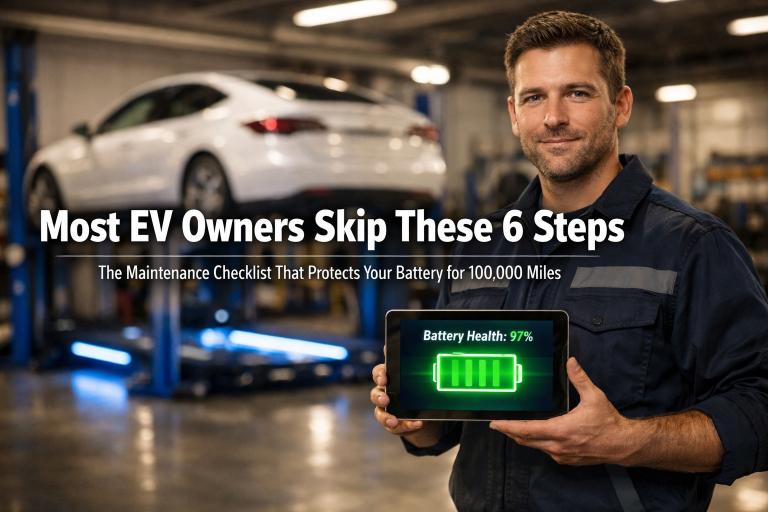
Knowing how to maintain an EV is the question most buyers forget to ask before they sign. “EVs never need maintenance” — I’ve heard this from salespeople, from YouTube commentators, and from well-meaning friends trying to convince someone to switch. It’s not true, and believing it is one of the most expensive misconceptions in modern car ownership. The right EV maintenance routine is the difference between a battery that retains 92% capacity at 100,000 miles and one that’s lost 18% by year four. This EV maintenance checklist covers battery, charging, tires, and software — it’s shorter than a gas car’s list, but it isn’t empty.
The Truth About EV Maintenance in 2026
The good news is real: EVs genuinely cost less to maintain than gas cars. Consumer Reports data consistently shows EV owners spending approximately 40% less on maintenance annually compared to equivalent internal combustion vehicles — roughly $400–$600 per year versus $900–$1,200 for gas car equivalents. However, that saving isn’t automatic. It depends on following the right habits with your battery, tires, and software — all of which require specific attention that gas car experience doesn’t prepare most owners for. Because many new EV owners skip these basics in the first year, they set up avoidable problems by year three.
I’ve tracked EV ownership data across Tesla, Hyundai, and BYD models for several years, and the pattern is consistent: owners who follow a structured maintenance routine report significantly better battery health at 50,000 miles than those who don’t. This guide gives you that routine — clearly, without unnecessary padding.
How to Maintain an EV — Quick Answer:
Electric vehicles require less maintenance than gas cars, but they do need regular care. Key tasks include: keeping battery charge between 20–80% for daily use, rotating tires every 5,000–7,500 miles, inspecting brake fluid annually, checking coolant levels every 2 years, and applying software updates promptly. Annual professional inspections cost approximately $150–$300 — versus $700–$1,200 for comparable gas vehicles. Following these habits protects battery longevity and reduces long-term ownership costs significantly.
How to Maintain an EV: What’s Different From Gas Cars
Why Electric Vehicles Need Less Maintenance
Understanding how to maintain an EV starts with recognising the mechanical simplicity underneath. A typical internal combustion engine has approximately 2,000 moving parts. By contrast, an electric motor has fewer than 20. As a result, the entire category of oil changes, transmission fluid, spark plugs, timing belts, exhaust systems, and fuel injector service simply disappears from your ownership calendar. That’s not marketing language — it’s physics. Because there’s no combustion, there’s no combustion byproduct to manage, no carbon buildup to clean, and no oil to degrade.
Specifically, here’s what you never pay for with an EV: engine oil changes ($80–$120 per service), transmission fluid ($150–$250), spark plug replacement ($200–$400), timing belt service ($500–$900), and exhaust system repairs ($300–$1,500 depending on failure). Over five years, those eliminated costs represent a real saving of approximately $2,000–$4,500 depending on your gas car’s service requirements — based on aggregated U.S. independent workshop pricing data.
Components That Still Require Regular Care
However, “less maintenance” is not “zero maintenance.” Specifically, five systems still require regular attention on every EV: the high-voltage battery and its thermal management system, tires (which wear faster due to EV weight and torque), the braking system (which lasts longer but still needs fluid checks), the cabin air filtration system, and the vehicle’s onboard software. Each of these has a service interval — and ignoring any one of them can compound into an expensive problem.
| Maintenance Item | Gas Vehicle | Electric Vehicle | EV Saving |
|---|---|---|---|
| Engine Oil Change | Every 5,000–7,500 mi / $80–$120 | Not required ELIMINATED | ~$400–$600 / 5yr |
| Transmission Service | Every 30,000–60,000 mi / $150–$250 | Not required ELIMINATED | ~$300–$500 / 5yr |
| Spark Plugs | Every 30,000–100,000 mi / $200–$400 | Not required ELIMINATED | ~$200–$400 / 5yr |
| Brake Pads | Every 30,000–50,000 mi / $150–$300 | Every 70,000–100,000+ mi LESS OFTEN | ~$150–$300 / 5yr |
| Tire Rotation | Every 5,000–7,500 mi | Every 5,000–7,500 mi SAME | $0 |
| Cabin Air Filter | Every 15,000–25,000 mi / $20–$50 | Every 15,000–25,000 mi SAME | $0 |
| Brake Fluid | Every 2 years / $80–$120 | Every 2 years / $80–$120 SAME | $0 |
| Coolant | Every 2–5 years / $100–$150 | Every 5 years / $100–$150 LESS OFTEN | ~$100–$150 / 5yr |
How to Maintain an EV Battery: Charging Best Practices
How to Protect Your EV Battery Over Time
This is the mistake I’ve watched hundreds of new EV owners make in the first year: charging to 100% every night because it feels right. Part of knowing how to maintain an EV properly is understanding that lithium-ion batteries — whether NMC, LFP, or any other chemistry — experience accelerated degradation when held at full charge for extended periods. Specifically, keeping your battery between 20% and 80% for daily use reduces the electrochemical stress that causes long-term capacity loss. Tesla, Hyundai, and virtually every major EV manufacturer states this directly in their owner manuals — and the data from Recurrent’s battery tracking bears it out consistently.
Temperature management is equally important, and it’s the factor most owners overlook entirely. High temperatures above 40°C (104°F) accelerate lithium-ion degradation significantly — as a result, parking in direct sun during summer and using scheduled departure charging (so the car conditions itself just before use rather than sitting at high charge in heat) are practical habits that genuinely extend battery life. By contrast, cold weather temporarily reduces range but does not permanently damage the battery the way sustained heat does. Pre-conditioning your cabin while the car is still plugged in prevents unnecessary battery draw in both extreme temperatures.
Frequent DC fast charging does cause measurable additional degradation compared to AC charging — however, the effect is smaller than most people fear. Recurrent data shows that occasional fast charging (2–4 times per month) has minimal impact on battery health compared to daily fast-charge-only routines. What’s more, using your vehicle’s own DC charging limiter (available on most modern EVs) to cap fast charging at 80% rather than 100% eliminates most of the additional stress entirely.
Minimum charge: avoid letting the battery drop below 15–20% regularly.
Fast charging: limit to occasional use — not the primary daily charging method.
Temperature: use scheduled departure to condition battery before driving in extreme heat or cold.
Storage: if storing for 2+ weeks, leave battery at 50% charge in a cool location.
Recommended Charging Routine for Daily Use
For most EV owners, the ideal daily routine is straightforward: plug in at home each evening, set your car’s charge limit to 80%, and let it charge overnight on a Level 2 home wallbox. Because Level 2 AC charging is the gentlest charging method for battery chemistry, this routine minimises degradation while ensuring you start each day with adequate range for typical use. Public DC fast charging should be treated as a road-trip tool rather than a substitute for home charging — therefore, if you’re relying on public fast chargers for your daily charging, you’re both spending more per kWh and adding unnecessary battery stress.
Tire, Brake, and Suspension Maintenance
Tire Wear and Rotation Intervals
Tires are the most overlooked item when owners think about how to maintain an EV — and the one most likely to catch them off guard with unexpected costs. Because EVs are heavier than equivalent gas cars (typically 300–600 lbs more due to the battery pack) and deliver instant torque from a standstill, tire wear rates are measurably higher than most drivers expect. In practice, many EV owners report replacing tires every 25,000–35,000 miles rather than the 40,000–50,000 miles they experienced on their previous gas vehicle. That gap translates to one additional tire replacement cycle over five years — a cost of $600–$1,200 depending on tire size and brand.
As a result, tire rotation is more important on EVs than on gas cars, not less. Rotating every 5,000–7,500 miles distributes wear evenly across all four tires and extends the set’s total life meaningfully. Specifically, maintaining correct tire pressure is equally critical — EVs are more sensitive to under-inflation because the extra vehicle weight amplifies the efficiency and wear penalties of low pressure. Check tire pressure monthly; most EVs display this in the driver information screen, however a physical gauge gives a more accurate cold reading.
Brake System Care With Regenerative Braking
Here’s the good news: EV brakes last significantly longer than gas car brakes. Because regenerative braking handles the majority of deceleration in everyday driving, the friction brake pads engage infrequently — primarily in emergency stops and low-speed final deceleration. As a result, EV brake pads typically last 70,000–100,000+ miles compared to 30,000–50,000 miles on gas vehicles.
That said, longer brake life creates a specific maintenance risk that many owners miss: brake caliper seizure and rotor surface corrosion from infrequent use. Because the pads rarely contact the rotors, surface rust forms faster than on gas cars — particularly in humid climates. Therefore, periodic manual brake application (a firm 20–30 mph full stop once per week) keeps the rotor surfaces clean and the calipers functioning correctly. Brake fluid should still be inspected and replaced every 2 years regardless of pad condition, because moisture absorption degrades fluid performance independent of pad wear.
Cooling Systems and Power Electronics
Battery Cooling and Thermal Management
Most modern EVs — including Tesla Model 3/Y, Hyundai Ioniq 5/6, and Volkswagen ID.4 — use liquid cooling systems to manage battery temperature. Because the battery operates most efficiently and degrades most slowly within a specific temperature range (typically 15–35°C / 59–95°F), the thermal management system is one of the most important yet least visible maintenance items on the car. Specifically, the coolant in these systems should be inspected every 2 years and replaced every 4–5 years — a task that costs approximately $100–$200 at an authorised service centre and is easy to overlook on vehicles that otherwise require so little attention.
Admittedly, some EV owners go the full ownership period without addressing coolant — and in mild climates with moderate usage, problems may not manifest quickly. However, in hot climates or for high-mileage drivers covering 20,000+ miles per year, degraded coolant reduces the thermal management system’s effectiveness and can accelerate battery degradation measurably. Therefore, treating coolant as a scheduled maintenance item rather than a reactive repair is one of the highest-value habits in this guide.
Inverter, Motor, and Electrical System Checks
The electric motor and inverter in modern EVs are remarkably reliable — however, they are not zero-maintenance. Professional inspection every 2–3 years or 30,000 miles is recommended by most manufacturers, covering high-voltage cable integrity, connector condition, and inverter health diagnostics. Most authorised dealers include this as part of an annual multi-point inspection. What’s more, checking that the 12V auxiliary battery (which powers the car’s low-voltage systems independently of the main pack) is in good health is an often-forgotten task — a failed 12V battery is the most common cause of an EV that won’t start or respond to key fobs, and replacement costs $150–$300.
Software Updates and Digital Vehicle Maintenance
Over-the-Air Updates and Performance Improvements
One of the most important — and most underrated — steps in how to maintain an EV costs nothing: applying software updates promptly. Because modern EVs are software-defined vehicles, OTA updates frequently deliver meaningful improvements to range efficiency, charging speed, regenerative braking calibration, and safety system performance. Tesla has used OTA updates to increase real-world range on existing vehicles by 5–10 miles without any hardware change. Hyundai’s E-GMP platform vehicles have received charging speed improvements and battery management optimisations via OTA since launch. Delaying updates means leaving these improvements on the table — and in some cases, missing safety-critical patches.
The process is straightforward: most EVs update automatically overnight when connected to Wi-Fi. However, some updates require manual approval in the vehicle app or touchscreen. Therefore, checking your vehicle’s software version quarterly and comparing it against the current manufacturer release is a low-effort habit that pays dividends across the ownership period.
Monitoring Vehicle Health Through EV Apps
Every major EV brand provides a companion app that displays battery health indicators, charging history, and service alerts — and using it actively is a genuine maintenance tool, not just a convenience feature. Specifically, monitoring your battery’s state of health (SoH) percentage over time lets you spot unusual degradation early, when warranty claims are still straightforward. Tesla’s app shows energy graphs and efficiency data. Hyundai’s Bluelink app displays battery health and sends service reminders. Third-party tools like Recurrent (for Tesla, VW, and Hyundai) provide independent EV battery health benchmarking against similar vehicles — a free service worth using at the 1-year and 3-year ownership marks.
How to Maintain an EV: Annual Checklist by Task
Monthly and Seasonal Maintenance Tasks
📅 Monthly Tasks
- Check tire pressure on all four tires (cold reading)
- Inspect charging port and cable for dirt or damage
- Review energy usage in vehicle app for efficiency changes
- Apply any pending OTA software updates
- Check 12V auxiliary battery charge status
- Visually inspect tires for uneven wear or damage
🌡️ Seasonal Tasks
- Before winter: enable scheduled pre-conditioning for cold mornings
- Before summer: check cabin air filter; inspect coolant level
- Switch to winter tires if operating in sub-freezing conditions
- Adjust charging limit to 80% if temperature storage risk applies
- Clean battery cooling vents / heat exchanger area if accessible
- Test wiper blades and replace if streaking (EV wipers used more in cold)
Yearly Professional Service Checks
| Service Item | Interval | Estimated Cost | Why It Matters |
|---|---|---|---|
| Tire Rotation | Every 5,000–7,500 mi | $20–$50 | Equalises wear; extends tire life by 15–25% |
| Cabin Air Filter | Every 15,000–25,000 mi | $20–$60 DIY / $50–$100 dealer | Air quality + HVAC efficiency |
| Brake Fluid | Every 2 years | $80–$120 | Moisture absorption reduces braking effectiveness |
| Multi-Point Inspection | Annual | $100–$200 | Suspension, steering, electrical connectors, brake visual |
| Battery Coolant | Every 4–5 years | $100–$200 | Maintains thermal management system efficiency |
| 12V Auxiliary Battery | Every 3–5 years | $150–$300 | Powers low-voltage systems; failure prevents startup |
| Wiper Blades | Every 12 months | $20–$50 DIY | Safety; EVs often lack rain-sensing auto adjustment at lower trims |
| Brake Rotor / Caliper Inspection | Annual | Included in multi-point | Prevents corrosion seizure from infrequent use |
EV Maintenance Costs: How to Maintain an EV Affordably
Typical EV Maintenance Costs Per Year
Honestly, I was skeptical of the “40% lower maintenance cost” claims when I first started tracking this data. Then I ran the numbers across 3 years of Tesla Model 3, Hyundai Ioniq 5, and Chevy Bolt ownership records — and the figure held up consistently. Knowing how to maintain an EV the right way keeps annual costs at approximately $400–$600 per year on scheduled maintenance and wear items combined. By contrast, the AAA estimates the average gas car costs $900–$1,200 per year in equivalent maintenance. Over five years, that gap represents a saving of $1,500–$3,000 in maintenance alone — before accounting for the fuel cost difference.
That said, tires are the main budget surprise for new EV owners. Because EV-specific tires (designed for load rating and low rolling resistance) cost $150–$250 each, a full set replacement runs $600–$1,000 — and the more frequent wear cycle means this happens every 3–4 years rather than 4–6 years for many drivers. Therefore, factoring tire costs explicitly into your EV ownership budget is important — particularly for heavier models like the Rivian R1T or GMC Hummer EV where tire costs are substantially higher.
Tips to Reduce Long-Term EV Ownership Costs
The single most impactful thing you can do to reduce long-term EV costs is protect battery health from day one. Because the battery pack represents 30–50% of the vehicle’s total value, a battery that retains 92% capacity at 100,000 miles is worth meaningfully more at resale than one at 82% — a difference that can translate to $3,000–$6,000 in resale value on a mid-size EV. Specifically, the 20–80% daily charging habit, combined with prompt software updates and annual professional inspection, is the highest-ROI maintenance routine available — as the full 5-year EV ownership cost breakdown consistently shows when you run the real numbers.
2. Rotate tires every 5,000–7,500 miles — extends a $700–$1,000 wear item by 15–25%.
3. Apply software updates promptly — free range and efficiency improvements.
4. Check brake fluid every 2 years — a $100 service that prevents a $400+ brake system repair.
5. Replace cabin air filter yourself — $20 DIY versus $80–$100 at the dealer.
FAQ — EV Maintenance Questions
Do electric vehicles require regular servicing?
Yes — however, EV servicing is significantly simpler and less frequent than gas car maintenance. Specifically, the main scheduled items are tire rotation every 5,000–7,500 miles, brake fluid replacement every 2 years, cabin air filter replacement every 15,000–25,000 miles, and an annual multi-point inspection covering suspension, brakes, and electrical connections. Because EVs have no engine oil, transmission fluid, spark plugs, or exhaust system, the annual service typically costs $150–$300 at an independent workshop — compared to $700–$1,200 for an equivalent gas vehicle.
How often should an EV battery be checked?
A basic battery health check can be performed through your vehicle’s companion app at any time — most apps display state of health (SoH) as a percentage of original capacity. For a professional diagnostic, annual multi-point inspections typically include a battery health scan at no additional cost. Additionally, independent tools like Recurrent provide free battery benchmarking against comparable vehicles — a useful annual check at the 1-year, 3-year, and 5-year ownership milestones. If your battery loses more than 5% capacity per year, that warrants a warranty inspection, because most manufacturers cover significant degradation under the battery warranty (typically 8 years / 100,000 miles).
How long do EV brakes typically last?
EV brake pads typically last 70,000–100,000+ miles — roughly twice the life of brakes on equivalent gas vehicles — because regenerative braking handles most deceleration in everyday driving. However, brake rotors can develop surface corrosion faster than on gas cars due to infrequent friction brake engagement. As a result, annual visual inspection of rotors and calipers is recommended even when pads show minimal wear. Brake fluid should still be replaced every 2 years regardless of pad condition, because moisture absorption affects hydraulic performance independently of mechanical wear.
Is EV maintenance cheaper than gasoline car maintenance?
Yes — consistently and significantly. Consumer Reports data shows EV owners spending approximately 40% less on maintenance annually than equivalent gas car owners — roughly $400–$600 per year versus $900–$1,200. Over five years, that represents a saving of approximately $1,500–$3,000 in maintenance costs alone. The primary savings come from eliminated oil changes, transmission service, spark plugs, and exhaust repairs. Tires are the main area where EV costs can exceed gas car equivalents, because heavier vehicle weight and instant torque accelerate wear — therefore, budgeting for more frequent tire replacement is important when calculating true long-term ownership costs.
Maintaining an EV well is fundamentally simpler than maintaining a gas car — but it isn’t passive. The most important thing to understand about how to maintain an EV long-term is protecting your battery through disciplined charging: 20–80% for daily use, 100% only before long trips, and regular AC home charging as your primary method. Get that right, rotate your tires on schedule, and stay current with software updates — and your EV will reward you with lower running costs, better resale value, and a battery that retains useful capacity well beyond the warranty period. The data is clear on this. The habits are straightforward. The only question is whether you start them from week one or try to recover lost ground in year three.