Last Updated: May 2026 — Tesla.com MSRP pricing, Cox Automotive depreciation data, and KBB residual projections verified
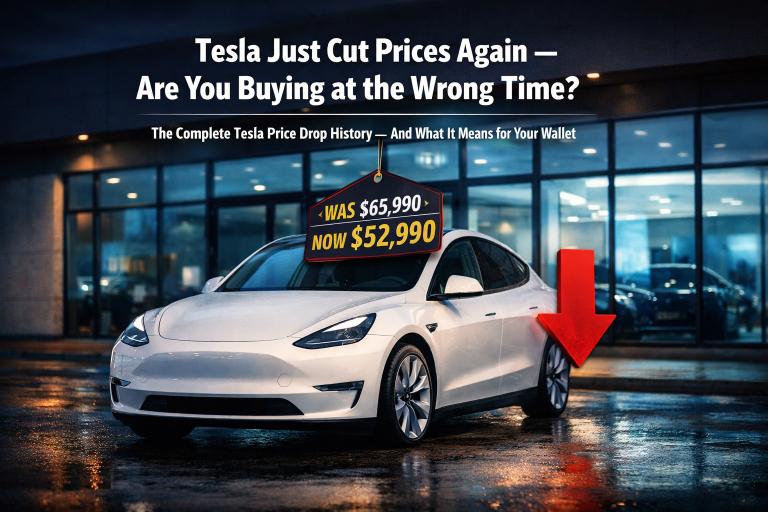
Tesla has cut its prices more than a dozen times between 2022 and 2025, dropping the Model Y by approximately $21,000 from its January 2023 peak. For most buyers in 2026, the answer to “should I wait for the next cut?” is: stop waiting. The largest cuts have already happened. The current Model Y base starts at approximately $44,990 — down from $65,990 at peak — and the margin for further significant reductions is narrow given Tesla’s cost structure at current production volume. Waiting six months for a speculative $2,000–$3,000 cut costs most buyers more than that in delayed use value or continued fuel and maintenance spending on whatever they are currently driving. The exception is if a confirmed model refresh is imminent, in which case waiting three to six months is financially justified. This article covers every cut in the record, what drives them, the math on waiting, and the specific conditions under which each decision is correct.
The framing matters here. The question “should I wait for Tesla to cut prices again?” is often the wrong question. The better question is whether you should buy new at all — because the used Tesla market, which has been reshaped by three years of new-car price cuts, now offers a substantially better deal for most buyers than anything Tesla sells off the configurator.

Tesla Price Drops — Should You Wait or Buy Now?
Short answer: For most buyers in 2026, buy now rather than wait. The Model Y is already down ~$21,000 from its 2023 peak. Further cuts, if they come, are likely to be $1,500–$3,000 — not $10,000. Waiting 6–12 months to capture a speculative small cut costs more than it saves for most buyers once opportunity cost is included. The exception: If a confirmed hardware refresh is publicly imminent, wait — the post-refresh clearance discount on the outgoing model is typically $3,000–$5,000 and it is reliable. Best value in 2026: A 2–3-year-old used Tesla Model Y, bought privately or from a dealer not Tesla-certified. The new-car price cuts of 2022–2025 have driven used values down to approximately $28,000–$34,000 for a 2022 Model Y Long Range — a 47–57% discount from its original MSRP.
Tesla’s Price Cut History: What Actually Happened
Tesla’s pricing strategy between 2022 and 2025 was unlike anything the automotive industry had seen from a major manufacturer. Rather than using dealer incentives, cashback offers, or seasonal promotions, Tesla adjusted its sticker prices directly and repeatedly — sometimes multiple times within a single year. The effect on buyers who had recently purchased at higher prices was immediate and financially significant.
The single largest cut came in January 2023. Tesla reduced prices across its entire US lineup in one announcement: the Model Y Long Range dropped from $65,990 to $52,990 overnight — a $13,000 reduction. The Model 3 Long Range fell from $53,990 to $45,990. Model S and Model X also saw cuts of $5,000–$15,000 depending on variant. This was not a clearance event or an end-of-quarter incentive. Tesla updated its configurator and the new prices applied to all orders immediately.
The January 2023 cut was the most dramatic, but it was not the first and not the last. Further price reductions followed throughout 2023 and into 2024 as Tesla continued using price as a primary lever for demand generation. By the time the refreshed Model 3 (Highland) and refreshed Model Y (Juniper) arrived in 2024–2025, the pricing landscape had settled significantly below 2022–2023 peaks. Our detailed breakdown of the full adjustment timeline is covered in the Tesla price drop history — the table below summarises where each model currently stands versus its peak.
How Much Have Tesla Prices Dropped? Model-by-Model
The most useful way to understand Tesla’s pricing is not as a single event but as a cumulative shift from the supply-constrained high-price era of 2021–2022 to the demand-stimulation pricing of 2023–2026. The table below shows each model’s approximate peak US MSRP, current base price, and total reduction.
| Tesla Model | Peak MSRP | Current Base (2026) | Total Drop | % Reduction |
|---|---|---|---|---|
| Model Y (base RWD) | ~$65,990 | ~$44,990 | -$21,000 | -32% |
| Model Y Long Range AWD | ~$62,990 | ~$54,990 | -$8,000 | -13% |
| Model 3 (base RWD) | ~$50,990 | ~$38,990 | -$12,000 | -24% |
| Model 3 Long Range AWD | ~$53,990 | ~$45,990 | -$8,000 | -15% |
| Model S (base) | ~$104,990 | ~$89,990 | -$15,000 | -14% |
| Model X (base) | ~$120,990 | ~$99,990 | -$21,000 | -17% |
| Cybertruck (base) | ~$79,990 | ~$69,990 | -$10,000 | -13% |
The table reveals a clear pattern: the base Model Y and base Model 3 absorbed the largest absolute reductions — the entry-level products that drive Tesla’s volume. The performance and flagship models (Model S, Model X) saw significant cuts in absolute terms but smaller percentage reductions. The Cybertruck’s trajectory is the least settled, with production economics still being optimised and further pricing adjustments more plausible than on the mature Model 3 and Model Y platforms.
What Triggers a Tesla Price Cut
Tesla’s price cuts are not random. They follow a consistent underlying logic — and understanding that logic is the most reliable way to assess whether another significant cut is coming and when.
Demand Shortfalls Against Production Capacity
Tesla’s primary pricing trigger is the gap between order volume and production capacity. During 2021–2022, demand exceeded production and Tesla raised prices repeatedly — buyers waited six to twelve months for delivery. When production caught up and surpassed demand in late 2022, Tesla reversed course. The January 2023 cuts were a direct response to softening order rates as delivery times shrank to near-zero.
When Tesla’s order bank falls below roughly two to three weeks of production at a given factory, expect a price adjustment. When deliveries are running at or above production rate with a meaningful wait time, expect prices to hold or rise. This is a mechanical relationship and Tesla has been consistent in applying it.
Battery and Manufacturing Cost Reductions
Tesla publishes its cost-per-vehicle data quarterly. As manufacturing costs fall — through cell chemistry improvements, manufacturing process changes at Gigafactories, and supply chain renegotiation — Tesla has demonstrated a willingness to pass a portion of cost savings through to retail pricing. The 4680 cell production ramp at Gigafactory Texas was explicitly cited by Tesla as a contributor to long-term pricing flexibility. Further cost reductions in this area are expected but the pace is uncertain.
Competitive Response
The arrival of genuinely competitive alternatives — Hyundai Ioniq 6 at $38,615, Ford Mustang Mach-E at $42,995, Chevrolet Equinox EV at $34,995 — has applied downward pricing pressure on Tesla’s mid-range models specifically. When a meaningful share of Model 3 or Model Y consideration buyers find a credible alternative at a meaningfully lower price, Tesla tends to respond. Our Hyundai Ioniq 6 vs Tesla Model 3 comparison covers where the price-performance trade-off currently sits.
Model Refresh Cycles
Tesla also uses pricing to manage inventory transitions. When a new hardware refresh arrives — as happened with the Model 3 Highland in 2024 and the Model Y Juniper in 2025 — the outgoing configuration typically receives a clearance-style price adjustment in the weeks before the new model becomes the primary configurator option. These refresh-driven cuts are typically $3,000–$5,000 and are the most reliable price reduction signal to watch for.

The Real Cost of Waiting: What the Math Says
Waiting for a price cut sounds rational. In some circumstances it is. However, most buyers who wait are not calculating the full cost of the decision — they are comparing only “new price today” versus “new price after the cut,” ignoring everything else that happens in between.
The Opportunity Cost Framework
Every month spent waiting has a cost. If you currently own a petrol vehicle and are waiting to switch to a Tesla, that cost includes:
- Fuel differential: The average US driver spends approximately $200–$280/month on petrol at current prices. A Model Y running on home charging costs approximately $45–$65/month in electricity at the US average rate. The monthly saving from switching is approximately $135–$215. Over six months of waiting: $810–$1,290 in avoidable petrol spend.
- Maintenance differential: EVs have substantially lower routine maintenance costs than petrol vehicles — approximately $300–$450/year less according to Consumer Reports data. Six months of waiting forgoes roughly $150–$225 of that saving.
- Depreciation on your current vehicle: Most petrol vehicles depreciate at $150–$400/month depending on age and model. Six months of continued ownership depreciates your trade-in or eventual sale price by $900–$2,400.
Combined, waiting six months for a speculative $2,000 Tesla cut costs approximately $1,860–$3,915 in foregone savings and additional depreciation. The cut would need to exceed $1,860 to break even on a six-month wait — and it would need to exceed $3,915 to actually come out ahead financially. Most incremental Tesla price adjustments in 2025–2026 have been in the $500–$2,500 range.
When Waiting IS the Right Call
Waiting is not always wrong. There are four specific circumstances where delaying a Tesla purchase is the correct financial decision.
A Confirmed Model Refresh Is Imminent
When Tesla officially announces or strongly signals an updated hardware revision, the outgoing specification receives a clearance discount of approximately $3,000–$5,000. The updated model also typically arrives with improved range, updated software integration, or interior changes. If a refresh is two to three months away and has been confirmed by Tesla, wait. The timing discount is predictable and the specification improvement is meaningful.
End-of-Quarter Delivery Push
Tesla runs its inventory harder in the final two to three weeks of each fiscal quarter (March, June, September, December). During this window, Tesla has historically offered free Supercharging credits, free Full Self-Driving trials, or reduced delivery fees on in-stock inventory. These are not price cuts — they are effective cost reductions. Buying in the final two weeks of a quarter has historically saved $500–$1,500 in added value versus buying mid-quarter.
You Are Buying Cybertruck
The Cybertruck’s production economics are less mature than Model 3 and Model Y. Tesla has publicly acknowledged ongoing cost reduction work on the 4680-cell-intensive Cybertruck platform. Further price adjustments are more plausible here than on the established platforms — and the Cybertruck’s current pricing is not yet at a level where demand is clearly outpacing supply. A wait of three to six months on a Cybertruck purchase is more defensible than on a Model Y.
You Are Financing and Rates May Fall
Tesla’s financing rates have moved with the broader interest rate environment. If you are planning to finance your Tesla purchase and rates are expected to fall in the near term — which requires a specific view on monetary policy, not just optimism — waiting for a rate decrease can save more than a price cut. A 1% rate reduction on a $45,000 loan over 60 months saves approximately $1,350 in total interest. This is scenario-specific and rate forecasting is unreliable, but worth considering if you have a concrete basis for the expectation.
New vs Used Tesla in 2026: Where the Value Actually Is
The most underreported story in the Tesla pricing discussion is the used market. Tesla’s aggressive new-car price cuts since 2022 have cascaded directly into used values — and the buyer who chooses a 2–3-year-old used Tesla today is the true beneficiary of Tesla’s pricing strategy, not the buyer who waited for the new-car configurator to move.

The Used Tesla Value Case in 2026
A 2022 Tesla Model Y Long Range AWD sold for approximately $62,000–$66,000 new. Per Cox Automotive and KBB data from early 2025, similar vehicles were trading in the $28,000–$34,000 range — a depreciation of approximately 47–57% in three years. That rate of depreciation is substantially higher than comparable petrol or hybrid SUVs, which depreciate at approximately 30–38% over the same period.
The cause of this accelerated depreciation is exactly what is being discussed in this article: Tesla’s new-car price cuts directly reduced the reference price for used vehicles. When the new Model Y dropped to $44,990, buyers evaluating a used 2022 Model Y at $40,000 rationally concluded they would rather pay the extra $5,000 for a new car with warranty. Used prices fell to maintain the spread. The buyer who purchased new in 2022 absorbed all of this adjustment. The buyer purchasing used in 2025–2026 inherits the benefit.
What the used Tesla buyer gets in 2026: a vehicle that is functionally close to current specification (the 2022 Model Y Long Range has the same EPA range as the 2025 model within approximately 15 miles), full Supercharger network access, and the same over-the-air software update capability as a new purchase. What they lose: the new-car warranty (though extended aftermarket coverage is available), any minor interior refinements from the Juniper refresh, and the confidence of a clean service history from day one. For most buyers, the trade-off strongly favours used. Our best used Tesla to buy in 2026 guide covers which model years and configurations to prioritise and which to avoid.
Verdict: Buy Now or Wait?
For a new Tesla purchase in 2026: buy now, unless one of the four specific wait conditions applies. The probability of a $5,000+ new-car cut in the next six months is low given current demand-supply dynamics, the maturity of the Model 3 and Model Y platforms, and the absence of a confirmed refresh announcement. The most likely scenario is incremental adjustments of $500–$2,500 — too small to justify a six-month wait once opportunity costs are factored in.
For a used Tesla: the window is genuinely good. Three years of aggressive new-car price cuts have compressed used values to a level that represents the lowest real cost per mile Tesla ownership has offered since the brand launched in the US market. Moreover, the battery longevity data on 2021–2022 Tesla vehicles is now robust — Norwegian registration data shows 2021 Model Y packs retaining approximately 88–91% capacity at 100,000 km, which is strong. Concerns about buying a used Tesla with a degraded pack are legitimate but smaller than they were two years ago.
Buy a Tesla Now (New or Used) If…
- You have reliable home charging — the running cost advantage of an EV only fully materialises with home charging access
- No model refresh has been announced or is credibly imminent for the model you want
- You are choosing between a 2–3-year-old used Tesla and a new one — the used vehicle offers significantly better value per dollar in 2026
- You are currently driving a petrol vehicle and the monthly fuel and maintenance savings from switching are substantial relative to your situation
- The new-car price just dropped in the last 30–60 days — buying into a recent cut rather than anticipating the next one is the better timing discipline
Wait to Buy a Tesla If…
- A confirmed Tesla model refresh for your specific model is 2–4 months away — the clearance discount on the outgoing specification is predictable and meaningful
- You are at the end of September, December, March, or June — waiting one to three weeks for the quarter-end delivery push is low-cost and often adds $500–$1,500 in effective value
- You are considering a Cybertruck — the production economics are less settled and further price adjustments are plausible
- You do not have home charging access and would rely primarily on public Supercharging — the cost advantage collapses significantly without home charging, changing the whole financial case
- You are financing and have a concrete basis to expect an interest rate reduction in the next 90 days — rate savings can exceed price cut savings in some scenarios
FAQ: Tesla Price Drops and Buying Timing
Will Tesla cut prices again in 2026?
Incremental adjustments are likely but a large structural cut on the scale of January 2023 is unlikely in 2026. Tesla’s pricing on Model 3 and Model Y has been relatively stable since the major reductions of 2022–2024, and current demand-supply balance does not suggest the kind of order shortfall that triggered the 2023 cuts. The most probable scenario for 2026 is adjustments of $500–$2,500 on specific configurations, and clearance pricing of $3,000–$5,000 on outgoing models ahead of refresh launches. A buyer waiting for another $10,000+ cut is likely waiting indefinitely on the current platforms.
How much has the Tesla Model Y dropped in price since 2023?
The Tesla Model Y base price has dropped approximately $21,000 from its peak of $65,990 in January 2023 to approximately $44,990 in 2026 — a 32% reduction. However, this comparison obscures a configuration change: the 2023 peak price was for a Long Range AWD model, while the 2026 base is a Standard Range RWD. On a like-for-like Long Range AWD comparison, the reduction is approximately $8,000–$10,000. Both figures represent real savings, but the headline $21,000 figure is comparing different specification levels.
Is it worth waiting for a Tesla price cut?
For most buyers in 2026, no. Waiting six months for a speculative $1,500–$2,500 cut costs approximately $1,800–$3,900 in foregone fuel savings, maintenance differentials, and depreciation on the vehicle being driven in the interim — making the break-even on the wait negative in most scenarios. The exception is a confirmed model refresh within two to four months, which historically triggers a clearance discount of $3,000–$5,000 on the outgoing specification. That is the only reliably predictable Tesla price reduction signal worth waiting for.
Did people who bought Tesla in 2022 lose money?
Yes, significantly. Buyers who purchased a Tesla Model Y Long Range in 2022 at approximately $62,000–$66,000 and sold in 2024–2025 realised losses of approximately $28,000–$36,000 — a 47–57% depreciation in two to three years. This is substantially worse than the approximately 30–38% depreciation typical of a comparable petrol SUV in the same period. The cause was Tesla’s subsequent new-car price cuts, which compressed the used market reference price. This is not a critique of Tesla as a vehicle — it is an accurate description of what happened financially to early-cycle buyers in that specific period.
When is the best time of year to buy a Tesla?
The last two to three weeks of each fiscal quarter — specifically late March, late June, late September, and late December. During these windows, Tesla has historically incentivised buyers with added-value offers (Supercharging credits, FSD trials, reduced delivery fees) to maximise quarterly delivery numbers. These are not sticker price reductions, but they add effective value of $500–$1,500. Additionally, buying within 30 days of a confirmed price cut is the most reliable new-car value position — buying into a cut rather than trying to time the next one.
Is a used Tesla a good buy in 2026?
For most buyers, yes — a 2021–2023 Tesla Model Y or Model 3 in the $28,000–$38,000 range is the best value available in the current EV market. The depreciation has already been absorbed. Battery longevity data on these vehicles is now well-established, with Norwegian registration data showing 88–91% capacity retention at 100,000 km for 2021 Model Y packs. The vehicles receive the same over-the-air software updates as new Teslas, and Supercharger network access is identical. The main risks are unknown service history on privately purchased vehicles and minor interior differences from the Juniper refresh on 2022–2023 pre-refresh models.
Does Tesla negotiate on price?
No. Tesla operates a fixed-price direct sales model with no dealer network and no negotiation at point of sale. The price on the configurator is the price you pay, plus destination and any applicable taxes. This makes purchase timing — specifically buying after a price cut, or during a quarter-end incentive period — the only lever available to buyers. There is no equivalent of dealer negotiation, manufacturer cashback, or competitive offer matching. If you want to pay less for a Tesla than the current configurator price, your options are: wait for the next cut, buy at quarter-end for added-value offers, or buy used.
- Tesla.com — Current US MSRP pricing for all models as of May 2026. Historical pricing from Tesla press releases and archived configurator data 2021–2025.
- Cox Automotive / Kelley Blue Book — Used Tesla Model Y and Model 3 residual value data and 3-year depreciation analysis. Data sourced from Cox Automotive Insights, Q1 2025.
- Consumer Reports — Annual maintenance cost comparison, EV vs internal combustion vehicles. 2025 Annual Auto Survey.
- Norwegian EV Association (Norsk elbilforening) — Battery capacity retention data for 2021 Tesla Model Y at 100,000 km, published 2024–2025.
- US Department of Energy — Average residential electricity rates and average annual petrol spend per vehicle, used in opportunity cost calculations.